
 What Is a Dry Ridge System?A dry ridge swaps wet mortar for screwed and clipped parts that hold the ridge tiles down. This guide names each…Guide · 10 min read
Dry Ridge & Dry Verge Systems in Crawley
Ridge and verge fixed down, not just patched with mortar.
Our dry ridge work in Crawley covers loose ridge tiles, failing verge mortar, rattling verge caps and full dry-fix upgrades on tiled roofs across Sussex and Surrey. We survey, share photos of your own ridge, then give one written price.
- Survey photos of your own roof
- One written price
- Repairs, re-roofs and emergencies
- Tidy site, waste taken away
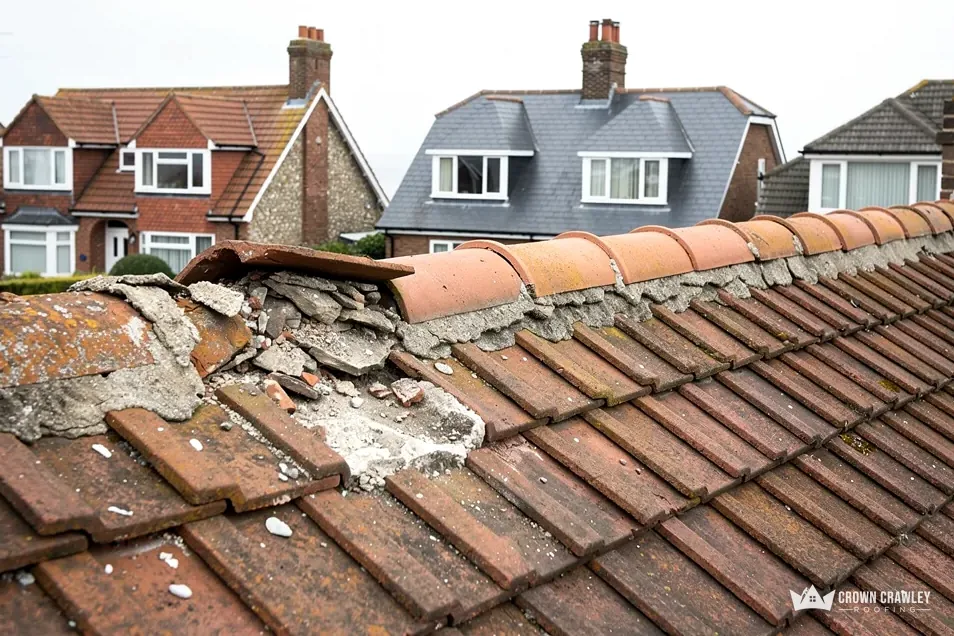
Signs your ridge or verge is failing
- Ridge tiles sitting crooked or rocking
- Crumbs of old mortar in the gutter
- Gaps showing along the ridge line
- Verge caps rattling or lifting in wind
- Pointing missing along the gable edge
What our ridge and verge service covers
 Dry ridge installationOld bedding stripped off and a mechanically fixed ridge system fitted along the whole top line of the roof.
 Dry verge replacementFailed pointing or broken caps removed, and a clipped or screwed verge system fitted along the gable edge.
 Loose ridge tile repairRocking tiles lifted, the bed cleaned out, and each one fixed back so it cannot shift in a gale.
 Dry hip systemsThe sloping hip lines of a hipped roof finished with fixed units in place of crumbling mortar joints.
 Mortar ridge rebeddingWhere a bedded ridge suits the house, tiles relaid on fresh mortar with mechanical fixings added.
 Verge caps on newer estatesCap and clip faults on recent builds traced and corrected, with the right parts for your tile profile.
Rebed, refix or go fully dry?
- RebedA few tiles have shifted, and the rest of the mortar line is sound.
- RefixTiles and caps are good but missing the fixings that should hold them.
- Go dryMortar keeps cracking along the whole run, so the system itself needs replacing.
How a ridge or verge job runs
- 1A photo from the groundYou send a picture of the ridge or gable edge and say where the gaps or rattles are.
- 2A survey up closeWe look at every ridge tile, hip and verge end, and photograph each fault we find.
- 3One written priceThe ridge and verge work comes as one total in writing, with the photos alongside.
- 4Fix, clear, photographWe fit the new system, clear the debris from gutters and drive, and send after photos.
The ridge and verge diary
Inside a dry ridge and dry verge job
Six stages from a loose tile on the skyline to a ridge and verge fixed down properly, for roofs around Crawley.
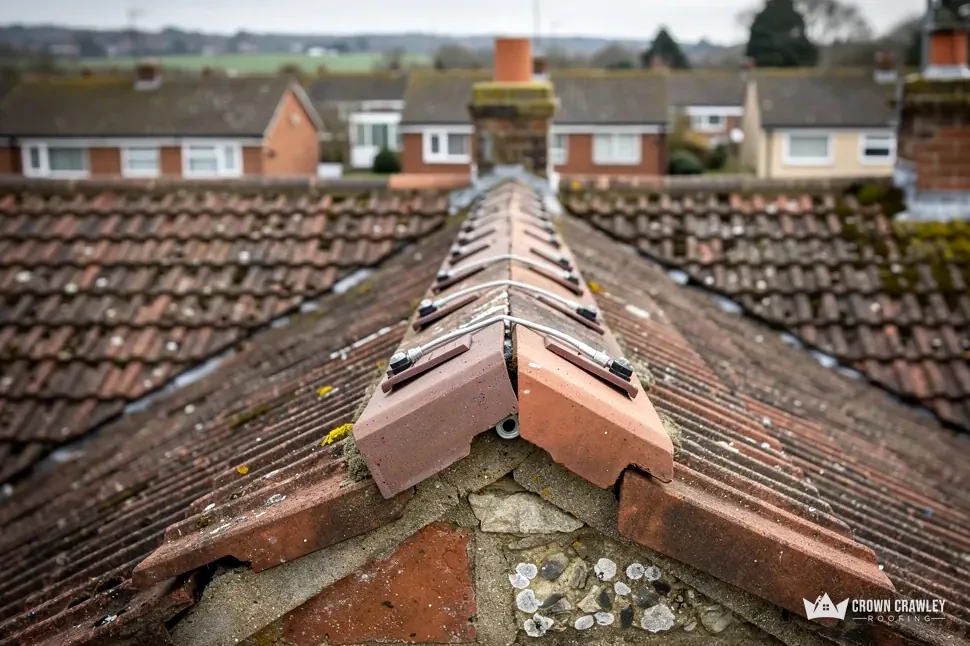
Stage 01 · First look
Dry ridge and dry verge installation in Crawley
A dry system holds the top and edge of your roof with screws and clips instead of mortar. Here is what that means on site.
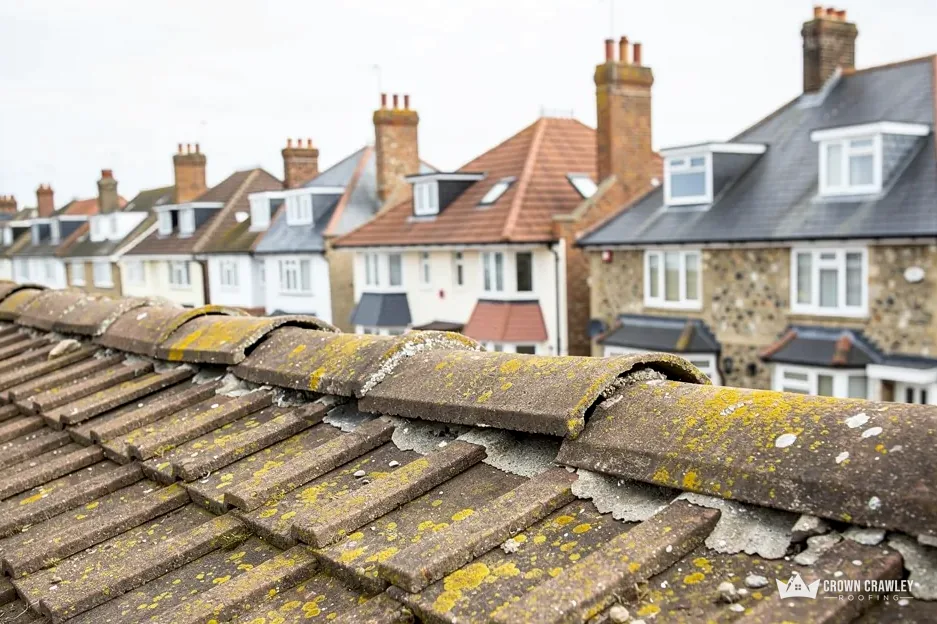
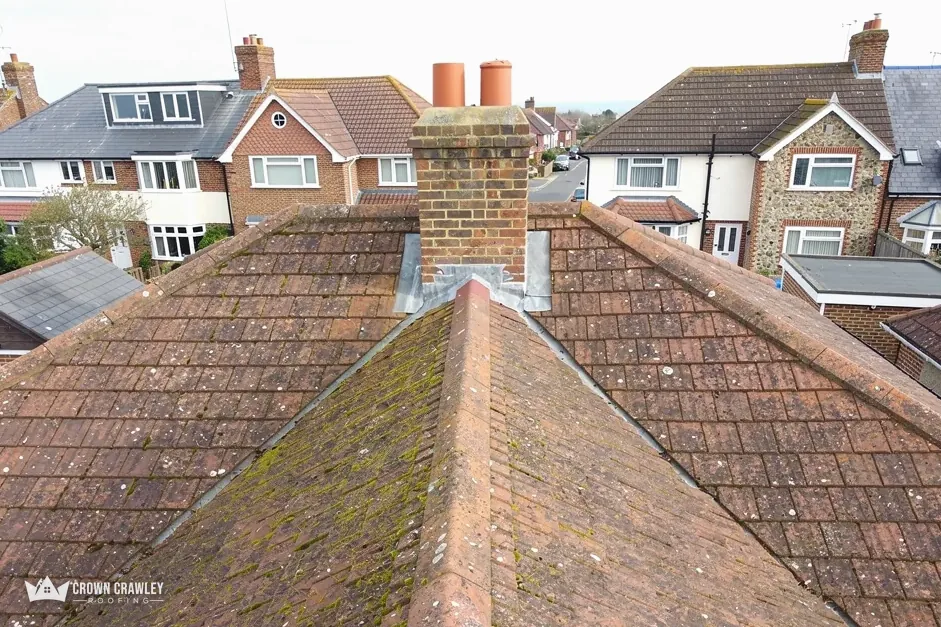
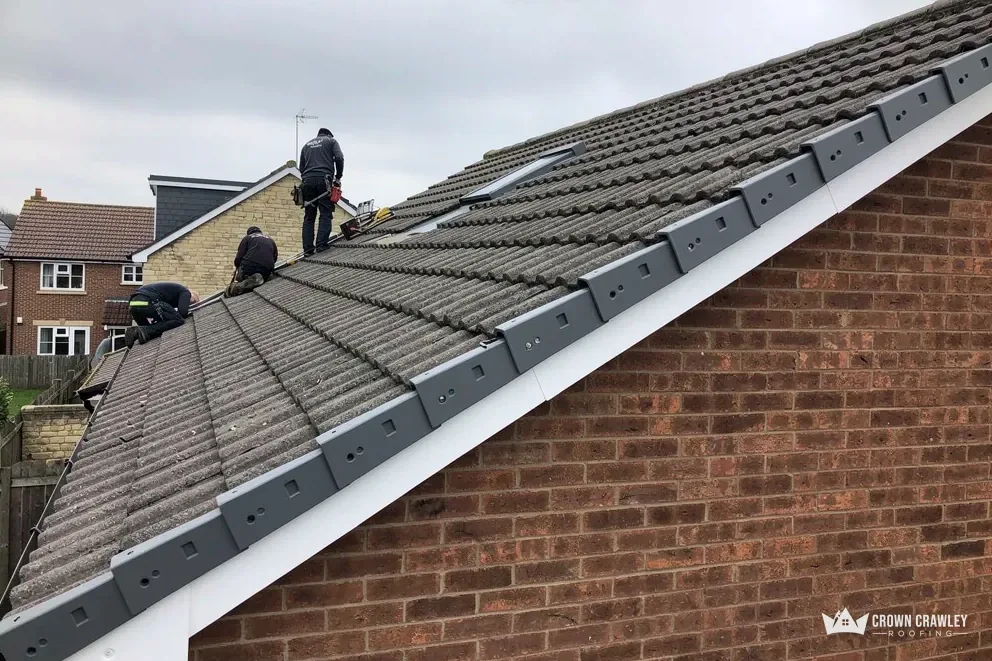
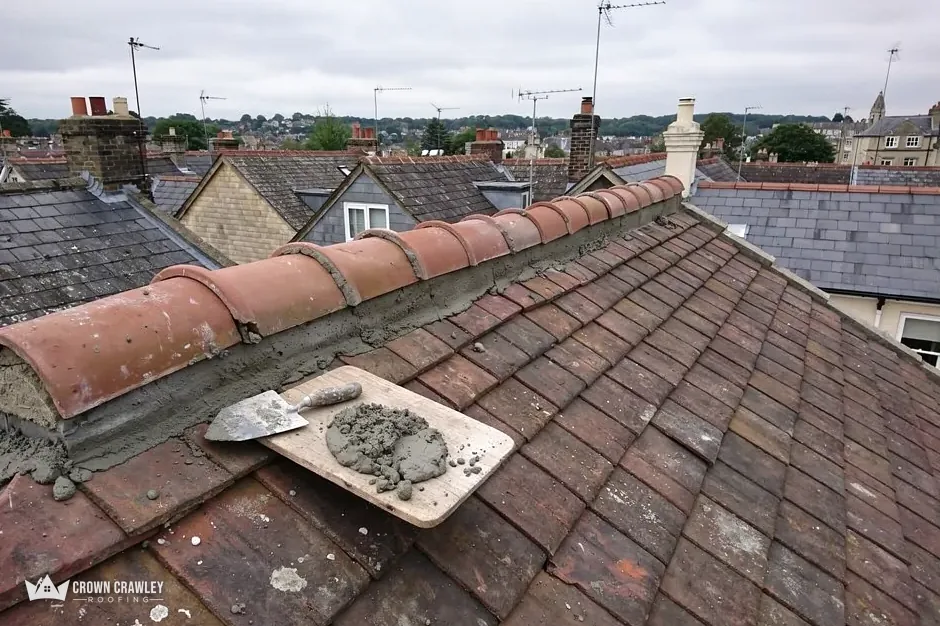
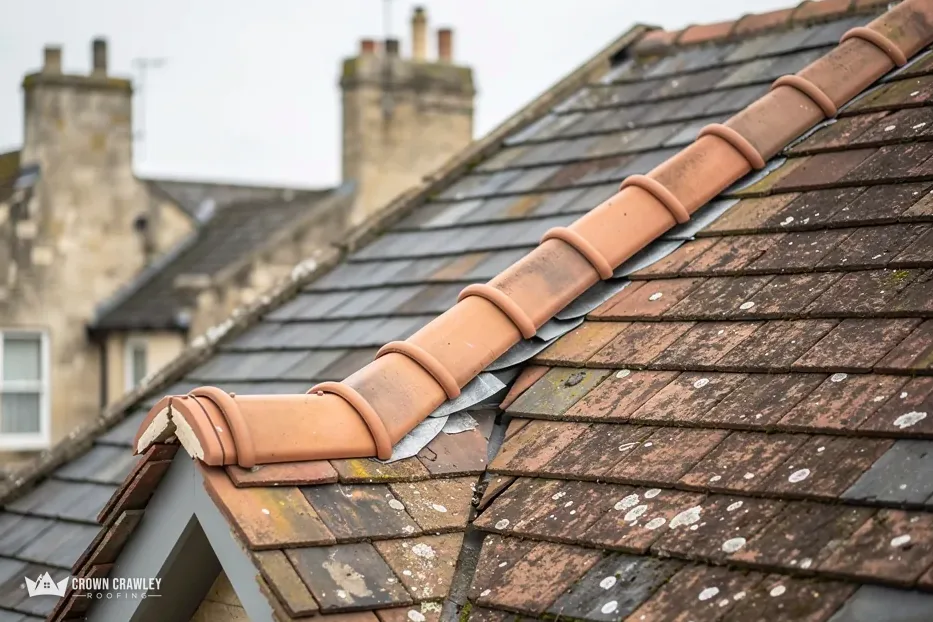
A dry ridge is a way of finishing the top of a pitched roof without a bed of mortar. The ridge is the line along the top where two slopes meet. Instead of cement holding each ridge tile down, the tiles or purpose-made units are fixed to the roof timbers with screws or clips, and a flexible strip beneath seals the gap between the slopes. A dry verge does the same job along a gable end. The verge is the sloping edge of the roof where it finishes against the side wall, and a dry system closes that edge with caps or trims that are clipped or screwed on rather than pointed in. Our dry ridge Crawley service and our dry verge Crawley work reach the villages around it too, whether you want a new system fitted or a failing one replaced.
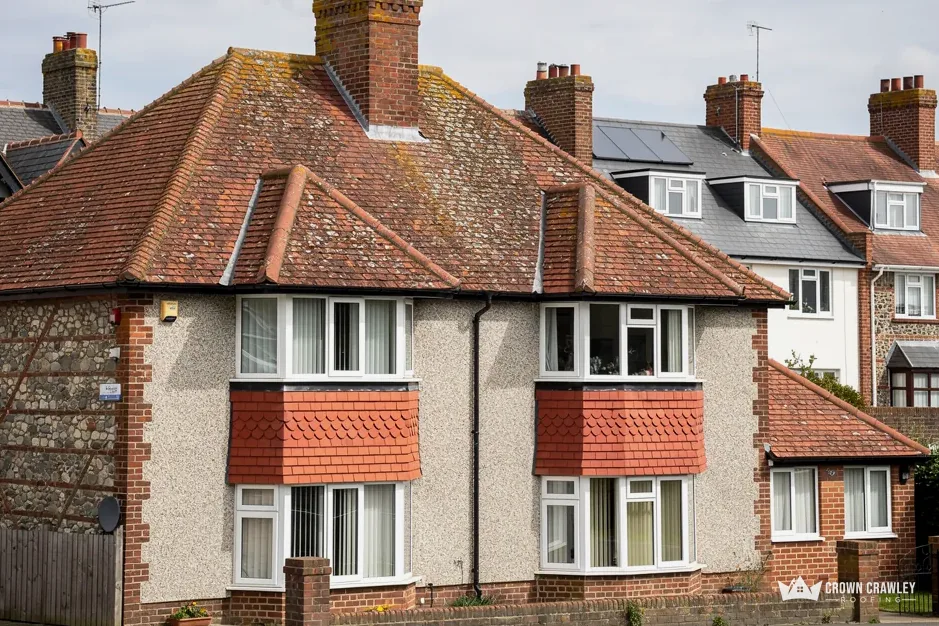
- Ridge line
- Hip meeting the ridge
- Verge at the gable
- Last tile course
What does dry ridge system installation involve?
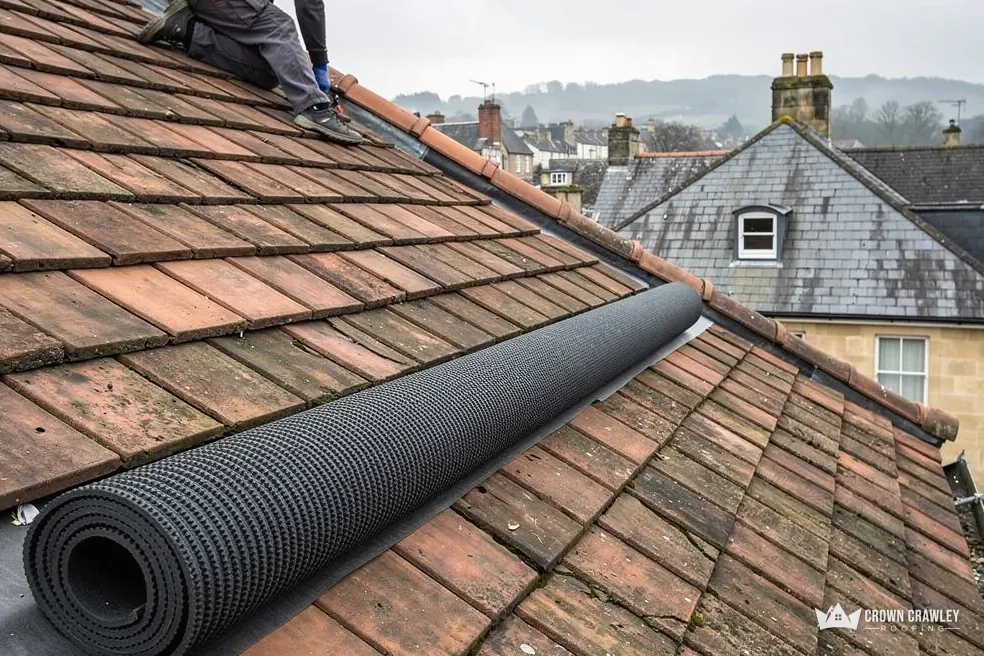
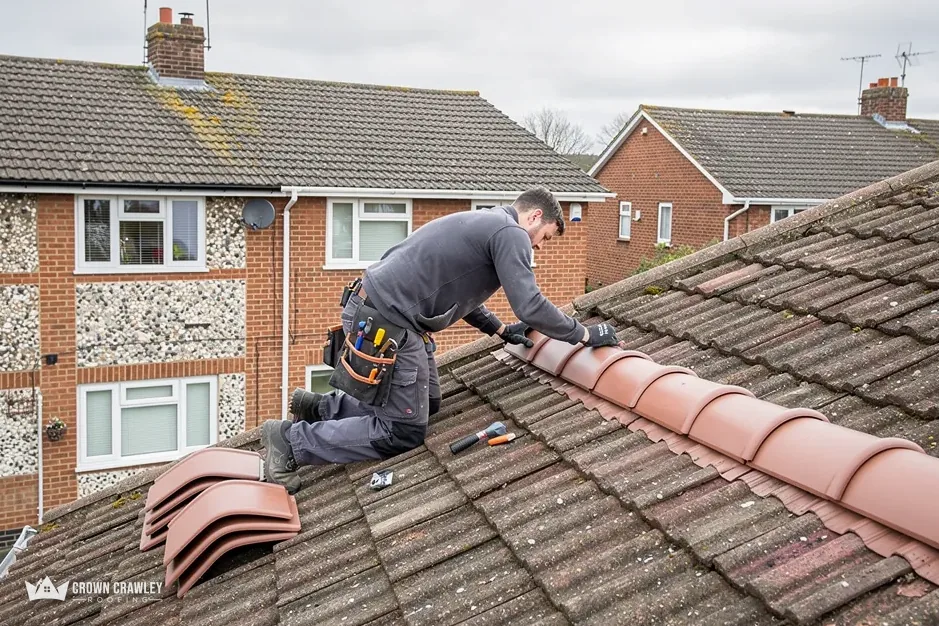
It starts with a survey of the ridge from a safe position, usually from a tower or scaffold access at the gable, because a ridge cannot be judged properly from the lawn. We note which tiles are loose, where the mortar has gone and whether the timber underneath is sound. Then the old ridge tiles and bedding come off, the top course is checked, and any soft timber is renewed. The new units are fixed along the line with the screws, clips and sealing strip that the maker specifies for that system, and each joint is checked before we move along. Every system comes with its own fixing instructions, so we follow the ones that came with yours rather than a habit. How long a ridge takes depends on its length, the number of hips and the access, and the written price says what we expect.
How is a dry verge fitted or replaced?
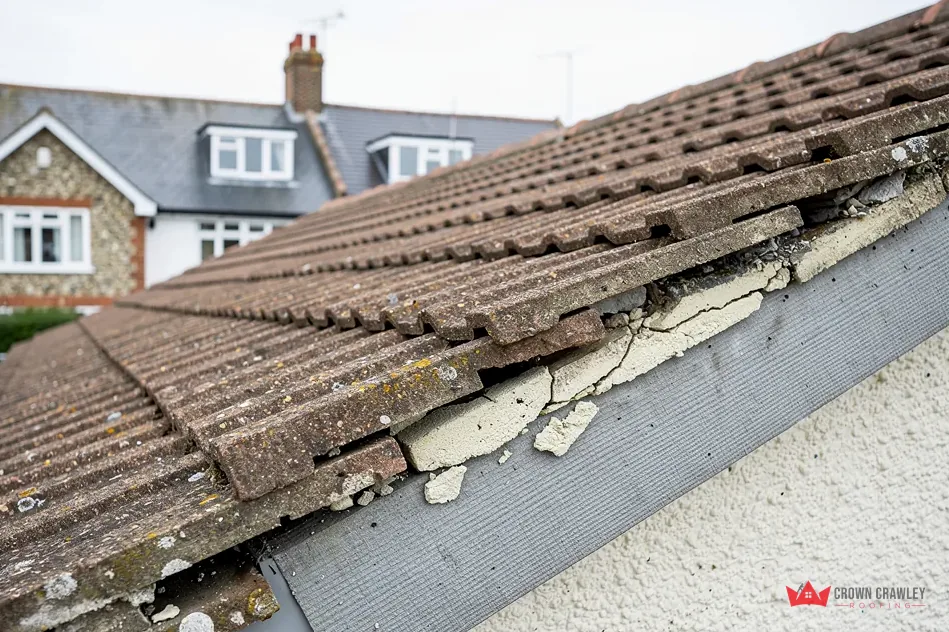
Along the gable we rake out cracked pointing and remove the old cap or loose end tiles. We look at the undercloak, the strip of board, tile or similar material that sits under the last tiles and carries them out to the edge. If it has failed it is renewed. Then the dry verge caps go on, each one clipped or screwed so the edge is held mechanically and not by mortar alone. Our guide to what a dry verge system is goes through the parts in more detail.
Keep reading
Can a dry system be fitted to a roof that is already built?
Often it can, because the old ridge or verge is stripped back to the tiles and timbers and the new system takes its place. The tile profile, the pitch and how old the covering is all play a part, and each system has a data sheet that says which tiles it suits. Our answer on fitting dry ridge to an existing roof covers the checks we make before we price.
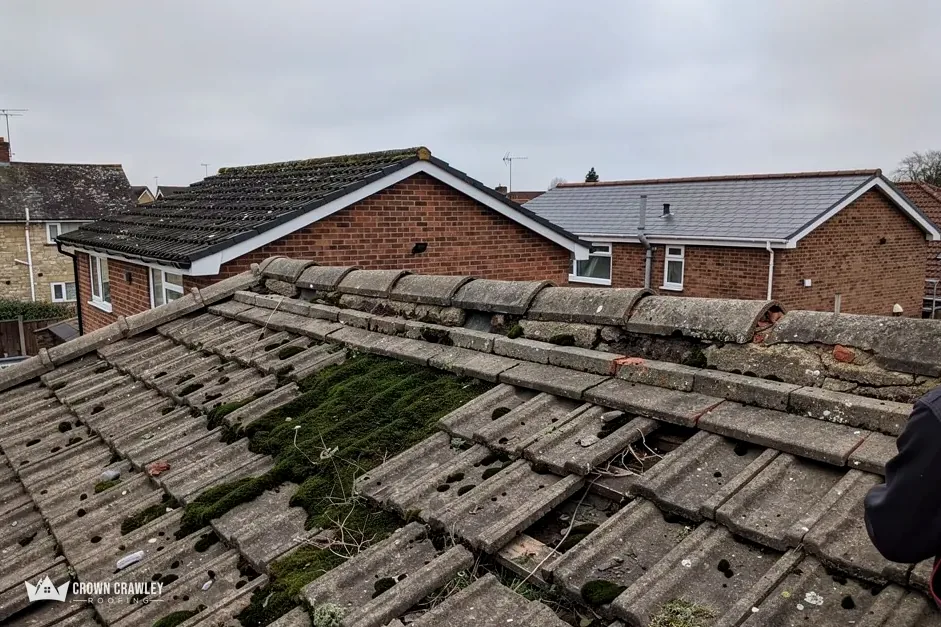
Stage 02 · The fault
Why mortar ridges and verges fail
Mortar is rigid and a roof is not, which is why bedded ridge and verge joints crack first and loosen the tiles above them.
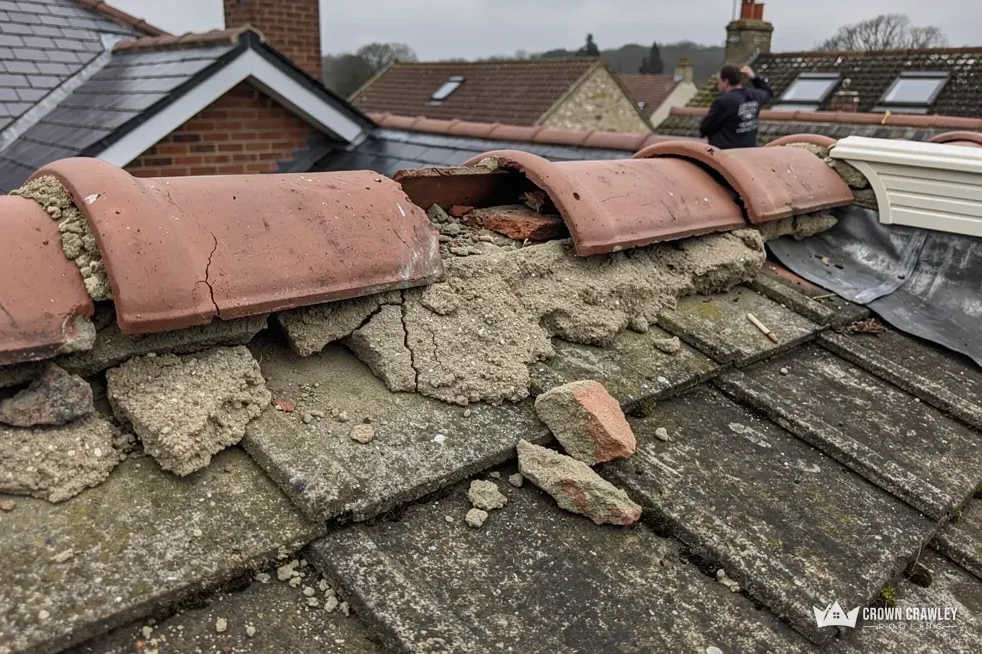
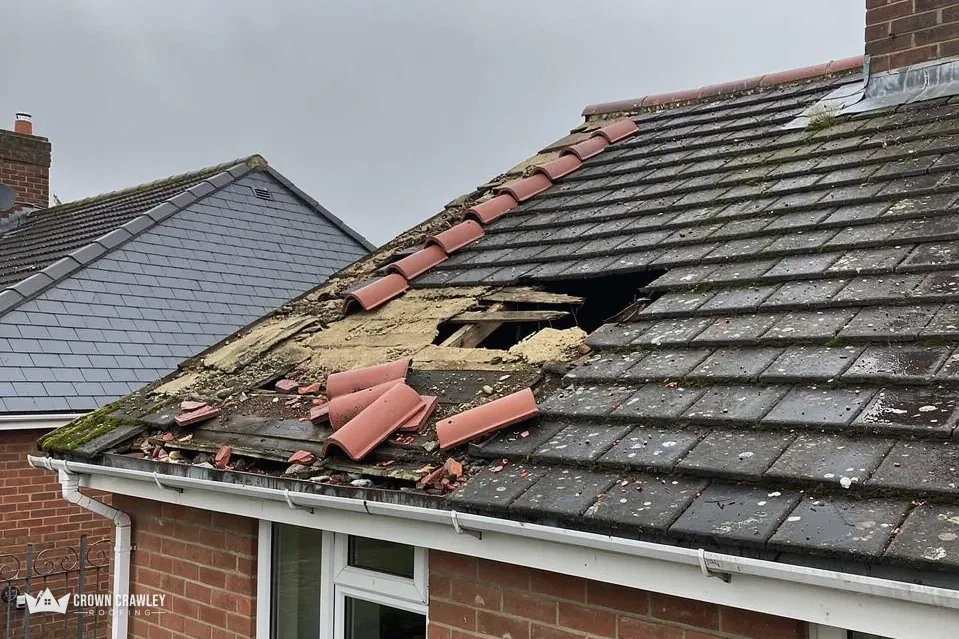
A roof moves a little every day. It warms and cools, takes wind from different directions and soaks up and dries out after rain. Mortar does not move with it. Over time hairline cracks open along the bed under the ridge tiles, rain finds them, and a hard frost widens them a little more. Eventually a ridge tile loses its grip and starts to rock, and the next gale does the rest. The pointing along a verge goes the same way, dropping out in pieces onto the path below. That is the usual story behind a call about loose ridge tiles Crawley homeowners report, or anywhere else with a bedded ridge, and it is why we look at the cause before we decide on the cure. A ridge that is merely dirty needs nothing, and one that has lost its bed needs real work.
Words you will hear
- Bedding
- Mortar a ridge tile sits on
- Pointing
- Mortar finish at an edge or joint
- Undercloak
- Strip carrying the last tiles outward
- Verge clip
- Metal fixing holding a verge tile down
- Hip
- Sloping line where two slopes meet outward
How can I tell if my ridge tiles are loose?
You can learn a good deal from the ground. Stand back and look along the top of the roof. A ridge should run in a straight line, so a dip, a tile sitting at an angle or a visible gap under a tile is worth noting. Crumbs of grey mortar in the gutter or on the ground below are another clue, and so is mortar that has gone dark and powdery. Binoculars help. Please do not climb up to test them, because a tile that rocks can slide away under your hand. Send us a photo and we will tell you what we see before anyone gets on a ladder. Our answer on why ridge mortar cracks explains the mechanism in more detail.
Ridge tile repair Crawley: what does it involve?
There are three routes. If only a handful of tiles have shifted, we lift them, clean out the old bed, and relay them on fresh mortar with mechanical fixings added. If the tiles are sound but the whole line has lost its mortar, we can refix the run with a proper mechanical system. If the bedding has failed along most of the ridge, patching will only buy a short reprieve, and a full dry-fix replacement is the better buy. We say which of the three your roof needs, and why, in the survey photos.
Mortar cracks where a roof moves. A fixing that holds the tile does not rely on it.
Are loose ridge tiles dangerous?
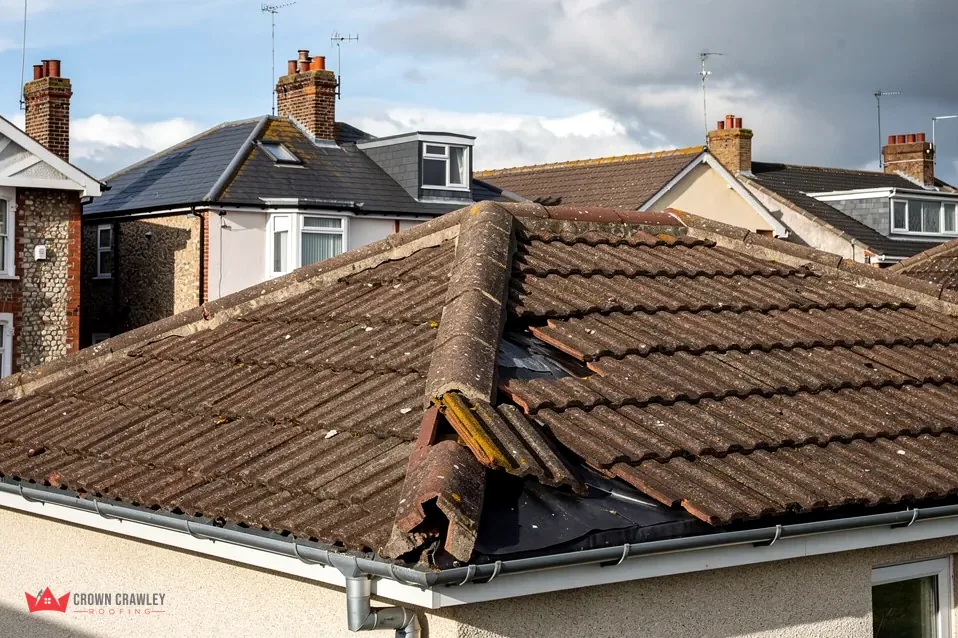
They can be, because a ridge tile is heavy and sits at the highest point of the house, so one that drops lands where people walk. Keep children and pets away from the area under a loose ridge or verge, and do not park below it. If a tile has already come off, tell us and we make the area safe first.
Water gets in at a failed ridge in a way that is easy to miss. It runs onto the underlay and travels down the slope before it drips, so the ceiling stain can be some distance from the cause. A damp patch in a bedroom after wind-driven rain is a reason to have the ridge and verge checked, as well as the tiles around the stain. Our answer on a ridge tile that has blown off sets out what to do first.
Stage 03 · Choosing
Dry fix vs mortar: the comparison
Mortar ridge vs dry ridge is not a contest with one winner. Each suits certain roofs, and the table shows where they differ.
Homeowners often ask which is better, and the plain answer is that it depends on the roof. A bedded ridge is the traditional finish, and with mechanical fixings added it is a sound choice. A dry ridge system replaces the bed with a fixed, tested set of parts. Both work when fitted properly, and both fail when they are not. What matters is the condition of your roof and what has been going wrong with it.
| Point | Mortar ridge, with fixings | Dry ridge system |
|---|---|---|
| How it is held | Mortar bed plus screws or clips through the tiles | Units screwed or clipped to the roof timbers |
| What fails first | The bed cracks and lets rain in | A missed fixing or a split cap |
| Look from the street | Rounded tiles bedded in a line | Matching caps with a clean edge |
| Repair | Rake out, rebed and refix tiles | Replace the units affected |
| Guide figure | Set by length and access in the written price | £50 to £70 per m, repair (Checkatrade, June 2026) |
What we compare on site
- Holding
- Mortar plus fixings, or fixings alone
- Look
- Rounded bedded tile or system cap
- Weak point
- Cracked bed, or a missed screw
- Repair
- Tile by tile, or unit by unit
- Matching
- Colour against your existing tiles
Is a dry ridge better than mortar?
Where mortar keeps failing, the answer is often yes. A fixed system takes the weakest link, the cement bed, out of the job, and that matters on a roof that takes wind from every side. Where the street is made up of bedded ridges and the existing ones are sound, a mortar ridge with fixings added can keep the look of the row and do the job. We would rather tell you that than sell a full replacement. Our guide on whether dry ridge is better than mortar weighs the two for different roofs.
What about hips on a hipped roof?
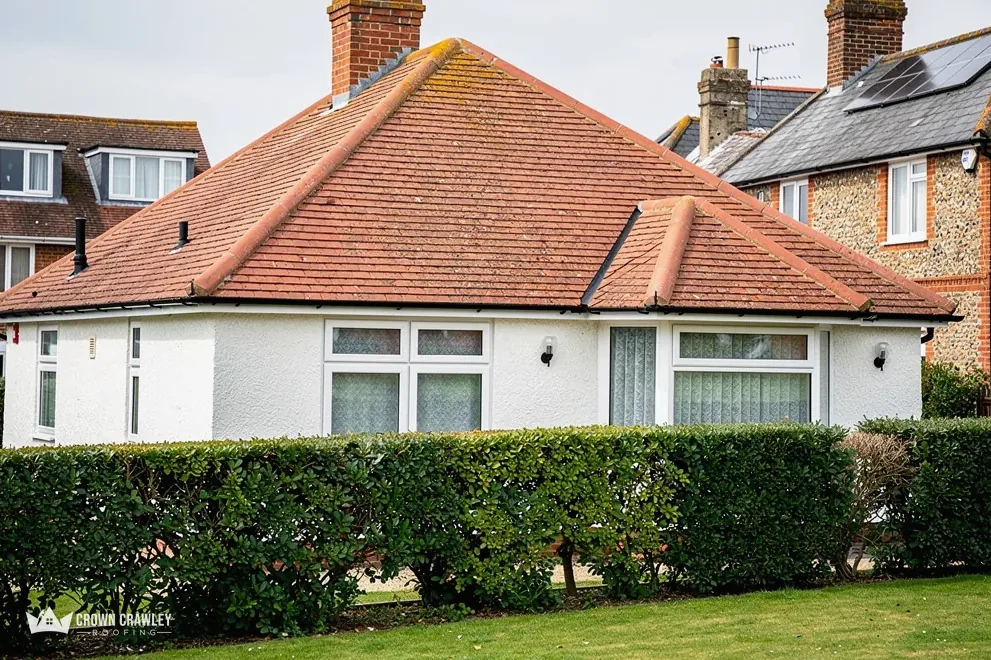
A hip is the sloping line down the outside corner of a hipped roof, and it is bedded in the same way as the ridge, so it fails in the same way. Dry hip units exist for the job, and the guide figure for a repair is higher per metre than for the ridge: Checkatrade gives £70 to £100 per metre in its June 2026 roof repair table, against £50 to £70 for dry ridge. Our page on dry hip systems explains how they fit.
Will it look different once it is done?
A dry ridge unit can look slightly different from a bedded half-round tile, so we show you the product and its colour before anything goes on your roof. If the look matters to you, say so at the survey and we will go through the options. A change of colour or shape along the roofline is the sort of thing a neighbour, a managing agent or a conservation officer may want to know about, so it is worth settling before a tile is fixed.
- £50 to £70dry ridge repair per metre, June 2026
- £70 to £100dry hip repair per metre, June 2026
- £10 to £25dry verge per linear metre, September 2026
Stage 04 · The standard
BS 5534 and mechanically fixed ridges
The code of practice for tiling says a ridge should not depend on mortar alone. Here is what it means for a house in Crawley.
BS 5534 sets out how pitched roof tiles and slates should be fixed, and BSI lists the current edition as BS 5534:2014+A2:2018. Marley explains that the 2014 revision stopped treating mortar by itself as a safe way to hold a ridge, and says every bedded tile and fitting "should include mechanical fixings". That is why a good roofer no longer rebeds a ridge with mortar and nothing else. BS 8612 is the standard that dry-fixed ridge, hip and verge systems are tested against, and BSI lists the 2018 edition as current. So when we fit a dry system, we choose one tested to BS 8612 and we fix it as its instructions say.
Does BS 5534 make my old mortar ridge illegal?
No. Marley states that "Installing to BS 5534 isn't required by law". It is a code of practice, and it sets the standard a ridge is built to when it is done well. BSI also cautions that some old roofs, especially those with traditional or reclaimed materials, may not suit its recommendations, so a handmade tile on an old cottage may need a different approach from a modern interlocking one. Our guide to BS 5534 and ridge and verge fixing goes further into what the standard covers.
What does a mechanically fixed ridge look like?
From the street, much the same as any other ridge, which is part of the point: the work is in what holds it down, not in how it reads from the pavement. Close up, each tile or unit has a fixing through it into the timber below, and the joints are closed by a strip rather than filled with cement. Each fixing has to meet timber that will hold it, which is why a soft ridge board is found and renewed at the survey stage and never left for later. When we finish, you receive photos of the ridge as it was and as it is now, and the fixings can be seen in them if you want to look.
Standards and permissions
- BS 5534
- Fixing code for tiled and slate roofs
- BS 8612
- Test standard for dry-fixed systems
- Mechanical fixing
- Screw, clip or nail, not mortar
- Like for like
- Same covering and the same appearance
Does a ridge or verge job need planning permission or building control?
For a like-for-like repair, usually not. Under the Town and Country Planning Act 1990, a repair that leaves the outside of the building looking the same is not treated as development. If the new system would look clearly different, or the house is listed or in a conservation area, check with Crawley Borough Council's planning team before work starts. On building control, Crawley Building Control says replacing more than 25% of a roof's surface needs approval, and a ridge or verge is a thin strip nowhere near that share. The Planning Portal's national test looks at 25 per cent of the building envelope and 50 per cent of the roof.
- BS 5534slating and tiling code, 2014 revision
- BS 8612test standard for dry ridge, hip, verge
- 2014revision: mortar alone not relied on
Stage 05 · Verges
Dry verge trouble on newer estates
Verge caps that rattle, lift or drop off are a common call on recent builds, and the cause is nearly always the fixing.
Crawley Borough Council lists Forge Wood as the newest of the town's 14 neighbourhoods, and Kilnwood Vale is a new neighbourhood on the western edge in Horsham district. If your gable edge on an estate like these was finished with dry verge caps, this stage tells you what to look for. We make no assumption about your house before we see it: a survey tells us what is actually fitted, and the photos show you.
- Dry verge cap
- Clip or screw position
- Last tile at the edge
- Gable wall below
Why are my new-build dry verge caps falling off?
The edge of a roof is where wind gets under things first. A cap that was clipped on without the clip engaging, a screw that missed the batten or a cap that does not suit the tile profile can all start to lift, and once one rattles it works loose over weeks. You often hear it before you see it, as a tapping in a gale, or find a cap lying in the border after a windy night. On a terrace or a pair of semis, the neighbour's verge can tell you a good deal about yours, because the same fitters often worked along the row. Cap length and tile profile vary, so we never order parts until we have seen the tiles themselves. Pushing a cap back on, or gluing it, does not make the fixing it lost. Our post on dry verge caps falling off your new-build goes through the common faults, and the answer on a dry verge rattling in the wind covers the sound itself.
What does dry verge replacement involve?
We take off the loose caps, check the last course of tiles and the undercloak beneath them, and look for the cause: a missing clip, a split cap or a tile that has moved. Then we fit caps and clips that match your tile and fix them as the maker instructs. Where a cap has simply been lost to wind, replacing that run may be all that is needed. Where the system was wrong for the tile from the start, we replace more of it. If you are weighing a swap from pointed mortar, our comparison of verge repointing and dry verge explains the choice.
A cap that rattles has lost its grip. It needs a new fixing, not a dab of sealant.
If the house is new, who pays for the repair?
Before you pay anyone, find out whether the house is still covered by the builder or a warranty provider, because a fault on a recent build may be theirs to put right. Keep photos of the fault and the dates you noticed it. You can then decide whether to go to the builder first or have us make it safe and document what we find. Our answer on new-build roof defects sets out the steps.
Birds sometimes nest in the gap under a verge. Under the Wildlife and Countryside Act 1981, someone who intentionally damages or destroys a nest that is in use, or still being built, commits an offence, so if we find an active nest the work waits and we talk it through with you. GOV.UK says all bat species are fully protected by law, and counts roof repair among the work that can affect them. If we see signs of either, we stop first and ask.
Stage 06 · Pricing
What decides cost, systems and colours
The length of ridge and verge, the access, the system and what lies beneath all move the price of the job.
We fix the price of ridge and verge work as a single sum after the survey. Four things shape it every time: how many metres of ridge, hip and verge there are, how we reach them, which system suits your tiles, and what we find underneath the old mortar. A short ridge on a bungalow is within reach of a ladder. A long ridge on a three-storey house, or a gable end over a driveway, needs a tower or scaffold, and the access we choose sits inside the one price you receive.
What do the national guides say about ridge and verge costs?
Checkatrade's roof repair table, dated June 2026, gives typical UK prices of £50 to £70 per metre for dry ridge repair and £70 to £100 per metre for dry hip repair. Those figures exclude VAT. Its dry verge guide, dated September 2026, puts a dry verge at approximately £10 to £25 per linear metre including materials and fitting, and in the region of £875 for a semi-detached house. These are national guide figures. They show whether a quote looks way off, and only a survey can price your own roof. Our answer on how much a dry ridge system costs goes into the factors in more detail.
What moves the price
- Length
- Ridge, hips and verges in metres
- Access
- Ladder, tower or scaffold at the gable
- System
- Make, colour and fit to your tile
- Timber
- Condition under the old mortar
Do I need scaffolding, and does it need a licence?
Where the gable or ridge is too high for a ladder, we set up scaffold or a tower. Checkatrade's fascia and soffit table gives £300 to £600 a week for each elevation of scaffold, a separate figure from the dry verge one above. Scaffold that stands on the highway needs a licence from the highway authority. West Sussex County Council charges £266 for one month, and the licence is sorted out jointly by us and the scaffolder. On private land no licence is needed.
Which systems and colours can I choose?
Systems come in a range of colours and profiles from tile makers and from specialist makers, so there is usually one that sits well beside your existing tiles. We hold the colour against your roof in daylight before anything is fixed, because the same colour can look different on a wet slope than on a sample card. Ask for the product's data sheet, and check that it is tested to BS 8612.
When you compare quotes, check that each covers the same ridge length, the hips and every verge, says whether VAT and scaffolding sit inside the total, and explains what follows if rotten timber turns up. To get yours started, send a photo of the ridge or gable edge from the ground, tell us the tile colour if you know it, and say whether anything rattles in a gale.
Keep reading
Our pitched roofing page covers the tiles, battens and valleys that sit beside a ridge, and the roof replacement page explains when a ridge job is better rolled into a full re-roof. A new covering gets a new ridge and verge as a matter of course, so it makes sense to look at all three together if your tiles are near the end of their life.
Typical UK prices for ridge and verge work
| Work | Guide price |
|---|---|
| Dry ridge repair | £50 to £70 per metre |
| Dry hip repair | £70 to £100 per metre |
| Dry verge, materials and fitting | £10 to £25 per linear metre |
National guide figures, not Crown prices. We fix our own after the survey, as a single written total with the photos beside it.
Checkatrade cost guides: roof repair table, June 2026 (dry ridge and dry hip, excluding VAT); dry verge cost guide, September 2026.
More on dry ridge and dry verge
Quick answers and longer reads on mortar, fixings, caps, colours and costs, for anyone deciding what to do about a ridge or verge.
Guides and posts
What Is a Dry Ridge System?A dry ridge swaps wet mortar for screwed and clipped parts that hold the ridge tiles down. This guide names each…Guide · 10 min read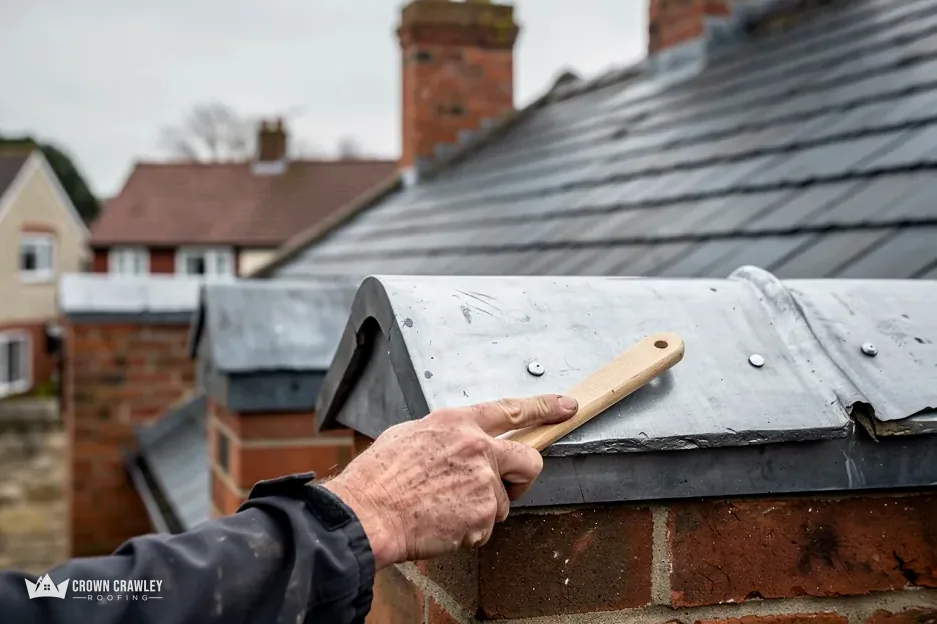 What Is a Dry Verge System?A dry verge closes the angled edge of a gable end with screwed or clipped parts, not mortar. Here is how the types…Guide · 9 min read
 BS 5534 and Ridge and Verge FixingRidge, hip and verge tiles used to be held on by mortar and little else. This guide explains what BS 5534 says about…Guide · 9 min read
 Is Dry Ridge Better Than Mortar?Dry ridge has taken over from bedded mortar on many roofs, but that does not make it the right answer for every…Guide · 9 min read
 Dry Hip Systems for Hipped RoofsA hipped roof has sloping tile lines at each corner, and each one has to resist wind and slide. This guide covers hip…Guide · 9 min read
 Ventilated Dry Ridge and Loft VentilationA ventilated dry ridge lets damp loft air escape at the very top of the roof. This guide explains how it works, where…Guide · 9 min read
 Dry Verge Systems ComparedNo single dry verge system is best for every roof. The right one depends on your tile profile, your colour and your…Guide · 9 min read
 Fitting Dry Ridge to an Existing RoofYou do not need a new roof to get a dry ridge. This guide covers when an older roof suits a retrofit, what has to…Guide · 9 min read
 Cloaked Verge TilesA cloaked verge wraps the last row of tiles over the top of the gable wall edge. This guide explains how it differs…Guide · 9 min read
 Verge Repointing vs Dry VergeA verge is the raked edge where a roof finishes at a gable wall, and its mortar takes a beating from weather. This…Guide · 9 min read
 Ridge Tile Types: Half-Round, Angled and MoreWhere a tiled roof peaks, the cap that covers the join comes in more than one shape. This guide compares the common…Guide · 10 min read
 Dry Verge Caps Falling Off Your New-Build? Why It Happens and Who PaysA verge cap on the lawn soon after you moved in is annoying and a little worrying. Here is why they come off, what to…Blog · 10 min read
Quick answers
- How Much Does a Dry Ridge System Cost?
- How Long Does Dry Verge Last?
- Do Dry Ridge Systems Need Maintenance?
- Do You Need Planning Permission for Dry Ridge?
- Do Ridge Tiles Always Need Mortar?
- Are Loose Ridge Tiles Dangerous?
- A Ridge Tile Has Blown Off: What Now?
- Why Is My Dry Verge Rattling in the Wind?
- What Colours Does Dry Verge Come In?
- Can You Have Dry Ridge With a Mortar Verge?
- Can Dry Ridge Go on Plain Clay Tiles?
- Can Dry Ridge Be Fitted to a Slate Roof?
- How Long Does It Take to Fit Dry Ridge?
- Why Is the Mortar on My Ridge Cracking?
- Can You Fit Dry Verge Yourself?
- New-Build Roof Defects: How to Claim
- Can Dry Verge Be Fitted Without Scaffolding?
- Can You Match Replacement Ridge Tiles?
- Birds Nesting Under the Verge: What Can Be Done?
- Is Dry Verge a Legal Requirement?
Related services
 Pitched roofingOur pitched roofing service covers tiled and slate roofs across Crawley and Sussex: slipped tiles, tired battens…
 Roof replacementOur roof replacement service strips the whole roof and covers it again: new battens, underlay, tiles or slate, ridge…
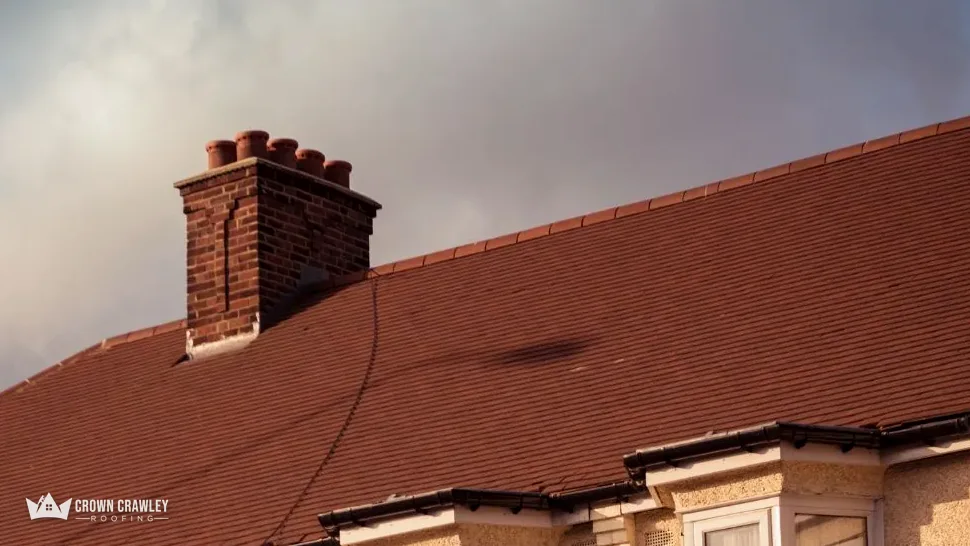 Chimney repairsWe repair chimney stacks across Crawley and the towns around it: crumbling mortar, cracked flaunching, failed lead…
Ridge and verge questions
Can I have a dry ridge on one side of the house only?
A ridge is one continuous line, so the system runs along the whole of it rather than a single slope. A dry hip is separate, and can be done on its own where only the hips have failed. The survey decides how far the work needs to run, and the written price covers exactly that length, whichever route you choose.
Will new ridge units match my weathered tiles?
They will be close, not identical, because tiles fade and gather lichen while a new cap starts bright. We hold the sample against your slope in daylight and choose the nearest colour from the range. The difference softens as the new parts weather, and we can show you the match on your own roof before anything is fixed.
Can birds still nest near a dry verge?
A dry verge closes the gap that birds sometimes use, but a nest already in use cannot be disturbed, because the Wildlife and Countryside Act 1981 treats intentional damage to an occupied nest as an offence. We check for nests at the survey, hold off if we find one, and tell you what happens next.
Is it safe for me to knock a loose ridge tile back into place?
We would ask you not to. A tile that has come loose can slide when touched, and the person on the ladder takes the risk. Keep clear of the area beneath it, take a photo from the ground, and send it to us. We make it safe first and then show you what fixing it needs.
What is the sealing strip under a dry ridge for?
It closes the gap between the two slopes beneath the ridge units, so wind-driven rain and dust do not blow in under them. The units sit on top and are screwed down through it. Check the maker's instructions for the strip your system uses, because different products use different parts, and we follow them every time.
What should I ask a roofer before they fit a dry system?
Ask which system they will fit, whether it is tested to BS 8612, how it will be fixed to your tiles and where the fixings go. Ask whether the price covers hips, every verge, scaffolding and VAT, and what they will do if the timber under the old mortar is rotten. A clear answer to each is a good sign.
Which ridge or verge is troubling you?
Photograph the ridge or gable edge from the ground and tell us where tiles look loose or caps rattle.