Roofers in Three Bridges

Roofs in a railway village that the new town absorbed in 1952.

Three Bridges was a small village before the new town reached it, and work from 1952 took in the older settlement there. We judge each roof's age from what is on it, then price once.

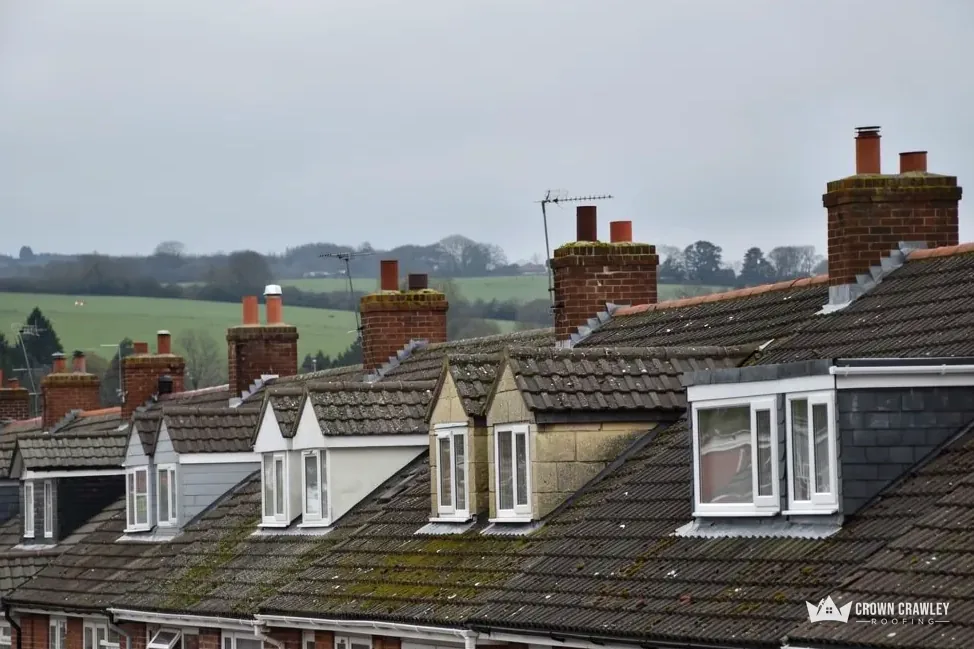
Dormer windows on a weathered tiled roof facing open fields

Three Bridges roofs, old village and new town

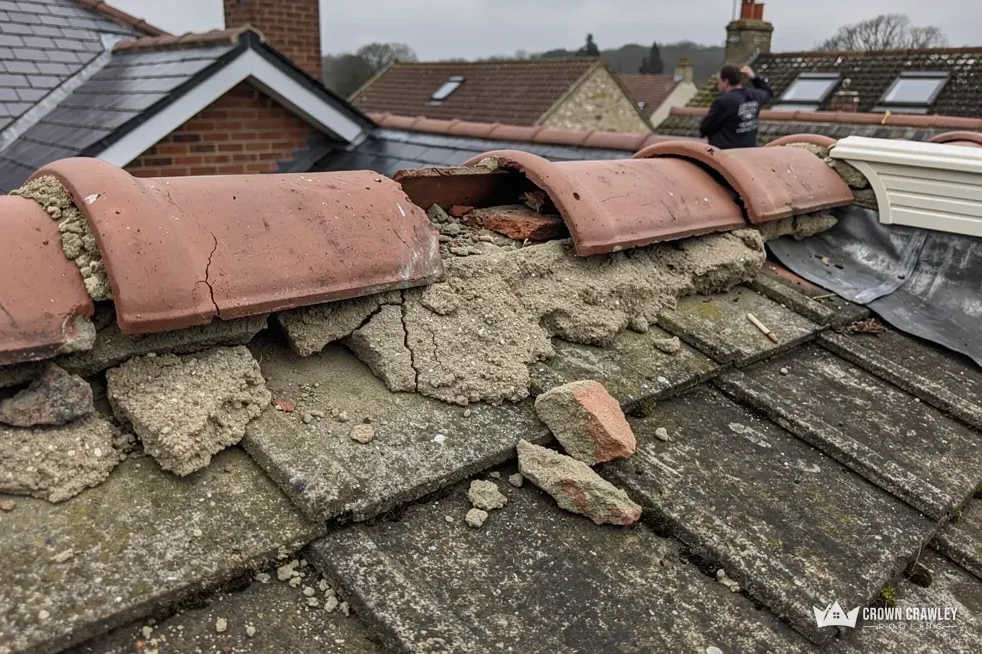
Crumbling mortar and cracked ridge tiles on a roof

The settlement west of the station

Work in 1952 took in the existing settlement west of the station. Older houses and new-town houses stand in the same streets, so we expect roofs of different ages and read each one separately.

Mixed-age tiled roofs on a street

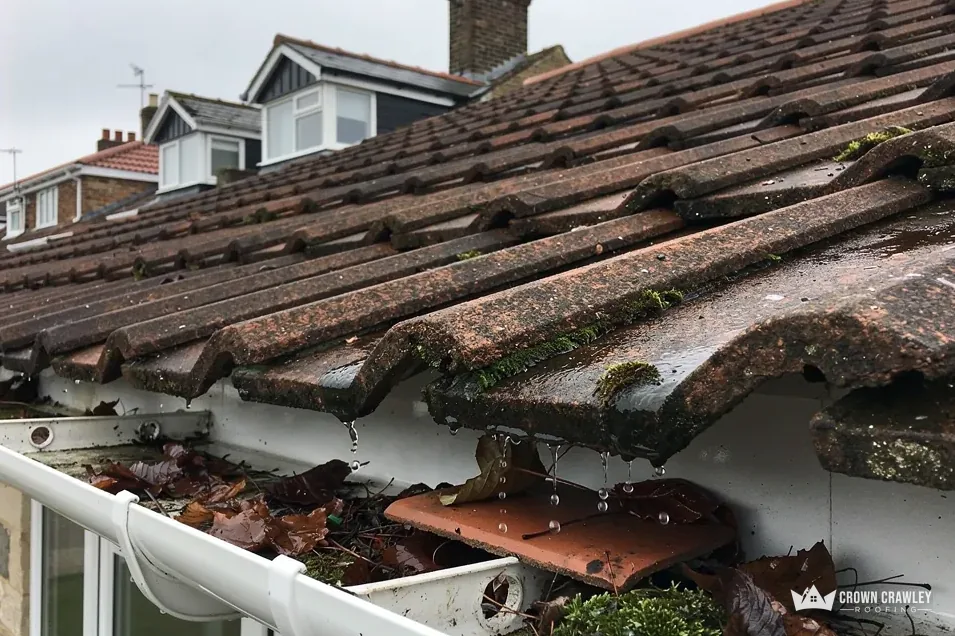
Slipped tiles lying in a blocked gutter

982 houses by 1955

By 1955 the neighbourhood was largely complete, with 982 houses built. A roof from those years is more than 70 years old, so we check what has been renewed since and what is original.

Tiled house roofs in rows

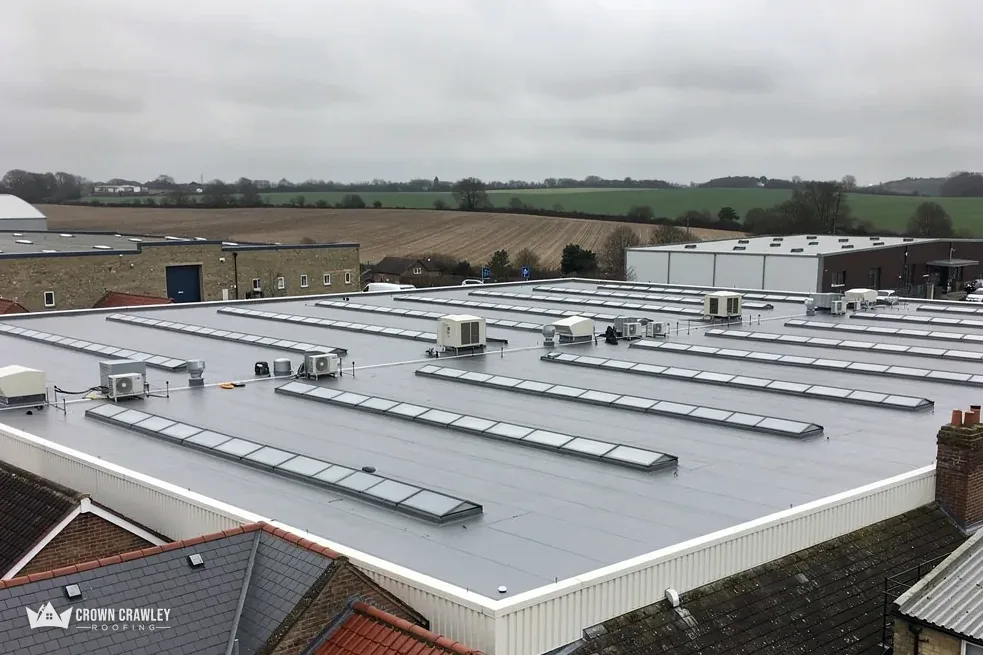
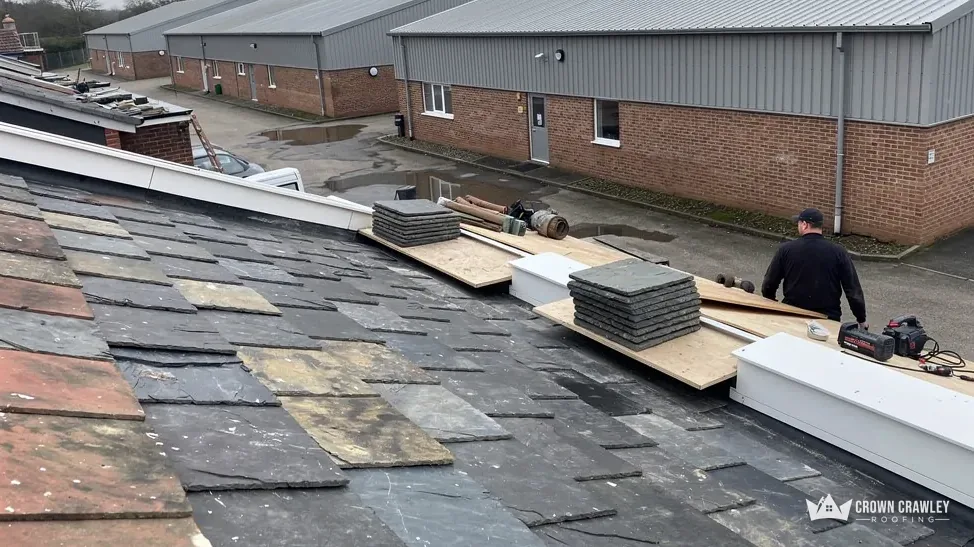
Large flat industrial roof with a line of rooflights

Next to the industrial estate

Hazelwick Avenue, built in 1960, linked the industrial estate with Three Bridges. A landlord or shop owner nearby can ask us about commercial roofing as well as home roofs, with the same survey and one written price.

Flat commercial roof beside a unit

Three Bridges, around the station

Map of Three Bridges and the neighbourhoods around it, with Crawley for reference.

Three Bridges lies in the east of the town around its station, a junction for the Horsham and East Grinstead lines in 1940.

Distance
1.3 road miles from Crawley, to the north-east
Drive
About 5 minutes
Council
Crawley Borough Council and West Sussex County Council
Planning authority
Crawley Borough Council
Ward population
9,649 (Census 2021, Three Bridges ward)
Building control
Crawley Building Control
Get a free quote

Three Bridges station-side notes

Reading a Three Bridges roof, village to new town

Three short chapters on a village folded into a new town, the lead on its older houses, and the questions to settle before a bigger job starts.

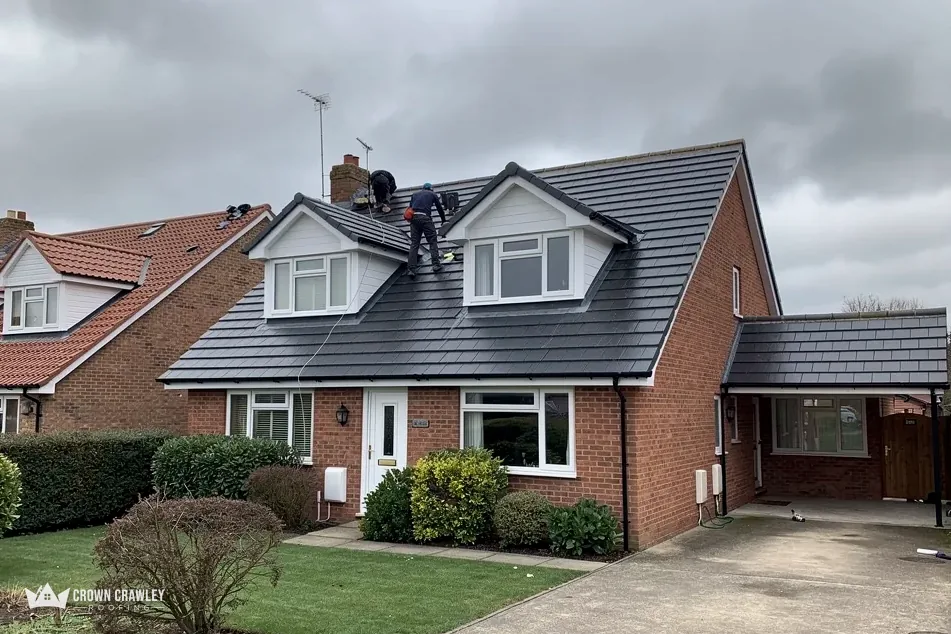
Dormer bungalow with a new dark tiled roof

Stage 01 · Background

A village folded into the new town

Three Bridges began as a small village, and work from 1952 took in the existing settlement west of the station.

Crawley Borough Council describes Three Bridges as a small village that merged with others to become the new town. The Victoria County History adds that work on the neighbourhood began in 1952, took in the existing settlement west of the station, and by 1955 was largely complete with 982 houses built. Put a village and a fast new neighbourhood together and you get roofs of at least two ages.

How can two roofs on one Three Bridges street differ so much?

A house from the older settlement can stand beside one built after 1952. The county records do not describe the covering on either, so we do not guess at tile or slate from the road. We read each roof when we reach it. Should it prove to be clay plain tile, Marley passes on a Building Research Establishment floor of 60 years, though for hand-made peg tile buildingconservation.com calls that number unreliable. Should it prove to be natural slate, CoRC's materials page says it can last 100+ years when looked after. Neither figure is a promise, and both tell us only what to look for. Where a roof turns out to be a mix of old and new work, with one slope renewed and another untouched, we say which is which and what the survey recommends for each slope, and the quote still arrives as one total price.

Where does a 70-year-old Three Bridges roof give way first?

The covering is the last thing to fail. First we check the battens, which can soften and split where water has reached them, then the underlay, which may have perished or never been fitted, then the fixings at the ridge, hips and verge. After that we look at the loft from inside, because daylight through the slope, damp timber or a tide mark on the boarding seen from below tells us more than the top surface does. A roof like this can be repaired in sections as well as renewed, so we price what the survey finds and not what the age suggests.

Words from a mixed-age street

Batten
Wooden lath carrying each row of tiles
Underlay
Sheet laid beneath the tiles
Pitch
The angle of the slope
Nib
Lip that hooks over a batten

Can a Three Bridges loft rot a roof from the inside?

Because warm damp air from the house condenses on cold timber, and an older roof may have little ventilation at the eaves. Marley's reading of BS 5250 asks for 25 mm along the eaves at pitches of 15 degrees or less, and 10 mm above that, where the underlay is the non-breathable kind. Quilt stuffed hard against the eaves can choke that opening, and freeing it costs little while sparing the battens. Our lead work page covers the metal at junctions, which we meet next.

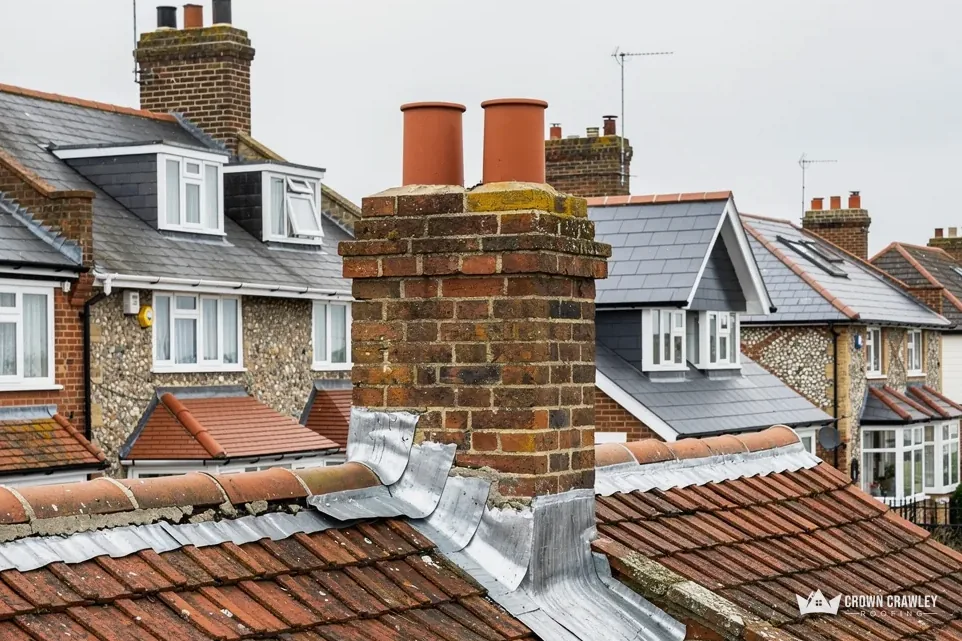
Chimney stack with orange pots and lead flashing among tiled roofs

Stage 02 · Older houses

Lead, slate and clay on the older houses

Where a Three Bridges house predates 1952, its flashings, valleys and soakers matter as much as the tiles do.

A house from before 1952 may carry lead where a post-war house has none: a soaker, a valley, a flashing round a chimney. Lead in sound condition can outlast the tiles around it, and a cost guide from MyJobQuote, updated in September 2026, puts flashing life beyond 80 years. So the job can be to keep what works and fix what does not.

What are soakers, valleys and flashings on a Three Bridges roof?

A soaker is a small folded square of lead tucked beneath the tiles beside a wall, working with the flashing above it to keep the joint dry. A valley is the gully formed where two slopes meet at an inward corner, and it collects the water from both, so its lining has to be sound. A flashing is the strip that seals a roof to a wall or a chimney. When any of them splits, water finds the gap quickly, and a small tear can wet a wall for weeks before a stain shows.

Sound lead is worth saving; split lead is worth replacing before it lets water in.

Lead codes by job

Code 3
Soakers only
Code 4
Soakers, flashings and valleys
Code 5
Flashings, valleys and box gutters
Flashing life
Can pass 80 years

Which lead code is right for each job?

Royston Lead's cast-lead brochure matches thickness to use. Code 3 is for soakers only. Code 4 serves soakers, flashings and valleys. Code 5 suits flashings, valleys, box gutters and dormers. Code 6 is thicker and used on the same range of jobs. We tell you which code we propose for your roof, and the reason for it, in the survey notes. Our guide to lead sheet codes explains the numbers in plain terms.

Can split lead be mended instead of replaced?

Sometimes. A lifted edge or an open joint on otherwise sound lead can be refixed or dressed back, and we tell you if the sheet has fatigued beyond that. A long split along a valley is a different case and usually points to renewing that length, with the slate or tiles either side lifted and relaid to suit. Either way, the photographs of the fault go to you first, and the figure in writing is built on what they show. We photograph the lead again when the work is done, so you can see the line we repaired and the neighbouring lengths we left alone. Where lead meets a chimney, we look at the flaunching and the pointing too, since a sound flashing cannot cure a cracked stack.

Stage 03 · Permissions

Before a larger Three Bridges job begins

Planning and building control sit with Crawley, and a few simple questions settle most of what a bigger job needs.

Most Three Bridges roof jobs begin and end with a survey and a price, because mending in matching materials leaves the street view of the house as it was. Bigger jobs bring in outside bodies, and it saves time to know which ones before you commit to a date.

Who has to approve a Three Bridges re-roof?

Building control for the borough is Crawley Building Control, and its published list of domestic work needing approval includes "repairing or replacing more than 25% of the surface area of a roof". The Planning Portal's national guidance measures differently, counting the share of the whole building envelope as well as the share of the roof, so the two answers can differ for the same roof, and we tell you which test is which. Weight is a second trigger: a covering heavier by 15 per cent or more calls for approval as well, which is why the Planning Portal points owners to an engineer's or surveyor's opinion beforehand. If the survey points that way, we call Crawley before a date is set, and the written price records what the council said. Our roof replacement page follows a whole Crawley re-roof from strip-out to ridge.

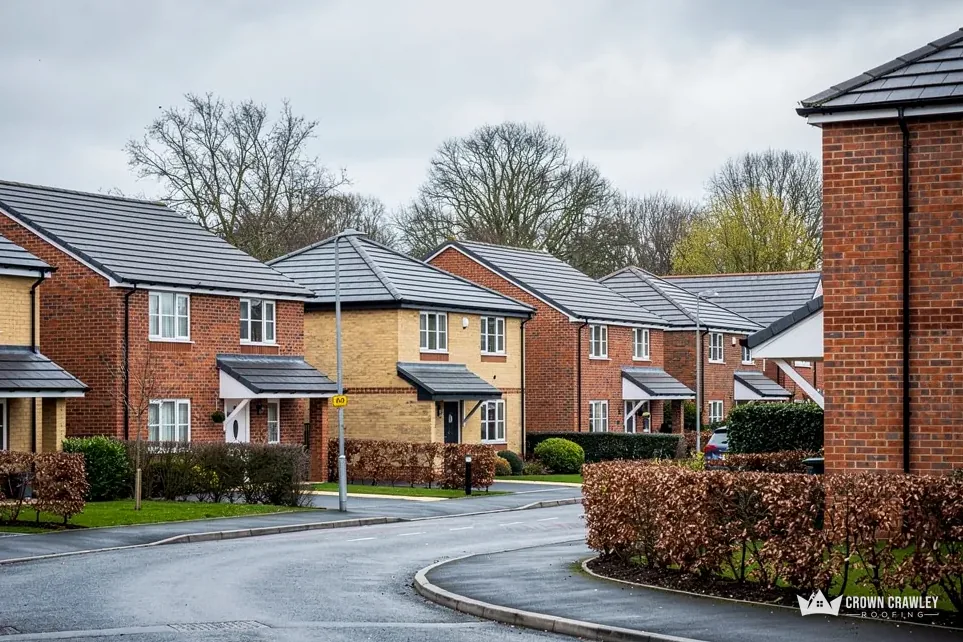
Modern estate road with brick houses and grey roof tiles

Does the look of a Three Bridges roof limit what you can change?

It can, near the station. Crawley Borough Council designated the Hazelwick Road Conservation Area on 20 March 2013 as a well-preserved example of late-Victorian and Edwardian building tied to the railway's growth. Outside it, matching-materials work stays simple. Altering a roof's shape, colour or material is a planning matter for Crawley Borough Council, and you are better off asking it before any tiles are ordered. Tell us what it says and the written price will follow.

What does scaffold on a Three Bridges road involve?

Poles on a Three Bridges pavement or road have to be licensed, and for Crawley the licensing body is West Sussex County Council. It wants 10 working days' notice at minimum, and it offers an express route at an extra £52, provided you email its licensing team before applying. The council states that it aims to process express applications within 1 working day. Our scaffolder and we line up that paperwork together, and the job date is set once it is granted. West Sussex words its rule around scaffolding erected on a public highway, which is why we measure the drive at the survey. A bat roost or an active nest found under lifted tiles halts that part of the roof while we phone you. For a first look, send your road and a photograph of the roof or junction in question.

Terms you may hear

Building envelope
The whole outer shell of a house
Structural engineer
Confirms rafters will take a heavier covering
Highway licence
Permit for scaffold on public ground

Three Bridges roofs: what to ask first

Does a Three Bridges house older than 1952 need lead work on its roof?

Not always. Lead sits at the junctions, like a chimney stack, a valley or a party wall, and an older house may have more of these than a post-war one. We check each junction and tell you whether the lead is sound, can be refixed or needs renewing. MyJobQuote reckons flashing can serve over 80 years, so sound lead earns its place.

Can scaffold on a Three Bridges road be fast-tracked?

Yes, at a price. Scaffold over a Three Bridges road or footway is a West Sussex County Council matter, normally with 10 working days' notice, but the county runs an express route for an extra £52, if you email its licensing team first. We work through the licence with the scaffolder, then tell your neighbours the dates once they are fixed, so nobody is surprised by a frame appearing outside.

Do you work on commercial roofs near the Three Bridges industrial estate?

Yes. Hazelwick Avenue was built in 1960 to link the industrial estate with Three Bridges, and units, shops and flat roofs sit near homes here. Our commercial roofing page explains the work. Anyone running a unit there is treated like a householder: a survey, the photographs and a single written total, and we plan access around the working day.

My Three Bridges semi needs one slope re-covered: will Crawley Building Control be involved?

Probably. Crawley's own building control list puts approval on work covering over a quarter of a roof's surface, and one slope of a two-slope roof is half of it. A covering 15 per cent or more heavier can bring approval in too. A few tiles or a refixed ridge sits outside that line. Should the survey show a big area, we contact the council before agreeing a date, and the written price notes the answer.

Arrange a price in Three Bridges

Tell us your Three Bridges road, attach a snapshot of the slope or joint that bothers you, and a survey visit gets booked.

01293 974253

10-year workmanship guarantee, in writing.

Call Get a free quote