
 Breathable Membrane vs Roofing Felt: Underlay ExplainedUnderlay is the layer nobody sees and everybody pays for. This guide compares bitumen felt with vapour-permeable…Guide · 9 min read
Pitched Roofing Services in Crawley
Tiled and slate roof repairs, from a single tile up.
Our pitched roofing service covers tiled and slate roofs across Crawley and Sussex: slipped tiles, tired battens, torn underlay, leaking valleys and loose ridges. We survey, share photos and give one written price.

- Survey photos of your own roof
- One written price
- Repairs, re-roofs and emergencies
- Tidy site, waste taken away
Signs your pitched roof needs a roofer
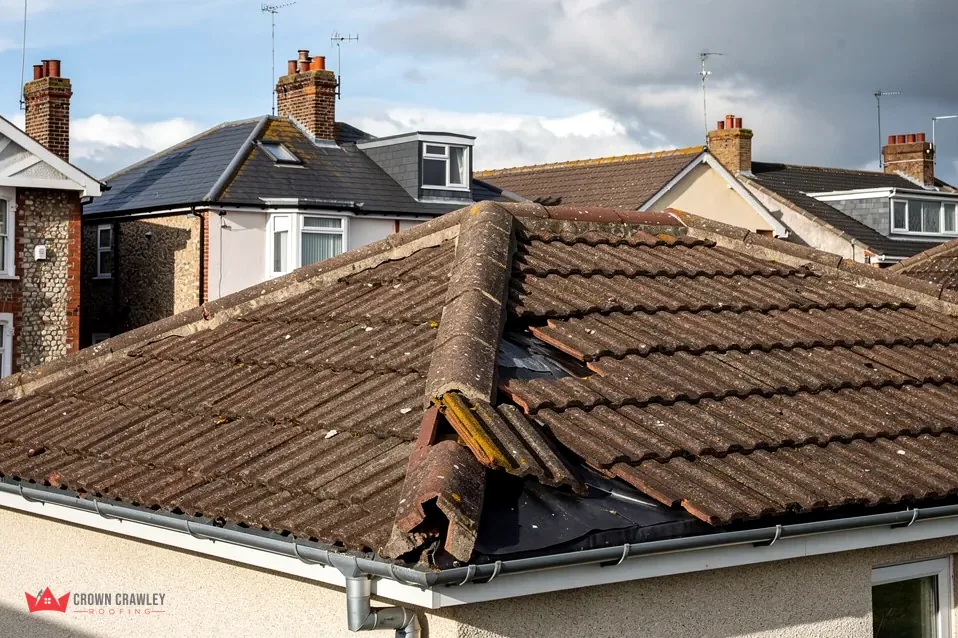
- Slipped or cracked tiles on a slope
- A tile or slate lying on the lawn
- Damp patches on an upstairs ceiling after rain
- Daylight between the tiles from the loft
- A dip or wave along the ridge
What our pitched roofing service covers
 Slipped and broken tilesSingle concrete, clay or slate pieces lifted out, replaced with a close match and fixed back so they stay put.
 Battens and fixingsRotten or split battens renewed around a repair, with nails and clips chosen to suit your tiles and your roof.
 Underlay and eavesTorn felt and failed eaves sections renewed, so water that gets under the tiles still reaches the gutter.
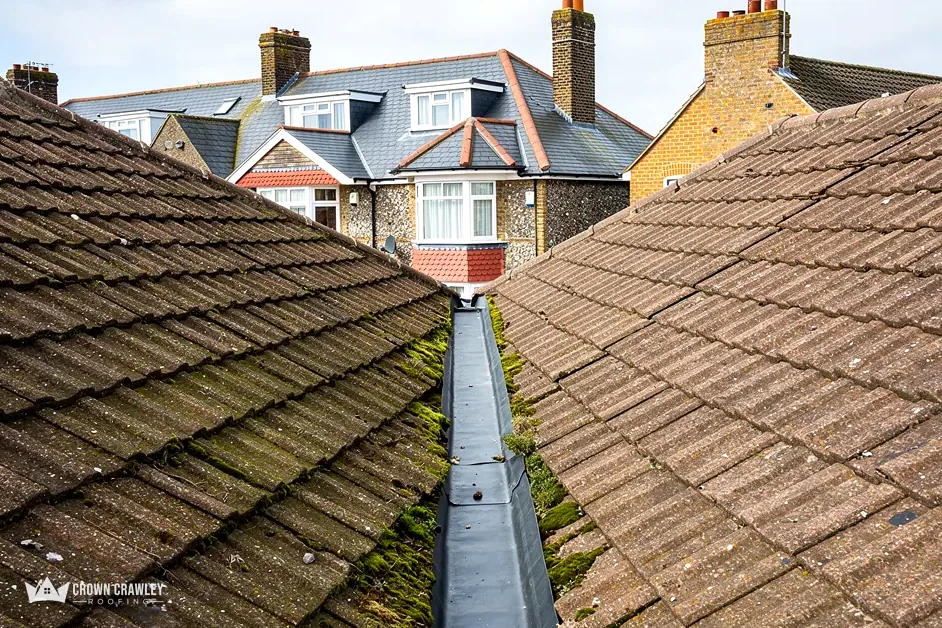
 Valleys and abutmentsMortar, trough and lead valleys repaired, with soakers and flashings renewed where a slope meets a wall or stack.
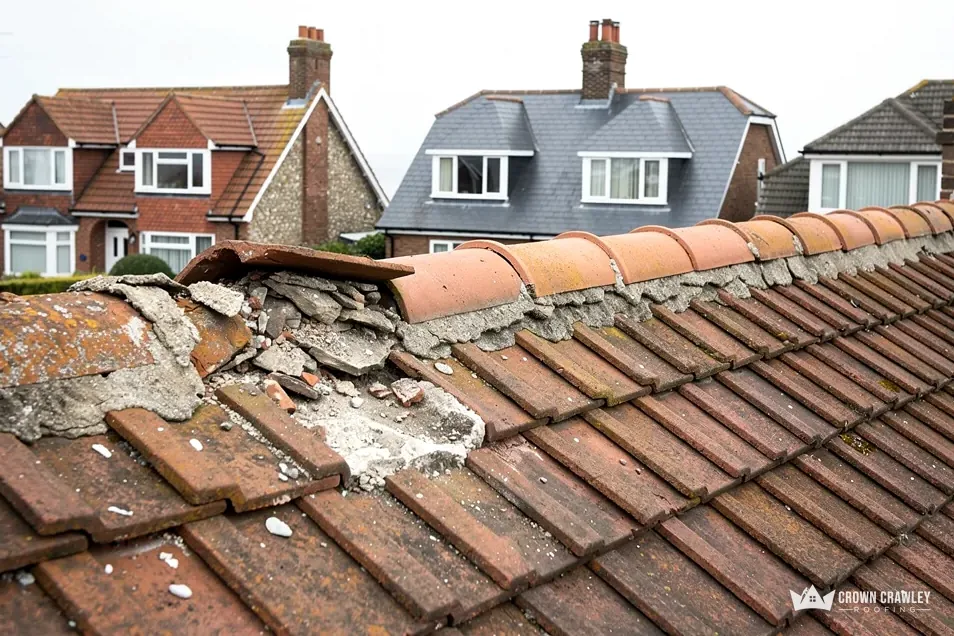
 Ridge and hip repairsLoose ridge and hip tiles rebedded with mechanical fixings, or changed to a dry-fix system where that suits better.
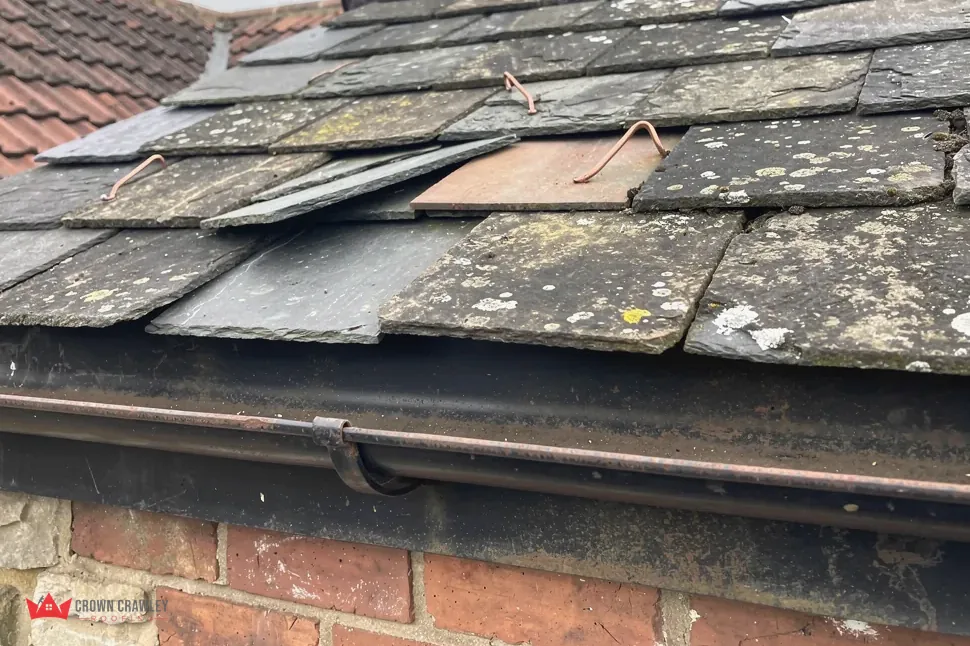
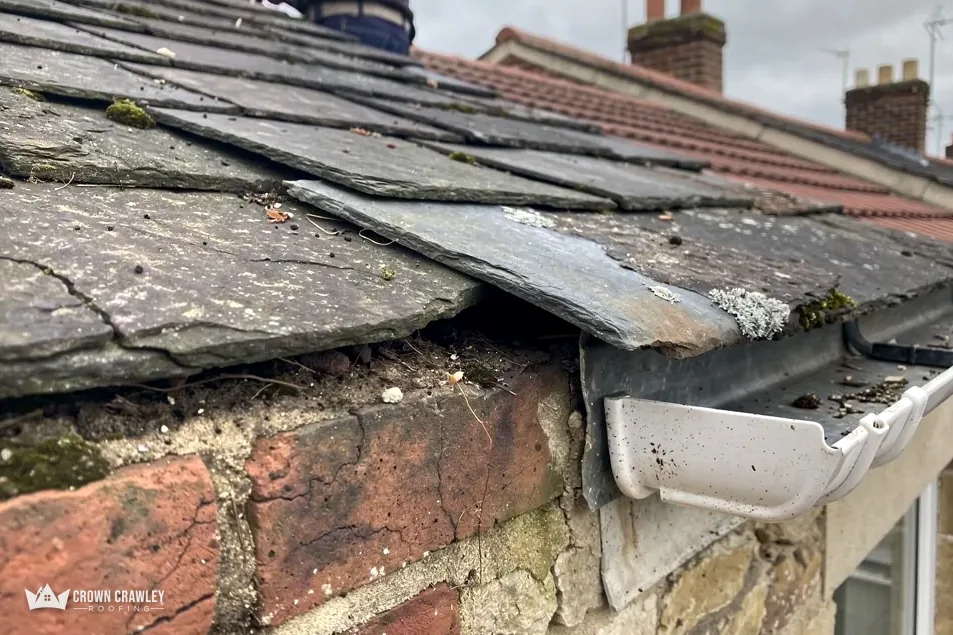
 Slate roof repairsSlipped slates refixed on tingles, and nail-sick patches stripped and laid again on new fixings.
Repair, re-use or re-roof?
- RepairThe tiles and battens are sound, and the fault sits in one place.
- Re-useThe tiles are good, but the battens or underlay beneath them have failed.
- Re-roofTiles, battens and underlay are worn out across the greater part of the slope.
How a pitched roof repair runs
- 1A photo and a few questionsYou send a picture of the slope and tell us when the leak or slipped tile first showed.
- 2A survey on the roofWe check the tiles, ridge, valleys and loft, and photograph each fault as we find it.
- 3One written priceYou receive a single total for the repair, with the photos and a plain account of the cause.
- 4Repair, check, photographWe fix it, check the loft below for daylight and damp, and send you the after photos.
The pitched roof diary
Inside a tiled roof repair
Six stages of a pitched roof job around Crawley, from reading the tiles from the garden to the last look in the loft.
Stage 01 · First look
Pitched roof repairs, slope by slope
A leak on a tiled roof usually has one cause. Find it and fix it properly, and the rest of the roof carries on.
A pitched roof is any roof with a real slope, covered in tiles or slates that overlap so that rain runs down and off into the gutter. It is a simple idea, and when it goes wrong the cause is usually simple too: a tile has slipped, a nail has rusted, a batten has softened or a joint has opened. Our pitched roofing, Crawley and Sussex wide, is built around finding that one cause and fixing it, rather than selling a new roof to cure a slipped tile. That is also why the survey always comes before the price.
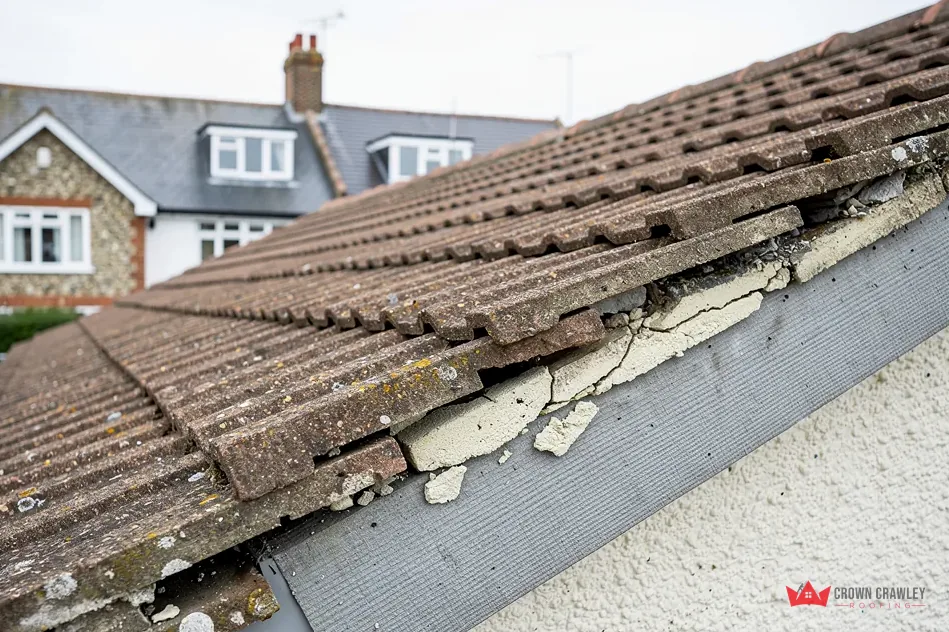
- Slipped tile mid-slope
- Ridge line
- Valley between slopes
- Eaves course
What counts as a pitched roof repair?
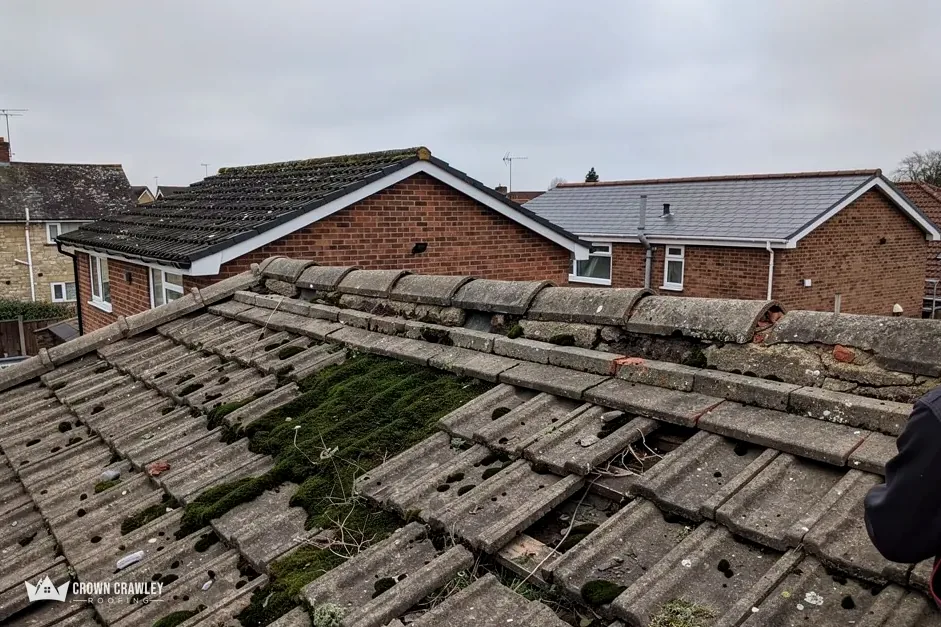
We carry out tiled roof repairs, Crawley to Horley and out to Horsham, on concrete interlocking tiles, small plain tiles in clay or concrete, and natural slate. The work runs from one cracked tile through to stripping a section, renewing the battens and underlay beneath it and laying the same tiles back. Valleys, ridges, hips and the joins where a roof meets a wall or chimney all count, because those are the places water finds first. The first job is always to trace where the water actually gets in, which can be some way up the slope from the stain on your ceiling, because water runs along the underlay before it drips. Stripping and recovering a whole roof is a different job with its own page.
Why do roof tiles slip in the first place?
Tiles hang by their nibs, small lugs on the back that hook over the battens, and on many roofs they are nailed or clipped as well. When a nail rusts through, a nib snaps or the batten under it rots, the tile slides. Frost can split an old tile, and wind can lift a course that was never clipped down. Our answer on why roof tiles slip goes through each cause in turn. A single slipped tile is a repair job. A pattern of them across a slope tells us to look underneath.
Keep reading
How is a single tile replaced?
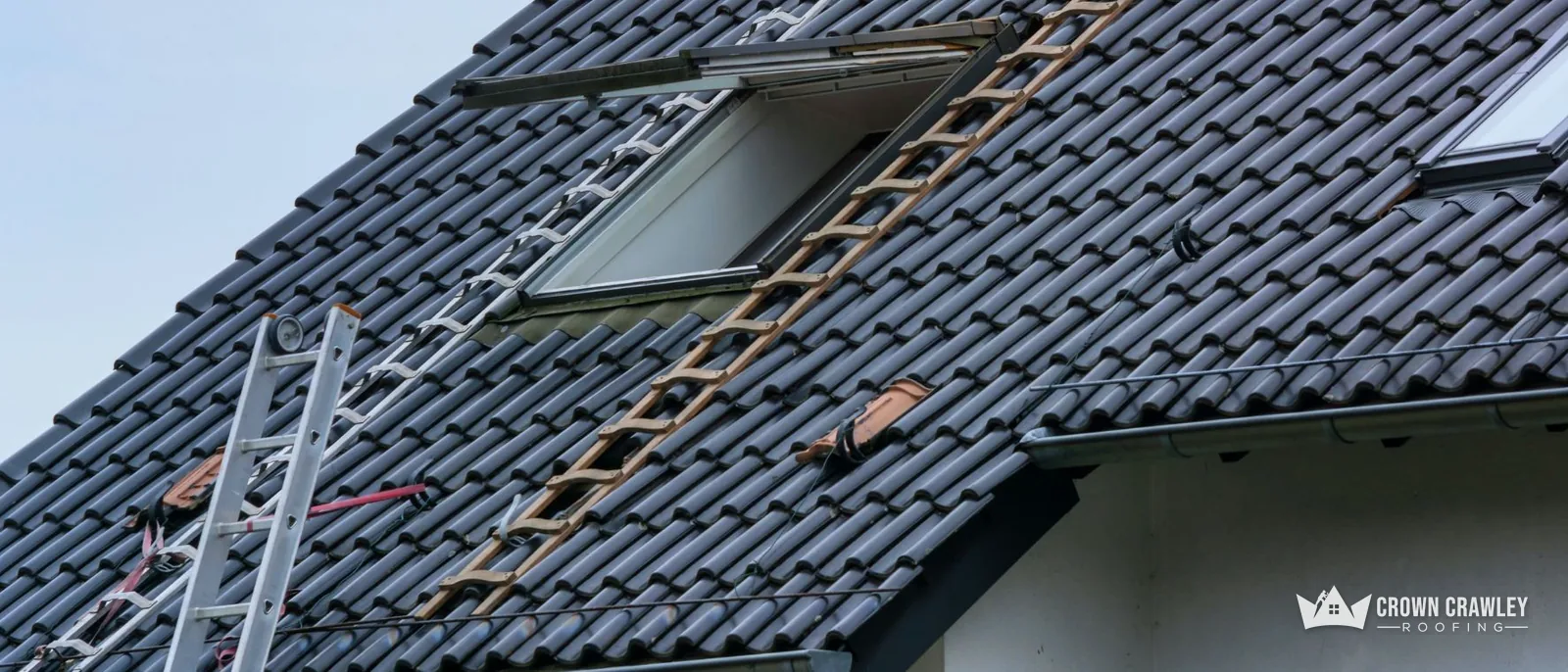
On an interlocking roof we ease up the tiles above, slide out the broken one, hook a sound tile over the batten and fix it so it cannot lift. Plain tiles and slates need their own methods, and a slate is often held on a tingle, a strip of copper or lead folded up under its tail. Our answer to can you replace individual roof tiles explains the method and the cases where it will not work. We photograph the tile before and after, so you can see the fix for yourself.
Stage 02 · Materials
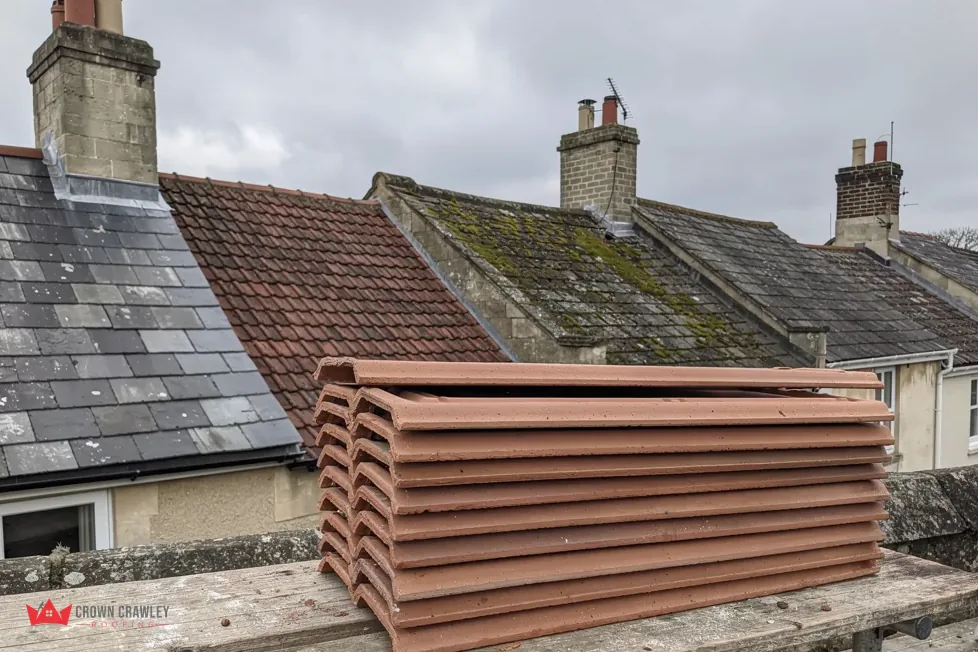
Concrete, clay and slate roofs
Each covering ages in its own way and needs its own repair method, so we work out exactly what you have before we price anything.
The pitched roofs we work on around Crawley are covered in one of three families: concrete interlocking tiles, small plain tiles in clay or concrete, and natural slate. Some houses carry more than one, with a porch or extension in a different tile from the main roof. Knowing exactly what you have matters, because a repair that suits one covering can damage another, and a tile that looks right from the road may not fit the battens on yours.
Tile and slate words
- Interlocking tile
- Large tile whose side grooves lock together
- Plain tile
- Small flat tile laid with a double lap
- Nib
- Lug on the back that hooks a batten
- Tingle
- Metal strip holding a refixed slate
- Nail sickness
- Corroded nails letting slates slip
How long do concrete and clay tiles last?
Marley gives concrete tiles a life of around 60 years, and adds that this "is not a guarantee or warranty of its longevity". For clay tiles, the Building Research Establishment figure is "a minimum life expectancy of 60 years". Old handmade peg tiles are another matter, and a conservation source warns that the 60-year figure is "clearly not a reliable guide" for them. So we judge the tile and its fixings separately. A concrete tile with a crumbling nib, or a face worn soft and porous, is near its end. A sound clay tile can often be stripped, sorted and relaid on new battens.
What changes on a slate roof?
For slate roofing, Crawley customers get the same survey and the same written price, but the repairs are different. CORC says that slate, if well maintained, can last 100 years and more. The weak point is the nails. When they corrode, slates slip one after another, a fault roofers call nail sickness. A few slipped slates can be refixed on tingles; widespread nail sickness means stripping that area and laying it again on new fixings. Slates are held by nails or by hooks, and the same slate supplier's guidance says hook fixings should not be used on any pitch below 25 degrees. BS 5534, the slating and tiling standard, sets the minimum pitch for natural slate at 20 degrees, so a shallow porch roof needs checking before slate goes back on. BSI itself notes that the standard's recommendations might not suit the re-slating or re-tiling of some old roofs, especially where traditional or reclaimed materials are used. A few older buildings nearby carry Horsham stone slabs; the Victoria County History records Crabbet Park's roofs being covered with them in 1940.
A slipped tile is the symptom. The nail, nib or batten behind it is the cause.
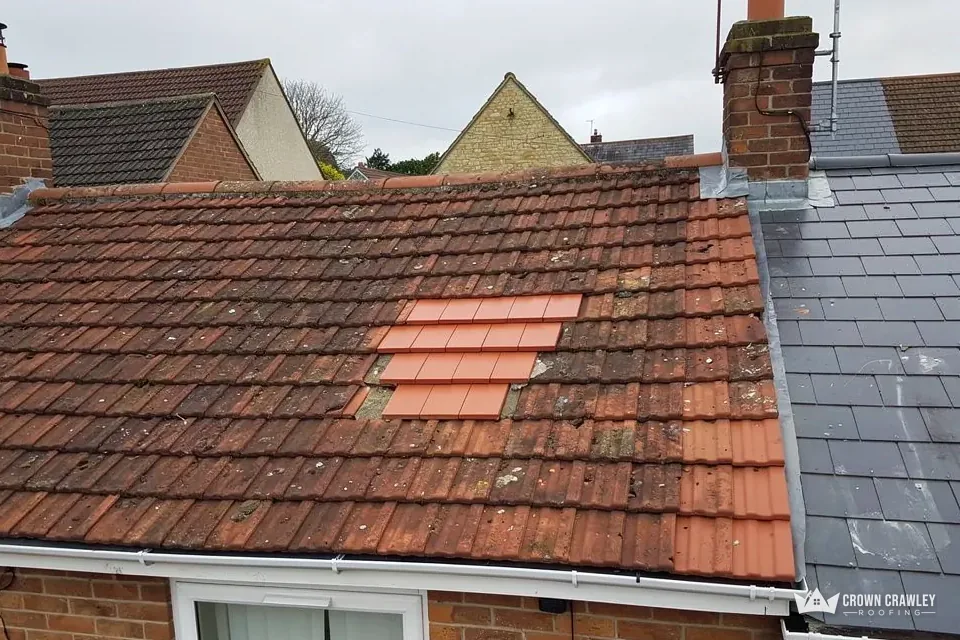
Where a tile has to be replaced, we match it as closely as we can from a current profile or a reclaimed tile. Our answer on matching old roof tiles explains what happens when a profile is no longer made. A new tile can look bright beside weathered neighbours for a while, so we place it where it shows least.
Every tile has a minimum pitch, so swapping one profile for another is not always possible. Marley lists 35 degrees for its concrete plain tile, 22.5 degrees for Double Roman and 17.5 degrees for Edgemere and Modern-Duo, while its clay Ashdowne plain tile needs 35 degrees. A low-pitched roof that suits a modern interlocking tile may be far too shallow for a plain tile. The product's data sheet decides it, and we check it before suggesting any change of covering.
- 100+ yearsslate, if well maintained (CORC)
- 60 yearsminimum life expectancy for clay tiles
- Around 60 yearsMarley figure for concrete tiles
Stage 03 · Junctions
Ridges, hips, verges and valleys
The edges and joins of a roof take the weather hardest, and each has its own mortar, lead or dry-fix detail to check.
Water tends to get into a tiled roof at its edges and joins rather than through the middle of a sound slope. The ridge caps the top. Hips run down the outside corners of a hipped roof. The verge finishes the gable end, and a valley runs down the inside corner where two slopes meet. Each of these has a mortar, lead or dry-fix detail, and each fails in its own way, so we check every one of them on a survey even when the call was about a single tile.
Ridge tile repairs: Crawley roofs old and new
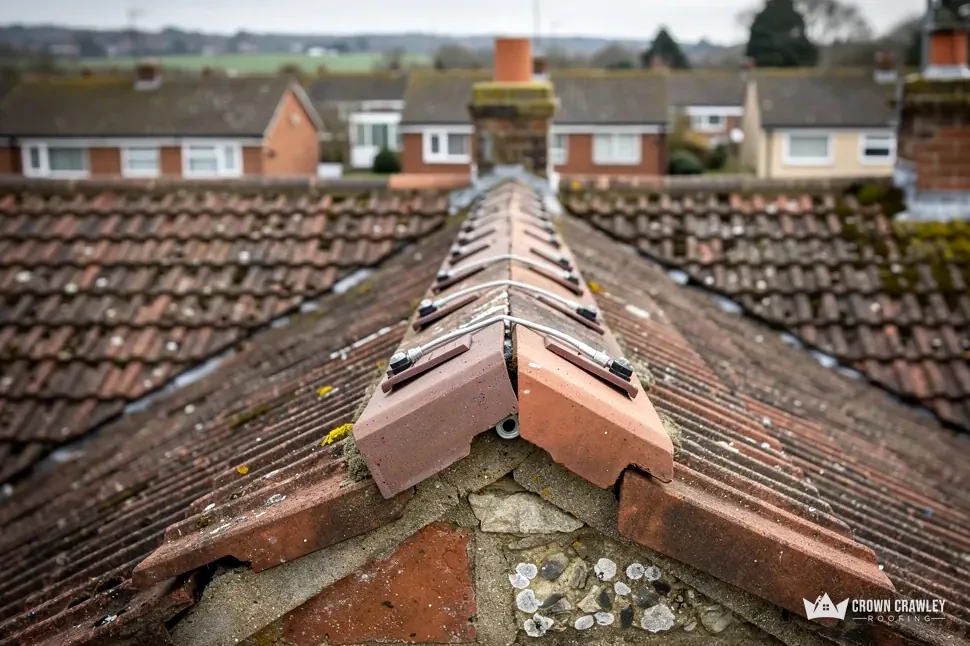
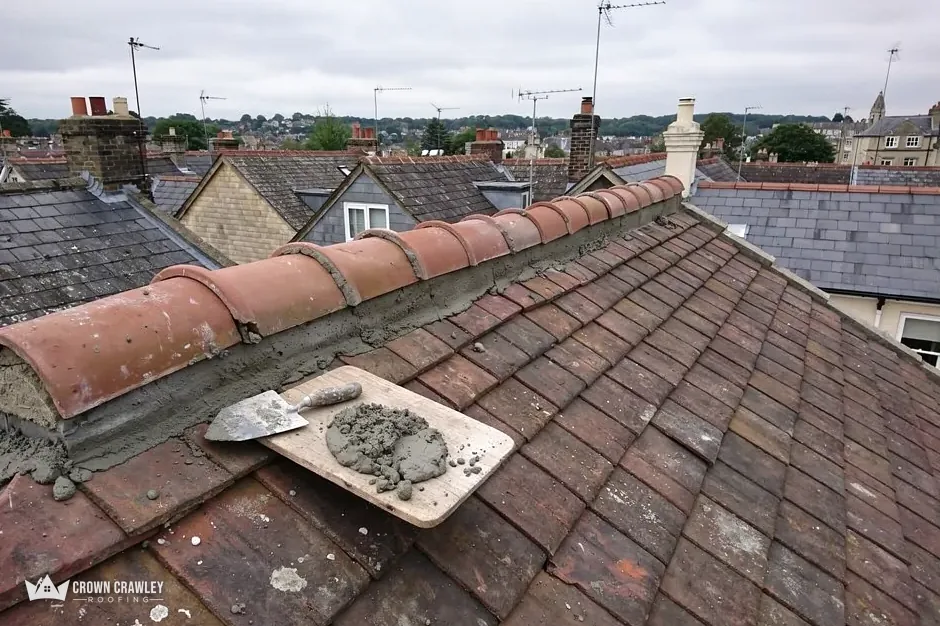
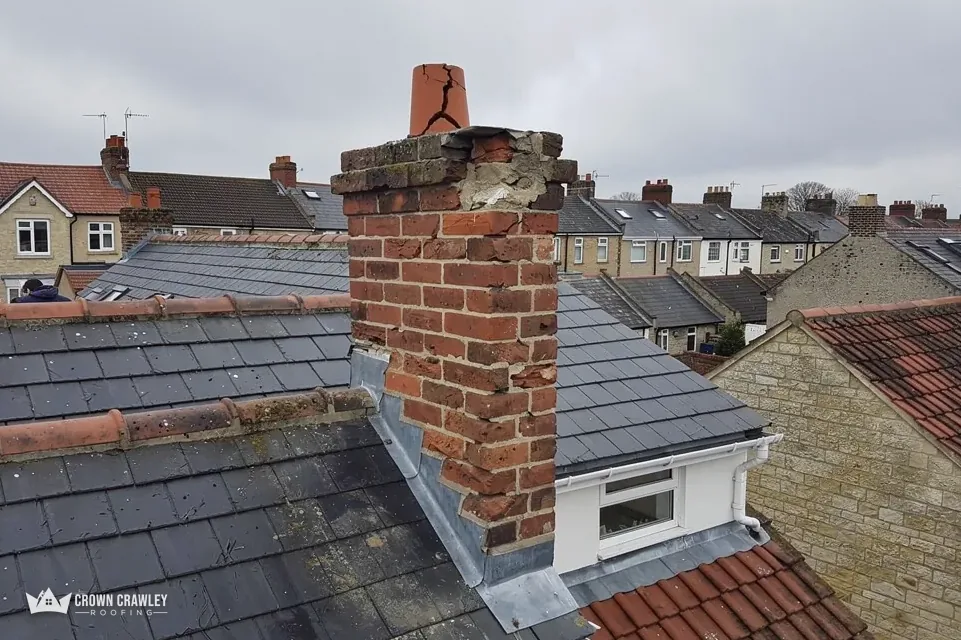
A mortar-bedded ridge cracks as the mortar ages, then the tiles rock and rain gets in along the joints. Marley explains that since BS 5534 was revised in 2014, mortar on its own is not enough to keep ridge and hip tiles in place, and bedded fittings need mechanical fixings too. So when we rebed a ridge, we add mechanical fixings, not just fresh mortar. Newer houses may already have a dry ridge: screwed units over a roll, from a system tested to BS 8612. Those fail at missed screws and split caps, and we replace just the units affected. Changing a whole roof to dry-fix is covered on our dry ridge and dry verge page.
Edge and junction checks
- Ridge
- Tiles tight, joints filled or capped
- Hips
- Caps fixed, no open joints
- Verge
- Mortar whole or caps clipped on
- Valley
- Clear, sound, no cracked mortar line
- Abutment
- Soakers and flashing sealed to wall
Which kind of valley does your roof have?
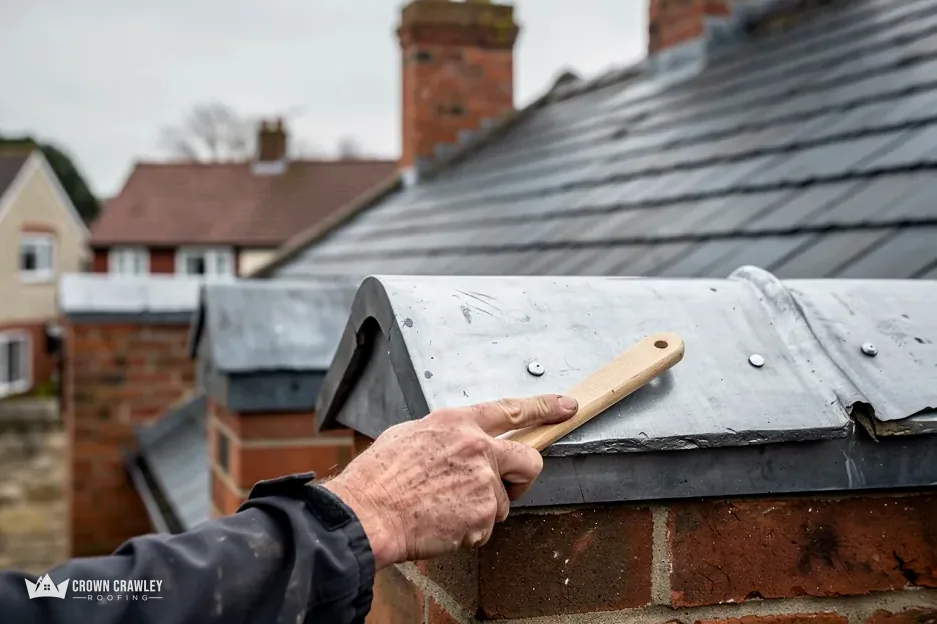
There are three common kinds. In a mortar-bedded valley the tiles are cut to meet along a line of mortar, which cracks with age. A dry valley uses a moulded trough under the cut tiles. A lead valley is a gutter lined with lead sheet, and Royston's lead brochure lists Codes 4 to 8 for pitched valley gutters, with Code 3 recommended for soakers only. A leaking valley shows as a stain in the corner of an upstairs ceiling, and a cracked mortar line is often visible from the garden. The fix might be repointing, refixing the cut tiles or relining the valley completely. Valleys also gather leaves and moss, and a blocked one can overflow under the tiles even when nothing is broken, so we clear and check every valley on a survey. On the verge, cracked mortar is raked out and renewed, or the edge is fitted with dry verge caps.
Where a slope runs into a wall or chimney, small lead pieces called soakers sit under each tile, and a lead flashing is dressed over them into the brickwork. If the mortar holding the flashing falls out, water runs straight down behind the tiles. We repoint or renew the flashing and check the soakers underneath it, then photograph the finished join.

Stage 04 · Underneath
Underlay, battens and roof ventilation
Under the tiles sit the battens and the underlay. When either one fails, refixing tiles on top only hides the fault for a while.
Lift a few tiles and you find the parts that do the quiet work. Battens are the timber strips nailed across the rafters that every tile hangs from. Underlay, sometimes called roofing felt or membrane, sits beneath them as a second barrier: it catches wind-blown rain and any water that gets past a tile, and carries it down to the gutter. Some roofs have sarking instead, a layer of boards or felt fixed across the rafters. Good roof tiling, Crawley or anywhere else, depends on all of this being sound, and the quality of the battens decides how long any tile stays where it was put.
What to look at
- Exposed timber battens
- Rafter below the battens
- Tile courses above
When do battens need replacing?
Battens fail through rot, usually where water has been getting in for a while, or where the nails fixing them to the rafters have rusted. A soft batten will not hold a tile nail, so tiles keep slipping however often they are refixed. From the loft you can see dark stains, splits and battens that sag between rafters. In a repair we renew the battens across the affected area; if they have gone across most of a slope, that slope needs stripping. Our guide on when roof battens need replacing sets out the signs and what a re-batten involves. The timber itself is a small part of the cost; the labour is in stripping and relaying the tiles above it, which is why we renew battens whenever a section is open for another reason. At the eaves, felt that has rotted where it drapes into the gutter lets water run behind the fascia. An eaves tray, a short rigid sheet under the bottom course, carries that water clear without stripping the slope.
Felt or breathable membrane?
Older roofs may have bitumen felt, which Marley calls HR, or non-breathable, underlay. With HR underlay on a cold roof, BS 5250 guidance asks for eaves ventilation of 25mm along the eaves at pitches of 15 degrees or less, and 10mm above 15 degrees. A breathable LR membrane, with a well-sealed ceiling and an air-permeable covering, can rely on the 3mm of gaps a normal eaves gives, subject to third-party certification. Without enough air, moisture from the house condenses in the loft and the battens rot from below. Our guide to breathable membrane versus felt explains the choice.
Keep reading
Spray foam is sometimes sold as a cure for a leaking roof. The Energy Saving Trust says of spraying foam onto a leaking roof without fixing it: "We don't recommend doing this." RICS also advises checking with your mortgage provider before any spray foam goes in. Our post on pitched roof repairs from tiles to structural fixes ranks the faults by depth.
Stage 05 · Pricing
What decides the cost of pitched work
Four things move the price of pitched roof work: how we reach it, how much is involved, the covering, and what sits underneath.
Our written price for pitched roof work is one total. It is shaped by what the survey shows, and the same four questions decide it every time: the access, the extent of the work, the covering, and what lies beneath the fault. The access we choose is built into the one total you receive.
Why does access change the price so much?
A bungalow's tiles are often within reach of a ladder and roof ladder. Work on a valley two storeys up calls for scaffold or a tower, so it can be done safely for as long as it takes. Checkatrade's tile replacement guide shows the effect: its October 2026 table puts replacing up to five tiles at £170 for a simple job, £225 with ladder access and bedding, and £500 once scaffold is involved. For a whole new roof, Checkatrade's roof replacement guide gives £700 to £1,300 for the scaffold nationally. Scaffold on the pavement also needs a highway licence: West Sussex County Council charges £266 for one month, and we arrange it with the scaffolder.
What moves the price
- Access
- Ladder, tower or full scaffold
- Area
- One tile or a whole slope
- Covering
- Concrete, clay or natural slate
- Findings
- Battens or underlay under the fault
What do the per square metre guides say?
Checkatrade's roof repair table, dated June 2026, gives typical UK prices per square metre for repairs of up to 3 m², excluding VAT: £90 to £120 for concrete tiles, £110 to £160 for plain clay tiles and £150 to £220 for natural slate. For new tiling on a pitched roof, its October 2026 installation table gives £120 to £230 per m² for plain tiles and £160 to £275 for clay. These are national figures, not our prices. They help you spot a quote that is far out, high or low, but they cannot price your roof.
The fourth factor is what we find. A slipped tile on sound battens is a small job; the same tile on a soft batten over torn underlay is a bigger one. That is why we survey before we price, and why the photos come with the quote, so you can see what drove the figure. Where the survey cannot see part of the roof, such as timbers hidden under a valley, the written price says what we will check once the tiles are lifted, and we agree anything extra with you before doing it.
The tile is the small part of a repair bill. Reaching it safely is the big part.
If you sign the contract at home after our visit, it is an off-premises contract, and the law usually gives you 14 days to cancel from the day it is made. That right does not cover a visit you asked for specifically to carry out urgent repairs. Either way, take the time you need over a price; nobody should feel pushed into signing.
When you weigh up quotes, compare totals for the same job. Ask each roofer which slopes, valleys or ridges their price covers, whether scaffold and VAT are included, and what happens if they find rotten battens once the tiles are up. A price that assumes nothing will be found underneath can grow later. Ours is set after a survey and photos of your own roof, and if something could not be seen, the written price says so.
- £170 to £500up to five tiles, October 2026
- £280 to £360a roofer's day, June 2026
- £700 to £1,300scaffold for a new roof, October 2026
Stage 06 · Sign-off
Permissions, sign-off and the loft check
Like-for-like repairs seldom need any permission, but bigger jobs can. Either way, every job finishes with a check in the loft.
Two sets of rules can apply before roof work starts: planning, which is about how the house looks, and the Building Regulations, which are about how it performs. For a straightforward repair neither usually comes into play, but it helps to know where the lines sit before a job grows.
Does re-tiling need planning permission?
Works that "do not materially affect the external appearance of the building" are not development under the planning Act, so replacing tiles like for like normally needs no planning permission. Changing to a different-looking covering is an alteration to the roof, and the rules differ for flats, listed buildings and conservation areas, so check with Crawley Borough Council's planning team before you choose a new look. In a flat or maisonette, the freeholder or managing agent usually has a say before any roof work, so read your lease first. A listed building needs listed building consent for works that would affect its character, and part of Ifield lies in the Ifield Village conservation area.
When does re-roofing need building control?
For re-roofing, Crawley Building Control asks for approval when more than 25% of a roof's surface is repaired or replaced, so we check with them on bigger jobs in the borough. The Planning Portal's national test is different: no application is normally needed if less than 25 per cent of the building envelope and less than 50 per cent of the roof is affected, though one is needed if a new covering raises the weight by 15 per cent or more. Replacing a handful of tiles comes nowhere near these thresholds, and the written price tells you if we expect approval to be needed. We cover full pitched roof replacement, Crawley and beyond, on our roof replacement and new roof page.
When the work is done we go back into the loft, check for daylight and damp under the repair, clear the gutters of mortar and broken pieces, and send you the after photos alongside the survey ones. We also note anything we saw but did not touch, such as a tired chimney flashing, so you can plan for it. Bats can affect timing too. Government guidance names repairing or replacing a roof among activities that can affect bats, which are fully protected, so if we find droppings or a roost we stop and talk to you first. To get started, send us a photo of the slope taken from the ground and tell us whether you can see daylight in the loft. That tells us what to check first when we arrive at your house.
Permission words
- Like for like
- Same covering, same look, same weight
- Building envelope
- Walls, floor, roof, windows and doors
- Listed building
- A building on the national heritage list
- Building control
- Checks work against the Building Regulations
Typical UK prices for pitched roof repairs
| Work | Guide price |
|---|---|
| Slipped or broken tiles (up to five) | £170 to £500 |
| Concrete tile repair | £90 to £120 per m² |
| Plain clay tile repair | £110 to £160 per m² |
| Natural slate repair | £150 to £220 per m² |
| Roofer's day rate | £280 to £360 per day |
These are national guide figures, not our prices. Yours is one written total, fixed once we have surveyed the roof and shared the photos.
Checkatrade cost guides: roof tile replacement table, October 2026; roof repair table, June 2026 (per m² figures for up to 3 m², excluding VAT).
Pitched roofing guides and answers
Short answers and longer guides on slipped tiles, battens, underlay and matching old tiles, for anyone weighing up a repair.
Guides and posts
Breathable Membrane vs Roofing Felt: Underlay ExplainedUnderlay is the layer nobody sees and everybody pays for. This guide compares bitumen felt with vapour-permeable…Guide · 9 min read When Do Roof Battens Need Replacing?Battens rarely get a second thought until tiles start sliding off them. This guide shows how to spot failing battens…Guide · 9 min read
 Loft Condensation and Roof VentilationDrips on the underside of the roof on a cold morning are rarely a leak. This guide explains why lofts sweat, how air…Guide · 9 min read
 Plain Clay Tile Roofs: Repairs and CareA plain clay tile roof is repaired one small tile at a time, and the matching matters as much as the fixing. This…Guide · 10 min read
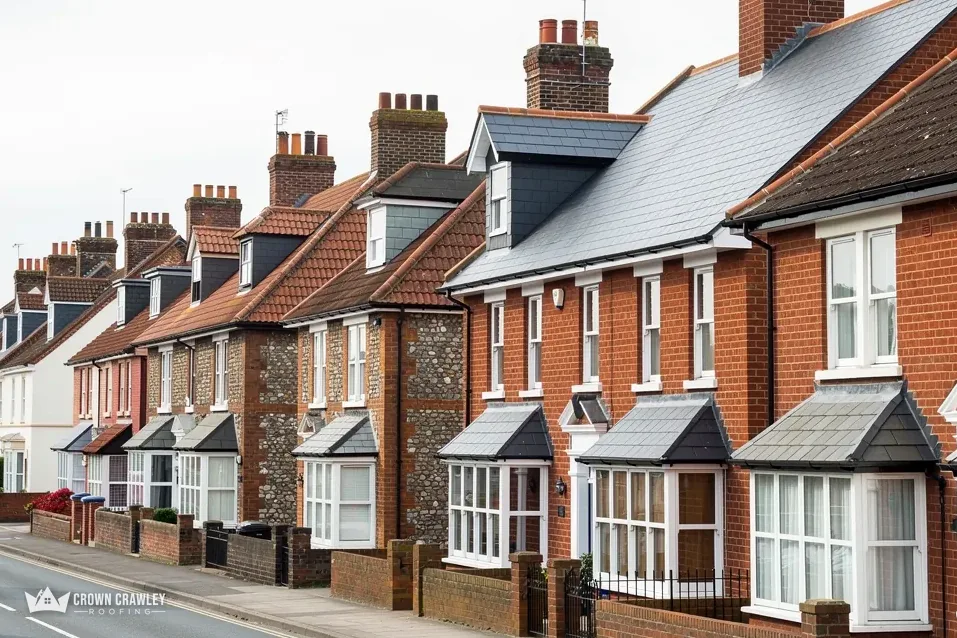 Natural vs Man-Made SlateA slate roof can mean split stone from a quarry or a manufactured copy. This guide compares the two on lifespan…Guide · 9 min read
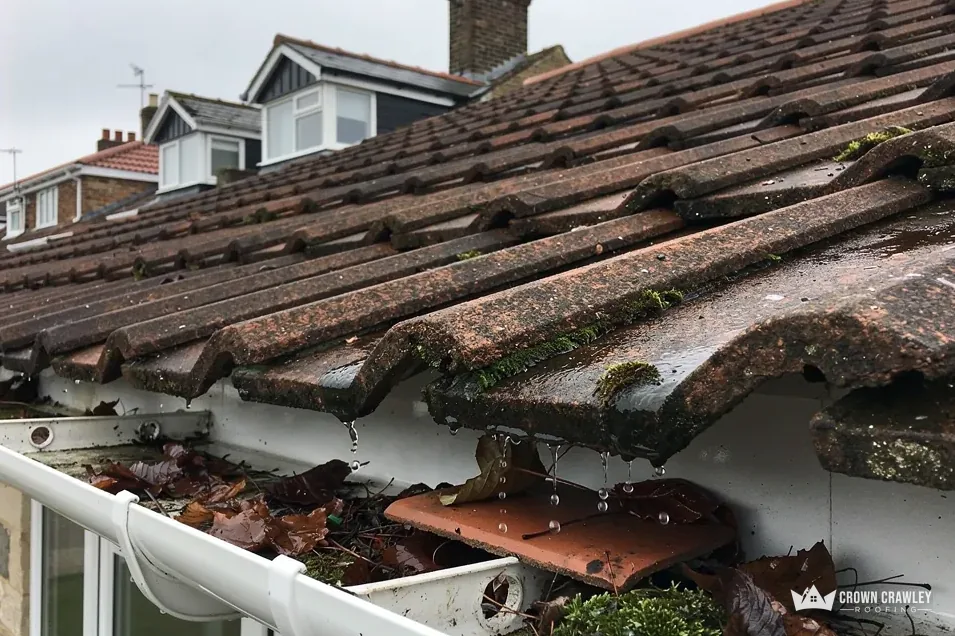 Pitched Roof Repairs: From Replacing Tiles to Fixing Structural IssuesA pitched roof fails in layers. Here is how to tell whether your problem sits in the tiles, the battens, the underlay…Blog · 9 min read
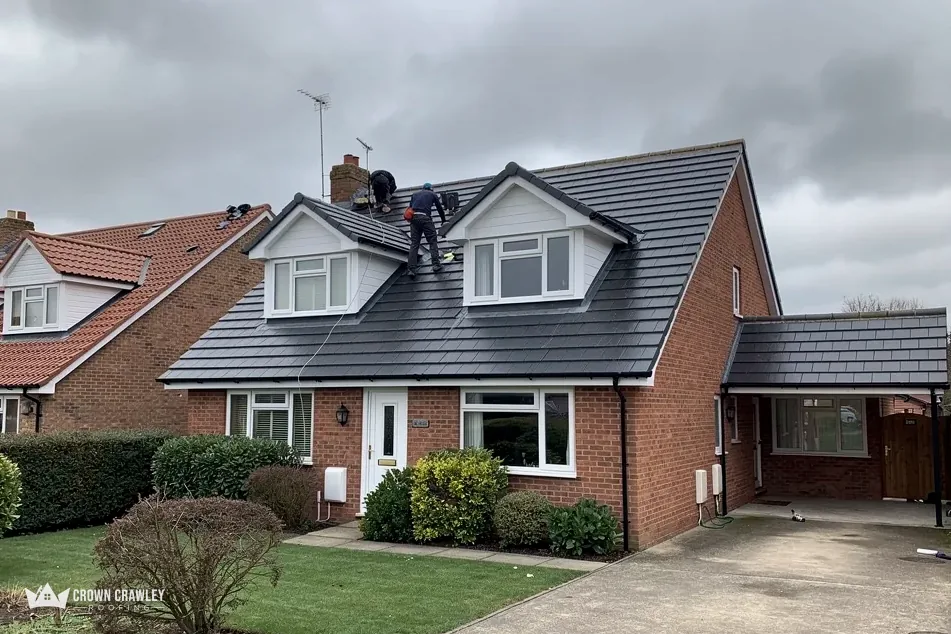 Pitched Roof Maintenance: Tips for Keeping Your Roof SoundA pitched roof stays sound when its ridge, valleys, eaves felt and ventilation get a regular look. Here is what to…Blog · 9 min read
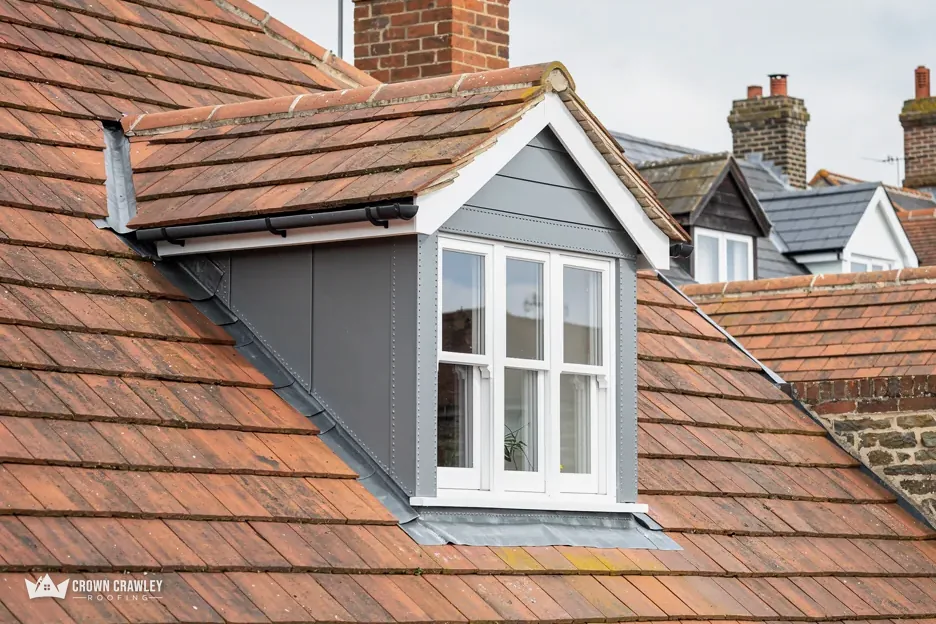 Pitched Roofing: The Benefits of a Classic DesignA sloping roof sheds rain by gravity, gives a house its loft and can outlast a flat covering several times over. Here…Blog · 9 min read
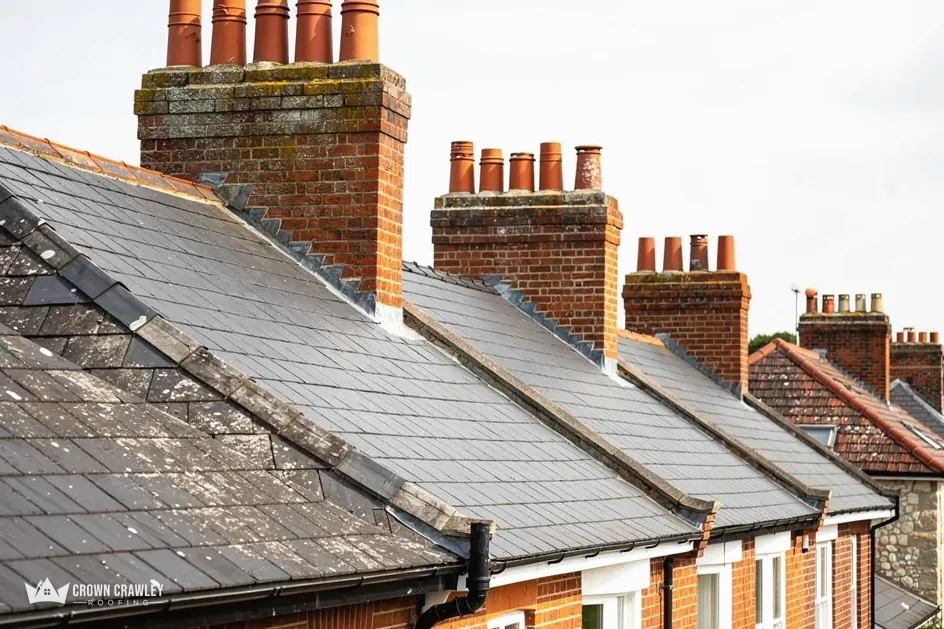 Choosing Pitched Roof Materials: Looks and PerformanceConcrete, clay and slate each give a pitched roof a different face, weight and pitch limit. Here is how to compare…Blog · 9 min read
 What Is the Typical Roof Pitch for a House?Pitch is the angle your roof slopes at, and it decides which tiles or slates can safely sit on it. Here is how to…Blog · 10 min read
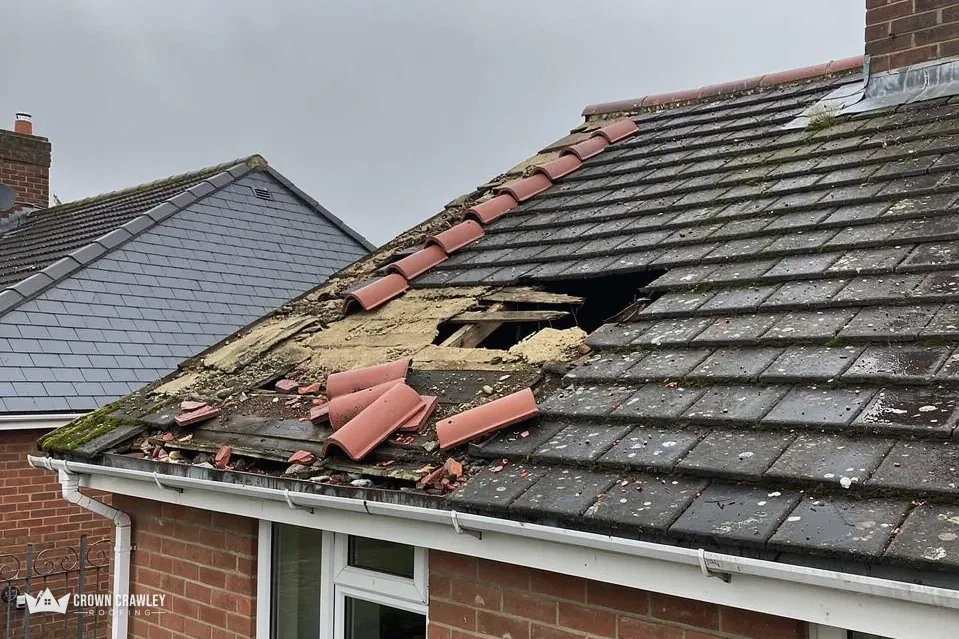 How Much Does It Cost to Repair Roof Tiles?On national figures, replacing a few roof tiles in 2026 runs from £170 to £500, and the gap is chiefly about…Blog · 9 min read
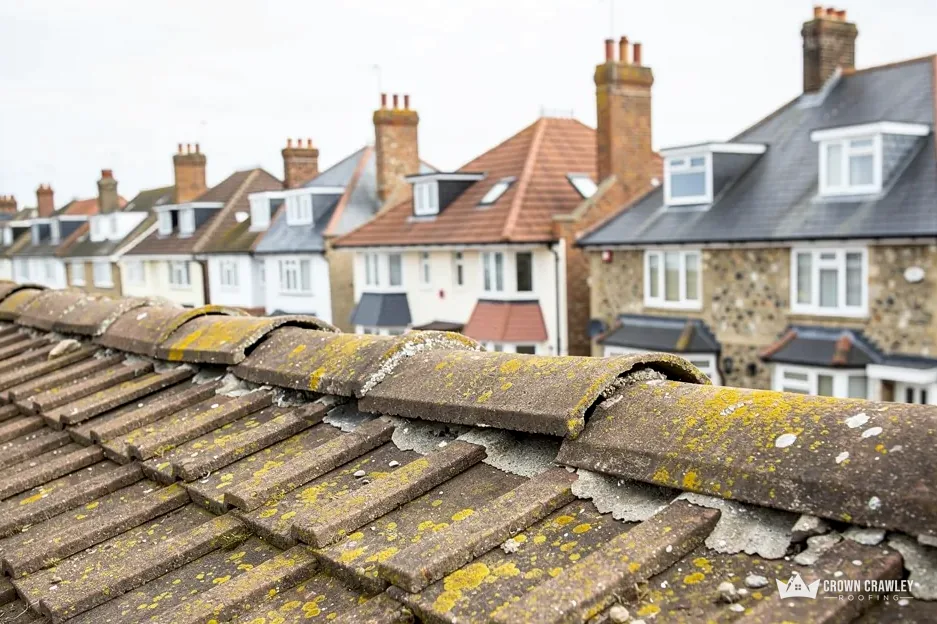 Crawley New-Town Roofs: Living With 1950s-60s Concrete TilesCrawley grew street by street after 1947, and a house from the 1950s or 60s may still wear its first concrete tiles.…Blog · 9 min read
Quick answers
- Can You Replace Individual Roof Tiles?
- Why Does My Roof Only Leak in Wind-Driven Rain?
- Can You Replace Roof Felt Without Removing Tiles?
- Can You Match Old Roof Tiles?
- Why Do Roof Tiles Slip?
- Cracked Roof Tile: Repair or Replace?
- Why Are My Roof Tiles Lifting in the Wind?
- Cracked Mortar Valley: What Are the Options?
- Why Is My Roof Sagging?
- Can You Change Concrete Tiles for Slate or Clay?
- Interlocking vs Plain Roof Tiles
- Do Roof Tiles Need Clips?
- Torn or Sagging Roof Underlay: Does It Matter?
- Why Is the Felt Rotten at the Eaves?
- Does Re-Roofing Improve Insulation?
- How Long Does a Roof Repair Take?
- Broken Tile Nibs: Why Tiles Slide Out
- What Is Nail Sickness on a Slate Roof?
- What Is a Slate Tingle Repair?
- Can You Convert a Flat Roof to a Pitched Roof?
Related services
 Roof replacementOur roof replacement service strips the whole roof and covers it again: new battens, underlay, tiles or slate, ridge…
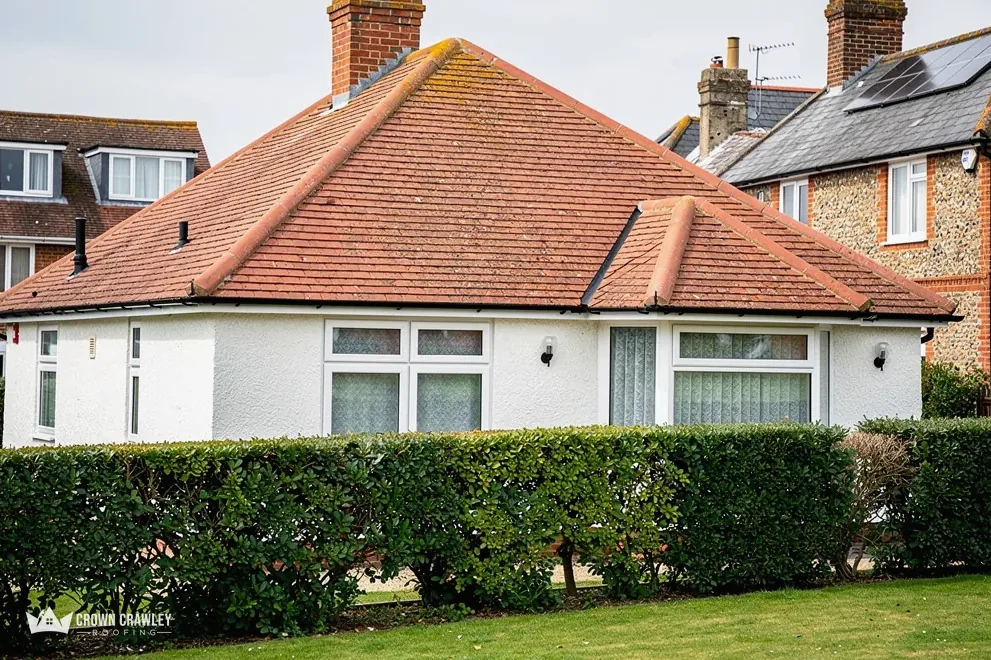 Dry ridge & dry vergeOur dry ridge work in Crawley covers loose ridge tiles, failing verge mortar, rattling verge caps and full dry-fix…
 Lead workOur lead work covers chimney flashings, step flashings, valleys, back gutters, bay and porch tops, dormer cheeks and…
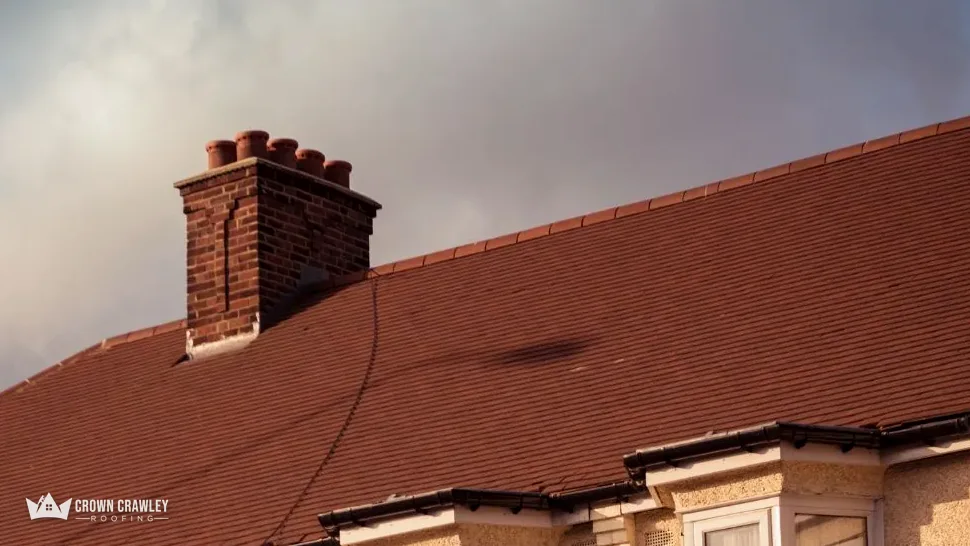 Chimney repairsWe repair chimney stacks across Crawley and the towns around it: crumbling mortar, cracked flaunching, failed lead…
Pitched roofing questions
Why does my roof only leak in certain weather?
A roof that stays dry in steady rain but leaks in a gale is usually letting in wind-driven water. Rain blown sideways can get under the laps of tiles, through a loose verge or past a gap in the ridge, then run down torn underlay. Note the wind direction when the stain appears, because that points us to the slope and the detail at fault.
How long does a concrete tile roof last?
Marley puts the life of concrete tiles at around 60 years, and says that figure is not a guarantee. In practice the fixings matter as much as the tile. Rusted nails, snapped nibs and soft battens can end a roof sooner, while a sound tile can be stripped and relaid on new battens. A survey tells you which you have.
Is damaged underlay enough reason for a new roof?
Not on its own. Underlay that has perished at the eaves can be put right with eaves trays and a new strip at the bottom of the slope. Underlay cannot be renewed properly from inside the loft, though, so if it has failed across a whole slope and the tiles are tired too, stripping that slope is usually the better buy.
Should I switch to dry ridge when re-roofing?
Either can be right. Since the 2014 revision of BS 5534, ridge tiles need mechanical fixings rather than mortar alone, which a dry ridge system tested to BS 8612 provides, and so does mortar with mechanical fixings added. Dry ridge suits exposed roofs where mortar keeps failing; mortar keeps the look of a street of bedded ridges.
Will re-roofing improve my insulation?
It can. Approved Document L treats renovating more than 50% of a roof's surface as a trigger to upgrade it where that is feasible and pays back within 15 years. The 2021 edition's Table 4.3 sets 0.35 as the threshold and 0.16 W/(m²K) as the improved figure until 24 March 2027, when the 2026 edition applies. Ventilation must be planned alongside.
Can we stay at home while the roof is repaired?
Yes, for repairs. The work happens outside, with a short visit to the loft to check underneath. We tell you each day what is happening, keep paths and the drive clear, and cover anything in the loft that could catch dust. If a slope is opened up, we make it weathertight at the end of every day before we leave.
Show us the slope that worries you
Send a photo of the slope from the ground and tell us whether you can see daylight in the loft.