Roofers in Langley Green

Roofs on terraces and semis from 1955, beside much older lanes.

Langley Green filled with nearly 1,600 houses by 1955, and a few far older buildings stand along its lanes. We go up, photograph what is there, then put one price in writing.

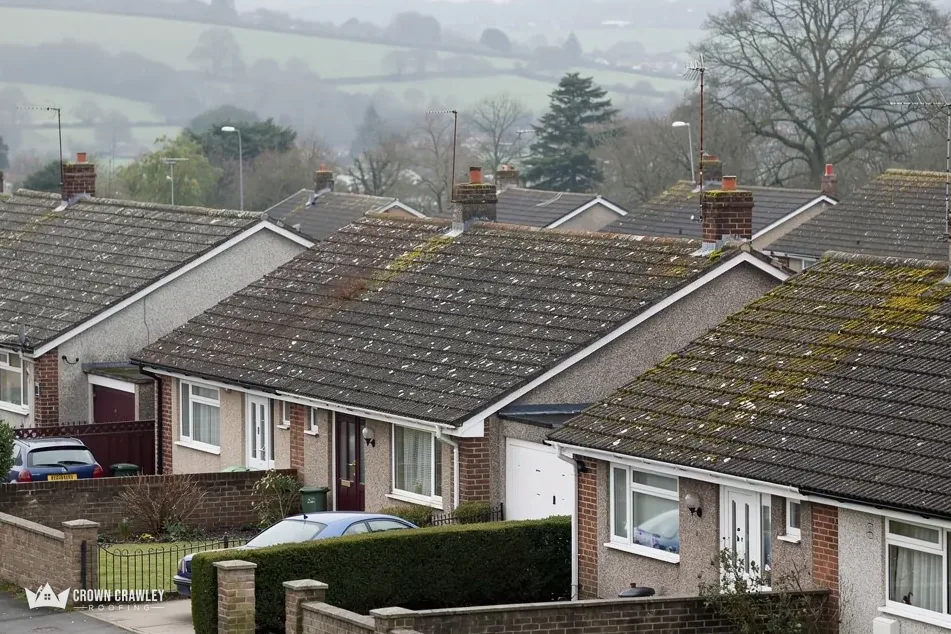
Terraced bungalows with grey tiled roofs along a cul-de-sac

Langley Green roofs, new-town and old-lane

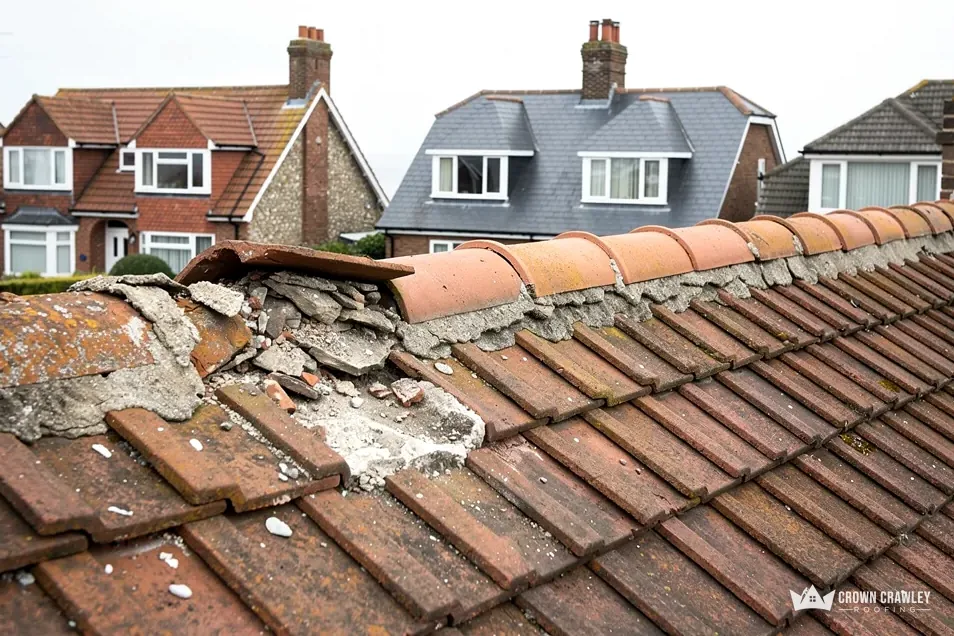
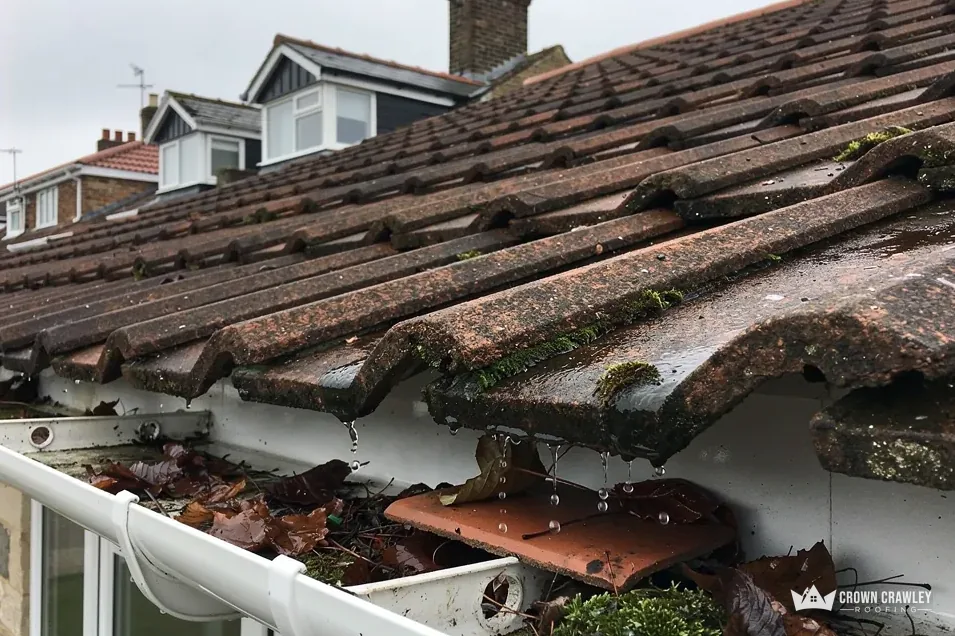
Broken mortar bedding along a clay ridge

Nearly 1,600 houses by 1955

Building was quick: nearly 1,600 houses were finished by 1955 and the neighbourhood was thought complete in 1956. Roofs close in age can share faults, so a problem on one is a fair hint to check the next.

Rows of tiled terrace roofs

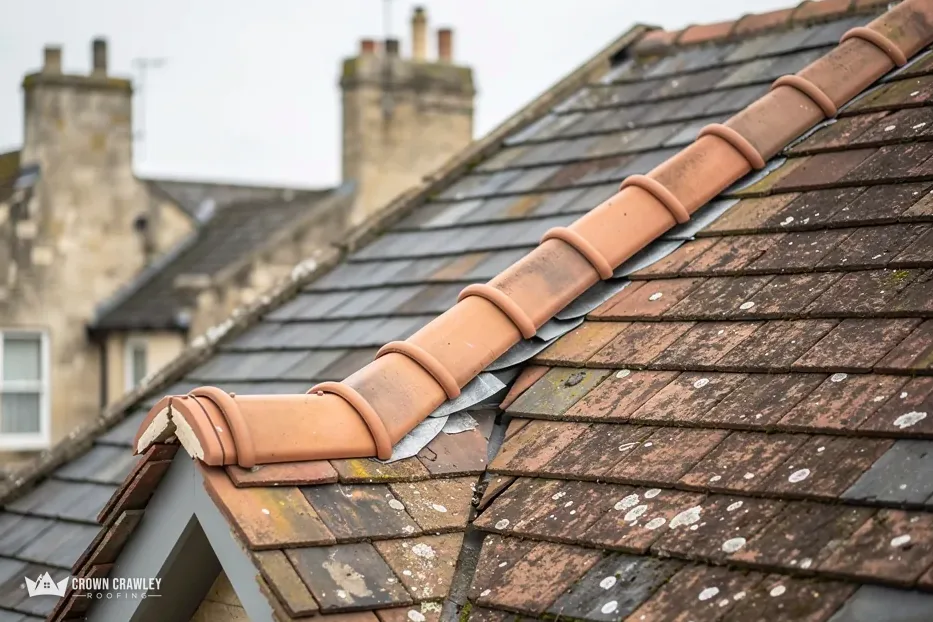
Clay ridge tiles along the hip of a weathered tiled roof

Terraces and semi-detached pairs

The county history describes new-town houses as terraces and semi-detached pairs with pitched, tiled roofs. A terrace shares its ridge and party walls, so we plan repairs with the neighbouring roof in mind.

Semi-detached pair with tiled roof

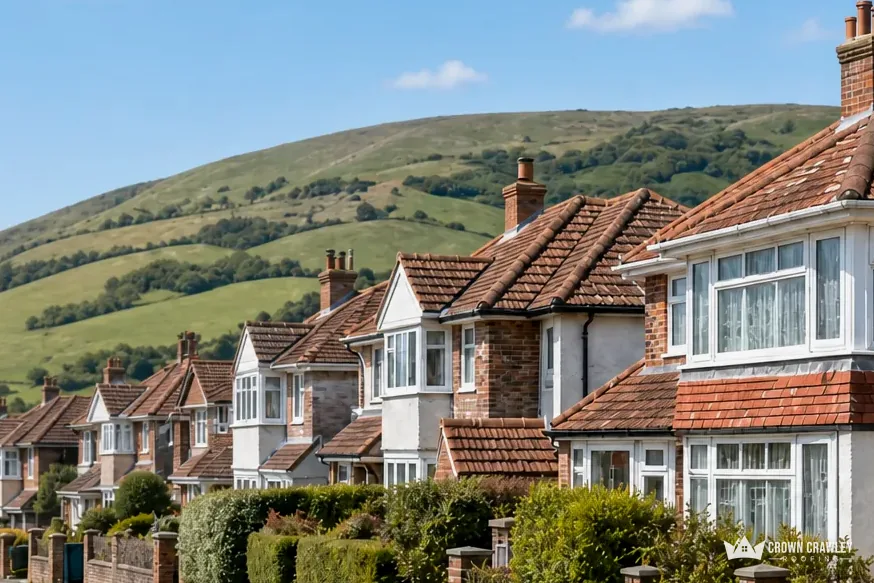
Row of suburban houses with tiled roofs below green downland

Old lanes and a listed farmhouse

Old houses along Langley Lane and Langley Walk pre-date the neighbourhood, and Langley Green Farmhouse is listed Grade II. Roof work on a building like that needs a different approach from a 1950s semi.

Timber-framed house with tiled roof

Langley Green, north-west of the ring road

Map of Langley Green and the neighbourhoods around it, with Crawley for reference.

Langley Green lies north-west of the ring road, named after one of Ifield parish's old commons, most of which were inclosed in 1855.

Distance
1.6 road miles from Crawley, to the north
Drive
About 5 minutes
Council
Crawley Borough Council and West Sussex County Council
Planning authority
Crawley Borough Council
Ward population
9,106 (Census 2021, Langley Green and Tushmore ward)
Listed building
Langley Green Farmhouse, Grade II (list entry 1298881)
Get a free quote

Langley Green, house by house

Reading a Langley Green roof, 1955 and earlier

Three short chapters on a neighbourhood that filled fast, the concrete gutters found on some 1950s houses, and the older buildings along the lanes.

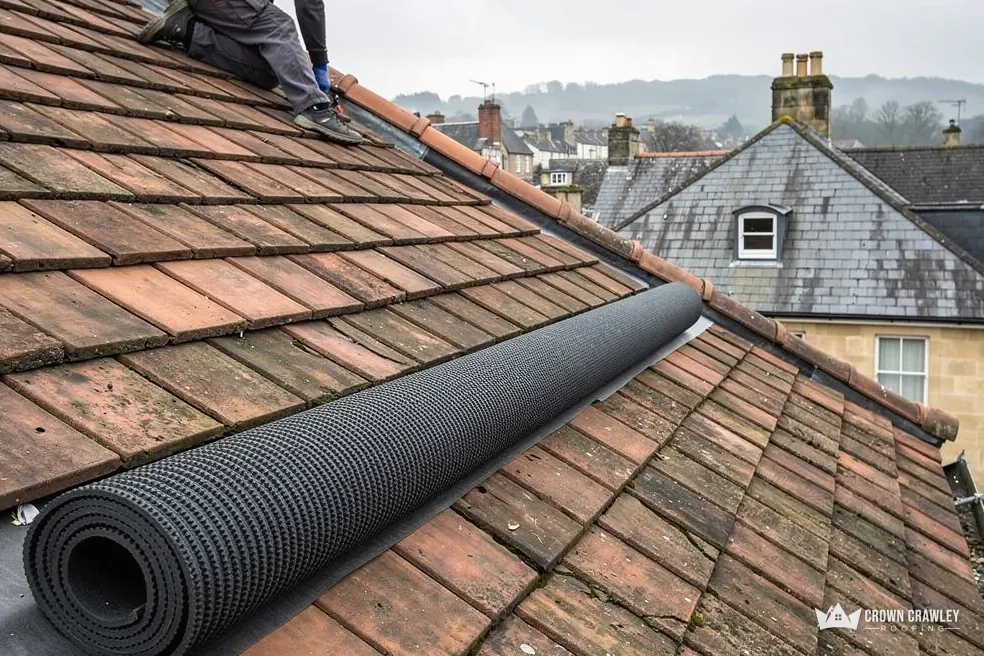
Roll of roofing membrane lying on a clay tiled roof

Stage 01 · Background

Nearly 1,600 houses in a few years

Langley Green was the first Crawley neighbourhood built where little settlement stood before, and it filled in a few years.

Langley Green was the first Crawley neighbourhood to take shape where there was little earlier settlement. The Victoria County History says nearly 1,600 houses were finished by 1955 and that it was thought complete in 1956. The same history describes most Crawley new-town houses as terraces and semi-detached pairs in pale red brick, sometimes rendered or clad, with pitched and tiled roofs. A house finished in 1955 is 71 years old now.

What a terrace roof shares

Ridge
Run across both neighbours' roofs
Party wall
Flashing sealed along the line
Hips
Caps fixed and bedding whole
Gutters
Joints tight and falls correct
Fascia
Boards sound with no rot

What does a Langley Green terrace share overhead?

More than the party wall. Along a terrace the ridge can run on across several roofs, the valleys and gutters meet at the boundaries, and the flashing along each dividing line is a joint that belongs to two households. So a fault at one end may start next door. At the survey we explain which neighbour is affected, so that a repair on your side does not leave a gap on theirs. With the owner's agreement we can look at both sides from the same visit, though the written price covers only the roof that is yours.

Which parts of a Langley Green semi fail first?

The chimney, the verge and the valley. The chimney stack carries flaunching, the sloped mortar bed around the pots that throws water off, and flashing where the stack meets the slope, and either can crack and let water into the loft below. The verge is where a slope finishes against the end wall of a gable, and it relies on mortar or on clip-fixed caps. The valley is the inward corner between two slopes, lined with lead or a similar material. Our chimney repairs page explains what each fault looks like.

Keep reading

Is a roof from 1955 beyond repair by now?

Not on age alone. If it is clay tile, the Building Research Establishment rates it at a minimum of 60 years, though a conservation journal warns the figure does not suit old peg tile. Concrete tile is around 60 years on Marley's reckoning, with no promise attached. What matters is the condition we find when we go up, and we photograph it for you.

Because so many neighbouring roofs were finished within the same few years, we also look along the street from the pavement before we climb. A run of lifted tiles in the same place on several roofs points to a shared cause, such as a weak fixing detail, and tells us what to check on yours. It also helps explain why a fault has appeared now rather than five winters ago.

Slipped tiles lying in a blocked gutter

Stage 02 · Gutters

Concrete gutters on some 1950s houses

Some houses of the 1950s were built with concrete Finlock-type gutters, and leaking joints are their best-known fault.

We cannot say that every house here has them, and the county records do not tell us which do, so we check each house at the eaves rather than guess from the date. Gutters of this kind were used on some houses of the 1950s, which is why we raise them on a Langley Green survey. The RICS defects record on Finlock gutters is the useful guide here. It pictures a 1950s house built by a local authority with this form of gutter, and it describes the fault plainly: water escaping through the joints has badly damaged the structure in a number of cases, and that gave the design a poor name.

How can you tell whether a Langley Green gutter is Finlock?

A Finlock gutter is a concrete trough at the foot of the roof, built into the eaves instead of hung from a fascia board like a plastic or cast-iron gutter. If your gutter is a plastic one on brackets, you do not have one. If you cannot tell, a photo of the eaves from the garden is enough for us to say whether it is worth a closer look.

Finlock gutter words

Finlock gutter
Concrete trough built into the eaves
Joint
Where two gutter sections meet
Lining
Metal liner laid inside the trough
Lintel
Beam carrying the wall over a window

Does a leaking one always have to come out?

No. RICS adds that a careful inspection can tell gutters needing wholesale replacement apart from ones that stay sound with proper upkeep, and that nobody should presume removal. That is our approach too. We photograph each joint from the ground and from the roof, look for staining below, check the concrete and any lining, and tell you what a repair would achieve before anyone mentions replacement. Because the gutter sits at the foot of the slope, work on it can involve the first courses of tiles and the eaves underlay, and the written price spells out whether scaffold is part of the total. Our guide to Finlock gutter lining goes through the lining option, and our gutters, soffits and fascias page covers the wider roofline.

Replacing a Finlock gutter should never be assumed before the joints have been examined.

What happens above a window when the joints leak?

The same RICS record points out that on some of these gutters the inner sections are filled with concrete, which makes a beam above the upstairs windows, and that this beam weakens if water reaches it through the joints. It also describes a gutter once lined with stainless-steel sections to stop the leaks, where the lining itself had since come to the end of its life. So a lined gutter is not a finished story either, and we look at the lining as closely as the concrete.

Stage 03 · Older buildings

Older buildings along Langley Lane and Walk

Old houses on Langley Lane and Langley Walk include a timber-framed cottage of about 1475 and a probable 17th-century grange.

The county history records old houses along Langley Lane and Langley Walk, among them Meeting House Cottage, a house with an open hall and timber frame dated to about 1475, and Langley Grange, probably from the early 17th century. Langley Green Farmhouse is listed Grade II, and the National Heritage List first listed it on 23 February 1983. Buildings like these are not what most of Langley Green looks like, but they sit within its streets, and they get different treatment from us: slower, more careful work, with more time spent on the timbers and on matching what is already there before any price is given.

Is my Langley Green house listed?

Most will not be. If yours is, any work that would change its special character needs listed building consent, even where the same job on an unlisted house would need no permission. The planning team at Crawley Borough Council can confirm the status of your address, and it pays to ask before any covering, ridge or chimney work is agreed. On a listed roof we wait for your answer before ordering materials, and we match the existing covering, ridge and detailing rather than offer a modern equivalent.

Checks on an older roof

Covering
Match the existing tile or slate
Timbers
Rot in rafters and battens
Lead
Right code for each junction
Chimney
Flaunching, pointing and flashing
Consent
Listed buildings may need written consent
Storm-damaged tiled roof with the battens exposed and tiles on the ground

What does an older roof need that a 1950s one does not?

A closer look at the timbers, because rot or movement in a rafter changes the repair. A matched covering, because new tiles in a different colour stand out on an old roof. And lead: a flashing, a valley or a soaker in the right sheet code for the job. Royston Lead's brochure lists Code 4 and Code 5 for flashings and valleys. According to MyJobQuote's cost guide, lead flashing can last for over 80 years, so sound lead is worth repairing rather than replacing. Our lead work page explains the codes in plain terms.

Does Crawley's approval rule reach these roofs too?

It does. Crawley Building Control wants to approve any job touching above 25% of a roof's surface area, listed or not, and Crawley's Ifield Village Conservation Area lies within a kilometre of Langley Green. If the survey points to a large area, we speak to the council first and the written price records it. Should the scaffold have to stand in the road, West Sussex County Council licenses it, with 10 working days' notice and £266 for one month. Where your own drive or garden is wide enough, that step disappears. To begin, photograph the roof and give us your lane or road name.

Langley Green roof questions answered

How do I know if my Langley Green house has Finlock gutters?

Look at the foot of the roof. A Finlock gutter is a concrete trough built into the eaves, not a plastic or cast-iron section on brackets. RICS records them on 1950s houses and says leaking joints are the known fault. A photo from the garden lets us tell you whether a closer look is needed, and removal is never assumed.

Does a listed house in Langley Green need consent for roof repairs?

Consent is needed for works altering a listed building's character. Swapping the covering for something different could count, while repairs in matching materials may not, but the council decides for your address. Langley Green Farmhouse is listed Grade II. Put the question to Crawley Borough Council's planners first, then forward us their reply so our written price reflects it.

Can you repair a shared ridge on a Langley Green terrace?

Yes, and we explain at the survey which parts are shared. A ridge can run across neighbouring roofs, which means mending your end might reach into the next house. We talk to the neighbour if the work crosses the line, leave both halves sound and hand whoever orders the job a single total price on paper.

Which photos help you price a Langley Green roof before the survey?

Pictures from the ground of every slope, plus the ridge, the stack and the gutter line, are enough to start, with a picture of any ceiling stain and the room it is in. Add your road name. We still go up and photograph the roof ourselves at the survey, since a photo from the garden cannot show what lies under the tiles.

Your Langley Green roof, priced once in writing

Tell us which roof, chimney or gutter concerns you and your road or lane in Langley Green, and we will arrange the survey.

01293 974253

10-year workmanship guarantee, in writing.

Call Get a free quote