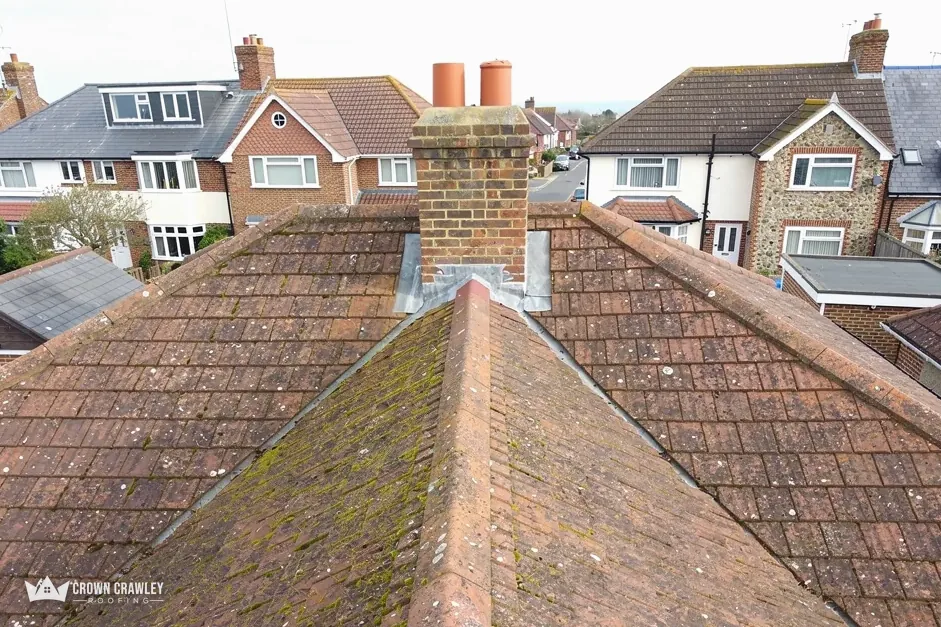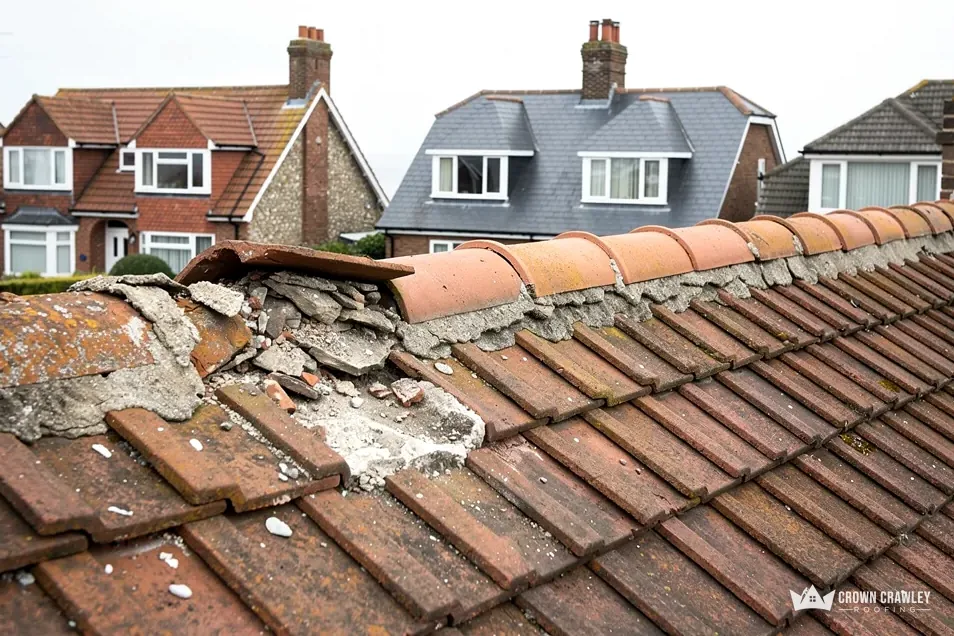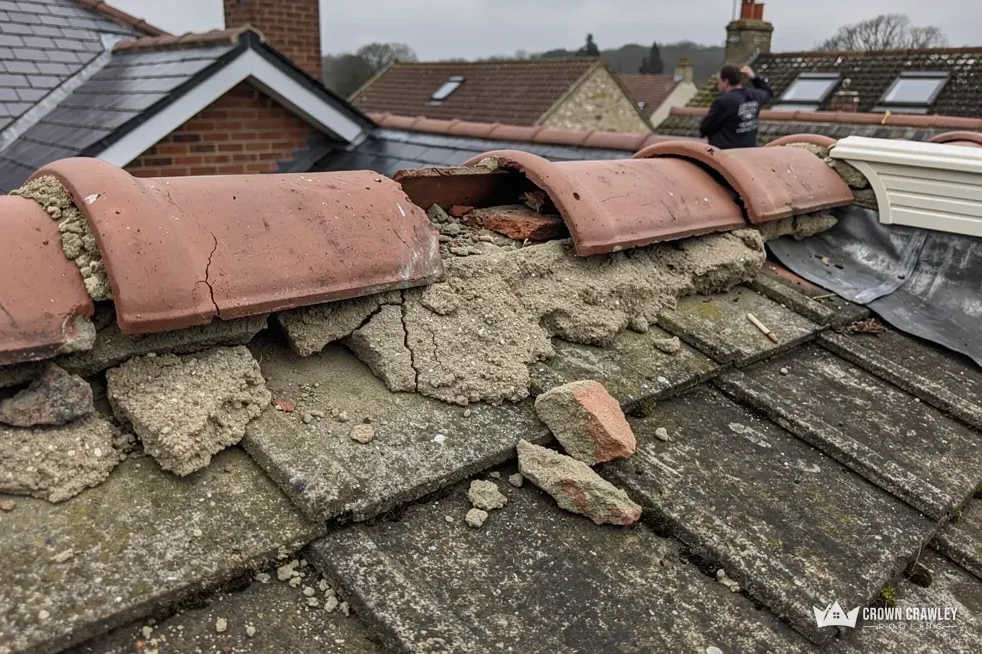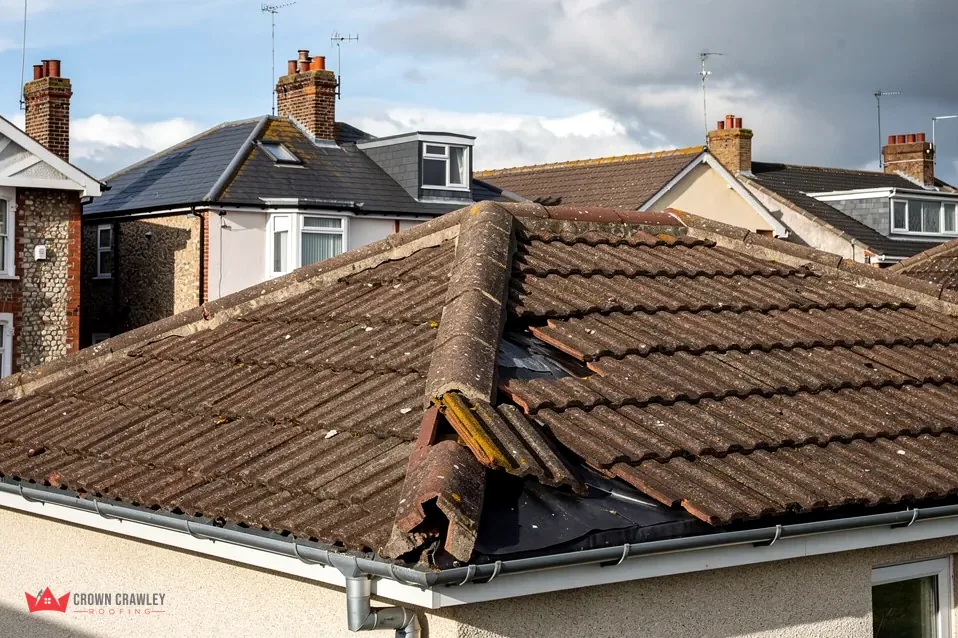
Look up at a tiled roof and your eye goes to the crest first. The ridge is where one slope rises to meet the next, and a row of purpose-made tiles caps it so rain runs off over the join. Hips, the sloping lines that run down the external angles of a hipped roof, get the same treatment. Those capping tiles are not all the same shape. Some are rounded like a half pipe, some are folded to a peak like a tent, and a few other profiles sit between the two.
The shape matters for three reasons. It alters the view from the road, it has to suit the tiles on the slopes below, and it decides what fixings and ventilation parts are available. If you are repairing a stretch of ridge, or being quoted for a new one, you will hear the profile named. This guide explains what each type is, where it tends to belong, how a roofer matches a new ridge to an old roof, and how the choice between dry and wet fixing affects it. It ends with answers to the questions people ask when a ridge tile has already come down.
What ridge and hip tiles actually do
A ridge tile is a cap. The slopes either side of the ridge are covered with ordinary tiles whose top edges stop just short of the peak, which leaves a gap along the join. The ridge tiles sit over that gap, overlap one another end to end, and keep the weather out. Mortar-bedded or dry-fixed, the cap does the same basic job. They also have to stay put in a gale, because they stand higher than anything else on the roof and take the full force of the wind.
How is a hip different from a ridge?
A ridge runs level. A hip slopes down from the ridge to the eaves, following the external corner where two slopes of a hipped roof join. Hip tiles are usually the same profile as the ridge, so the roof reads as one continuous cap. At the foot of a hip, a hip iron or a similar fixing stops the lowest tile creeping down the slope, and at the top the hip meets the ridge in a detail that needs careful cutting.
Why does the profile matter?
Each profile spreads the load and sheds water in its own way, and each one needs the right accessories: end pieces, ridge vents, hip starters and the clips or brackets that hold the run in place. Two tiles that look similar from the ground can have different widths, lengths and overlaps, so a repair cannot always borrow a tile from another range. Our guide to what a dry ridge system is shows how those fixings fit together under the cap.
Half-round ridge tiles
The half-round ridge is the profile many people picture. Seen from the end, it is a smooth arch, rather like a pipe cut lengthways. It has been made in clay and in concrete for a long time, and a rounded cap suits many roofs because it has no hard edges to collect rain or catch the light in a harsh way.
Where does a half-round ridge belong?
It is common on roofs covered with plain tiles, pantiles and many concrete tiles, and it sits easily on both traditional and newer houses. The rounded arch also reads well on a pitched roof seen from a distance, since the curve softens the line against the sky. On a hipped roof the same arch runs down each hip, and a rounded end piece finishes the lowest tile.
What are its weak points?
Rounded tiles meet one another at a joint, and a wet-bedded joint is a place where mortar can crack and fall away. A rounded tile also gives less natural grip to a mortar bed than a flat face would, which is one reason the older bedded method needs regular checking. When the ridge is fixed dry, the tiles are held with clips or screws instead, and the joint between each pair is covered by the overlap rather than relying on mortar to seal it.
Ridge tiles come in set lengths, so the roofer measures the run, works out how many tiles are needed and plans the cut at the gable end. If the ridge ends at a verge, the last tile is usually a special end piece that closes the open end of the arch.
Angled ridge tiles
An angled ridge tile is folded to a point, with two flat faces meeting at a crisp apex. From the end it looks like an upturned V. Some people call it an apex or hogsback ridge, though the names vary between makers, so it pays to check which one a supplier means before ordering.
Where does an angled ridge belong?
Angled ridges are widely used with flat-profile tiles, slates and fibre cement slates, where a sharp, straight cap matches the clean lines of the slopes. They give a more modern, tailored look than the rounded arch. Many clay and concrete ranges offer both profiles in the same colour, which lets a homeowner choose purely on appearance.
How does the angle fit the pitch?
Because an angled tile is a fixed shape, the angle between its two faces has to suit the roof. If the faces are wider apart than the slopes, the tile sits on its edges and leaves a gap underneath. If they are closer together, the tile sits on the ridge and splays at the bottom. Makers therefore offer angled tiles for different pitch ranges, and the product data sheet states which range each one suits. A roofer who measures the pitch before ordering avoids a visible gap or a tile that rocks.
Angled ridges also have flat faces, so they are easier to fix with a mechanical clip or a screw through the face, and the flat surface gives a dry-fix system a stable place to bear. That is one reason new-build estates often use them with dry systems, a point we return to in the section on fixing methods further down.
Third-round, bonnet and other profiles
Half-round and angled are the two names you will hear most, but tile makers list further shapes, and the one on your roof may be neither. Knowing the other names helps when a quote mentions one you do not recognise.
Third-round and shallower arches
A third-round ridge is a shallower arch than a half-round. It sits lower, looks flatter against the sky and is made to cover roofs with a lower pitch, where a tall half-round would look too heavy. Where the pitch is steep, the arch has to be taller to meet the slopes, so a half-round is the better match.
Bonnet hips and ridge ends
A bonnet hip is a rounded or angled tile that finishes the bottom end of a hip, usually with a closed, hooded shape that stops water running out of the open end of the arch. Ridge ends, apex pieces and gable end tiles do a similar job at the ends of a ridge. These are accessories rather than long-run tiles, and they are often the hardest part to match on an older roof.
Mono and special profiles
A mono ridge is made for a roof with a single slope that finishes against a wall, where the usual two-sided cap does not apply. Some ranges also offer decorative or finial-topped tiles for the ends of a ridge. Ask the roofer to name the profile and the maker on the quote; our dry ridge and dry verge page covers the wider range of ridge work. Our guide to matching replacement ridge tiles covers what to do when the original range is no longer made.
Matching new ridge tiles to an old roof
When a few tiles have blown off or cracked, you want the repair to blend in. On a roof that has weathered for decades, that is harder than it sounds. New tiles are cleaner and often a slightly different tone, however closely the colour code matches, and a long-discontinued range may not be made at all.
What does a roofer look for?
Start with the profile, then the maker if it is stamped on the underside, then the colour and texture. Measure the length of a tile along the run and the width across the base, because a near-match in the wrong size will not overlap the neighbours correctly. A photo of the underside of a loose tile, with a ruler beside it, is very useful when you send details to a supplier.
What if the range has gone?
Options include a reclaimed tile of the same profile, a current range that comes close, or replacing the whole run so every tile is new and uniform. Replacing the whole ridge costs more up front than patching a few tiles, but it avoids a patchwork that stands out from the road, and it lets the whole run be fixed to the current standard at the same visit. On a roof in a conservation area or on a listed building, the choice can be tied to the original look, so check with the council's planning team before changing the profile. A listed house adds a further step: changes that affect what makes a listed building special need listed building consent, and the South Downs National Park Authority treats routine upkeep and small like-for-like repairs made in place as outside that requirement.
Dry or wet fixing: does it change the choice?
Traditionally, ridge tiles were bedded on a bed of mortar and pointed along the edges. That is wet fixing. Dry fixing replaces the mortar bed with a mechanical system: a batten or ridge rail along the top, clips or brackets, and screws or nails through each tile, with a ventilated roll or strip that seals the gap underneath.
What does the standard say?
Marley's February 2026 post reads the 2014 revision of BS 5534 as a turning point: mortar's own grip cannot be the only thing holding ridge and hip caps, and bedded work needs a mechanical fix as well. BS 8612 is the standard that dry-fixed kits are tested against. Marley also states that installing to BS 5534 is not required by law. A bedded ridge can therefore still be correct, provided it is also held mechanically.
Do both profiles work with both methods?
Yes, though each maker's dry system is built around a particular range, so the tile and the fixings should come from the same maker. The roofer checks that the dry system on offer lists your profile before quoting. A mortar-bedded ridge with added clips is still a valid option on some roofs, particularly older ones where appearance matters. Our comparison of dry ridge against mortar sets out the trade-offs in a table.
Ask in writing which tile profile, which fixing method and which end pieces are included in the price, and send photos of any odd corners such as a hip meeting a gable. The survey then starts from the details you have already spotted.
Part of our Dry Ridge & Dry Verge Systems in Crawley
Ridge tile profile questions
Can I swap a half-round ridge for an angled one?
Usually it can be done, but it changes the look of the roof, and every tile, end piece and fixing in the run has to change together. On a listed building or in a conservation area, ask the council's planning team first. A half-round cap on slates, or an angled cap on pantiles, can look out of place.
Are ridge tiles the same as hip tiles?
Often the same profile, but not always the same product. A hip tile may need a bonnet end or a hip starter that a ridge does not, and hips need a fixing that stops the lowest tile sliding down the slope. Quote both together so the run matches from ridge to eaves.
How do I find out which ridge tile I have?
Look for a maker's name or number stamped on the underside of a loose tile, and measure its length and width. Photograph the end profile from the same angle as the ridge. Send those details with the street view, and the roofer can tell you whether the range is still made.