A roof covering has two jobs. It has to keep the weather out for as long as it can, and it has to look right on the house it sits on. People tend to think about the second job when they are choosing and only meet the first when something goes wrong. This page is a map rather than a verdict.
We go through the coverings a British house can carry: concrete and clay tiles, natural slate, flat membranes and metal. For each one we say what it is, what shapes its life, what the roof underneath has to be like and which of our service pages deals with it. We do not name a winner, because the right covering depends on the pitch of your roof, the strength of its timbers, where the house stands and what you can spend. Read it before the survey and the conversation at the kitchen table gets much easier. If you would rather see everything we do in one place, the homepage lists every service, and our guide to roof work costs covers the money side.
Start with pitch and weight, not colour
Every covering has a lowest pitch it will work at. Pitch is the angle of the slope, measured in degrees, and it decides what water does when it lands on a tile. Too shallow, and wind-driven rain gets under the laps instead of running off. So the first question for any new roof is not which look you like but which coverings your slope will accept.
What do the data sheets say?
Each tile comes with a lowest safe pitch on its data sheet. Marley's table runs from 15 degrees for some of its concrete profiles and one clay pantile, up to 40 degrees for its Canterbury clay tile, with its plain concrete tile at 35 degrees. Natural slate sits lower on the scale: BS 5534 indicates a minimum of 20 degrees, and the supplier we read advises against slate hooks on anything shallower than 25 degrees. Always check the exact tile, because two profiles that look alike can differ by many degrees.
Does the roof underneath matter as much as the covering?
It matters more than the tile does. Tiles hang from battens, slim timber laths fixed over the rafters, and the rafters carry everything. The Planning Portal lists a heavier covering as a trigger for Building Regulations approval, meaning a new covering at least 15 per cent heavier than the old one. It also suggests a structural check beforehand. So we look at the timbers during the survey, you get photos of whatever we find and we say plainly which coverings the roof can carry. Our roof replacement service works that way from the first visit.
Concrete tiles and how long they last
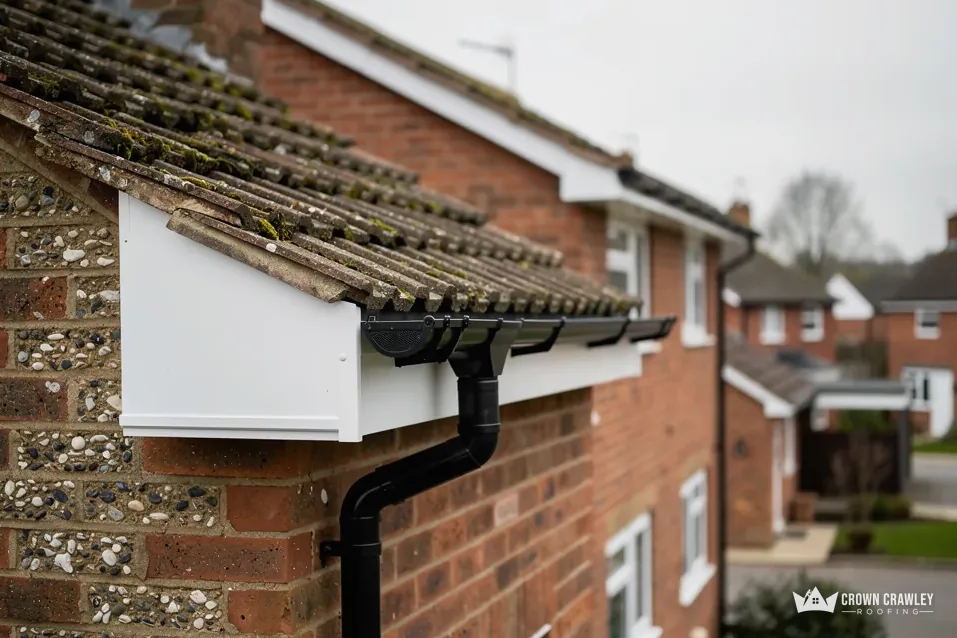
Concrete interlocking tiles are still made in a wide range of profiles, which makes them straightforward to repair and to replace in full. Each tile is large, so a roof goes on quickly, and each one hooks over a batten by its nibs, the small lugs on the back. That is also why a single slipped tile is a quick fix. Our answer on replacing individual roof tiles explains how it is done.
Is sixty years realistic for concrete?
Marley quotes roughly 60 years for its concrete tiles, but says in the same breath that this is no promise of longevity. We read it the same way. Sixty years is a ceiling for a well-fitted roof in good order. What shortens a roof's life is often not the tile at all but the parts around it: underlay that has perished, battens that have rotted after a slow leak, and mortar on the ridge or verge that has cracked and let go.
What about roofs from the 1950s and 1960s?
A roof laid in the 1950s or 1960s is now old enough that the underlay and fixings deserve a proper look before anyone talks about replacing the tiles. Our post on living with 1950s and 1960s concrete tiles goes into the detail.
Where do the ridge and verge fit in?
At the summit, the ridge is where the two main slopes join. A hip runs down a sloping corner of the roof. The verge trims the roof edge over a gable wall. All three were traditionally bedded in mortar. Marley reports that since the 2014 revision of BS 5534, mechanical fixings are expected on ridge and hip tiles, because mortar by itself cannot be relied upon. That is the thinking behind dry-fix systems, covered on our dry ridge and dry verge page.
Clay tiles and natural slate
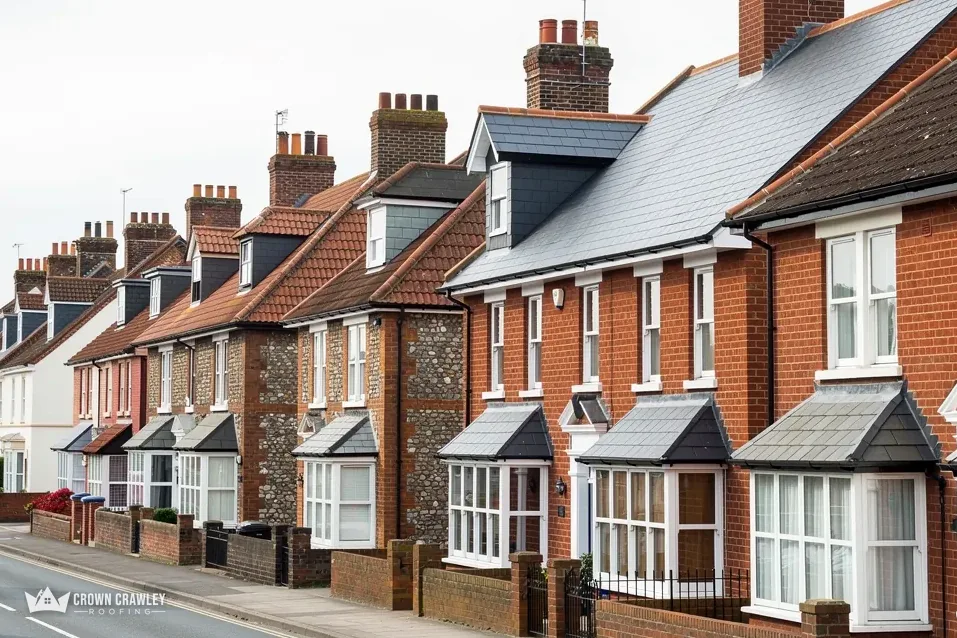
Clay and slate are the traditional British coverings, and both have a reputation for outliving the people who fitted them. The reputation is partly earned and partly marketing, so it helps to look at what is actually published.
How long do clay tiles last?
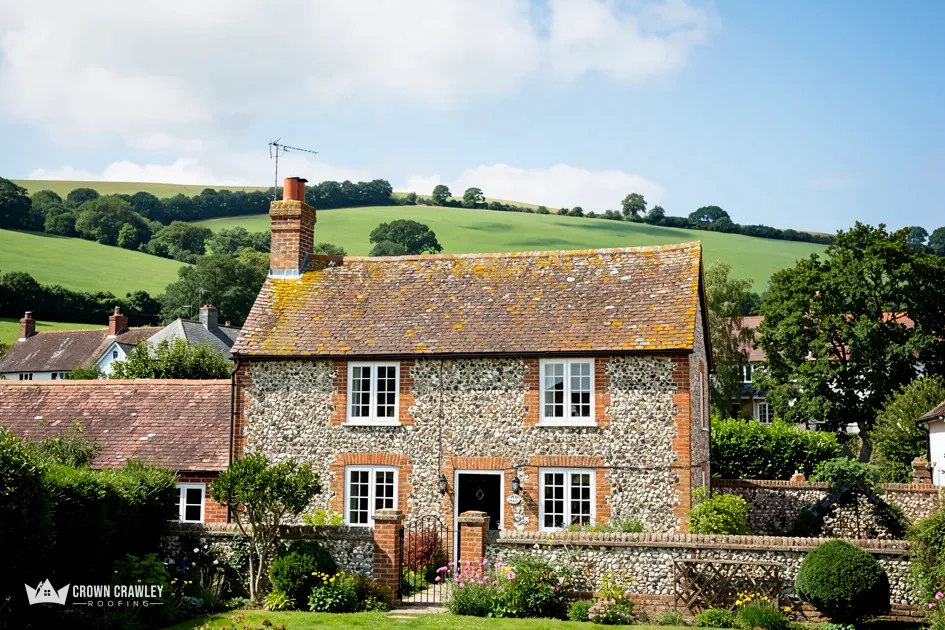
Guidance from the Building Research Establishment sets 60 years as the minimum for clay tiles. That figure is for clay only, and it is a floor, not an average. A building conservation article warns that for old peg tiles it is clearly not a reliable guide, because age, firing and frost damage vary so much from one batch to the next. A plain clay tile roof is made of small tiles, each lapping two courses below, so repairs are fiddly but very possible. We have a guide to plain clay tile roofs if yours is one.
What about natural slate?
The roofing trade body CoRC says slate can last 100 years or more with good maintenance. Notice the maintenance clause. A slate itself rarely fails; the nail holding it does. Iron rusts, the slate slips, and the usual repair is a small strip of copper or lead called a tingle. Slate comes in natural and man-made forms, and the two behave differently. Our guide to natural versus man-made slate sets out the differences.
Can I change from one to the other?
Sometimes, but pitch, weight and street appearance all play a part. Listed houses and homes in a conservation area should ask the council's planning team first, ahead of choosing a different material, because a different look can need consent that a like-for-like repair does not. Pitched coverings of every kind come under our pitched roofing service.
Flat roofs: EPDM, GRP and felt
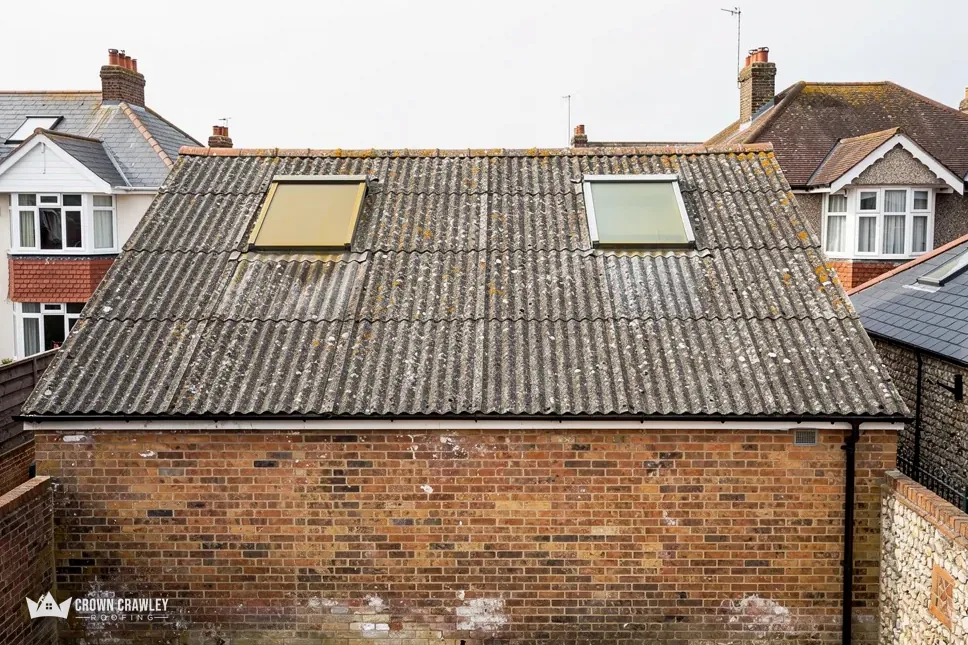
A flat roof is rarely truly flat. BS 6229:2025 applies to flat or curved roofs whose pitch is no more than 10 degrees, and it keeps a minimum finished fall of 1:80 across the main roof and any internal gutters, so water has somewhere to go. Roofs that hold puddles for days age quickly, whatever they are made of.
What are the main membranes?
Three families cover most house extensions, garages and dormers. EPDM is synthetic rubber supplied as one large sheet, laid whole and fixed at the edges. GRP is glass-reinforced plastic, better known as fibreglass, laid as resin and matting that sets into a hard, joint-free skin. Felt is bitumen sheet, usually laid in layers, and torch-on felt is the version heated into place. Each fails in its own way. EPDM tends to give up at seams and upstands, GRP can crack if the deck under it moves, and felt blisters and splits as it ages.
How long should I expect each to last?
GreenSpec expects EPDM to serve for 20 to 30 years. Less, a home improvement guide updated in March 2026, gives GRP as 25 to 40 years and felt as 10 to 20 years. Treat all three as ballpark figures rather than commitments, because the deck underneath and the quality of the edges matter as much as the sheet on top. Our post on GRP, EPDM and felt for a garage roof compares them side by side.
On a flat roof, a replacement membrane is renovation in the eyes of Approved Document L, which is why insulation can join the job. Our flat roofing service starts with a survey of the deck, the falls and the outlets before any price is given.
Metal, lead and green roofs
Metal is the covering you picture on a modern extension, but on a British house it appears in older and quieter ways too. Lead lines valleys and wraps chimneys, zinc covers dormers and curved roofs, and sheet metal is common on commercial buildings.
Is lead a roof covering or a detail?
Both. Houses usually meet lead as flashing, the strip that weatherproofs the junction where a roof meets a wall, a chimney or a roof window. It is sold in numbered codes by weight, and the lighter codes suit soakers and flashings while heavier ones are used for gutters and flat areas. A September 2026 costs page reckons well-fitted flashing can outlast 80 years. A full lead roof is a specialist job, and we cover it under lead work.
What about zinc and other sheet metals?
VM Zinc points to the Building Research Establishment's Environmental Product Declaration, which states 100 years for zinc. As with every figure on this page, that is the published life of the material in good conditions. Seams, fixings and the deck decide how much of it you see in practice. If you are weighing zinc against a tiled roof, bring the question to the survey. A metal roof also behaves differently in rain and sun, and our post asking whether you can paint a metal roof shows how much upkeep one can need.
What should I know about green roofs?
A green roof is a planted layer on top of a waterproof flat-roof build-up. It adds weight, so the structure has to be checked first, and it still needs a sound membrane underneath, because a leak under a living roof is hard to trace. It suits the right building. It is not a general upgrade.
Matching the covering to the house and the budget
Once the pitch, the structure and the planning position are settled, the choice narrows quickly. What remains is mostly appearance, upkeep and cost over time. The covering usually moves the price of a new roof a long way, but access, the size of the roof and whatever the survey uncovers beneath the old covering move the total as well.
How much do different coverings cost?
HomeBuilding's guide, last updated on 30 September 2025, gives typical UK ranges that show the spread: £6,500 to £10,000 for a small terrace with Roman tiles, £12,000 to £18,000 for a detached house in clay, and £18,000 to £25,000 for a detached house in Welsh slate. The figures are national, from a published guide, and are not Crown prices. Your roof's size, shape and access change them, and the survey leads to one written total, not a rate per square metre.
What should I ask at the survey?
Ask what the roof can carry, what the old covering is hiding, and whether the data sheet allows your pitch. Ask whether you need new battens, new underlay and new ridge fixings, or whether some of it can stay. Ask who arranges the scaffold and, if it stands on the pavement, who arranges the licence from the highway authority. And ask whether the quote includes VAT. Our post on choosing materials for a replacement roof gives a fuller checklist, our look at which roofing material lasts the longest goes further on lifespans, and the roof regulations guide covers the rules.
Whatever you choose, send us the address and a few photos from the ground. We will come back with what we would check first on that kind of roof.
Part of Roofers in Crawley: the full guide
Choosing a covering: your questions
Can I put slate on a house that has concrete tiles?
Often, yes, but it is a redesign rather than a swap. Slate needs a pitch of at least 20 degrees under BS 5534, different battens and fixings, and the new covering has to suit the rafters. We check all of that at the survey and show you photos before any price is agreed.
Does a long-lasting covering mean a long warranty?
No. A published lifespan describes how long a material can last in good conditions, while a warranty is a written promise from whoever fitted and supplied it. Marley is explicit that its 60-year figure for concrete tiles is not a warranty. When you compare roofers, ask for any cover in writing and read what it includes.
Can I swap material without asking anyone?
Like-for-like replacement is normally not development, but on a house even a visible change of material is normally covered by the general right for roof alterations, though flats, listed buildings and Article 4 areas differ. Building Regulations can apply too. Check with the council's planning team and your building control body before you order anything.