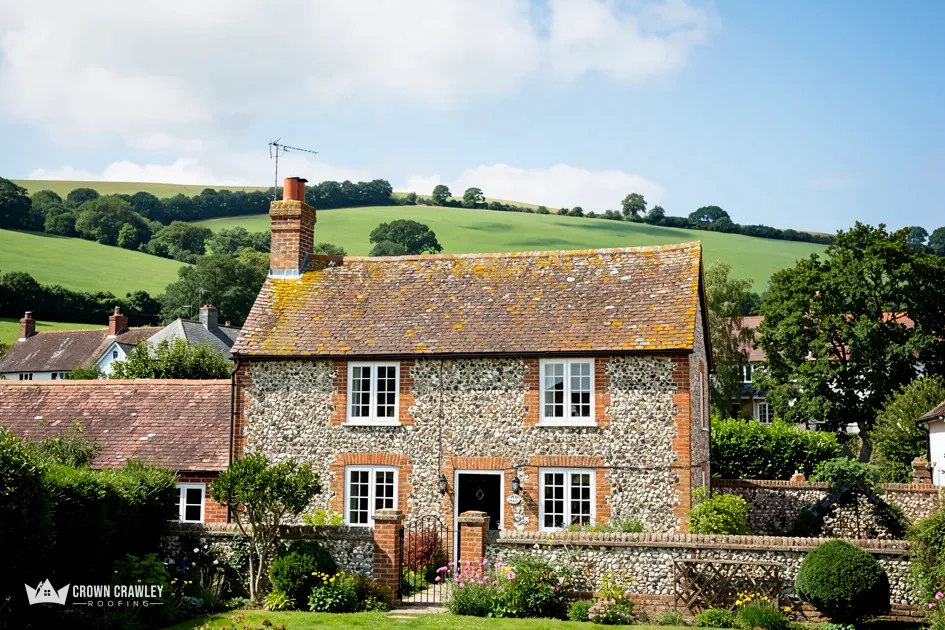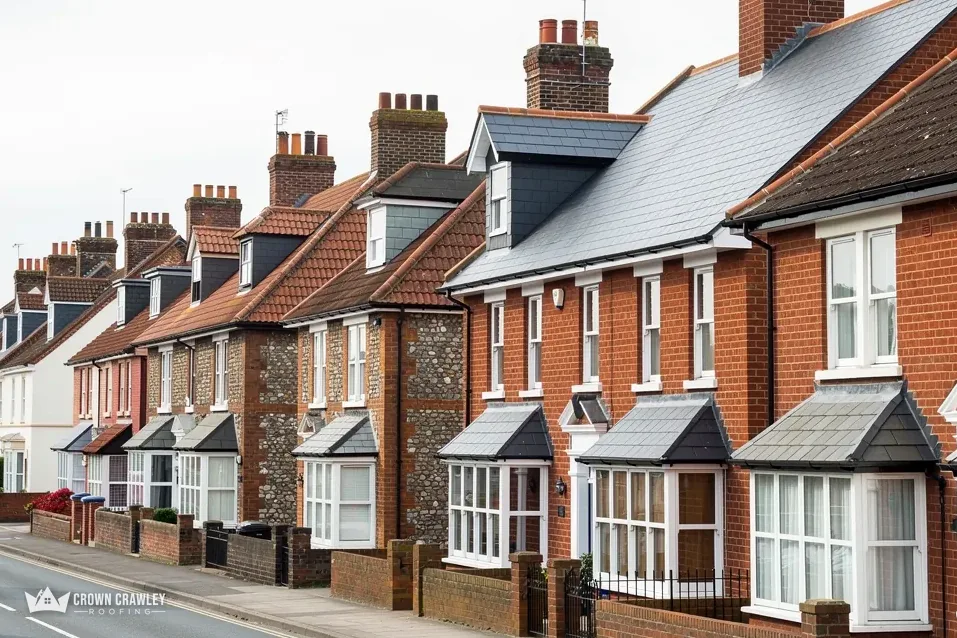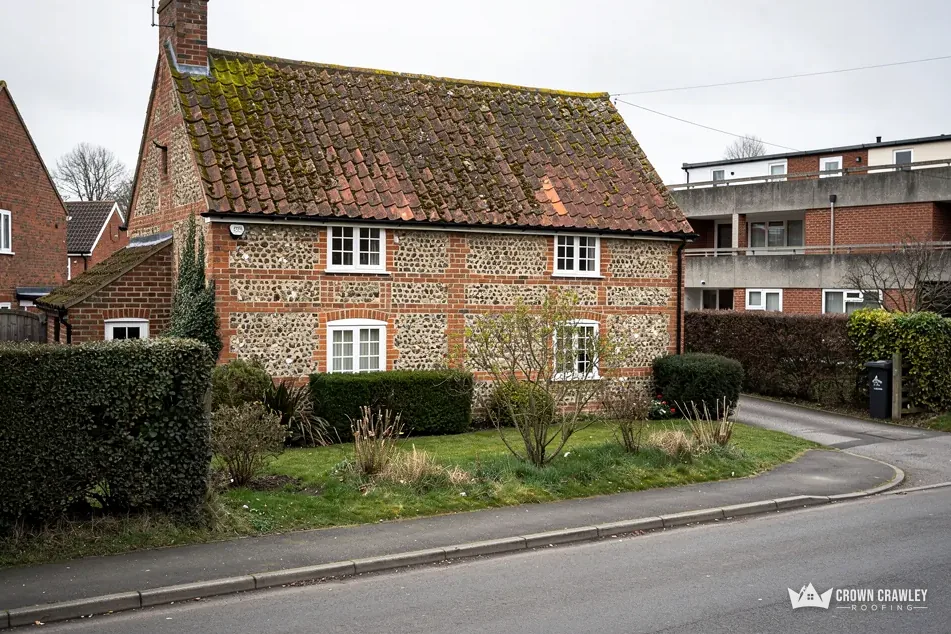
It is easy to treat Crawley as a place you pass through on the way to somewhere else. Stay a morning and it turns out to have more going on than the road signs suggest: big public parks, a mill pond with a long history, a High Street older than the town built around it, and churches that were standing well before the first new-town house went up in the late 1940s.
We are a Crawley roofing contractor, so we cannot walk past a building without reading its roof. This guide covers the places we would take a friend, in an order that makes a sensible day, and says what to notice on the way: why a bandstand roof looks the way it does, what makes a church roof steep, and how the tiled roofs of the 1950s estates differ from the older houses near the green. Everything about the places comes from Crawley Borough Council's own pages or from the Victoria County History. Opening times and prices change, so check the council or venue before you set out.
Tilgate Park and the estate beside it
Crawley Borough Council describes Tilgate Park as having lakes, lawns, gardens and woodland, with bridleways for long, unhurried walks, and as a Green Flag award winner. It also names Tilgate Nature Centre among the park's attractions. A separate council page says the park holds a zoo with more than 75 species, and that 2026 marks 60 years since an overgrown estate began its transformation into the leisure park it is today.
What is the history behind it?
The Victoria County History records the 72-acre park being transferred to the urban district council around 1964, and an army camp there housing building workers from 1950 to 1957. Those were the people putting up the new town. Roads and sewers for the Tilgate neighbourhood were laid in 1955 and its houses were built between 1956 and 1958.
What do the roofs tell you?
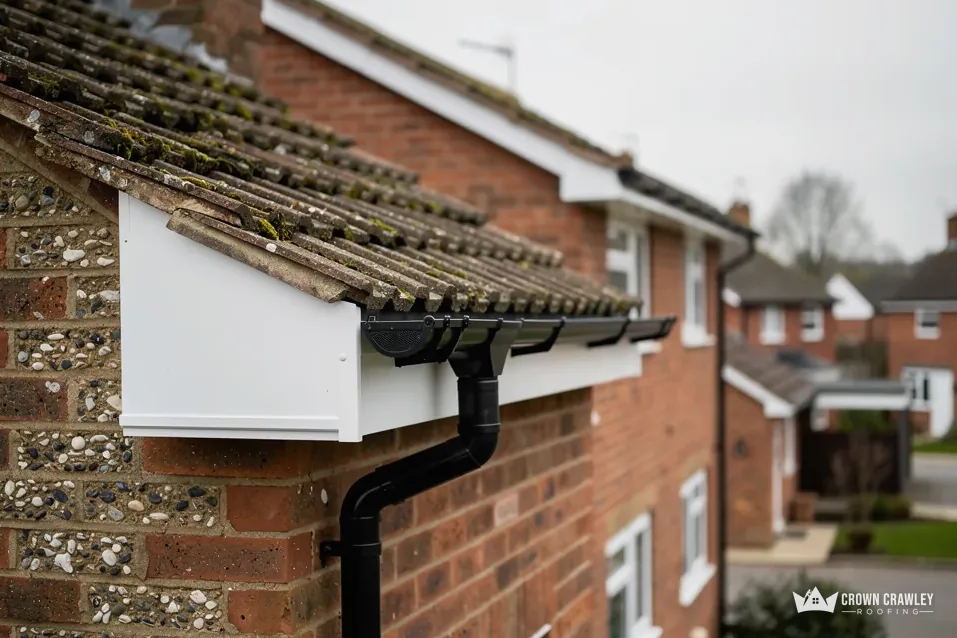
Walk out of the park into the streets of the neighbourhood and you are among houses of exactly that age. In the Victoria County History's words, the new-town housing of this period came as pale red brick terraces and semis, some rendered or clad, under pitched tile roofs. Look along a terrace at the ridge line, the line of the ridge, the tiles along each gable end (roofers call that edge the verge) and the guttering. Houses of this era are now old enough to be worth a roofer's attention, which is why we wrote a post on Crawley new town roofs and concrete tiles. Our Tilgate page has more on the neighbourhood.
Goffs Park and its Victorian bandstand
The council's park listing describes Goffs Park as set in over 20 hectares of woodland, lawns and conservation habitats, with a Green Flag award. It is the sort of park where you can do a loop in half an hour or stay all afternoon with a flask.
What is in the nearby Memorial Gardens?
The same council page lists the Memorial Gardens, with mature trees, shrubs and flowers, a Victorian bandstand and an unsupervised play area. A bandstand is a lovely example of a small roof doing a hard job. It is open to the weather on every side, so the covering has to shed water from all directions, and the joint where the roof meets its supporting posts is the point where trouble usually starts. Whoever looks after a roof like that watches the flashings and the fixings first.
Why does a park roof matter to you?
Because the same few details decide how long any roof lasts. Where two surfaces meet, water finds a way in, and it is the junction, not the middle of a roof, that fails first. That is why a roofer's survey spends so long at chimneys, valleys and wall abutments. Those are details you can check on your own house while standing on the ground, binoculars in hand if you own a pair.
If you are walking from Goffs Park towards the west of the town, you will pass through neighbourhoods built on a different timetable, which makes a comparison between streets easy. The council lists Bewbush Water Gardens, an area of semi-formal ponds and natural planting, alongside Ifield Mill Pond.
Ifield Mill Pond and St Margaret's church
Crawley Borough Council's page describes Ifield Mill Pond as made up of northern and southern ponds. The Victoria County History says the pond was made by holding back Ifield brook upstream of the village, and that it was once a hammer pond, the name for a pond made to drive an ironworks hammer. It is a pleasant place to stand and watch the water, and the old village sits close by.
Why is the church roof so steep?
St Margaret's, Ifield's parish church, has a Grade I listing, and the Victoria County History points out the unusually high, steep pitch of its medieval crown-post nave roof. A steep pitch sheds rain and snow quickly, which was a real advantage when coverings were handmade and not especially watertight. A crown post is a short vertical timber standing on a beam and supporting the central purlin, the long horizontal timber that carries the rafters.
Who looks after a roof like that?
The rules for historic churches are different from the rules for a house. Listed building consent is not the route for a Church of England parish church in regular use; its own faculty process takes its place. That is the ecclesiastical exemption, and it covers only certain denominations. If you look after any listed building, ask Crawley Borough Council's planning team what is needed before work starts. Planning permission can still apply to development that alters what a listed place of worship looks like from outside.
The Ifield area also contains older houses, among them Meeting House Cottage in Langley Lane, which the Victoria County History dates to about 1475 and calls a timber-framed open-hall house. Our Ifield page says more about roofs in the old village.
Crawley High Street and West Green
The High Street is where the old town meets the new one. A green here was already known as West Green by 1532, the Victoria County History reports, and numbers 60 and 62 Ifield Road are a late-16th-century timber-framed house. West Green is also where the new town began: building was under way by 1949 and the neighbourhood was judged largely complete in 1954.
How do you read a mixed street?
Stand at one end and look along the roofline. A street that has grown over four centuries shows its history in the heights of its ridges, the angles of its pitches and the materials on its slopes. Timber-framed buildings of the 16th century carried steep roofs. Late-Victorian houses in the West Park area were built in red brick and tiles, according to the Victoria County History. Then come the post-war houses, with their simpler tiled roofs. Each generation expected a roof to behave differently, and each is repaired differently.
What should owners of older buildings remember?
Ask before you change anything. A listed building, or one inside a conservation area, can carry stricter rules for even small external changes than a modern house does. Like-for-like repairs that leave the outside looking the same are not normally development, though a listed building may still need consent where the work touches its character. Talk to the council's planning team first, and keep photos of what the roof looked like beforehand. Our guide on whether you need planning permission for roof work explains the general rules.
Old churches and houses beyond the centre
Crawley's churches are not all medieval. At Three Bridges, St Richard's was rebuilt in Gales Drive, opening in 1954, according to the Victoria County History. It is built of yellow brick, with a nave and a lantern at the east end. A lantern is a raised glazed or louvred turret that lets light into the roof space, and it is a detail that demands careful flashing where it meets the main roof.
Is there a mansion worth a detour?
Broadfield Park is managed as a nature reserve, and the council says it is set in the grounds of Broadfield House, a Grade II listed building dating back to 1830. Any house of that age is worth a look from the path, for the shape of its roof and the chimneys standing on it.
Which place suits which kind of day?
For a morning with children, Tilgate Park has the lakes and the zoo. For a gentler walk, the Mill Pond and the old village of Ifield suit a long lunch. For architecture, start with St Margaret's, then move to the High Street and finish at the Gales Drive church to see the difference between a medieval roof and a 1954 one. If you are planning a day around several of these, the full list of parks is on the council's parks and gardens page.
One practical point. Everything above is best seen from the ground, and a good pair of binoculars turns a pavement into a viewing platform. Please do not climb onto a roof or lean a ladder on anyone's building to get a better view. Binoculars do the job.
Looking up on your own street
A day spent noticing roofs makes you better at spotting problems on your own. After a walk through Crawley's parks and neighbourhoods, try the same exercise outside your front door, in daylight and with a dry pavement under your feet.
What can you check from the pavement?
Look for single tiles that have dropped below the line, a patch where one is missing, a ridge that sags, crumbling mortar at the gable edge, and gutters that overflow or droop. Check the fascia boards below the roof edge for staining, and the downpipes for staining on the wall behind them. All of this is visible from the ground. The point is not to diagnose anything, only to notice what has changed since last autumn.
When is it time to ask a roofer?
When you see daylight in the loft, water on a ceiling, or something that has moved. A survey looks at the roof close up, and afterwards we show you photos of your own roof. One total written price follows the survey. The importance of regular roof inspections explains how often a look makes sense.
If you came for the parks and left with a stained ceiling on your mind, it is not a strange outcome, and a good surveyor will say so without any drama. Whatever you find, take dated photos and keep them. And if you want a hand reading your roof, you can start at our Crawley roofing homepage and send us a few pictures.
Part of Roofers in Crawley: the full guide
More about visiting Crawley
Is Tilgate Park free to enter?
Admission and parking arrangements change, and the zoo and other attractions have their own terms and prices. Check Crawley Borough Council's Tilgate Park pages before you travel, especially for zoo tickets, parking and seasonal events such as the Sunday car boot sales. If you are bringing a dog, the same pages explain where dogs are allowed.
Can you go inside St Margaret's church in Ifield?
Opening depends on the parish and on services, so we cannot promise a time. It is still a working parish church. If the door is shut, the outside of the building still shows you the steep roof, and the parish can tell you when a visit is welcome.
Who maintains the roofs of historic buildings in the town?
The owner does. That might be a council, a parish, a trust or a private household, and the consent route depends on the building. A working Church of England church uses a faculty. Other listed buildings need listed building consent where work changes their character. The council's planning team can advise, and the building's own custodians will know the history of past repairs.