A roof does not fail all at once. It gives notice, usually in small ways: a tile on the lawn after a gale, a brown ring on the landing ceiling, a patch of light in the loft that should be dark. Each sign on its own may be a repair. The question that matters is how many you can see, how widely they are spread and whether the same faults keep coming back after they are fixed.
This guide sorts the signs by where you can see them: from the garden, from the loft and from inside the house. For each one it says what is usually going on underneath and where a repair stops being sensible. This version takes over from an earlier article on this site that relied on one average lifespan and some American phrasing. Lifespans vary a great deal by covering, and the sensible test is the condition of your own roof, which a survey with photographs of the actual timbers and tiles can settle in one visit.
Start with age, but read it against the covering
Age is the first clue and the least reliable on its own. A felt flat roof at 15 is near the end of its range, while a natural slate roof at 80 may be barely halfway through. The same number of years means very different things on each. So ask first what the covering is, and when it was last laid, then set that against the typical lives published for each material.
- Torch-on felt: 10 to 20 years, according to Less in March 2026.
- EPDM rubber: 20 to 30 years, according to GreenSpec.
- GRP: 25 to 40 years, again from Less.
- Concrete tiles: around 60 years in Marley's description, which it says is not a guarantee.
- Clay tiles: at least 60 years, going by the Building Research Establishment, for clay alone.
- Natural slate: 100 or more years if it is well maintained.
How old is old enough to worry?
When a roof is in the last third of its typical range, small faults start to cluster and you should look more carefully. That is a prompt to inspect, not a verdict. Plenty of roofs outlast the published figure, and plenty fail early where the batten or underlay was poor. If you moved in lately and know nothing of the roof's history, a survey will tell you how much working life remains. Crawley's neighbourhoods went up in phases from 1947, so roofs on neighbouring streets can differ in age by decades and in the covering laid.
Clues visible from the lawn
Stand back across the road or at the bottom of the garden and look along the line of each slope. A healthy roof reads as straight lines. Trouble shows as a break in them.
Which shapes and gaps matter?
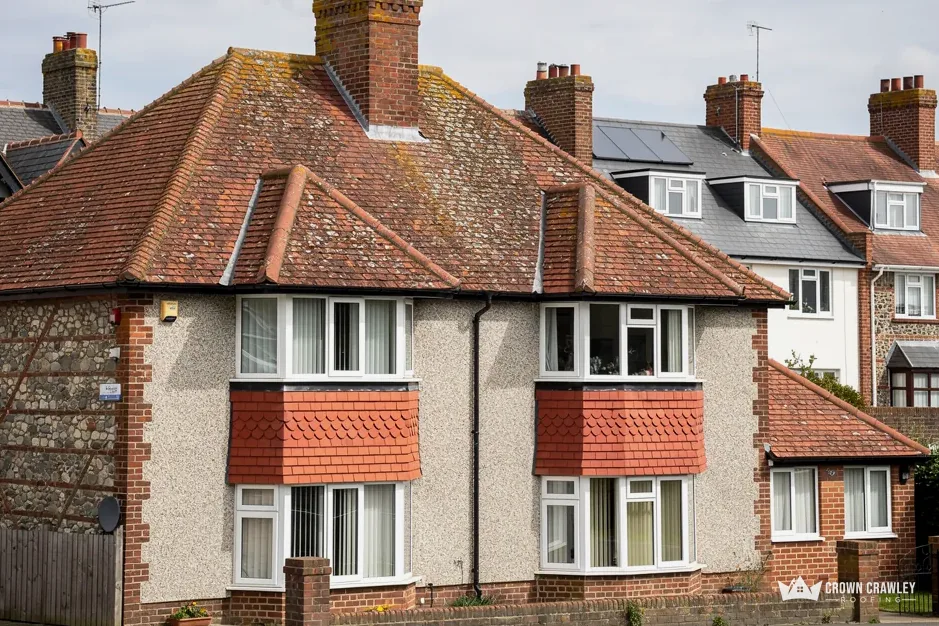
A ridge that dips in the middle, or a slope that looks dished or wavy, points to something moving in the frame. That is the sign to take most seriously, because tiles can be replaced in an afternoon but a weakened rafter cannot. Gaps in the courses of tiles, or a run of tiles sitting lower than their neighbours, suggest the battens or their fixings are giving way. Slates that have slid down show up as dark slivers where there should be overlap, a pattern known as nail sickness when the nails have rusted through.
Is moss a sign of replacement?
Moss alone is not. It holds moisture against tiles and can block gutters, but a mossy roof with sound tiles and sound battens can be cleaned and kept. What moss can do is mask the real signs, so a clean-up often reveals more. How the cleaning is done matters. Marley advises against powerful jet washes, because they can wear away the glaze or grit of the covering and cut its useful life a good deal.
What about the chimney and the edges?
Crumbling mortar at the verge, loose ridge tiles and failed flashing at the chimney are repairs in themselves. They become a replacement argument only when they appear together with the signs above. Our page on when roof battens need replacing explains the point at which a pattern of slipped tiles stops being a tile problem.
What the loft tells you
The loft shows the side of the roof that the weather cannot reach, and judging a covering that may be finished starts there. Go up on a bright day and switch the light off. You are looking for three things: light, damp and movement.
What does daylight mean?
Pinpricks of light between tiles are a warning, but a few can be ordinary gaps that overlap above. Broad strips of light, light around the chimney or light along the ridge suggest displaced tiles or a failed junction. Torch beams showing through the felt itself are a different matter, because holes in underlay mean the roof has lost its second line of defence.
What do dark patches and soft timber say?
Stains on the battens and rafters, and wet or dark insulation beneath them, show where water has been getting in, sometimes for a long time. Push a screwdriver gently into a stained batten: if it sinks in, the timber has lost its strength. Where staining runs across a whole slope, the repair is the slope. A white furry growth or a musty smell can also point to condensation from poor ventilation rather than a leak. Marley's reading of BS 5250 puts a continuous 25mm eaves gap on pitches of 15° or less with non-breathable underlay, and 10mm on steeper roofs, so look at whether insulation has been stuffed into that gap.
Is any of this safe to check yourself?
From the loft hatch, with a torch, yes. Do not step off the joists and never go out onto the roof.
Signs inside the house
Rooms under the roof give their own warnings, though they are the hardest to read. Water wanders. By the time it shows itself it may have tracked sideways along timber for a metre or more, so the mark on a ceiling seldom sits right under the hole.
Which marks are worth acting on?
Brown rings that spread after rain, paint that bubbles or peels on a ceiling, damp patches near chimney breasts and mould in the corners of upstairs rooms all deserve a look. One mark that dried after a storm may be a single slipped tile. Marks that return in the same place after you have had the roof repaired suggest the repair missed the cause. Keep a note of the dates and the weather, since a pattern helps a surveyor.
Could the problem be elsewhere?
Often, yes. Blocked or leaking guttering can send water into the eaves, and condensation can look very like a leak. A good surveyor works out which it is before recommending a new roof. Where gutters and roofline are failing at the same time as the covering, replacing both in one visit saves paying twice for the scaffold. We carry out that kind of combined job under our roof replacement service.
What if the damage comes from a storm?
Ring the insurer first, and do as it asks before any permanent work is booked. A temporary cover is reasonable, with receipts kept and the damage recorded in pictures before anything is cleared away. Wear and tear is often excluded from policies, so read the wording before assuming a claim will succeed.
When repairs stop making sense
Repairing is the right call far more often than people expect, and a surveyor who recommends a new roof for one slipped tile is not helping you. The decision comes down to how widespread the faults are and how often they return.
What does a repair cost compared with a replacement?
Checkatrade's October 2026 table gives £170 to £500 for swapping as many as five tiles, the top figure including a scaffold. A new roof for a typical three-bedroom semi is around £12,000 on its guide. Those two numbers explain why repairs are attractive. They also show the danger: a roof that needs a repair every winter keeps spending money year after year, without getting any closer to being sound.
Which signs point towards replacement?
Several of these together: the same faults across more than one slope; battens that are soft or split over a large area; underlay that is torn, brittle or missing; a covering already near the top of its published range; repairs that have been repeated within a year or two; and a sagging frame. Any one of them can be fixed locally. A cluster means the roof is spending your money on a covering that cannot be saved. Our page on whether a new roof adds value looks at what you get back.
If you are on the border, ask for the survey to treat repair and replacement as two options with a written total price each.
What happens when the answer is a new roof
Deciding you need a new roof sets a process in motion, and it is calmer if you know the steps. A survey looks at every slope, the loft and the roofline. You are shown pictures taken on your own roof, and a single written total price follows. The covering is named in it, the scaffold is included or excluded in plain words and you are told whether VAT, at the 20% standard rate, is in the figure.
How long does it take, and can you stay at home?
A typical house takes days rather than weeks, with the weather deciding some of the schedule. Our page on how long a roof replacement takes sets out what drives the timescale. Most households stay at home through the work, which brings noise and some disruption but no need to move out.
Does it need approval?
It may. Nationally, the Planning Portal sets two limits for work needing no application: under 25 per cent of the building envelope and under 50 per cent of the roof. A replacement covering that is 15 per cent heavier, or more, overrides both limits. Crawley Building Control publishes a separate rule for the borough, so a full re-roof is put to them at the outset. In a conservation area or on a listed house, the council's planning team needs to hear before tiles are ordered.
To begin, give us the house's age, the covering and what you have noticed, with a few pictures from the garden or the loft hatch. We then look at whether the signs you describe stay in one slope or run across the whole roof.
Part of our Roof Replacement & New Roofs in Crawley
Signs a roof is finished
Can a roof be too old to repair?
There is no single age. A repair makes sense while the battens, underlay and frame are sound. When they are soft, torn or sagging across a slope, new tiles just sit on tired foundations. A survey of the timbers, rather than the calendar, decides whether the roof is past repair.
Is a leak always a reason to replace the roof?
No. Many leaks come from one slipped tile, a worn flashing or a blocked gutter, and all of those are repairs. A leak becomes a replacement question when it keeps returning in different places, or when the timbers under it are wet and soft. A survey separates the two.
Will insurance pay for a new roof that is worn out?
Policies commonly exclude gradual wear and tear and cover sudden damage such as a storm. Read your wording, tell the insurer before arranging permanent repairs and keep photos and receipts of every cost along the way. Complaints about an unfair outcome can go to the Financial Ombudsman Service.