People usually ask this question when the quote in front of them is large and they want to understand exactly what the money buys. It is a fair thing to ask. A covering that lasts twice as long can work out cheaper per year of service, even when the first bill is bigger. But lifespan figures are slippery. They come from manufacturers, trade bodies and cost guides, each measuring something slightly different, and none of them can see the exposure, the fixings or the workmanship on your roof.
So this post does two jobs. It lays out the typical published lifespans in one place, naming the source of each, and then it looks at what makes a roof wear out sooner than the table suggests. Treat every figure as a range, never as a promise. If you want to see how the choice plays out on a real replacement, our roof replacement page explains the process. The older version of this post leaned on American roofing; this one sticks to what is used on British houses.
Typical lifespans side by side
The table gathers the published figures we use. Read the last column before the middle one, because it tells you how much weight to give each number. A tile maker's estimate for its own product, or a retailer's for fascia boards, comes from someone with something to sell. A building research body or a conservation group has less reason to flatter. Dates matter too: a figure from 2016 deserves more scepticism than one from 2026, and the table names its sources so that you can weigh each one.
| Material | Typical life as published | Who published it |
|---|---|---|
| Natural slate | 100+ years if well maintained | Roofing trade body (CoRC) |
| Zinc sheet | 100 years | Environmental declaration, quoted by a zinc maker |
| Lead flashing | Over 80 years | MyJobQuote, September 2026 |
| Clay tile | At least 60 years | Building Research Establishment, via Marley |
| Concrete tile | Around 60 years | Marley (not a warranty) |
| GRP (fibreglass) | 25 to 40 years | Less, March 2026 |
| EPDM (rubber) | 20 to 30 years | GreenSpec |
| uPVC fascia | 20 to 40 years | A fascia retailer |
| Torch-on felt | 10 to 20 years | Less, March 2026 |
Notice how the table splits into three groups. Stone, metal and fired clay sit at the top. Anything built from layers of bitumen or rubber sits at the bottom. That does not make the long-lived materials better for every roof, because a pitched covering and a flat covering are doing different jobs on different shapes of building. A garage, an extension and a main roof may each need a different answer, and a surveyor can say which suits which.
Slate and zinc, the two that reach a century
Natural slate is the benchmark. Split from rock, it does not absorb water in any meaningful way, does not rot and does not fade, which is why a slate roof can see out several owners. Zinc gets to a similar figure by a different route, forming a protective surface layer as it weathers. Sheets are joined by seams and standing joints and are mostly seen on modern extensions, dormers and some contemporary houses, where the clean lines suit the design. One zinc manufacturer quotes an environmental product declaration, prepared with the building research body, that states 100 years.
Why do slate roofs still need work?
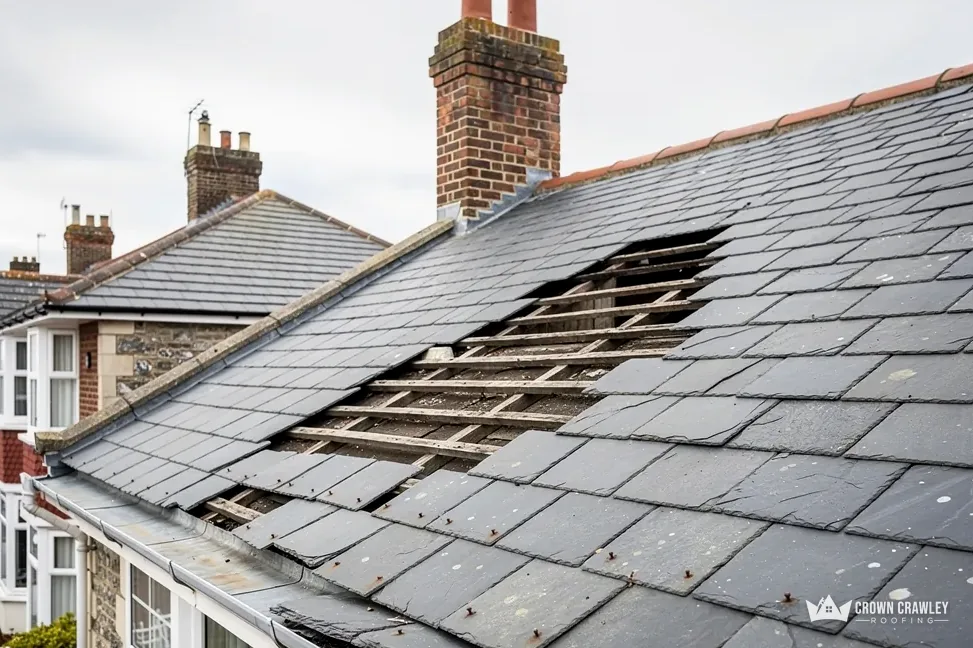
Because the stone is not the weak link. Slates are held on by nails, and the nails rust. The fault is called nail sickness, and it lets slates slide out of position one at a time on roofs whose stone is perfectly sound. A thin copper or lead strip called a tingle can hold one stray slate, but if slipping is widespread the good slates are best taken off, sorted by condition and laid again over new battens, underlay and fixings, topped up with reclaimed ones to match.
What is the catch with metal?
Cost, and the quality of the detailing. Metal is normally priced higher than tile, and it asks more of the installer: thermal movement has to be allowed for, and the sheet must be fixed so that it can shift slightly without tearing. A metal roof's life depends on the joints, the fixings and the way water is led off. A century is the material's potential, not a result you can count on from a poor installation. Our answer on metal roofing sheets for houses goes into the choices.
Clay and concrete: roughly sixty years on paper
Most British houses wear tiles, and the figure that matters most to them is 60. The Building Research Establishment publishes a minimum life expectancy of 60 years for clay tiles. Concrete tiles are put at about the same by Marley, with the maker's own remark that this figure is no warranty. Marley's page was created in September 2016, so it is worth reading as a rule of thumb rather than a measurement.
Do old handmade tiles follow the same rule?
Not reliably. A building conservation article cautions that the 60-year figure is unreliable for old peg tiles, whose clay, firing and fixing vary from batch to batch. A survey of the actual roof tells you more than a table can, because a roofer can lift a tile or two and see the clay, the nibs and the battens for themselves.
Why does the roof wear out before the tile?
Usually it is what lies under the tile, and nobody sees those layers until the roof is open. Battens rot where water has run along them for years. Old felt perishes at the eaves. Nails and clips fail, which is why a roof can have plenty of life left in the tiles and still need stripping, with the sound ones reused. Before you pay extra for a tile with a longer reputation, ask what the cost of the clay alternative would be: our guide to clay tile roof cost has the details.
Flat roofs live shorter lives
The lowest rows of the table belong to flat roofs, and there is a reason. With barely any fall to carry water away, a flat roof stays wet for longer and bakes harder in summer than a pitched one. Its waterproofing is a thin, continuous skin, and the skin is where the wear shows up.
How do the three common coverings compare?
EPDM is a rubber sheet, and GreenSpec gives it an expected service life of 20 to 30 years. GRP is a fibreglass laminate finished in resin, which Less puts at 25 to 40 years. Torch-on felt, the bitumen sheet melted onto the deck by a flame, sits at 10 to 20 years in the same source. The pattern is plain: more modern membranes tend to last longer than felt, but each has seams and edges that need good workmanship to reach the top of its range.
Does a longer life justify a higher price?
Sometimes. Checkatrade's September 2026 guides give £80 to £100 per square metre for EPDM and £50 to £80 for felt. If the felt lasts at the low end and the EPDM at the high end, the dearer membrane costs less per year of service, though neither figure is a guarantee. The comparison changes if the roof is easy to patch and the budget is tight, or if the building will be demolished or extended before the membrane reaches the end of its range. Our flat roofing page sets out the options in more depth.
Lead, fascias and the small parts
A roof's covering is only one part of its life. The metal and plastic parts around it have their own timelines, and any of them can fail first.
How long does lead last?
MyJobQuote's guide to chimney leadwork says flashing can last for over 80 years, which is why lead is chosen for the awkward corners where nothing else will do. That is potential, not certainty. Lead is also heavy and soft, so it creeps downhill on a slope if long sheets are laid without joints. Lead sheet comes in codes by thickness, and Royston's brochure shows that thinner codes suit soakers while thicker ones suit valleys and flashings. A flashing laid in the wrong code, or fixed without allowing for movement, will not reach the figure. Our page on lead work explains the codes.
What about the roofline?
One fascia retailer says uPVC boards last between 20 and 40 years. Treat that with the caution you would give any seller's figure. Boards fail early where gutters overflow onto them, where the end grain is not sealed, or where the board was cut thin to save money. Because fascias outlive neither slate nor concrete, a long-life roof often gets a new roofline halfway through its life. That is easiest when the scaffold is already up for another reason, and a gutter that overflows onto a new board will wreck it faster than any sunshine.
What shortens the life of any roof
The table assumes a sound installation and ordinary care. These are the habits and faults that pull a roof below it.
Which problems cause the earliest failures?
A slow leak is the worst, because it soaks battens and rafters long before a stain shows. Poor ventilation is the quiet cousin: Marley's reading of BS 5250 asks for a continuous eaves gap on cold roofs under old-style felt, and blocked eaves let condensation attack the timbers from below. Rusting fixings come next, particularly nails that were never meant for a damp roof space. Then comes mortar used on its own to hold ridge and hip tiles, which Marley says has not been enough since the 2014 revision of BS 5534. A tile laid below its minimum pitch is another early failure, since the maker's data sheet sets that limit for good reason.
Can cleaning hurt a roof?
Yes. Marley advises against high-powered jet washes, warning that they can scar the surface of slate or tile and cut its working life considerably. Moss removal should be gentle, and any product used should be authorised for the job and applied exactly as its label says. Home owners should not use biocides sold for professionals only, because HSE says the general public should never do so. Our guide on whether moss is damaging your roof covers the sensible approach.
None of this adds up to a promise from us or anyone else. A published lifespan is a typical range under typical conditions, and a warranty is a separate document with its own conditions. Ask any roofer what cover comes with the work, get the answer on paper, and check what it takes in.
Part of our Roof Replacement & New Roofs in Crawley
Roof lifespan queries
Is the longest-lasting material always the best buy?
No. A century-long covering is wasted if you are moving next spring, and may be unsuitable for the pitch, the structure or the planning rules. Match the covering to the roof and the budget, then ask for the maker's data sheet. Longevity matters most when you plan to stay.
Does a manufacturer's warranty tell me how long my roof will last?
No. A warranty covers defects for a stated period and comes with conditions. Lifespan is the time a material tends to serve in practice. Marley says its roughly 60-year concrete tile figure is not a warranty. Read the wording for what is covered, for how long and who pays out.
Why do two roofs of the same age wear so differently?
Exposure, workmanship and upkeep differ. A south-facing slope bakes, a shaded one stays damp, a poorly ventilated loft rots its timbers from below, and one roof may have had its gutters cleared while the other never did. A survey with photos shows how yours is really ageing.