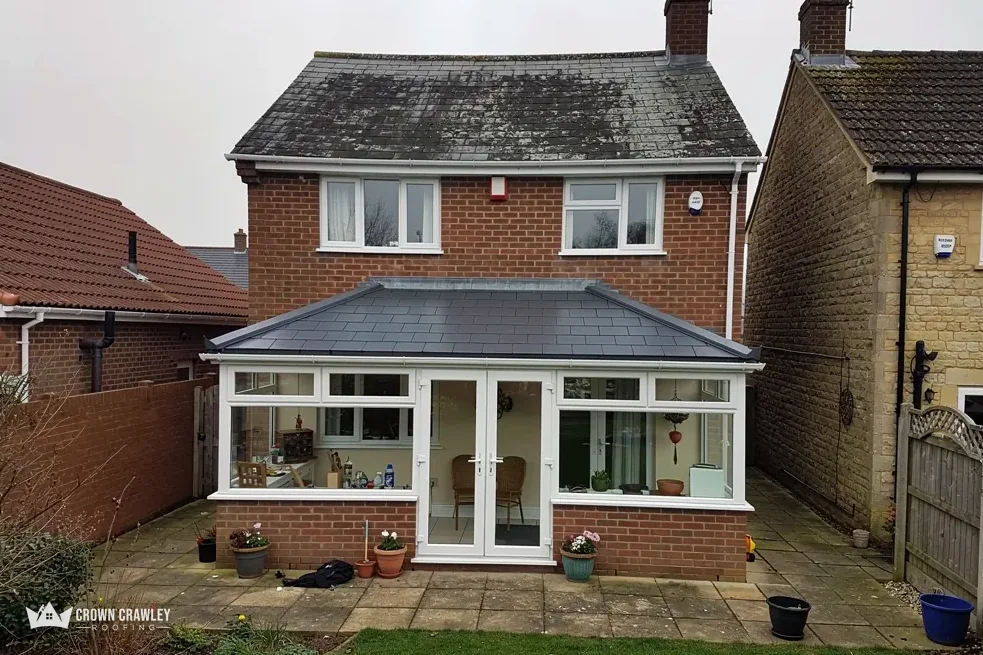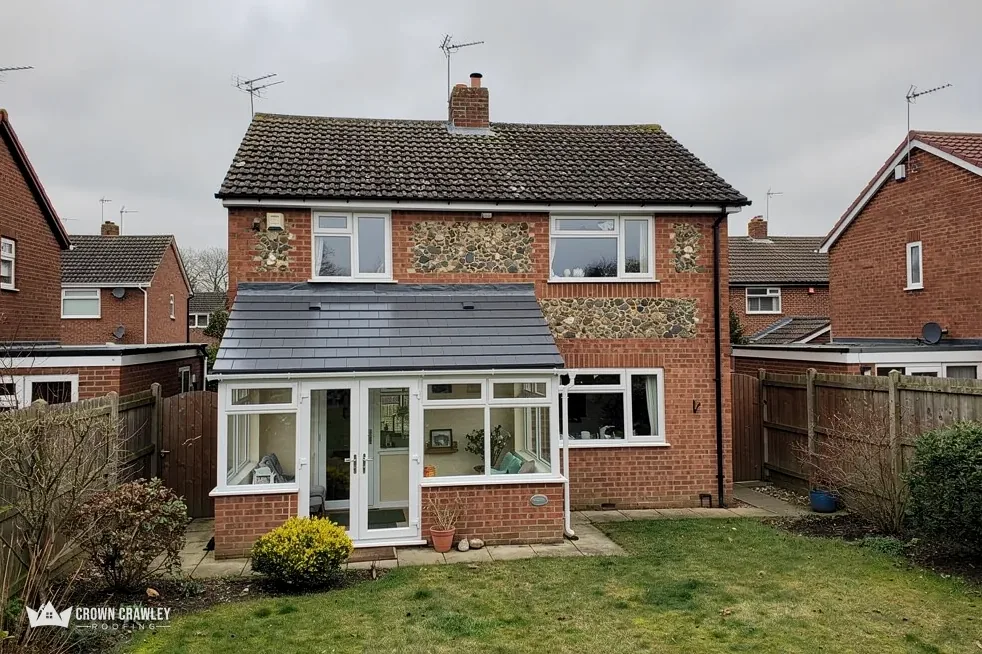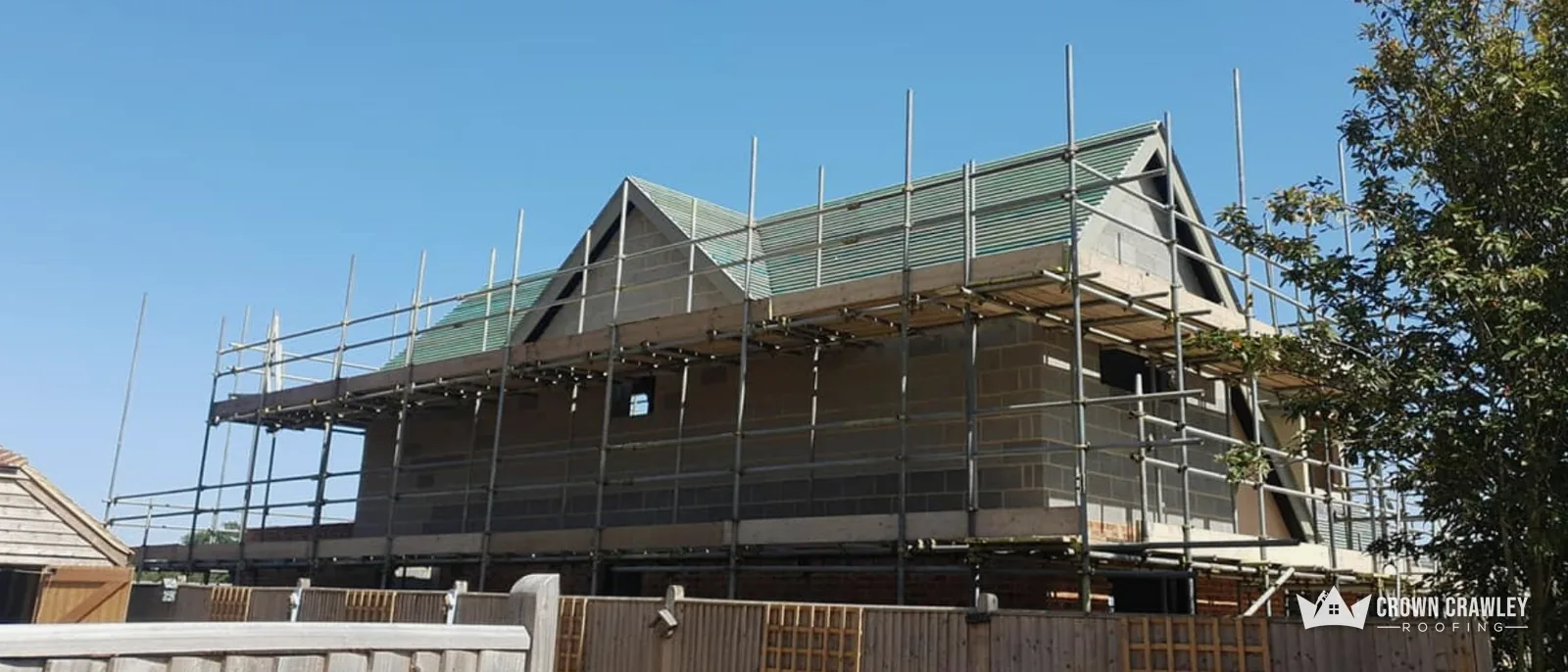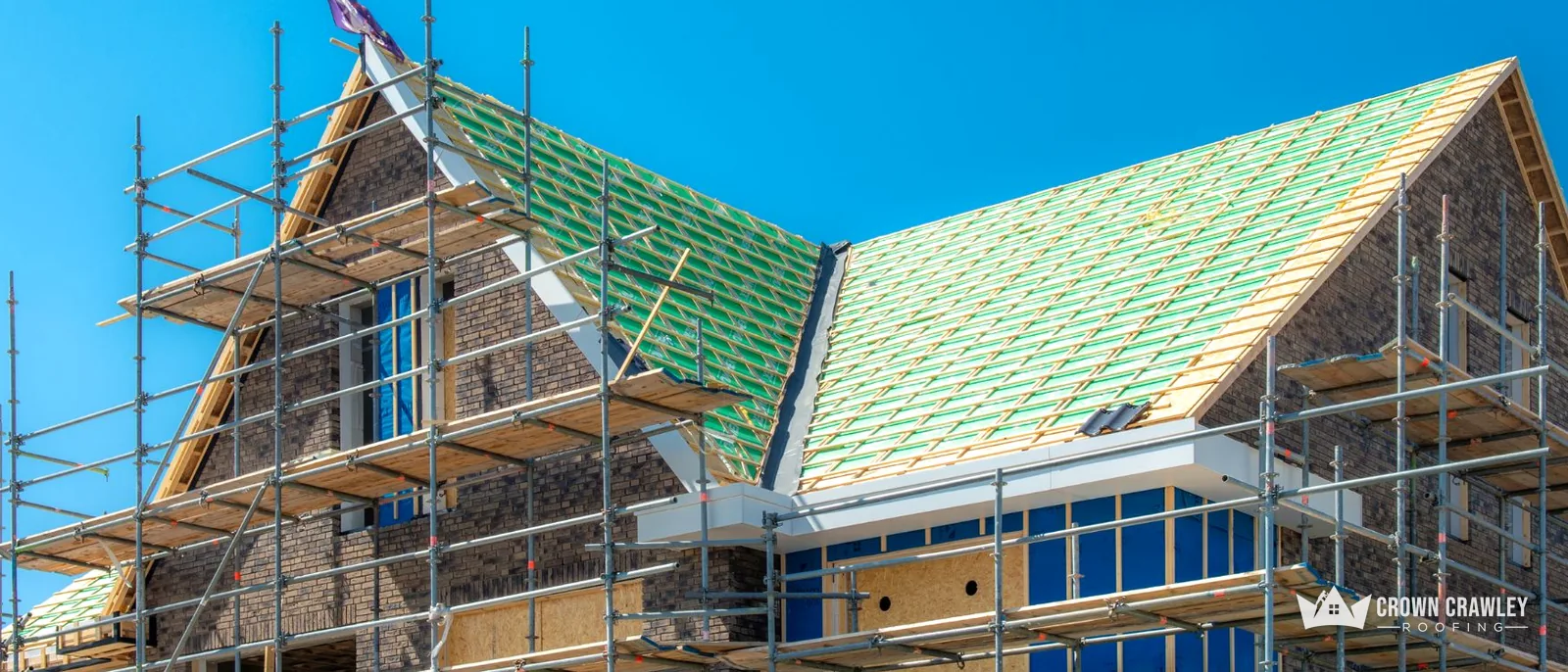
Nobody replaces a roof for fun. The usual trigger is a leak, a survey report or the fourth repair in as many winters. But once the old covering is off, the house gets a rare chance to be improved from the top down, and that is where the extra benefits come from, such as better insulation, a ventilation fix or a neater roofline. Some arrive automatically. Others only arrive if you ask for them while the roof is open, because they are far harder to add afterwards.
Below we go through what a replacement can change, in rough order of how much difference it makes: the dry, sound structure itself, the insulation, the ventilation, the way the house looks, and how buyers read the roof. We also say plainly what a new roof will not do, so you can weigh the cost with open eyes. For the practical side, from price to timing, see our roof replacement page. An earlier version of this post spoke in American terms and promised more than any roofer can deliver. This one sticks to what is true here.
A dry structure and a clean slate on repairs
The first benefit is also the least glamorous. A new roof gives you fresh battens, fresh underlay and fresh fixings under a covering with its whole working life ahead of it, which is a very different starting point from a patched one. The parts you cannot see are the ones that fail first on an old roof, so renewing them is where most of the long-term value sits. A homeowner standing in the garden sees only tiles. A roofer sees the layers that decide whether those tiles keep the house dry.
What happens to the timbers underneath?
When the tiles are stripped, every rafter is visible for the first time in decades. Any that have softened from an old leak or from condensation can be mended while they are exposed, and that is a repair you cannot do properly from inside the loft. Sound timber is then protected by a new membrane instead of a perished one.
Will it stop the repairs?
It should pause them for a long time, but it will not abolish them, and it is better to know that now than to be surprised later. Published lifespans come as ranges. Marley puts concrete tiles at about 60 years but adds that it carries no warranty, while the roofing trade body CoRC says natural slate can last 100+ years if looked after. Neither number is a promise about your house, and the survey photos show how your own roof is ageing. Gutters still fill with leaves, moss still grows on shaded slopes and flashings still deserve an occasional glance. A fresh roof restarts the repair clock without switching maintenance off.
Insulation: the upgrade the rules have a say in
For most households this is the benefit that matters, since a poorly insulated loft lets warmth leak out of the house. Re-roofing is the most economical moment to fix that, since the scaffold is already standing and the rafters are bare.
Does a new roof have to be insulated?
Often the Building Regulations say yes. In volume 1 of Approved Document L, fitting a new waterproof membrane to a flat roof is renovation. A major renovation touches above a quarter of the external building envelope's surface, and the roof itself must be upgraded when over half of the roof's own surface is renovated. For a renovated roof the 2021 edition, in force from 15 June 2022, sets a threshold U-value of 0.35 W/(m²·K) in Table 4.3, with an improved value of 0.16. A new element in an existing dwelling is held to 0.15 in Table 4.2. From 24 March 2027 the 2026 edition applies, with the same figures in Tables 3.3 and 3.2. If 0.16 cannot practically be reached, or would take longer than 15 years to repay, the lowest workable value that does repay in that time is used instead. Ask your building control body which route applies to your roof, and have the answer in writing before the work starts, because it affects how thick the insulation has to be.
What about spray foam and VAT?
Be careful with spray foam. The Energy Saving Trust does not recommend foaming a roof that leaks without fixing the leak first. RICS adds a different warning: ask your mortgage lender whether its rules permit these products before you order any. As for tax, HMRC applies a zero rate of VAT to energy-saving materials until 31 March 2027, after which the reduced rate of 5% returns. Whether your insulation counts is for the guidance and your adviser to confirm, not a promise we can make here.
Ventilation and the end of the damp loft
Insulation and ventilation are partners. Warm, moist air rises from kitchens, bathrooms and bedrooms into the loft, and with no way out it condenses on the coldest surface it finds. The wet patch tends to appear on the lower face of the underlay and the battens, and the damage looks exactly like a slow leak.
What does a good detail look like?
It depends on the underlay. Marley's reading of BS 5250 asks for a continuous 25mm eaves gap where a cold roof sits beneath non-breathable felt at pitches of 15 degrees or less, and 10mm on steeper ones. A breathable membrane above a well-sealed ceiling may get by on ordinary 3mm eaves construction, but only where third-party certification backs the product. Either way, the lesson for homeowners is simple: when new insulation goes in, the air path at the eaves must stay open.
How can you tell the loft is breathing?
Look at it on a cold morning. Frost on nail tips, beads of water on the underside of the felt, a musty smell and dark patches on timber are all the loft saying that moist air is trapped. After a re-roof those signs should fade within a season, and if they do not, the detail at the eaves is the first place to look. Take the time to ask the roofer to photograph the eaves before the last courses of tiles go on, and keep the picture with your other papers.
Kerb appeal and what you can change
From the road, the roof makes up a big slice of the view of your home. Fresh tiles with a straight ridge, tidy verges and clean gutters lift the whole front of a house. Moss-stained, sagging slopes do the opposite, and it is something buyers register before they have even reached the door, and neighbours notice it too.
Can you change the colour or the covering?
Within limits. Planning law does not treat work as development when the house looks materially unchanged, so replacing a tile with a close match is usually fine. A visibly different material or colour is another matter, and in a conservation area or on a listed building you should speak to the council's planning team before ordering. Our post on choosing roofing materials for a durable replacement compares the main choices.
Does the covering have to suit the roof?
Yes, in two ways. First, pitch: every tile has a minimum, listed on its data sheet. Marley's published figures run from 12.5 degrees for some concrete profiles to 40 degrees for one clay tile. Second, weight: the Planning Portal also lists any new covering that makes the roof 15 per cent or more heavier. A heavier tile can therefore turn a simple swap into an approval job, so ask for a structural opinion before you place the order.
Selling, buying and the roof on the survey
Many people replace a roof because a buyer's survey flagged it, and others do it a year or two before selling. In both cases the benefit is less about the price and more about friction: fewer awkward questions, fewer delays, and a clearer record of what has been done to the house.
Will a new roof raise the asking price?
We cannot name a figure, and anyone who does is guessing. The thing we can say is that a roof with paperwork behind it takes one worry out of a sale. A buyer's surveyor sees no stained battens or patched slopes, and the conversation moves on. Our page on whether a new roof adds value explains the thinking in more detail.
Which papers should you keep?
The written price and the receipt, the building control completion certificate if one was issued, the paperwork for any guarantee, and the manufacturer's details for the tiles and underlay. Add the photos from the survey and from the finished roof, plus any note of what the surveyor found under the old tiles. A solicitor acting for the buyer may ask for any of these, and having them to hand saves a week of emails. Keep the details of any roof insulation as well, since a surveyor or energy assessor may want to see them.
With a sale close and only minor faults showing, a repair may be enough at far lower cost, so ask for both options on paper before you decide.
What a new roof will not do
It helps to be straight about the limits, because a few of the claims made for new roofs do not stand up.
Will a grant pay for it?
Almost certainly not. No national scheme we have checked funds re-roofing or roof repair. The schemes that exist pay for insulation and heating. The Great British Insulation Scheme closed on 31 March 2026, and ECO4 is due to run until 31 December 2026. Loft, wall and underfloor insulation fall within the Warm Homes: Local Grant for eligible households, with a stated income limit of £36,000 a year or less and an EPC rating of D to G. Check gov.uk and your council for what is open at the time you apply, and treat any letter or call promising a grant for a new roof with suspicion.
Will it transform the heating bill?
Not by itself. The covering keeps rain out and does very little for warmth. Any saving comes from the insulation laid at the same time and from the draughts closed off around the eaves, and it depends on the house you started with. A written price should say plainly what insulation, if any, is included, because that is what you are buying for the energy benefit, and it is the line to compare if you ask more than one roofer.
Is it a fixed-cost job?
Not quite. Checkatrade's roof replacement guide (October 2026) puts a typical three-bedroom semi at about £12,000, and the final total depends on access, size, covering and what the survey finds. Treat the guide as a rough marker. The real number is the written price that follows the survey.
Part of our Roof Replacement & New Roofs in Crawley
Practical points on new roof benefits
Should I add loft insulation at the same time as the new roof?
It is often the best moment, because everything is open and the access is paid for. Whether you must depends on the proportion being renovated, which building control can confirm. Keep the air path at the eaves clear, and ask that the insulation thickness is written on the price.
Will a new roof make the house quieter?
A little, perhaps. Tight fixings and fresh underlay can stop rattles and flapping in the wind. Rain on tiles is still audible, and insulation does more to dull noise than the covering. Do not buy a roof for the sound alone, and ask the roofer what the underlay and fixings will do for rattles in particular.
How soon after a new roof can I sell?
There is no waiting period. Many owners sell soon after, helped by the completion certificate, the photos and the paperwork. A buyer's surveyor will want to see them, so gather everything in one folder as soon as the work is signed off, including the photos taken before the old roof came off.