Plain clay tiles are small, flat and slightly curved, and a roof of them looks unlike any other covering. Each tile is about the size of a paperback, so one slope holds hundreds, laid in overlapping courses with a soft, uneven texture that machine-made tiles do not copy. You find them on older brick houses, cottages and farm buildings, and on some of the older homes around Ifield and the early settlement at Three Bridges, though only a survey tells you what covers your own roof.
That small size is both the charm and the difficulty. A plain tile roof can often be kept going by careful repair, but only if the repair uses tiles that suit the old ones and fixings that hold. Done badly, a patch leaves odd colours, cracked neighbours and a leak that returns after the next storm. This guide explains how plain clay tiles work, the signs that a course is failing, how reclaimed tiles are matched, how the fixing of old tiles differs from new work, and how a roofer decides between mending a roof and laying it again.
How a plain clay tile roof works
A plain tile roof sheds water by overlap, not by the shape of each tile. Every tile sits across the joint between two tiles in the course beneath, so at any point on the slope there are at least two thicknesses of clay between the rain and the timbers. That is why plain tiles are laid at a fairly steep pitch. Marley's data for its clay plain ranges lists minimum pitches from 30 to 40 degrees, depending on the tile, so ask for the maker's figures before any tile is swapped.
What are the parts of the roof?
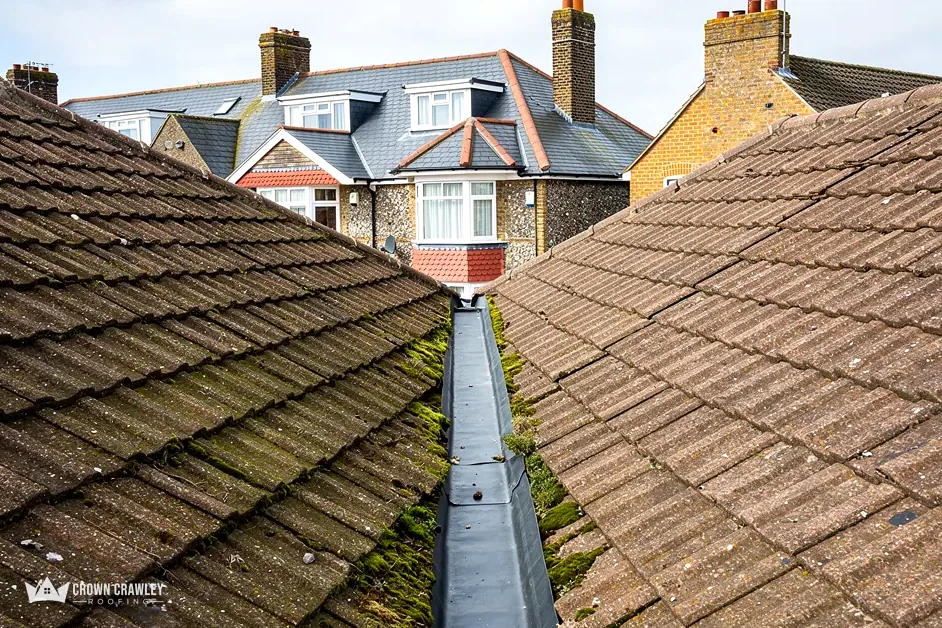
The tiles hang on timber battens by two small projections on the back, called nibs. The battens run across the rafters, which form the timber frame. At the crest of the roof sits the ridge. The verge is the trimmed edge of the slope beside a gable wall, and a valley is the inside corner between two slopes, where rain gathers on its way down.
Why does a tile that looks minor matter?
Because everything depends on the overlap, one cracked or missing tile leaves a hole in the water path, and the course above and below start to share the work. On a bigger tile that might go unnoticed for a while. On a plain tile roof the gap is small but the fixing is light, so neighbours loosen easily.
Our pitched roofing page sets out how we approach tile repair and replacement across different coverings.
Signs a plain tile roof needs attention
Most early signs show from the ground, and you can check them on a dry day without climbing anything. Walk round the house and look up at each slope in turn, with binoculars if you have a pair.
What can you see from the garden?
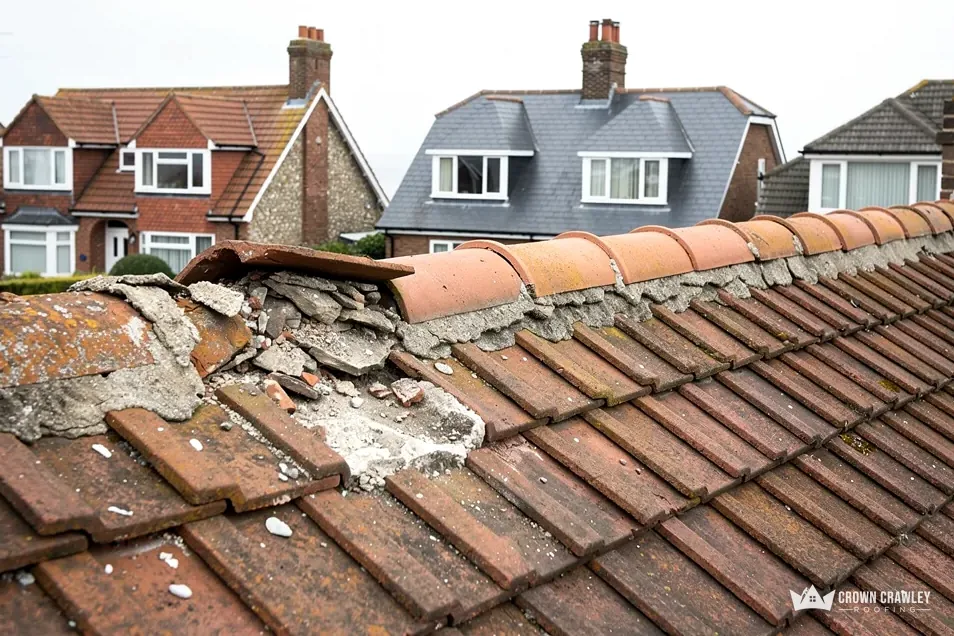
Look for gaps in the pattern where a tile has slipped or dropped, and for tiles whose lower edges stand proud of their neighbours. Lines that sag or ripple more than old age explains deserve a closer look. Flaking, where the face of a tile peels away in layers, is frost damage, and tiles in that state keep shedding pieces. Scattered fragments in the gutter or on a flat roof below are a giveaway. Moss packed between courses holds water against the clay, so read our guidance on cleaning a clay tile roof before anyone brushes it off.
What can you see from the loft?
Many old tile roofs have little or no modern underlay, so a chink of daylight is not always a fault. A damp patch, dripping or staining on the timbers after rain is. Check the undersides of the battens near the eaves and around the chimney for dark, soft wood, and look for crumbs of mortar on the loft floor, which often come from a cracked verge or ridge.
Do not walk on plain tiles to inspect them. They are thin, and one footstep can crack several that look sound from above.
Photograph whatever you find, with a chimney or a window in the frame to show where it is. A picture of the right spot saves a roofer a long search.
Repairing slipped, cracked and flaking tiles
Most plain tile repairs are small: lift the tiles above a damaged one, take it out and slide in a replacement. Each tile is hooked on its batten and covered by the course above, so the order of working matters.
How is one tile swapped for another?
The roofer eases the tiles in the courses above clear of their nibs, which frees the damaged tile. If a nail holds it, the nail is cut or drawn. The new tile is slid up into the gap and hooked on the batten, and the courses above are lowered back into place. Where the old tile was nailed, the new one is nailed too. We cover the wider question in our answer on replacing individual roof tiles.
Why do the same tiles keep slipping?
A tile that slips twice has usually lost its hold: a nib has snapped, the batten beneath it has softened, or the nail has rusted away. Refitting the same tile cures nothing. The roofer checks the batten and the courses around it and deals with the cause, which sometimes means a short run of new battens. Our page on why roof tiles slip goes through the usual causes.
What might a repair cost?
Checkatrade's roof repair guide, June 2026 table, lists plain clay tile repair at £110 to £160 per m², up to 3 m² and excluding VAT. Its tile replacement guide, October 2026 table, puts up to five replacement tiles at £170 to £500, with the top figure covering scaffold. These are UK guide figures for comparison. What we charge for your roof is set by a survey, and arrives as one total price in writing.
Matching reclaimed and new tiles
On a handmade clay roof, no two tiles are quite the same. Colour runs from orange through red to brown, with darker flashes where tiles sat close to the heat in the kiln, and long weathering has blended the whole slope into something richer than new tile can offer. A bright new tile among them looks like a patch because it is one.
Where do reclaimed tiles come from?
Reclaimed tiles come off demolished or re-roofed buildings and are sold on by salvage yards and specialist merchants. They are already weathered, so they blend at once. Size, thickness and curve still have to match, because a tile a few millimetres larger will not sit at the right gauge, which is the spacing between rows. When we strip a section of your roof we keep and sort the sound tiles, which gives a matching stock for the repair itself.
When are new clay tiles the better choice?
If one slope is being renewed, a mix of old and well-chosen new tiles, with the new ones set in the less visible areas, can work. New handmade plain tiles can be sourced in a spread of colours, though they take time to tone down. Our page on matching old roof tiles sets out the thinking in more detail.
Check that what you have is clay. Concrete plain tiles exist and look similar from a distance, and a close look at a broken edge or the way the colour runs through the thickness usually settles it. A roofer will check before ordering anything, because the two materials weather and weigh differently.
Fixings, nails and what the standard says
How plain tiles are secured depends on the age of the roof and how exposed the site is. Many old roofs rely on nibs and weight alone, with only some courses nailed. Modern practice asks for more, and the choices on a repair should reflect that.
What does BS 5534 ask for?
BS 5534 is the code of practice used for slating and tiling. BSI warns that parts of the standard may not fit a roof built of traditional or reclaimed tiles, so on a plain clay roof it informs the roofer's judgement without replacing it. Marley points out that installing to BS 5534 is not a legal requirement, yet it remains the yardstick most roofers work to. In practice, an old roof that is re-laid usually gets more nails and clips than it started with.
Why does the nail matter?
A tile nail that rusts through leaves the tile hanging on its nibs alone, and that holds until the first hard gust. Corrosion-resistant nails avoid this. On a roof with slipped tiles you may find old nails snapped or reduced to a brown stain. If the nails are failing across a slope, that hints at the battens too.
What about the ridge?
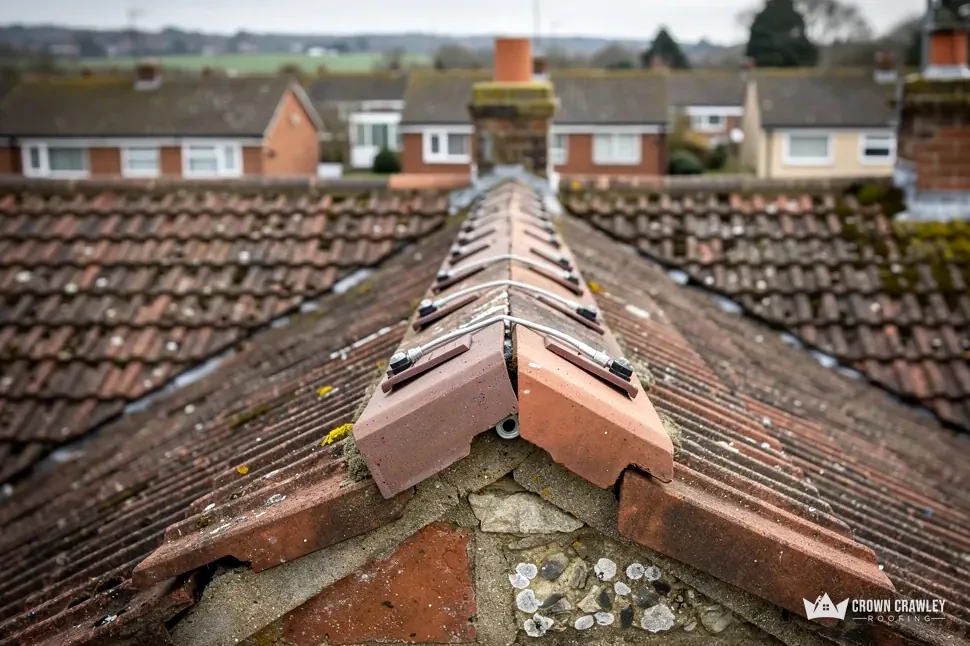
Traditional ridge tiles were bedded in mortar alone. Marley reports that after the 2014 revision, mortar by itself is not relied on to hold ridge or hip tiles, and each bedded fitting should also be fixed mechanically. If your ridge is cracked or loose, ask what fixing will go back. Some roofs suit a dry-fixed ridge and some are better kept bedded, and the survey settles which.
Repair, partial re-lay or full re-roof?
Plain tile roofs invite a particular judgement. Clay lasts, so many are worth saving, but the timber beneath ages too, and at some point it costs less to take a slope down than to keep chasing leaks.
How long does clay last?
Marley cites 60 years as the minimum life expectancy Building Research Establishment research gives clay tiles. A building conservation article warns that this does not hold for old peg tiles. A tile can outlive the roof around it, and a lifespan is a range, never a promise.
When does a patch stop making sense?
When damage spreads over a slope, the battens have gone soft in places, or a leak returns after every repair, re-laying that slope is likely to be better value. The sound tiles come off, are sorted and stacked, new battens and underlay go on, and the best tiles are laid again with matching reclaimed ones filling the gaps. The look of the roof survives while what it hangs on is renewed.
What do the rules say?
The Planning Portal test for when approval is normally unnecessary is less than 25 per cent of the building envelope and less than 50 per cent of the roof. Crawley Building Control names replacement of more than 25% of a roof's surface as work it must approve, so raise a whole-slope re-lay with them. If the house is listed, listed building consent covers works that affect its character, and a conservation area adds its own care. The Ifield Village conservation area takes in part of Ifield. Ask Crawley Borough Council's planning team first about an older or protected house.
What helps us price it?
Photos from the ground and a note of where leaks show indoors are the best start. Send them through the enquiry form, WhatsApp us, or call 01293 974253, and mention any earlier patch, such as a different tile colour in one corner. Our visit begins with a survey, you see photos of what we find, and the written quote is one price for the whole job. When comparing quotes, see whether VAT and scaffolding are included. Tell us early if bats use the roof, because roof repair can disturb a protected roost.
Part of our Pitched Roofing Services in Crawley
Plain clay tile roof queries
Is an old plain clay tile roof worth repairing?
Often it can. Slipped, cracked or flaking tiles are swapped one by one, and a failing patch can be stripped and laid again. Renewing a whole slope makes sense when battens are soft right across it or leaks keep returning. The survey tells you which case you are in.
Where do you find tiles to match an old plain tile roof?
Salvage yards and specialist merchants supply them, and so do the sound tiles on your own roof when a section is stripped. Reclaimed tiles have already weathered, so they blend in. Size, thickness and curve must match as well as colour, or courses will not sit true.
Will a plain tile repair need planning permission or building control?
Swapping tiles like for like generally falls outside planning control, though listed buildings and conservation areas need extra care. Whether building control is involved turns on the share of roof replaced. Check with Crawley Borough Council's planning team and building control before larger work begins.