Think of a tiled roof as four layers stacked on top of each other. On the outside are the tiles or slates that shed the rain. Under them, timber battens hold every tile in place. Beneath the battens, the underlay catches anything the tiles let through. And carrying all of it are the rafters, the sloping timbers that make the shape of the roof. A leak, a slipped tile or a dip in the ridge always starts in one of these layers, and the deeper the layer, the bigger the repair.
This guide works down through them in order. For each one you will find the signs you can spot from the garden or the loft, what a roofer does to fix it, and the point at which a repair stops making sense. It replaces an older post of ours that borrowed too much from American advice about asphalt roofing. British pitched roofs are tiled or slated, and they are repaired very differently.
Start where the water shows
Before anyone talks about tiles, find out where the water is getting in. That sounds obvious, but a stain on a bedroom ceiling is rarely directly below the fault. Water that gets past a tile runs down the underlay, along a batten or down a rafter before it drips, so the real cause can sit well up the slope.
What can you check safely yourself?
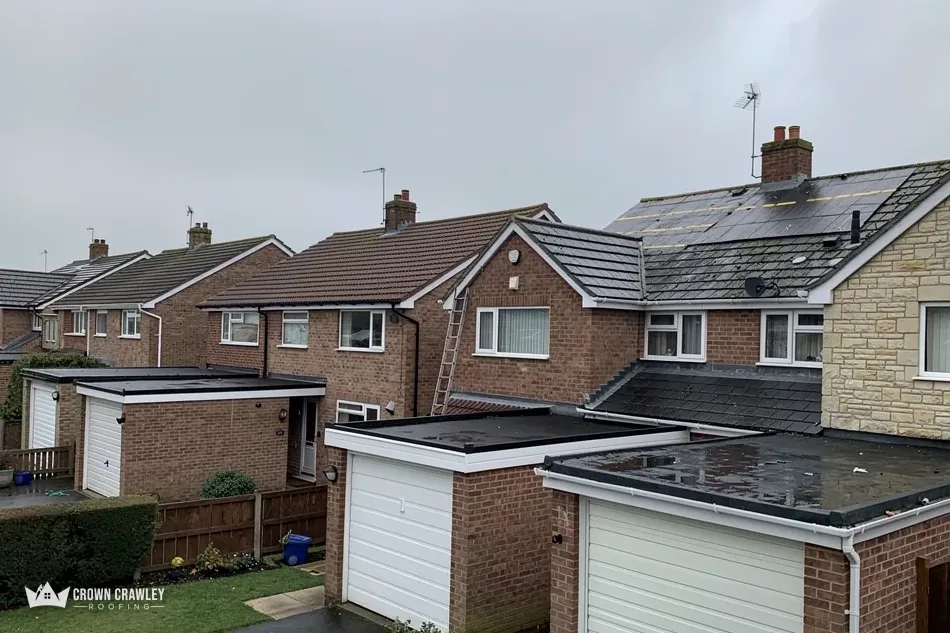
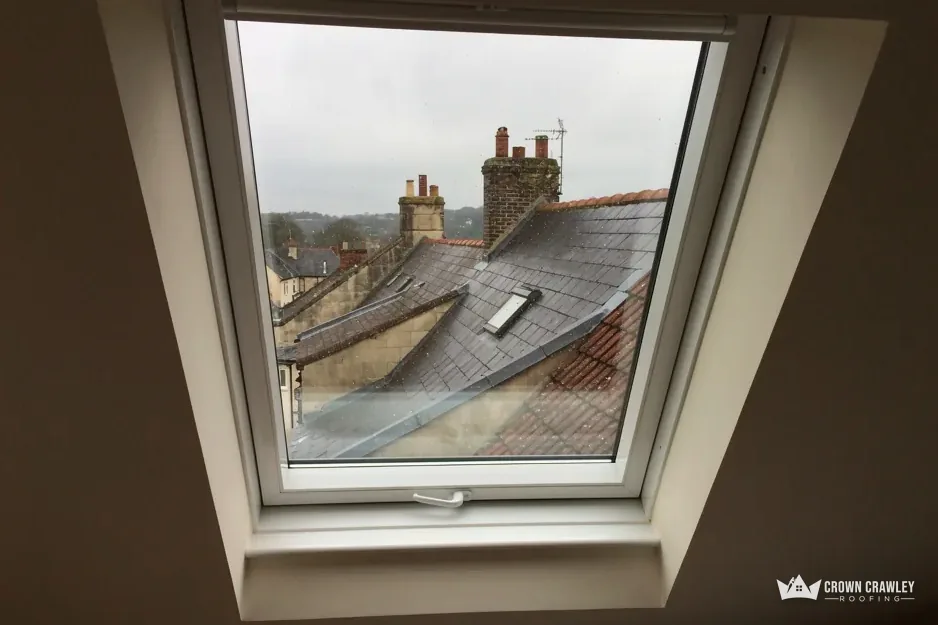
Do it from the ground and from the loft, never from a ladder on the roof. From the garden, look along each slope for tiles that sit lower than their neighbours, a gap in a row, a tile or a broken corner on the lawn, a ridge line that dips, and mortar missing from the gable edge. Binoculars help. In the loft, on a bright day, switch off the light and look for daylight between tiles. Then, with a torch, look for dark stains on battens and rafters, damp insulation and felt hanging torn or slack between the rafters.
When should you call a roofer?
Call when you see water inside, daylight in the loft, or any sign that the timbers have moved. A roofer with proper access can then see what you cannot: the fixings under a slipped tile, the condition of the battens at the eaves, the mortar in a valley. Ask for photos of whatever they find. Pictures of your own roof are the best defence against being sold more work than you need, and the best way to understand why a bigger job is genuinely due. Our pitched roofing service starts every job this way.
Layer one: tiles, slates and ridges
Plenty of repairs never go deeper than the surface. A tile cracks in a frost, a slate slips when its nail rusts, a ridge tile rocks loose as the mortar under it ages. These are the smallest problems to fix and the quickest to get worse if they are left, because every gap lets rain reach the layers below. Leave one slipped tile for a winter and it can become a stained ceiling by spring.
How is one tile or slate replaced?
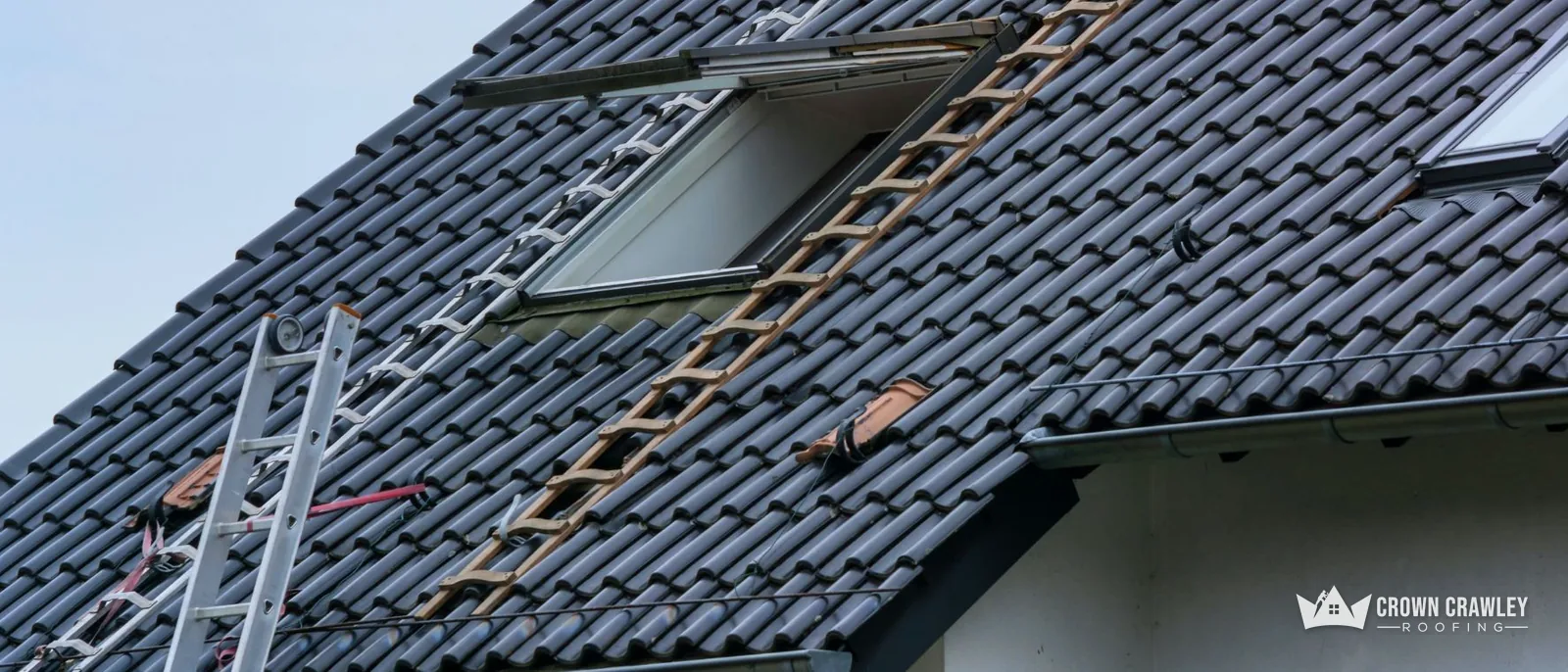
On an interlocking concrete roof, the roofer lifts the tiles overlapping the broken one, slides it out, hooks a new tile over the batten by its nibs and fixes it down. Plain tiles are smaller and lap two courses below, so the method differs. A slipped slate is often refixed with a tingle, a narrow strip of copper or lead nailed to the batten and folded up under the slate's tail. Our answer to can you replace individual roof tiles covers the methods in more detail.
Can the new tile match the old ones?
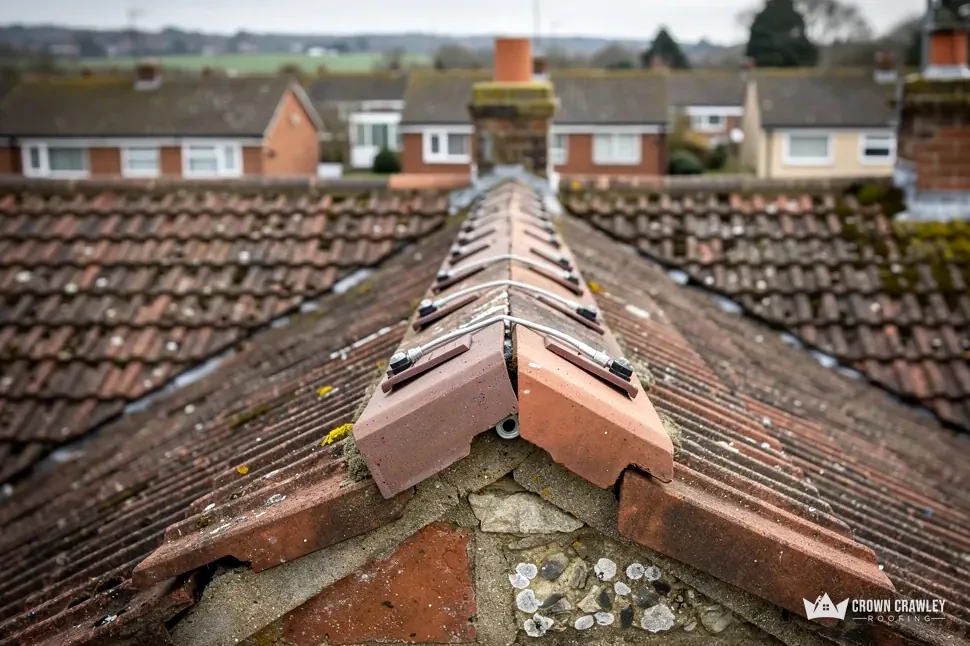
Usually, close enough. Many concrete profiles are still made, reclaimed tiles fill the gaps, and where nothing matches, a roofer can lift sound tiles from a hidden slope and fit the new ones in their place. Ridges are their own job: a loose ridge tile is lifted, cleaned and rebedded, and the code of practice, revised in 2014, expects mechanical fixings as well as mortar on ridges and hips. Before buying anything, check the minimum pitch on the tile's data sheet, because a profile that suits one roof may be too flat for yours.
Layer two: battens and their fixings
When tiles keep slipping in the same area, however often they are put back, the problem has moved down a layer. Battens are thin timber strips nailed across the rafters, and every tile on the roof hangs from them. They are hidden, they are cheap, and when they fail they take the tiles with them.
Why do battens fail?
Rot is the usual reason. A leak that has been running quietly for a few winters soaks the battens under it until they go soft. Condensation does the same from below when a loft is poorly ventilated. The nails holding the battens to the rafters can also rust through, and on slate roofs the nails holding the slates to the battens corrode in the same way, a fault known as nail sickness. Any of these leaves the tile with nothing firm to grip. If the same tiles have been refixed twice in a year, ask whoever comes next to look at the battens.
What does a batten repair involve?
The tiles over the damaged area are stripped and stacked, the old battens and nails come out, new battens go on at the right gauge for the tile, and the tiles go back with fresh fixings. On a small area this is still a repair. If the battens have softened across most of a slope, the job becomes a re-roof of that slope, because there is no way to renew them without lifting every tile. From the loft you can often judge which it is: look for dark staining, splits and battens that bow between rafters. Our guide on when roof battens need replacing goes into the signs.
Layer three: underlay and ventilation
Underlay is the membrane that lies across the rafters beneath the battens. On older roofs it may be bitumen felt; on newer ones, a breathable membrane. Its job is to catch wind-driven rain and snow that gets past the tiles and carry it to the gutter. A roof can run for years with damaged underlay if the tiles are sound, but it loses its second line of defence.
Underlay cannot be properly replaced from inside the loft. It sits under the battens, so renewing it means taking the tiles and battens off that area first.
Where does underlay fail first?
At the eaves. The bottom edge of the felt drapes into the gutter, and decades of sun, wet and wind can rot it away, so water that reaches the felt runs behind the fascia instead of into the gutter. The fix is often an eaves tray, a rigid sheet fitted under the bottom row of tiles, rather than a new roof, and it costs far less than stripping the slope. Torn felt higher up the slope is a different matter and may need a section stripped.
Why does ventilation matter?
Non-breathable felt traps moisture. Marley's guidance on BS 5250 says a cold roof with this kind of underlay needs a continuous gap at the eaves, 25mm on pitches of 15 degrees or less and 10mm on steeper roofs. Block that gap with insulation and warm, moist air rising from the house condenses on the felt, soaking the battens from below. Our guide to breathable membrane versus felt explains the choice when underlay is renewed.
Layer four: rafters and structural problems
The deepest layer is the structure itself: rafters, purlins and the walls they bear on. Problems here are serious, and they need diagnosing by someone who understands loads, not just tiles.
What are the signs of a structural problem?
Look for a ridge that sags in the middle, slopes that look dished or wavy from the street, cracks in the walls just below the eaves, or rafters in the loft that are split, bowed or soft at the ends. Common causes include timbers weakened by a long-running leak, struts removed during a loft conversion, rot where rafters sit on a damp wall, and a heavier covering laid on a roof built for something lighter.
Who should you call?
A roofer can spot the signs and make the roof safe, but the fix needs a structural engineer or a surveyor to say what the timbers need. Weight matters here. The Planning Portal says Building Regulations approval applies where a new covering makes the roof 15 per cent or more heavier, and suggests a structural engineer or surveyor inspects it beforehand. Approved Document A treats a rise in the load on the roof of more than 15% as significant. So swapping concrete tiles for something heavier is never just a cosmetic choice.
Structural repairs usually mean stripping the affected area, strengthening or replacing timbers, then laying new battens, underlay and tiles. At that point it can make sense to weigh the repair against re-roofing the whole slope.
Storm damage, insurance and the rules
A sudden failure after a storm is handled a little differently from slow wear, because your insurer may be involved and the first priority is to stop the water.
What should you do first when a storm hits?
Tell your insurer first and follow its instructions. Put up a temporary cover, such as sheeting over a hole, to limit further harm, and hold on to receipts for every cost. Take photographs before anything is moved; the Institution of Structural Engineers notes that photographs matter a great deal in an insurance claim, as they record the damage. Be realistic, too. Which? reported that Financial Conduct Authority figures put the payout rate at only 32% of storm-related claims made in 2024 resulted in a payout. Wear and tear can be excluded, so read your policy. If a claim is handled unfairly, the Financial Ombudsman Service takes complaints.
Never go onto a roof yourself after a storm. Wet tiles, loose pieces and a weakened structure make it the most dangerous time to be up there.
Do repairs need permission?
Like-for-like repairs normally do not. Under the planning Act, a job that does not materially change how the outside of the building looks is not development. Building Regulations come in on larger jobs: the Planning Portal states that approval is not normally required when under 25 per cent of the building envelope and under 50 per cent of the roof is affected, while Crawley Building Control publishes its own guidance for the borough, so check with your building control body. Listed buildings need listed building consent for work that affects the character of the building. And bats are fully protected, and the government's guidance singles out roof repair as work likely to affect them.
Part of our Pitched Roofing Services in Crawley
More about pitched roof repairs
How long does a pitched roof repair take?
It depends on the layer. Refixing a few tiles or a section of ridge is usually a short job once access is in place. Renewing battens or underlay over part of a slope takes longer, because the tiles come off first. Structural work takes longest, as an engineer may need to specify it. Weather and scaffold booking also affect the timing.
Can a pitched roof be repaired rather than replaced?
Where the fault is local, yes. Slipped tiles, a loose ridge, a cracked valley or a short run of rotten battens are all repairs. Replacement makes sense when the same faults run across whole slopes: worn tiles, soft battens and failed underlay together. Photos from a survey should show you which applies to your roof.
Does home insurance cover pitched roof repairs?
Policies usually separate sudden damage, such as a storm lifting tiles, from gradual wear, which is often excluded. Read your policy wording and contact your insurer before arranging permanent repairs. Keep photos and receipts for any temporary repair. If you think a claim has been handled unfairly, you can complain to the Financial Ombudsman Service.