Most pitched-roof trouble starts small and out of sight. A hairline crack in the mortar under a ridge tile, a valley clogged with moss, a strip of felt at the eaves gone brittle, a loft that never quite dries out: none of these lets the rain in today, and all of them cost less to deal with now than after a winter of leaks.
This post is about the upkeep that suits tiled and slated roofs in particular. It starts at the top with the ridge and works down through valleys, eaves and ventilation, then covers moss, trees and wildlife, and ends with the line between a job you can do from the garden and one that needs someone with proper access. Where a task means going onto the slope, the advice is to stop and ring a roofer. A roof is a poor place to learn, and a fall from one is far more expensive than any repair it might have saved you.
Ridge and hip: the first place to look
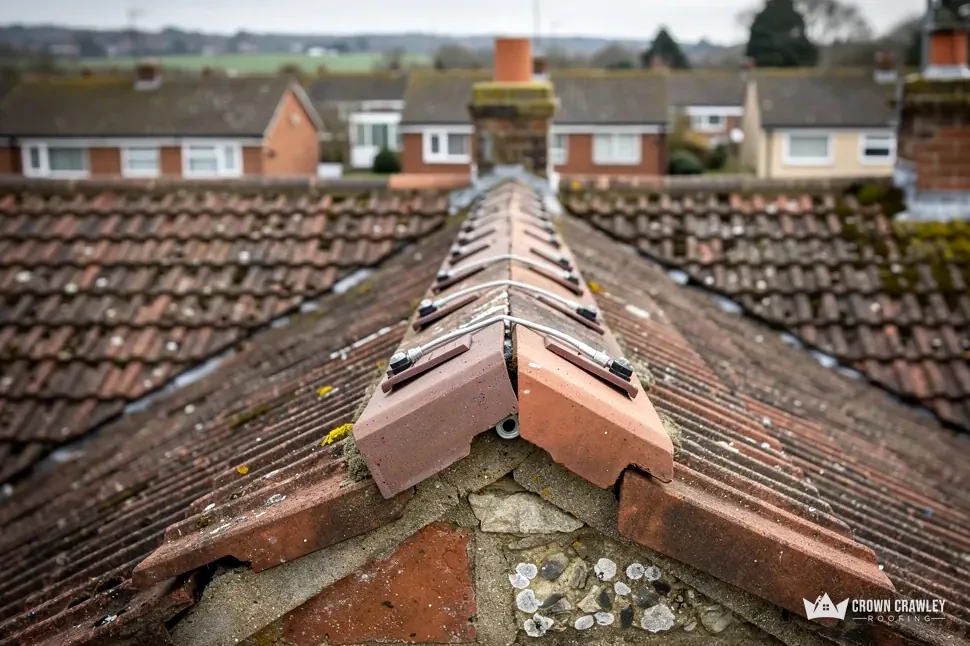
Along the apex sits the ridge, with hips running down the outer corners, and both feel every gust. They are also the parts most likely to have been bedded in mortar when the house was built, and mortar shrinks, cracks and lets go.
What shows from the garden?
Stand back in the garden or across the road and sight along the ridge line. Binoculars help. You are hunting for a ridge tile that sits crooked, a gap where the mortar has fallen out, crumbs of mortar in the gutter or down on the path, and any place where the ridge line dips instead of running straight. Check the gable ends, too, where the edge tiles are fixed with mortar or clips, and note any that have moved or cracked since you last looked. If you can see daylight or a loose tile edge, it needs a roofer.
Is a dip in the ridge a maintenance job?
No. A ridge that sags between its ends can mean the timbers underneath have moved, and no amount of rebedding will cure that. Get it looked at before anyone retiles it. A sound ridge, by contrast, is a straightforward repair: lift the tiles, clean the bed, rebed them and add the mechanical fixings the current code of practice expects. Marley points out that the 2014 revision of BS 5534 expects mechanical fixings on anything bedded, though the standard is guidance, not law.
What are dry systems?
Dry ridge and dry verge use clips, screws and caps in place of mortar, tested to BS 8612. They do not crack in the same way, and some owners choose them when an old mortar ridge is due for renewal. Our dry ridge and dry verge page explains how they go on.
Valleys, flashings and abutments
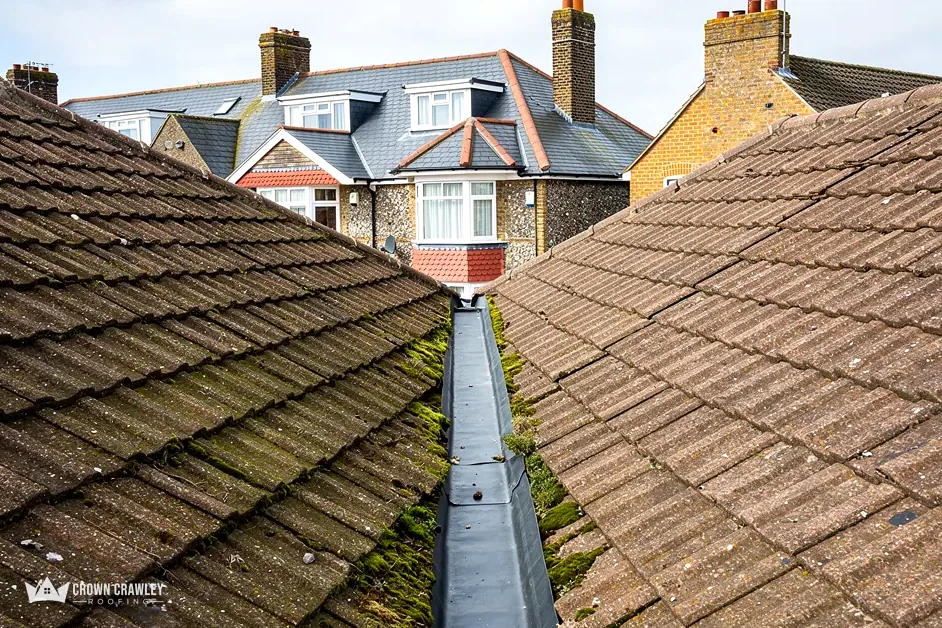
Where two slopes meet at an inside angle, the gutter-like channel between them is a valley, and it carries water from both sides down to the gutter. An abutment is the point where a roof slope meets a taller wall, such as a side extension, a dormer cheek or a chimney stack. Both need a waterproof junction, and both are classic leak points because water gathers there.
How do valleys go wrong?
Leaves, moss and silt build up in the channel and slow the flow, so water backs up under the tile edges. Older valleys finished in mortar crack along the join with the tiles. Lead-lined and fibreglass valleys can split or lift at the joints. A stained or mossy valley line, or tiles along it that have sunk, will often show from the garden. Our answer on mortar valley cracking shows what to look for.
What should you look at around lead?
Lead flashing is dressed over the join between roof and brickwork, and it can be the source of a brown ceiling stain when the tiles look perfect. Look for lifted edges, cracks along bends and gaps where the pointing has fallen away. A lead cost guide from MyJobQuote, last updated on 22 September 2026, gives lead flashing a life of more than 80 years. Treat that as a figure for the metal, never a promise for any roof, and when a flashing fails it is often the fixing or the sealing around it that has gone.
Chimney junctions work the same way, and the stack itself deserves a look from the garden for crumbling pointing or a leaning cap. Our chimney repairs page covers those jobs.
Eaves felt, fascia and the gutter line
The lowest edge of the roof does more work than any other part. Rain from the whole slope arrives there, and the underlay that protects the timbers underneath has to carry it into the gutter.
What goes wrong at the eaves?
The felt is draped over the fascia edge into the gutter, where sun, damp and gusts can perish it over the years. Once it has failed, water that arrives there can track behind the fascia and miss the gutter altogether. You may notice a stained or rotting fascia, damp soffit boards, or green stains on the wall beneath. A rigid eaves tray slipped beneath the lowest course is often the cure, a much smaller job than stripping the slope. There is more detail in our separate piece on rotten felt at the eaves.
What does the gutter have to do with the roof?
A gutter that is full or sagging pushes water back onto the eaves. Overflow at one point in a dry spell suggests a blocked outlet or a joint that has opened, and a gutter that has dropped out of line holds water where it should drain. Brett Martin's guide for new installations is a fall of 1mm for every 600mm. From ground level you can tell a lot by watching a gutter during heavy rain. Clearing it means a ladder, though, and the safest route is to have the work done with the right access.
Fascia, soffit and gutter are linked, which is why we look at them together. Our gutters, soffits and fascias page sets out the options.
Loft ventilation and condensation
Ventilation is the least visible maintenance job and one of the most useful. A roof void that cannot breathe collects moisture from the house below, and the dampness settles on the felt and in the battens.
How much air does a cold roof need?
Drawing on BS 5250, Marley explains that where non-breathable felt lines a cold roof, air must pass freely along the whole eaves, through a 25mm gap on pitches up to 15 degrees and a 10mm gap on steeper ones. Breathable, low-resistance underlay can rely on the ordinary eaves construction of about 3mm provided the plaster ceiling underneath is sealed well and the covering lets air through, subject to third-party certification. Which route you have depends on what is under your tiles, so check the product rather than assuming.
What do you do in the loft?
Look at the eaves from inside with a torch. If insulation has been packed tight to the roof edge, or a vent is blocked, ease it back so air can move. Look for darkened battens, black spots of mould, or droplets on the felt on a cold morning. Our guide to loft condensation and roof ventilation goes much further.
What about spray foam?
Be careful. Energy Saving Trust advice on foam sprayed over a leaking roof is simple: it does not recommend doing this. RICS suggests asking your mortgage lender whether its policy permits foam insulation at all. Fix the roof first, find out what your lender thinks, and only then think about insulation.
Moss, trees and wildlife
Moss and lichen are easy to see and easy to over-react to. They hold moisture against the tile, and thick clumps can block valleys and gutters, but a little growth on a shaded slope is not an emergency.
Should you clean moss off?
Do it with care or leave it to a roofer. Marley warns that powerful jet washes can scar tile and slate faces and cut their expected life. Keep the spray gentle or leave it to a roofer. The HSE is clear that biocides meant for professional users are not for householders, and some need certified operators. Checkatrade's April 2026 roof cleaning guide gives typical UK prices of £8.50 to £14 per m², with about £18 per m² more where scaffold is needed. Our roof cleaning and moss removal page covers how we work.
Why do overhanging trees matter?
Branches that touch the roof scrape the surface in wind and drop leaves into valleys and gutters. Cut back anything rubbing the roof, from the ground or by a tree surgeon, but check the tree for protection before cutting.
What about nests and bats?
The Wildlife and Countryside Act makes it an offence to deliberately damage any wild bird's nest that is occupied, which includes one still being built. Bats get stronger cover, extending to their roosts and breeding sites, and government guidance lists roof work among the things that can affect them. If you find droppings, a nest or bats themselves, stop work and get advice before disturbing anything.
What to leave to a roofer
You can do a great deal from the ground: walk round after a storm, look along the ridge, check the valleys and the gutter line, scan the gable ends and look for fallen mortar or tiles in the borders. Do the same from the loft with a torch. Photograph what you see, and keep the pictures with the date, ideally standing in the same place every time, so they compare easily. If something changes between looks, you will know when it started.
Which jobs need a roofer with access?
Anything on the slope itself. That includes replacing tiles, rebedding or replacing a ridge, relaying a valley, renewing lead flashing, fitting an eaves tray, repairing felt and clearing gutters from height. These jobs need tower, scaffold or roof ladders, and they carry real risk without them. A sagging roof line, daylight in the loft, and wet battens also belong on the list.
What does a maintenance visit from us involve?
It begins with a survey, after which the photos of your own roof are shared with you. The visit covers the ridge and hips, valleys and abutments, tile condition, the eaves detail and the ventilation. You get a written account of what is sound and what needs doing, and one total price for any work that follows. Where a roof is leaking, making it safe comes ahead of everything else. Our pitched roofing page sets out the wider range of jobs.
To help us prepare, send a photo of the ridge and one valley taken from the ground, plus a picture of the eaves from inside the loft if you can reach them safely.
Part of our Pitched Roofing Services in Crawley
More on looking after a pitched roof
How often should a tiled roof be looked at?
A walk round the outside once a year, plus another after any big storm, catches most visible changes early. Look along the ridge, valleys and eaves from the ground, then check the loft with a torch. Photograph what you see so changes are easy to spot. Anything on the slope itself is a job for a roofer.
Should I scrub moss off my own roof?
It is better not to. Standing on a wet roof is risky, and Marley says powerful jet washing can mark tile and slate surfaces. Some biocides are for professional use only, according to the HSE. If moss is blocking a valley or gutter, ask a roofer to clear it and check what lies underneath.
Does breathable underlay mean I can ignore loft ventilation?
Not without checking. Marley says low-resistance breather underlay can rely on normal eaves construction of about 3mm so long as the ceiling beneath is sealed well and the covering is air-permeable, subject to third-party certification. Older felt needs a proper eaves gap. Find out which underlay you have before blocking or adding anything.