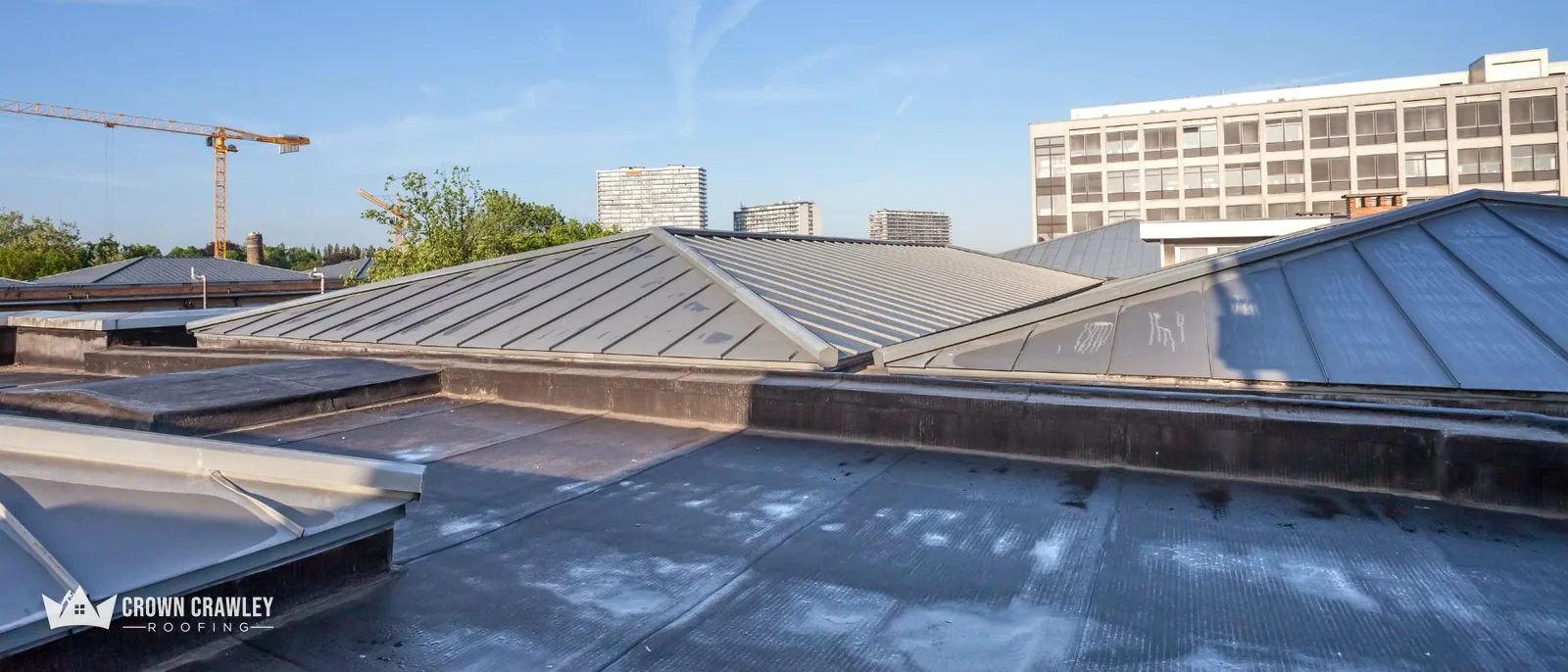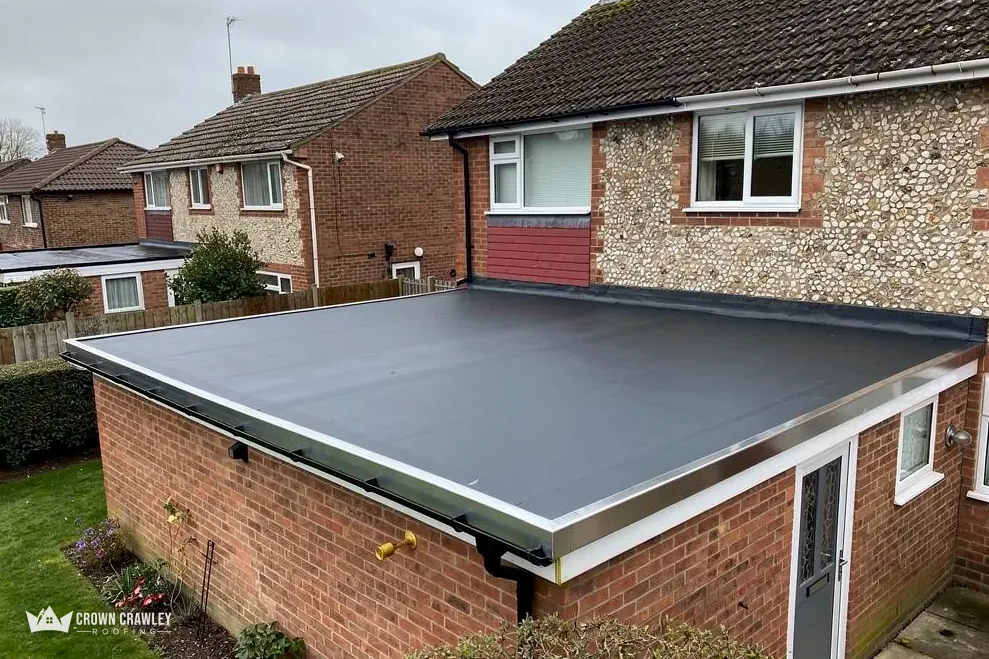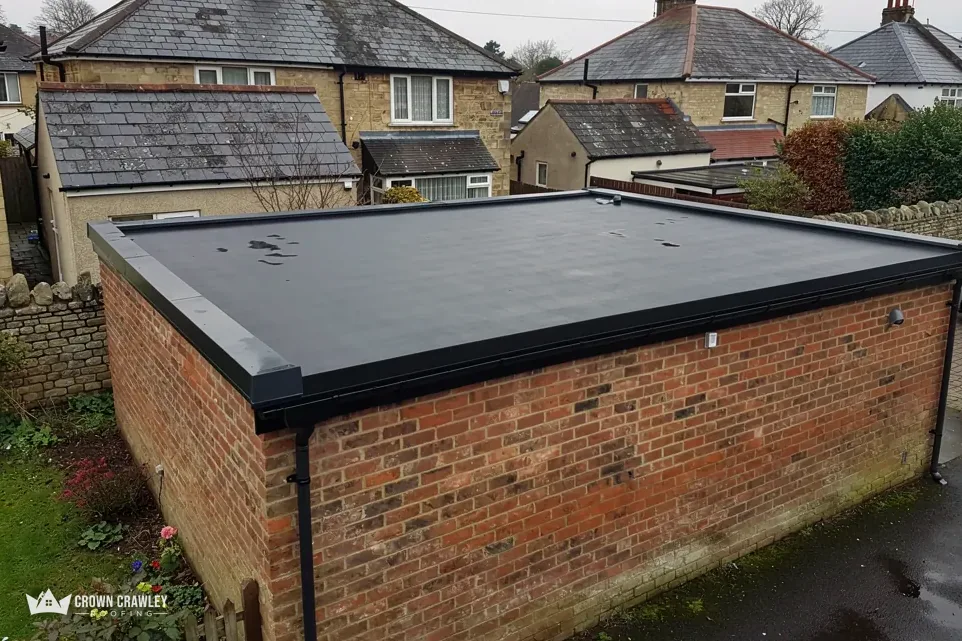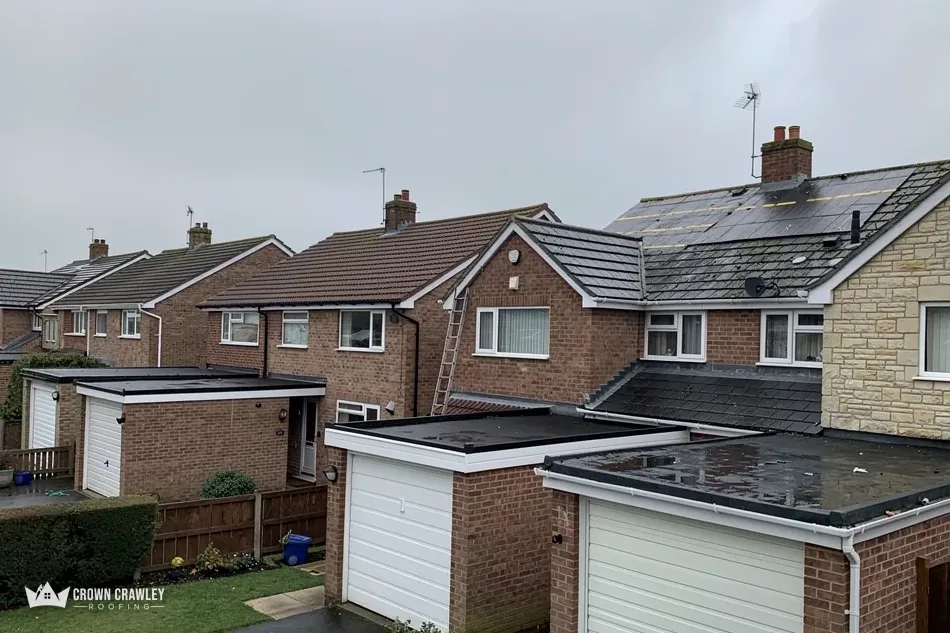
Most garage roofs are flat, and most of them are covered in one of three things: felt, EPDM or GRP. Felt is bitumen-based sheet, usually stuck down in layers. Our flat roofing service covers all three. EPDM is a single sheet of synthetic rubber, glued to the deck. GRP is glass-reinforced plastic, a resin and glass-fibre skin that sets hard on the spot. All three can keep a garage dry. They age differently, cost differently and suit different habits.
A garage is not a house roof in miniature. It is small, so the cost gap between materials is a few hundred pounds, not thousands. It often has no insulation and no loft below to warn you about a leak. It gets used more than people admit, as a place to stand a ladder, dump a bag of leaves or reach a gutter. And it is the roof that homeowners are tempted to cover themselves on a free weekend. This post compares the three coverings with only that kind of roof in mind, using typical UK ranges from published cost guides and telling you where a written quote after a survey has to take over.
What a garage roof asks of a covering
Judge the roof before you judge any product. A single garage roof is a small rectangle with a few edges, usually one fall towards a gutter, and sometimes a wall on one side where it meets the house or a neighbour. That wall junction, called an upstand, is where most garage leaks begin, long before the middle of the roof gives up. Whatever covering you choose has to turn up that wall neatly and be sealed at the top.
Why does the deck matter more than the membrane?
The covering is only as sound as the boards under it. Many older garages have thin, bowed or damp timber that has been dry for years because the roof above it was tight. Lay a new covering over soft boards and it will fail where they fail. A survey should include probing the deck from above and, where you can get into the garage, looking at the underside for dark patches and sagging. If a few boards are bad, they are replaced before anything else goes down.
Does the roof drain properly?
Water has to leave. BS 6229:2025 keeps a minimum finished fall of 1 in 80 for general roof areas, and manufacturer guidance suggests laying out the build-up for around 1 in 40, which leaves room for the deck to settle. A garage that has always held a puddle in one corner is telling you the fall is poor, and no covering fixes that by itself. The cost of correcting a fall is one of the things that moves a garage quote, so it is worth asking whether your roof needs it. Our answer on the minimum fall for a flat roof explains the numbers.
Felt, EPDM and GRP side by side
These are national figures from published guides, not Crown prices, and they are typical ranges rather than promises. Lifespans are what the guides report for the covering; a guarantee from an installer is a separate thing and is not the same as how long the roof will last.
| Covering | Typical life | Typical cost per m² |
|---|---|---|
| Felt (bitumen layers) | 10 to 20 years | £50 to £80 |
| EPDM (rubber sheet) | 20 to 30 years | £80 to £100, average £90 |
| GRP (glass-fibre resin) | 25 to 40 years | £36 for the covering only; around £210 fully insulated |
Sources: Less flat roof guide, March 2026, for felt and GRP lifespans; GreenSpec for EPDM; Checkatrade rubber roofing and fibreglass roof guides, September 2026, for the costs.
Why is the GRP cost range so wide?
Because the two figures describe different jobs. The low one covers the GRP skin alone. The high one includes a fully insulated build-up, with insulation boards, vapour control and the finishing coat. A garage is often covered without insulation, so the first figure is nearer, but a garage that has been turned into a workshop or a room is a different job, and then the insulation is not optional.
Are the lifespans a safe guide?
They show the order of the thing, not your roof. A felt roof laid carefully over firm boards can outlast a poor GRP job, and a sun-baked, tree-shaded or ponding roof ages faster than the range suggests. Compare how a covering fails, not only how long it is meant to last. Our answer on how long a GRP roof lasts goes further, and the felt answer does the same for bitumen layers.
What a single garage costs in each material
Per-square-metre rates are hard to picture, so here is a worked illustration. Say your garage roof measures 18 m². That figure is an example, not a standard; measure your own length and width, and add the upstands and any overhang. Multiply the rates above by the area and you get a rough spread.
At £50 to £80 per m², felt on 18 m² comes to about £900 to £1,440. EPDM at £80 to £100 per m² comes to about £1,440 to £1,800. GRP covering only, at £36 per m², comes to around £650, and the fully insulated rate of around £210 per m² would be nearer £3,780. These are arithmetic from national guides, not a quote. They exclude VAT unless the guide says otherwise, and they leave out scaffolding, deck repairs and fall corrections.
What pushes a garage price up or down?
The deck, the access and the edges. A garage you can reach from a driveway with a tower or a ladder needs little in the way of scaffold. One squeezed against a boundary, with no room on the neighbour's side, takes longer to work on. Rotten boards, an old covering that has to be stripped, rainwater outlets that need moving, and fascia and trims that must be renewed all add to the sum. When prices come in, find out if each one carries VAT and scaffolding, since totals only compare fairly when they cover the same ground.
Our garage flat roof cost answer goes through those drivers. Ours is a single total, put in writing once we have surveyed the garage and sent you photos of its own roof.
Footfall, ladders and what lands on a garage roof
A garage roof gets stepped on more than a house roof. Someone clears the gutter, fetches a ball, rakes off leaves, or lifts a satellite dish. Think about this before you choose, because the three coverings feel and behave differently underfoot.
Which covering takes a footstep best?
GRP sets as a hard shell, so it tends to cope best with the occasional walk-on, provided the deck beneath is firm. Rubber EPDM is a flexible sheet; it is tough, but a sharp edge, a dropped tool or a ladder foot can cut or dent it, and its surface should not be dragged over. Felt can mark, scuff and, in hot weather, soften at the surface. None of them is meant for a patio, and every maker publishes its own limits, so ask for the data sheet on whatever is proposed for yours. Our answer to can you walk on a GRP roof covers the ground rules.
How do you keep a garage roof free of damage?
Set rules. Pick one route to the gutter and keep to it. Wear soft-soled shoes. Pad any ladder foot rather than resting it on the membrane. Keep branches cut back so they cannot rub, and never leave heavy items, such as bags of gravel or old paint tins, sitting on the surface. If you plan to put a solar panel, a water tank or a roof lantern on top, tell the roofer before the covering goes down, since these change the deck, the edges and the way the covering is finished.
Can you do a garage roof yourself?
This is where the roofing aisle does its selling. EPDM kits come cut to size, GRP is sold in tins, and felt is sold in rolls. A small garage looks like the ideal first project. Sometimes it is a fair one. But the risks and the savings are not the same for each material, and it pays to be straight about it.
Which covering is safest to attempt yourself?
None of them is risk-free. Torch-on felt means working with a gas flame next to timber,. Our answer on whether torch-on felt is safe sets out the issue. GRP depends on the weather, the temperature, the mix and the preparation, and a resin laid in damp or cold conditions can fail to bond. EPDM looks the simplest, yet the glued seams, the corners and the wall upstand are exactly where a first-timer struggles, and sheet that is cut wrongly cannot be put back.
What is the real saving?
On a garage, the labour you save is a few hundred pounds. The cost of getting it wrong is a new deck, a stripped roof and a second go. Working at height alone, with a ladder against a garage wall and a roof you cannot test, is also where most of the danger lies. If you do go ahead, read the maker's instructions end to end, check the weather forecast across the whole job, and ask someone to hold the ladder. If the deck is soft or the roof already leaks into the garage, get a roofer to look first.
Matching the covering to your garage
There is no single winner here, and a roofer who names one before seeing the roof is guessing. These pointers help you narrow it.
Where does felt earn its place?
On a plain roof where the budget is tight and a shorter life is acceptable. A garage that you may demolish or convert in a few years does not need a 30-year covering, and laid properly on a sound deck, felt does its job.
When does EPDM suit?
When the roof is a large, simple rectangle and you want few joins. A single sheet over the whole area means fewer seams to fail, and it handles slight movement in the structure well. It is a sensible middle choice for a lean-to or a garage with an upstand wall.
When is GRP the better buy?
When the roof has awkward corners, many penetrations or regular footfall, or when you want a smooth, joint-free finish in a chosen colour. It costs more at the top end, but it has the longest published life of the three.
One more rule applies if the garage is attached to the house. Approved Document L lists replacing a flat roof's waterproof membrane under renovation, so put it to your building control body whether the insulation has to be improved. For a detached outbuilding, raise the same question before work begins, since the answer can change the build-up and the price. Because garages vary so much, the first thing to send is a handful of pictures of the roof, its length and width, and which side the gutter is on. From those, the survey checklist is clear: deck condition, fall, the upstand and the outlet.
Part of our Flat Roofing in Crawley
Garage flat roof questions
Is a garage roof cheaper to cover than a house extension roof?
Usually the total is lower because the area is smaller, but the rate per square metre does not always fall. Small jobs carry fixed costs for access, waste and set-up. The written price after a survey takes in the deck, the edges and any fall correction, so ask what the price includes.
Can new GRP go over my old felt?
Sometimes, but it depends on the felt being sound, dry and firmly stuck to a good deck. Blistered or wet felt is stripped first. Our answer on putting GRP over felt sets out the checks that apply, and only a survey on the roof itself can settle it for your garage.
Do I need approval to recover a garage roof?
Like-for-like recovering usually does not need planning permission, as it does not materially change the building's appearance. Building Regulations can apply, particularly for an attached garage or a conversion. Ask your building control body, which for Crawley homes is Crawley Building Control, before work starts.