Look at a flat roof the morning after rain and you will often see a patch of water that has not drained. Some of it will be gone by lunchtime and some will still be there next week. The two are not the same problem. A damp patch that dries quickly is usually harmless, while a pool that stays for days is telling you something about the slope, the structure underneath or the outlet that is meant to clear it.
This guide sorts one from the other. It explains what ponding is, what the standard says about the slope a flat roof should have, the common reasons water stands and the checks a homeowner can make safely from the ground or a window. It then describes how a roofer puts a proper fall back into a roof by using firrings, and when a repair will do. It does not give a price for the fix, because the cost depends on the roof's size, its structure and what is found once the old covering is lifted.
What ponding is and why it is a worry
Ponding means water that stays on a flat roof after the rain has stopped and the rest of the surface has dried. A film of moisture left on a textured surface is normal. A pool with a visible edge, a tide line of dirt or green growth around it, is ponding. Roofers also use the word for shallow depressions that hold water only on particular wind directions, because a roof that drains well in one direction of rain may hold water in another when the wind shifts the flow.
Why does a pool matter at all?
There are three reasons. The first is weight. Water weighs one kilogram a litre, so a pool 20mm deep across ten square metres holds about 200 litres, or 200 kilograms, sitting on joists that may already be sagging. The second is wear. A covering that stays wet at one spot ages faster than the dry area around it, and dirt and algae collect in the pool and keep the surface damp. The third is frost: water that freezes and thaws repeatedly works at laps and seams.
Does every flat roof allow some ponding?
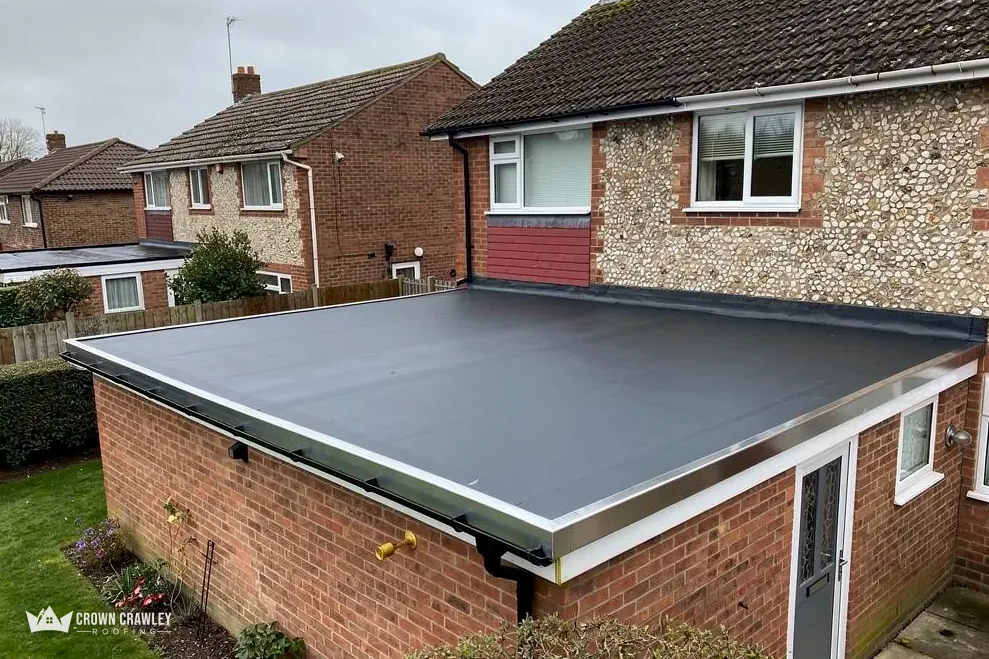
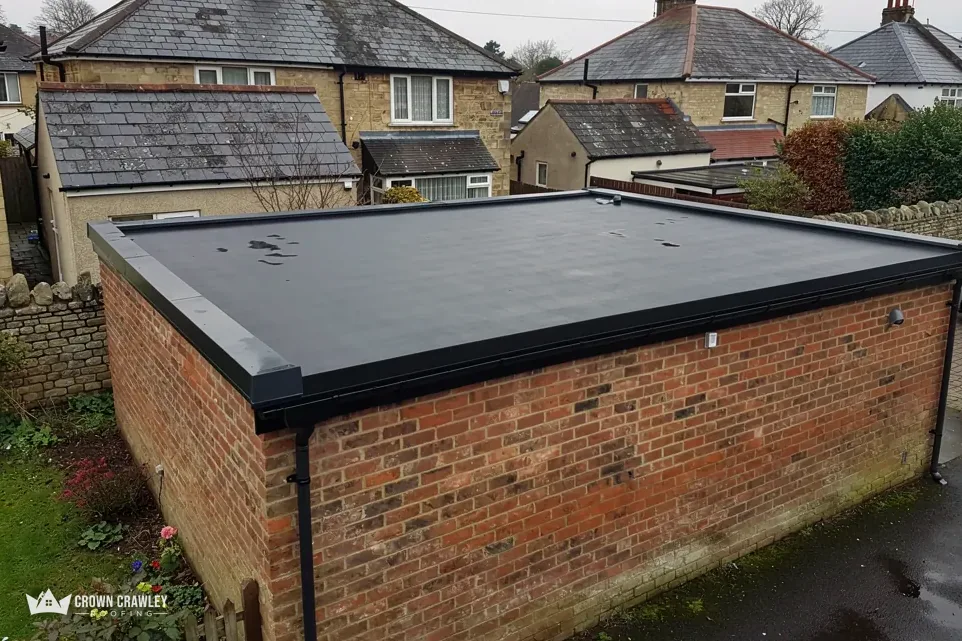
Some coverings and their makers tolerate shallow water better than others, and manufacturers differ in what they accept before a warranty is affected. That is a question for the data sheet of the actual product, not for a rule of thumb. What nobody wants is a roof designed to hold water. The aim is a roof that sheds it, and the gap between that aim and a roof that has settled over the years is where most ponding comes from. Roofs on garages, porches, bay windows and rear extensions are the usual places, because they were often laid by different trades at different times from the main house.
How much fall a flat roof should have
Flat is a trade term and not a description. A flat roof is built with a slope so that water runs to an outlet or a gutter, and the slope is expressed as a ratio. A fall of 1:80 means the roof drops 1 unit for every 80 units it runs. Over a four-metre span that is 50mm. That is not much, and it is easy to lose: a deck that dips by 25mm between joists can take half the fall away before the covering goes on.
What does the current standard say?
BS 6229:2025 replaced the 2018 edition on 16 December 2025 and covers flat or curved roofs whose pitch is not greater than 10 degrees. It sets a floor of 1:80 for the finished fall, across the main roof areas as well as internal gutters. The word finished matters. It is the slope the roof must still have after the structure has settled and the covering is down, not the slope drawn on a plan.
Why design for more than the minimum?
Because timber moves and decks deflect. IKO, a membrane manufacturer, writing about the 2018 edition, says the designer should aim for 1:40, which leaves room for the roof to settle without losing its slope. Designing exactly to 1:80 leaves no margin, and a small amount of sag would then create a pool. Falls are also easier to build in at the start than to correct later, which is why the survey measures where water goes before a covering is chosen. Our answer on the minimum fall for a flat roof goes through the numbers again, in a shorter form.
The usual reasons water stands
When a roofer finds a pool, there is usually one dominant cause, though two often overlap. Finding the right one decides the fix, because treating the wrong cause just moves the puddle.
No fall to begin with
Some flat roofs were laid with too little slope, or with a fall that runs away from the outlet. Garage and extension roofs built flat across level joists are the usual cases. The covering may have been fitted well, but the deck under it never had a chance to drain, and no amount of care with the membrane can supply a slope the structure lacks. In that situation every winter simply repeats the same pool.
Deflection and sagging
Joists carry the load of the deck, the covering, any insulation and the water on top. If they are undersized or have been wetted by an earlier leak, they bend downwards in the middle, and the middle is where the pool appears. Soft or spongy boards underfoot, a visible dip when you look along the roof from a window, or a ceiling below that has started to bow all point this way. Sagging roofs may need the deck replaced, not just recovered, and any joists that have taken on water need checking for rot before anything new goes on top.
Outlets and edges
A blocked or partly blocked outlet holds back a perfectly well-sloped roof. Leaves, moss and silt gather at the outlet, and a roof drained by a gutter at one edge depends on that gutter staying clear. An outlet fixed above the surrounding membrane can also leave a permanent pool around it. Our answer on a blocked flat roof outlet gives the checks that tell a blocked outlet from a roof that has no fall.
When standing water matters and when it does not
A sensible way to judge is to compare the pool with the rest of the roof. A shallow, short-lived film on a roof that is otherwise flat, dry and firm is something to watch. A deep pool that returns in the same place after every rainfall is a problem, and the longer it lasts, the more likely it is that something is wrong beneath.
What are the warning signs?
Look for water that is still there well after the surrounding surface has dried, a stain line that creeps outward with each wet spell, green growth or a dirt ring, a covering that feels soft or looks blistered, and any damp patch on the ceiling underneath. A pool that sits above a ceiling stain is serious, because the water may already be finding a way through a seam. Any of these is a reason to ask a roofer to survey, and none is a reason to go up yourself.
Does the covering make a difference?
Yes, but not in a way that excuses a pool. On a typical build, GreenSpec puts EPDM at 20 to 30 years of service, and Less puts GRP at 25 to 40 years and felt at 10 to 20. These are typical bands and not promises, and any covering will do worse if it spends its life under water. Seams, laps and edge trims are the weakest points, and they are the points a pool lies against. Blistered areas are a separate topic and often follow trapped damp. If a roof has both a pool and blisters, treat the pool as the likely cause and look for the source of the dampness at the same time.
How firrings put the fall back
A firring is a tapered strip of timber fixed on top of the joists, thicker at one end than the other, so the deck laid across it slopes. Cut to a run of lengths, firrings can create a fall across a whole roof, and they are the standard way of correcting a roof that never had one.
How are firrings fitted?
The old covering and deck come off, and the joists are checked and strengthened where they have bowed. Firrings are then fixed along each joist, each one tapering the same way and graded so the fall runs to the outlet. A new deck of boards goes over them, followed by insulation and a new waterproof layer. The work is similar to a full re-roof, because new firrings cannot go in under a covering that is still stuck to the deck.
Are there other ways to get a fall?
In a warm roof the insulation itself can be supplied as tapered boards, laid over the deck to create a slope without altering the structure underneath. That suits a roof whose joists are sound but flat. Our guide to warm roof against cold roof describes how the two builds differ. A sloped screed is a third method, but it adds weight, which is another reason to look at what the joists can carry. The survey decides between these routes, and the choice is explained to you with photos of the deck.
What to check now and what to ask for
You can learn a good deal without leaving the ground. Photograph any pool from a first-floor window on a dry day soon after rain, look along the roof edge for a dip and look at the ceiling beneath for stains or bowing. Clear any outlet or gutter you can reach safely from a stable position, and do not walk on a flat roof unless you know it is firm. A weak deck can give way, and so can a roof that looks sound. Taking a few photographs now also gives you a record to compare with later, which helps the roofer tell a new problem from an old one.
Can a pool be repaired instead of recovering?
Sometimes. If the deck is firm, the cause is a blocked outlet or one low spot and the covering is otherwise sound, clearing the outlet and patching or recovering a small area can be enough. If the deck has sagged, a repair will not hold, because the shape is wrong and the pool will return. Our flat roofing page lists what we fit; the flat roofing overview is the place to start.
What should the quote tell you?
Ask what fall the finished roof will have, how it was measured and where the water goes at the bottom of the slope. Ask whether the joists are being checked, what happens if they need strengthening once the covering is lifted and whether the outlets are changing. You receive a single written total once the survey is done. To get it moving, send us photos of the pool, the ceiling beneath and the outlet, along with the age of the covering, and we will start the survey from those.
Part of our Flat Roofing in Crawley
Standing water questions
Is a puddle on my flat roof a problem if it dries within a day?
Usually not. A shallow film that clears within a day or so on a firm, dry roof is something to keep an eye on. A pool that comes back in the same spot after every rainfall, or that sits above a ceiling stain, is worth a roofer's survey.
Can I fix ponding by adding more coating to the low spot?
Rarely. A coating cannot change the shape of the deck beneath it, and a thick patch at a low spot just makes it a little shallower. If the deck has sagged or never had a fall, the lasting answer is to rebuild the slope with firrings or tapered insulation.
Should I walk on the roof to clear the water?
No. A wet flat roof can be slippery, and a deck that has ponded may be soft underneath. Photograph the pool from a window, clear any outlet you can reach safely and ask a roofer to inspect. Walking on the covering can also crack it, particularly in cold weather.