Ask five people what a new roof costs and you will hear five different numbers, each said with total confidence. The reason is simple. Roof work is a family of very different jobs, from re-bedding one ridge tile to stripping a house back to its rafters, and each price shifts with how big the roof is, what it is covered with, how tall the building stands and whatever the survey finds underneath. A figure that fits a terrace in one street can be half the cost of the same job on a tall detached house round the corner.
This guide, from Crown Crawley Roofing, gathers typical UK ranges from national cost guides for the jobs people ask about most. It names the guide and the date beside every figure and explains what drives each one. Treat them as national averages from third parties. They say nothing about your particular roof, and they are not Crown's prices. Their use is to show whether a quote sits in a sensible area and what to ask when it does not. For how Crown reaches one written total after a survey, see our costs page.
Why one national figure never fits your roof
Cost guides quote prices per square metre, per metre of edge or per job, and then give a wide band. The width of the band is the honest part. Two roofs of the same size can land at opposite ends of it for reasons you cannot see from the pavement.
What moves a roofing price?
Access comes first. A bungalow with a clear drive is quicker to work on than a three-storey terrace where everything has to go up scaffold, and the scaffold is itself a cost. After that comes the area and shape of the roof: a plain gable is cheaper per square metre than one with hips, valleys, dormers and a chimney, because every junction needs cutting and flashing by hand. The covering matters a great deal. Concrete interlocking tiles, plain clay tiles and natural slate sit at very different points on the scale, and so do felt, EPDM (a rubber membrane) and GRP (glass-reinforced plastic) on a flat roof.
What stays hidden until the survey?
Condition is the unknown. Rotten battens, a sagging rafter or a wet wall plate only show once the covering is off, and a good survey looks for the signs beforehand: slipped tiles, daylight in the loft, staining, a dip in the line of the roof. Our surveys come first for exactly this reason, with photos of your own roof handed over alongside the price. A phone estimate for a whole re-roof is a guess; a written total after the survey is a price.
The ranges below are best read as a map of where the money goes. If a quote falls far outside them, ask why. There may be a sound answer, such as a tall building, a slate roof or a difficult site. There may not.
Repairs: tiles, ridges, verges, chimneys and lead
Repairs are the jobs most often priced by the metre or by the visit, which makes them the easiest to compare, so long as you know what each price includes.
What do tile and ridge repairs cost?
Checkatrade's roof tile replacement guide, in its October 2026 table, prices swapping no more than 5 slipped or cracked tiles at £170 to £500: about £170 for a simple job, £225 where a ladder and bedding are needed, and £500 where scaffold has to go up. Its roof repair guide (June 2026 table) gives repair rates per square metre, excluding VAT and for up to 3 m².
| Covering | Typical UK repair range per m² |
|---|---|
| Concrete tile | £90 to £120 |
| Plain clay tile | £110 to £160 |
| Natural slate | £150 to £220 |
| Fibre cement | £90 to £130 |
The same guide gives dry ridge repairs at £50 to £70 per metre and dry hip at £70 to £100 per metre. Checkatrade's dry verge guide (September 2026) says £10 to £25 per linear metre, materials and fitting included.
And chimneys and leadwork?
Checkatrade's chimney repair guide (April 2026) gives flashing at £250 to £1,000, repointing at £300 to £1,000 and a cap at £180 to £520. Its repointing guide (October 2026) averages around £750, and quotes £1,000 to £3,500 for rebuilding the stack above the roofline. MyJobQuote (updated 22 September 2026) prices chimney leadwork at £350 to £460 without scaffold and £700 to £920 with it. Plain lead flashing repair is £50 to £70 per metre, or £80 to £120 for stepped flashing in Code 5 lead. See our chimney repair cost guide for the detail.
New roofs: costs by house type
A re-roof is the biggest single figure most owners will see, so it is worth looking at more than one source. Different guides measure different houses, and the gaps between them tell you something.
What is a typical new roof price?
Checkatrade's roof replacement guide (October 2026) lands on around £12,000 for a 3-bed semi and roughly £17,000 for a 4-bed detached. By roof shape, hipped roofs run £9,250 to £18,000 and gable roofs £7,000 to £16,250, with the table marked plus VAT. Its scaffold figure is £700 to £1,300.
HomeBuilding's guide, last updated 30 September 2025, is a little lower for small houses. Its figures: £6,500 to £10,000 for a small terrace roofed in Roman tiles, and £10,000 to £15,000 for a 3-bed semi of 65 m² in plain concrete tiles. A detached house is £12,000 to £18,000 in clay or £18,000 to £25,000 in Welsh slate. The spread between guides is itself useful: it shows how much the answer depends on the house.
What about the cost per square metre?
Checkatrade's roof installation guide (October 2026) puts plain tiles at £120 to £230 per m² and clay at £160 to £275, with pitched roofs overall at £120 to £275. Our own page on the cost to re-roof a three-bed semi walks through the same ground.
Does a new roof need approval?
Sometimes, and approval can add time. The Planning Portal sets its test at less than 25 per cent of the building envelope and less than 50 per cent of the roof. Within Crawley, Crawley Building Control lists replacing more than 25% of a roof's surface among work needing approval in its own area. Ask your roofer to check with your building control body before work starts.
Flat roofs: felt, EPDM and GRP
Flat roofs are priced by the square metre, and the covering sets the rate. They are also where the gap between a cheap-looking quote and a good-value one can be widest, because layers under the top surface carry much of the cost.
What do the main flat coverings cost?
Checkatrade's rubber roofing guide (September 2026) puts EPDM at £80 to £100 per m², average £90, and felt at £50 to £80 per m². Its fibreglass guide (September 2026) gives GRP as £36 per m² for the skin only, climbing to around £210 per m² once the roof is fully insulated. Checkatrade's roof installation guide (October 2026) gives flat roofs overall at £50 to £110 per m². For a whole flat roof its table, last updated December 2024 and so older than the rest, shows £2,800 to £7,500.
Why does insulation change the price so much?
Because Approved Document L lists a replacement flat roof membrane as renovation, and renovation brings insulation standards into play. A skin laid over what is there is a different job from a roof rebuilt with insulation and a proper fall to the outlet. When you compare two flat roof quotes, check that both include the same build-up, not only the same top layer.
Is the lowest rate the best buy?
Not necessarily. GreenSpec expects EPDM to serve for 20 to 30 years. Less (updated March 2026) says GRP lasts 25 to 40 years and felt 10 to 20. Those are typical ranges, not promises, but they show why the lowest rate per square metre is not always the lowest cost across the life of the roof. Our flat roof cost per m² page goes deeper, and the repair or replace guide helps when the roof is already ageing.
Roofline, windows and cleaning: smaller jobs, real costs
Fascias, gutters, roof windows and cleaning sit around the edges of a roof job, and they are often done together to share access. Each has its own pattern of pricing.
What do fascias, soffits and gutters cost?
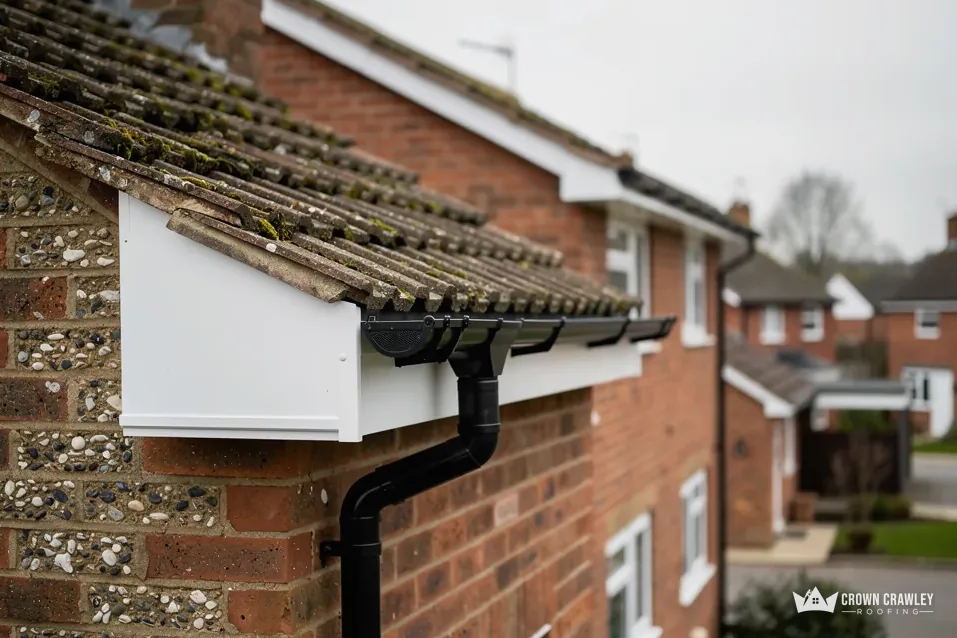
Fascia and soffit work, covered in Checkatrade's guide (updated December 2025, table September 2026), runs at around £150 per linear metre, with capping over existing boards at £85 per linear metre. A small semi averages £2,750. Fascia means the front board the gutter clips to; soffit means the flat panel beneath the overhang. Gutters alone are £650 to £1,700, average £1,000, for 15 to 20 metres with three downpipes (October 2026). See the page on gutter replacement cost.
And roof windows?
Checkatrade's window fitting guide (October 2026) averages £1,250 for a new roof window and £1,025 to replace an existing one. Repairs run from £165 to £1,050, and a full like-for-like replacement £1,000 to £2,500 (July 2026). Our guide to the cost to fit a Velux window sets out what changes between roofs.
What does roof cleaning cost?
Checkatrade's April 2026 roof cleaning guide gives £8.50 to £14 per m², with hand removal and biocide at around £11.50 per m². For a semi that comes to £637.50 to £862.50, and scaffold, where needed, is around £18 per m² on top. Professional cleaning should use products authorised for the job, applied to the label, and should avoid high-pressure jets that can damage tiles. Read more in our roof cleaning cost page. Cleaning often shows up other jobs, such as a cracked tile or a blocked gutter, so a survey photo of the roof before and after is worth asking for.
Scaffold, VAT and reading a quote
Three things can quietly change a total: whether it includes scaffold, whether it includes VAT, and how much the roofer expects to find once the covering is off.
How much does scaffold add?
Checkatrade's roof replacement guide (October 2026) estimates scaffold for a new roof at £700 to £1,300. Where scaffold stands on the public highway, Highways Act 1980 s169 asks for a highway authority licence, while private land needs none. Ask your roofer who arranges it, and check the total covers that fee. Our page on scaffolding for roof repairs explains when it is worth having.
Is VAT included?
Per GOV.UK, the standard rate of VAT is 20%. Some of Checkatrade's tables are marked ex VAT, so a national range can sit well below the figure you finally pay. The one common exception is energy-saving materials such as insulation, which GOV.UK lists at zero rate to 31 March 2027 and then 5%. Our post on VAT on roof repairs goes through the cases.
What should a good quote look like?
It should be a single total in writing, after someone has looked at your roof, saying what is covered and what happens if hidden damage turns up. Citizens Advice recommends at least 3 written quotes before you decide. When you compare them, check that each includes the same scaffold, the same VAT treatment and the same covering. A lower total that leaves something out is not lower at all. If you want Crown's number, send us your address and a few photos of the roof, and we will arrange the survey.
Part of Roofers in Crawley: the full guide
Roof cost questions
Is a roofer's day rate a fair way to judge a quote?
Only as a rough check. Checkatrade's June 2026 repair guide gives £35 to £45 per hour or £280 to £360 per day for a roofer. A real job also needs materials, access and waste removal, and the time depends on the roof, so a fixed written total after a survey is the better test.
Why do two roofers quote very different totals for one roof?
Usually the scope differs. One may price scaffold, new underlay and ridge fixings while the other prices only the covering, or one may allow for hidden timber repairs and the other not. Ask each to say in writing what is included, and whether VAT is in the total.
Is there a grant to pay for roof work?
For a new roof, usually no. The national schemes now running pay for insulation and heating, not for re-roofing or repairs, and each one sets its own rules on household income and energy rating. Your council can say what is open locally, and GOV.UK lists the current schemes, so check there before you plan around any help.