Ask three roofers how they clean a roof and you may hear three different answers: scraping, jet washing and soft washing. The last term is the one people understand least, because it describes a method and not a product. In plain terms, soft washing means applying a cleaning solution to the roof at low pressure, leaving it to do the work, and rinsing it off gently, so the tiles are not blasted with a hard jet of water.
That sounds simple, but a lot hangs on the details: what the solution is, how much water is used, where it runs afterwards and what the roof looks like once the job is done. This guide walks through each of those. It covers why high pressure is a poor fit for tiles, how a soft wash is carried out, how run-off is controlled, what results are realistic, and what a soft wash cannot do. Read it before you compare quotes, because the word "soft" gets used loosely. The roof cleaning and moss removal page shows how this method fits into a full clean.
What soft washing means on a roof
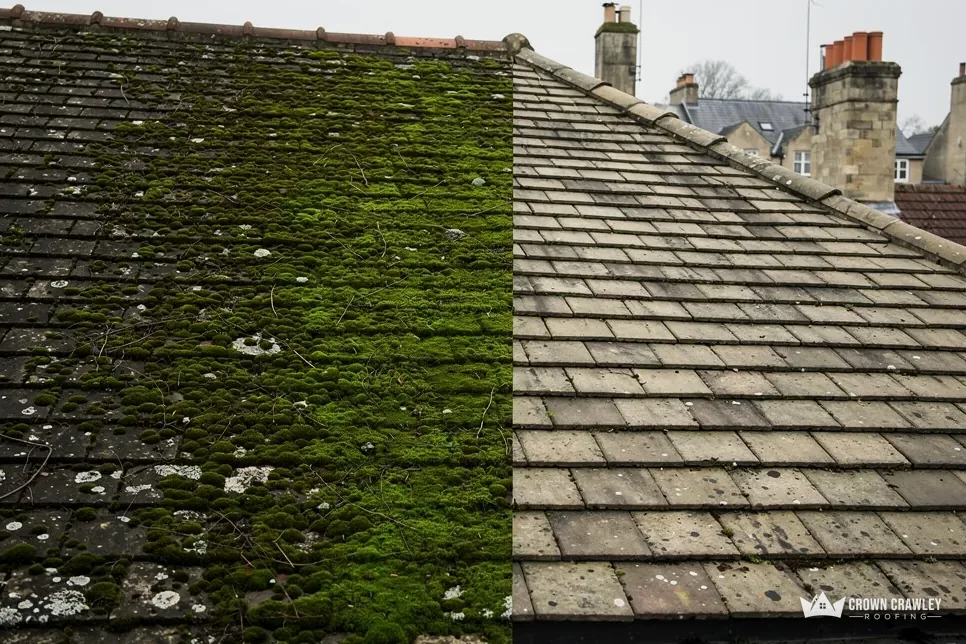
On a roof, soft washing is a way of cleaning with chemistry instead of force. A solution that kills moss, algae and lichen is sprayed onto the surface from a low-pressure pump, much like a garden sprayer but with a wider and steadier spread. It is left to dwell, then rinsed away with clean water at low pressure. Growth that is thick, such as a layer of moss, is usually lifted off by hand first, because no spray will dissolve a mat of moss deep enough to hold a handful of water.
How does it differ from jet washing?
A jet wash uses a narrow, powerful stream to blast dirt off, and on a tiled roof that stream can be the problem. Marley, itself a tile maker, steers people away from powerful jetting, which it says can harm the face of slate and tile and cut into its working life. Soft washing leaves the surface alone, so the roof is cleaned without being worn. Our page on pressure washing roof tiles sets out the reasons in more detail.
Is "soft" always soft?
Not always. Some firms use the term for a washer set to a lower pressure than usual, which is still a jet. Ask what pressure is used and whether the lance is held well off the tile. If the answer is vague, ask for the method in writing on the quote, because a vague method is hard to hold anyone to if the tiles come off worse than they went on.
Which roofs suit a low-pressure wash
Soft washing suits most pitched coverings, because it works on the growth and not on the tile. That is why surveyors and roofers reach for it first on tiles of unknown age. It is a particularly good fit where the surface is old, soft or already worn, and where force would do harm. The method does less for roofs that are sound but heavily loaded with thick moss, where hand removal does most of the work.
What about concrete and clay tiles?
Both take a soft wash well. Our page on moss on concrete roof tiles explains how growth takes hold on that surface, and why gentle treatment beats scouring. Clay tiles can be sensitive in a different way: older and handmade ones may have a fragile face, and our page on cleaning a clay tile roof covers the points to watch. For both kinds, a low-pressure treatment is the safer choice.
What about slate and other coverings?
Slate is brittle at the edges and is held by nails and hooks, so it should be cleaned gently and from a safe position. A cracked slate or a loose tile found on the day should be reported and photographed before anything else is touched. Our page on broken tiles found during roof cleaning describes what happens next. A soft wash is also no cure for a roof with failing felt or lifted ridge tiles; cleaning shows those faults up but does not fix them.
How a soft wash is carried out
The method is simple, and a job usually runs in this order. Knowing the order helps you spot a crew that cuts corners, and it gives you a checklist to hold up against the quote you are handed.
Preparation and access
The roof is surveyed first, from the ground and close up, and loose or broken tiles are noted. Scaffold or other safe access is set up where the roof, the height or the pitch require it, and nobody stands on tiles that could slip. Gutters are checked, windows and vents are closed, and the garden is prepared as set out in our guide to roof cleaning chemicals, gardens and ponds.
Removal and application
Thick moss is brushed or scraped off by hand and collected, not washed down into the gutters. The solution is then applied from the top of each slope downwards, which covers the surface evenly and stops dirty streaks running across clean tiles. The mixture follows the product label, and the dwell time is whatever the label says; a roofer ought to name it when you ask.
Rinse and finish
Once the solution has worked, the roof is rinsed at low pressure. Debris in the gutters is cleared, downpipes are checked, and the crew report what they found. A written note of any broken tiles, with photos of your own roof, is a sign the job has been done properly. If you want to know how long it all takes, how long a roof clean takes breaks it down.
Controlling run-off from a soft wash
One strength of soft washing is that it uses relatively little water, because the chemistry does the work and the rinse is gentle. That makes the run-off easier to manage than the output of a jet wash, which sends large volumes of water across the roof and over the edge. Even so, whatever washes off the tiles still lands in the gutter, so a plan is still needed, and it should be agreed before the first spray.
Where does the water go?
It follows the path of rainwater: along the gutters, down the pipes and out at the bottom. If the downpipes reach a soakaway, a water butt, a pond or a bed of plants, the crew need to know before the work starts. A careful contractor covers or diverts the outlets where needed, blocks gullies that lead to drains the product label advises against, and rinses planted areas with clean water.
What should the product label say?
The label limits the strength, the surface and the way the product is applied, which is why it matters. The HSE advises that trade-only biocides are not for householders, so the product name and the label are worth reading before the day. Ask for both, and keep a note of them with your quote.
Wildlife is part of the plan too. Nests that are in use and bat roosts are protected by law, so tell the roofer about both before work starts.
What results to expect and when
A soft wash does not make a roof look new the day it is done, and a good roofer will tell you that at the survey, before any money changes hands. The treatment works over time, so the full effect appears gradually as the dead growth dries, breaks down and is washed away by rain.
What changes on the day?
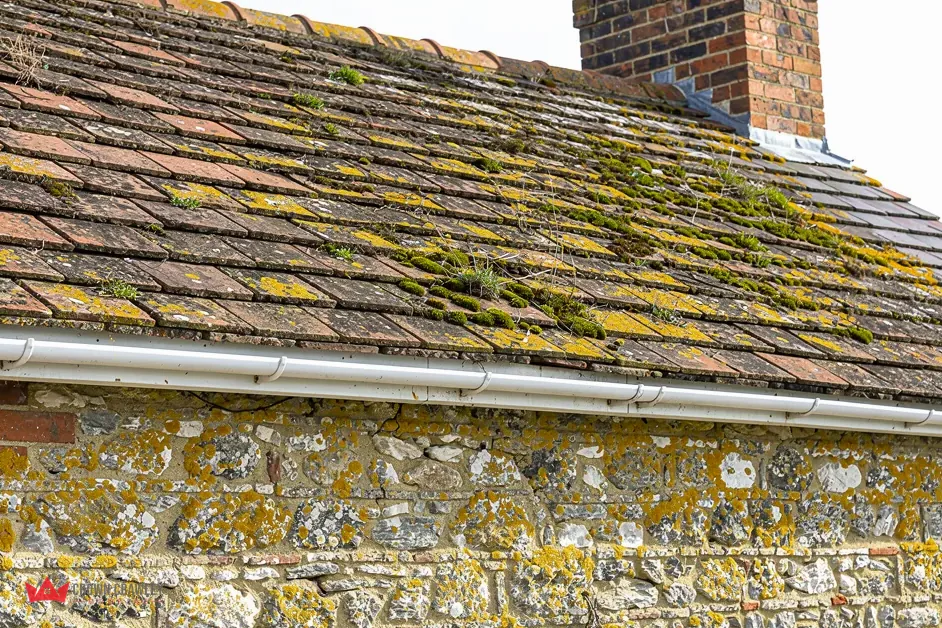
Loose moss and surface dirt are removed, so the roof looks cleaner straight away, and the gutters are clear. Staining from algae, the black or green streaking on north-facing slopes, may be less obvious at first, then fade over the following weeks as the treated growth breaks down. Our page on black streaks on roof tiles explains what those marks are. How quickly the colour changes depends on the product, so ask what to expect for the one being used.
How long do the results last?
That depends on the roof and its surroundings. A shaded slope under trees collects spores and damp faster than a sunny one, and the growth returns sooner. Nobody can promise a figure, and anyone who gives one without seeing the roof is guessing. Our page on how long roof biocide lasts covers the factors.
What does it not fix?
Cleaning does not repair cracked or slipped tiles, rotten battens or failed flashing. Treating a roof that is worn out only makes it look better for a while, and the survey shows whether the money would do more good spent on repairs. If a cleaned roof reveals a lot of tired tiles, you will see that in the photos we share, and you can decide what comes next knowing exactly what the roof is like.
Cost, and whether a soft wash suits you
Cleaning is charged by the area of roof and the access needed. In its April 2026 table, Checkatrade lists typical UK work at £8.50 to £14 per m², with hand work plus biocide near £11.50 per m², a semi-detached house at £637.50 to £862.50, and scaffold, where needed, near £18 per m². None of those is a price for your roof. What we hand over afterwards is a single total in writing.
What pushes the price up or down?
The size of the roof matters most, followed by how much moss has to come off by hand and how awkward the roof is to reach. A roof that needs scaffold costs more than one served by a ladder or a tower. Anything the survey turns up, such as broken tiles or blocked gutters, moves the figure again. Our page on roof cleaning cost goes through the factors. When you compare offers, check what each includes: the method, hand removal, gutter clearing, scaffold and VAT. A quote that says only "roof clean, one price" tells you nothing about the method, and the lowest figure may be a jet wash that wears your tiles.
When is a different approach better?
A roof with only a light covering of dry moss can sometimes be cleaned by hand alone, which avoids a solution altogether. Our page on manual moss removal from a roof explains where that works. A flat roof needs a different method, covered in cleaning moss off a flat roof.
What should you do next?
Photograph the slopes from the ground, note which are shaded and say whether the downpipes run to a pond, butt or soakaway. We take it from there at the survey. If you are also weighing up a protective finish after the clean, roof tile coatings have their own guide.
Part of our Roof Cleaning & Moss Removal in Crawley
Soft washing, answered
Does soft washing remove moss or only kill it?
Both, in two steps. Thick moss is lifted off by hand first, then the solution treats the growth that remains, which breaks down over the following weeks. The treatment alone will not clear a thick mat, which is why the hand work comes first.
Is soft washing gentler on my tiles than a pressure washer?
Yes. A jet delivers force straight onto the face of the tile, while a soft wash relies on the solution and a low-pressure rinse. Tile makers steer people away from powerful jetting for that reason, and the gentler method leaves the surface intact, which is why it is the usual choice on tiled roofs.
Must someone be in during a soft wash?
Not for the whole job, but be there at the start to agree the plan for the garden, the downpipes and any pond, and at the end to hear the findings and see the photos. Windows and vents must be closed, and the crew need to reach an outside tap for rinsing.