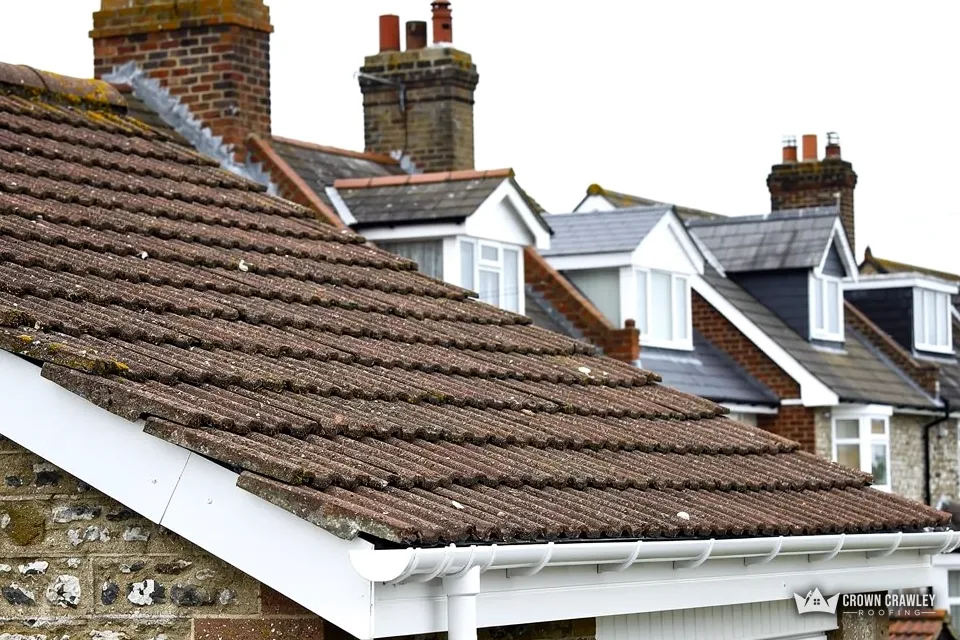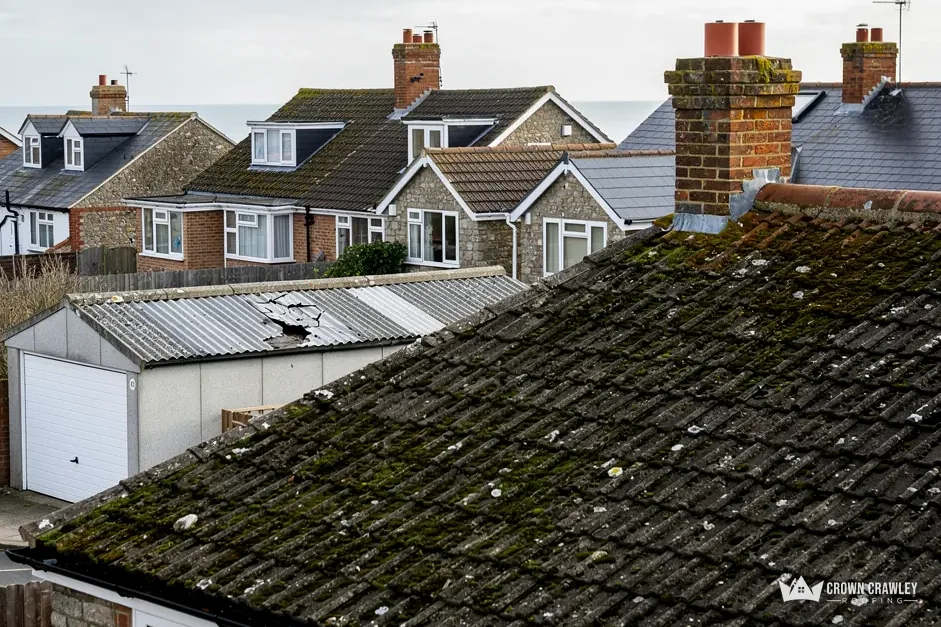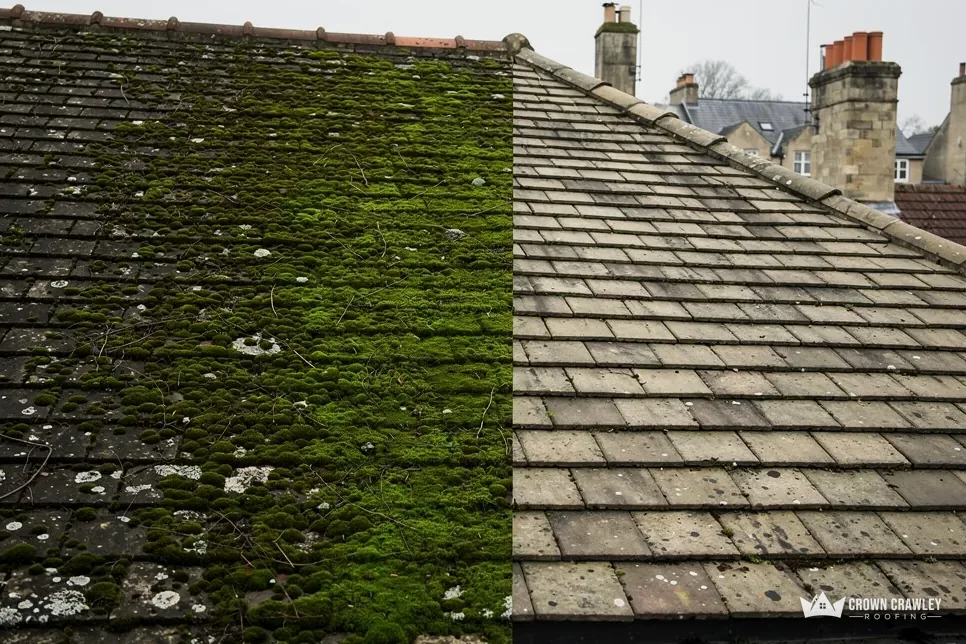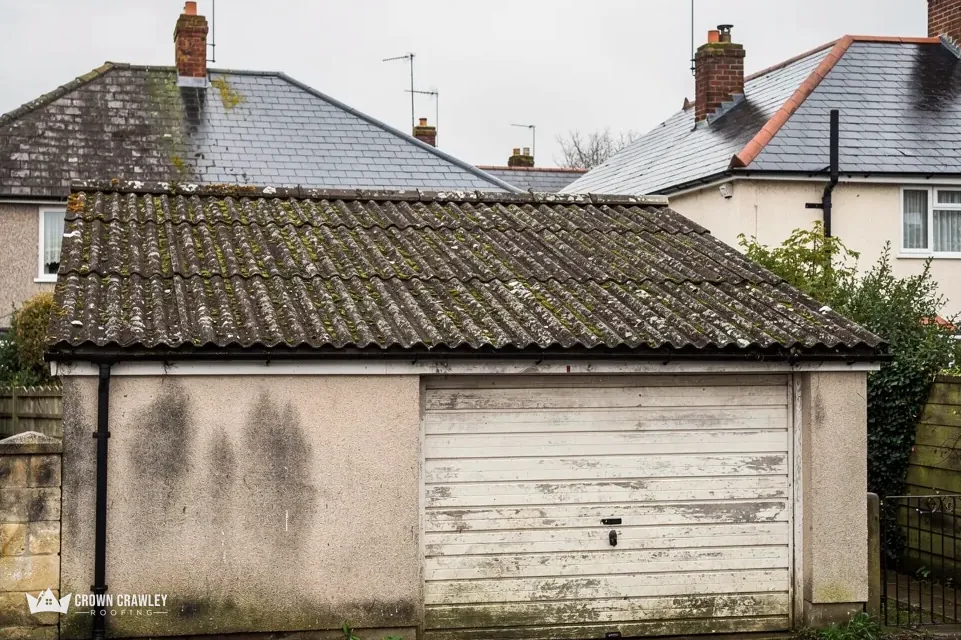
Moss does not grow on a dry, well-drained surface. When it appears on a flat roof, something is keeping the covering wet: a hollow that holds water, a blocked outlet, a layer of leaves and silt, or a gutter edge that has sagged. The green or black film is the plant life telling you where the damp sits. Scrape it off and leave the cause, and it will be back within a season or two.
Flat roofs also take a different kind of care from pitched ones. The covering is a continuous membrane, not overlapping tiles, so a nick from a scraper or the wrong chemical can open a path for water straight into the building. A garage roof, an extension, a porch and a dormer top are all small areas, and it is tempting to climb up with a stiff brush. This guide explains why moss grows on each of the common coverings, how to clear it without harming the membrane, how to deal with ponding, and when clearing is not enough and a repair or a new covering is the sounder choice.
Why moss and algae grow on a flat roof
Moss needs moisture, a little shade and something to hold on to. A flat roof offers all three in the wrong places. Leaves, seeds and dust settle on a surface that does not shed them as a pitched slope does, and they rot into a thin soil. Moss spores land and take hold in the damp patches, and algae spreads as a green or black film in the wetter areas.
What does the growth look like?
Algae appears as a green, grey or black stain that spreads across the covering. Moss stands up from the surface in cushions, often along the edges, around outlets and in the lowest part of the roof. Lichen forms flat, crusty patches. Seeds sometimes germinate in silt, and a small weed in the corner of a flat roof shows how long that silt has sat there.
Is it only cosmetic?
Not always. Growth that stays wet against the covering holds water on it, and moss roots can lift the edges of felt laps and get under the seams. Moss and debris near an outlet also block drainage, which makes the ponding worse. A roof that holds water for days after rain is carrying a load it was not meant to, and the covering ages faster. Our guide to ponding water on flat roofs covers the water side of the problem.
Shade makes a difference. A roof under a tree, or against a taller wall that blocks the sun, stays damp longer after each shower and grows moss sooner. Trimming back branches helps, though leaf fall and the water they drip still land on the roof.
Ponding: the cause behind the moss
Flat roofs are not flat. They are built with a gentle fall toward the outlet so that rainwater runs off. The current code of practice, BS 6229:2025, keeps a minimum finished fall of 1:80 across general roof areas and internal gutters. The membrane maker IKO, writing about the 2018 edition, advises designing for 1:40 so that the finished roof still drains once the build has settled and tolerances are allowed for.
Why does water stay on the roof?
Several things cause it. The deck may have sagged between joists, a board may have swelled, the original fall may never have been enough, or the outlet may sit higher than the lowest part of the roof. Silt and leaves can also dam the water at an edge. Ponding that is shallow and clears within a day or two is a nuisance. Water that lies for long spells, or that returns to the same hollow every time, points to a shape fault that cleaning will not cure.
How do you tell a hollow from a blocked outlet?
Watch the roof the day after rain. If the water drains to the outlet slowly and leaves a dirty tide mark, the outlet or gutter is partly blocked. If water sits in a patch in the middle of the roof away from any outlet, the deck has dipped. A roofer can confirm this with a level or a straight edge. From an upstairs window, photograph the water a day after rain and send it with your enquiry.
Fixing a dip can mean lifting the covering and adding tapered boards or levelling the deck. Which route suits a roof depends on the deck, the covering and the budget, and the written quote after the survey sets it out as one total price.
Moss on felt, EPDM and GRP
The three common flat roof coverings behave differently under a brush and under a treatment, so the method has to suit the material.
Felt
Felt roofs are bituminous sheets, often with a mineral cap, laid in layers. The surface is rough and holds growth well. Felt is also easier to damage by scraping, because the cap sheet can be torn or its granules stripped. The Less cost guide, updated March 2026, gives felt 10 to 20 years, so a felt roof with heavy moss and blisters may be well into later life. Our guide to torch-on felt safety covers the installation side.
EPDM
EPDM is a synthetic rubber membrane laid in a single sheet. It is smooth, so growth sits on the surface and brushes off more easily, but the membrane can still be cut by a blade or a hard-edged scraper. GreenSpec lists 20 to 30 years as the expected service life. Watch the edges and upstands, where debris and standing water gather.
GRP
GRP, glass-reinforced plastic, is a rigid fibreglass skin laid without laps with a resin topcoat. It resists moss better than felt, but algae still stains it, and the gelcoat can be dulled by harsh scrubbing or strong chemicals. The Less guide gives GRP 25 to 40 years.
On any covering, the aim is to take the growth off the surface without cutting, scouring or leaving harsh residue behind. Check the maker's care advice if you have it, because a warranty can depend on how the roof is maintained.
Clearing moss without damaging the membrane
The safest approach is the gentlest one that works, and on a flat roof that usually means hand tools that cannot cut and a treatment that does the rest.
How is the growth removed?
The roofer clears loose leaves and silt by hand first, then lifts moss with a soft brush or a plastic scraper, working in one direction toward the outlet. Metal blades and wire brushes are out, as is a pressure washer on a felt or GRP surface. Tile maker Marley advises against high-powered jets on its own products, and the caution carries over to a membrane, where a jet can lift laps and drive water under the seams. See our page on manual moss removal for the method.
What about treatment?
An authorised moss and algae treatment can be applied after the main growth is off, to kill what remains. The HSE keeps professional-only biocides out of the hands of the general public, and each product comes with conditions on the label that have to be followed. Ask what is being used and check that it suits the covering. Treated runoff goes to the outlet, so keep ponds and water butts clear of it. Our page on how biocide roof treatment works explains what the treatment does.
Who should go up?
A flat roof is not always safe to stand on. Rotten decking, rooflights and thin edges can give way. If you are not sure the surface will bear weight, leave it to a roofer who can reach it safely. Never lean a ladder on a gutter.
After the clean: edges, outlets and repairs
Once the roof is clear, the real condition of the covering shows, and this is when most of the useful decisions get made.
What should you check?
Look for blisters, splits at the laps, cracking along upstands, lifting at the edge trim and a hollow around the outlet. A clean roof often shows a repair that needs doing, and moss may have been hiding a split. Check the outlet, gutter and downpipe for blockages, since a clear roof draining into a full gutter is still a wet roof. Our page on moss in gutters covers that side.
When does cleaning stop being enough?
A repair is worth doing if the covering is sound and the damage is local. Renewing the covering is the better buy when blistering, splitting or ponding spreads across the roof, or when the covering is near the end of its expected life. Our guide to repairing or replacing a flat roof helps with that call.
What about the rules?
Approved Document L counts renewing a flat roof's waterproofing as renovation, and bigger renovations bring insulation upgrades into scope, so a re-cover can raise insulation questions. Cleaning alone does not. If a re-cover is planned, ask your building control body whether the work needs approval.
Once the roof is clean and dry, it is a good moment to photograph it. Pictures of the covering, laps and outlets give you a record to compare against next year, and show a roofer how fast any wear is moving.
Keeping a flat roof clear
A flat roof does not need a lot of attention, but it does need some. A short routine stops most moss before it starts.
How often should you look?
Look at the roof after autumn leaf fall and again after winter, from a window, a landing or a safe ladder position on the ground. Check for debris at the outlet, standing water that has not drained within a couple of days, and new growth at the edges.
What does it cost, nationally?
Checkatrade's roof cleaning guide, April 2026 table, lists £8.50 to £14 per m² for cleaning, and its flat roof pages list £50 to £80 per m² for felt and £80 to £100 per m² for EPDM when a roof is renewed. Use them as a yardstick only. A hollow that needs levelling, or a covering past its best, changes the picture, and after our survey you get one written total. Ask whether VAT, charged at the standard 20%, is inside the figure you are given.
What should you send us?
A few photos of the roof after rain, the type of covering if you know it, and a note of any damp patch indoors. Say whether water lies for more than a day. Tell us if the roof is above a habitable room, a garage or a lean-to. The full range of work is on our roof cleaning and moss removal page.
Part of our Roof Cleaning & Moss Removal in Crawley
Flat roof moss queries
Why does moss keep coming back on my flat roof?
Usually because water still sits on the surface. Moss needs damp, and a hollow, a partly blocked outlet or a silted edge keeps the covering wet. Clearing the growth without curing the ponding gives a clean roof for a season. A survey finds where the water stays and why.
Can I clean moss off a felt roof myself?
You can sweep loose leaves and silt from a safe position with a soft brush. Scraping felt risks tearing the cap sheet, and a flat roof may not bear your weight. Treatments have rules about who may use them. If in doubt, ask a roofer to deal with it.
Does cleaning a flat roof need building control approval?
Cleaning alone does not. Approved Document L counts renewing a flat roof's waterproofing as renovation, so a re-cover may need approval depending on how much of the building envelope is affected. Ask your building control body before any re-cover starts, and keep what they send.