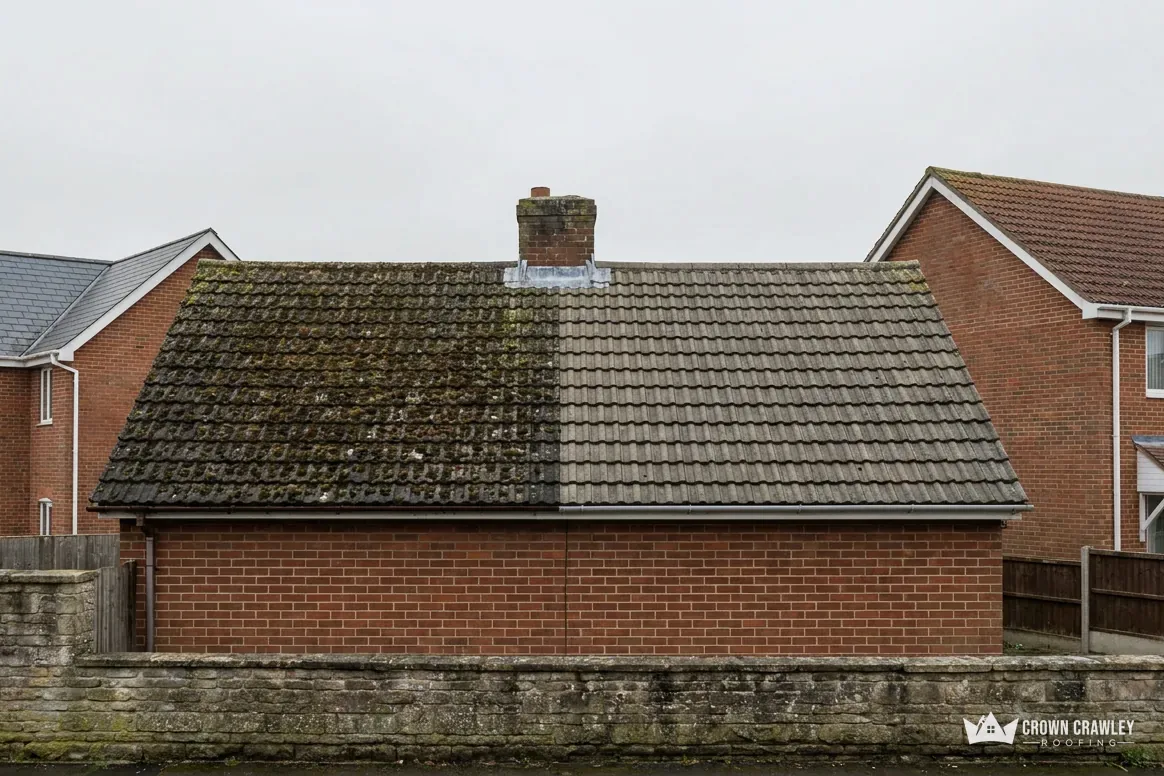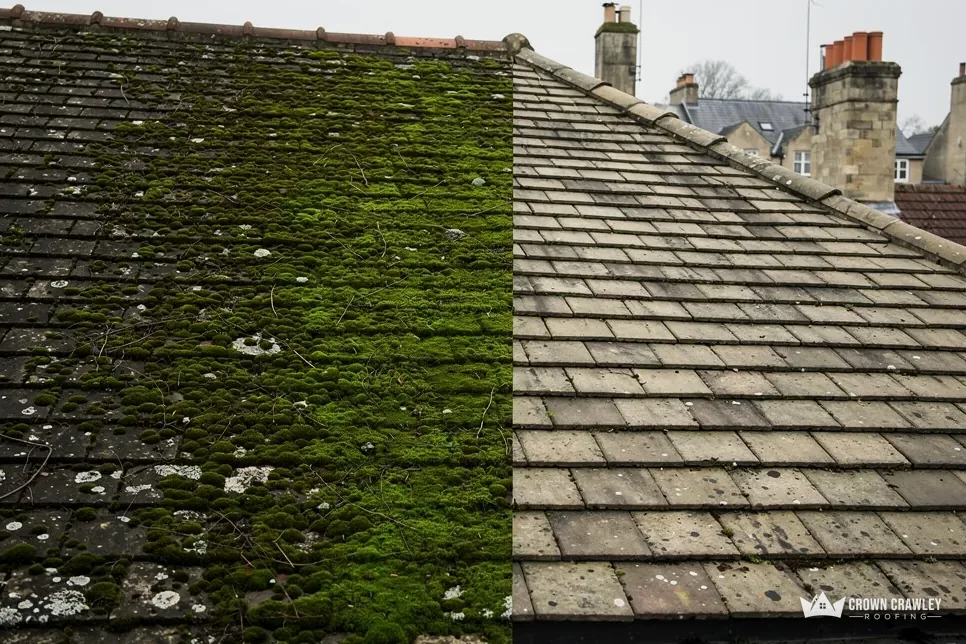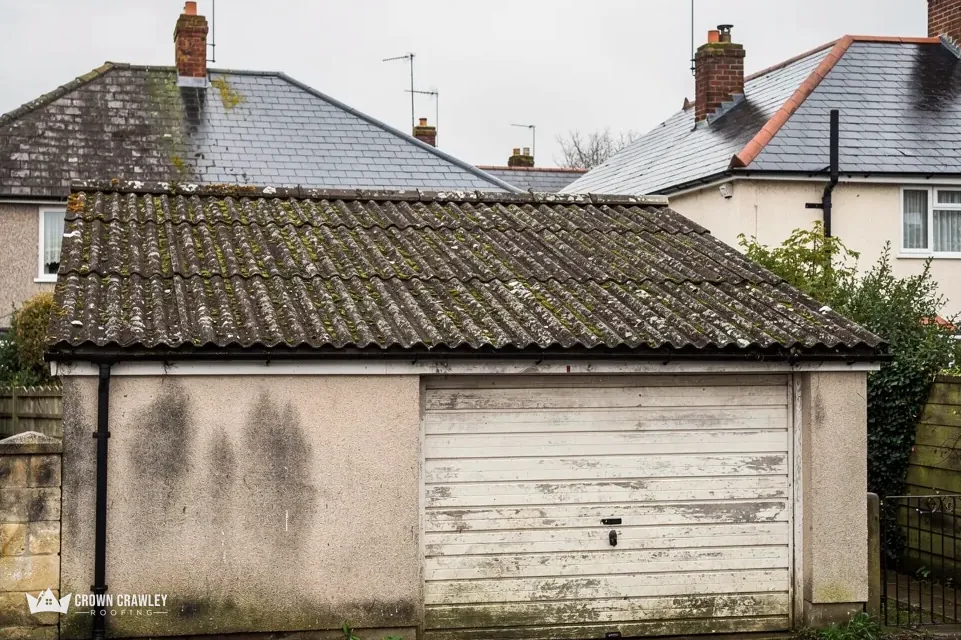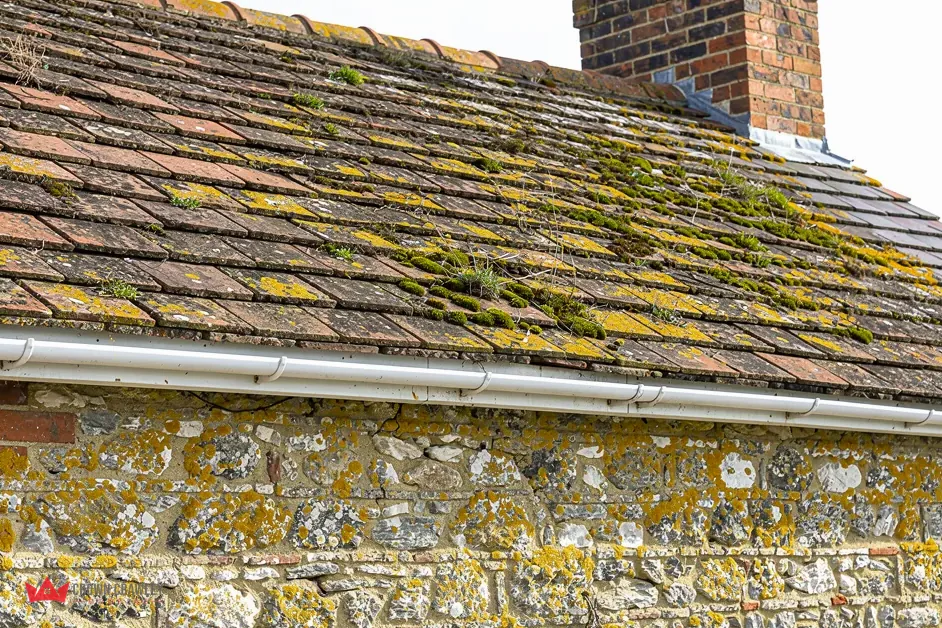
Moss grows in a thick, springy mat that roots itself into the rough surface of a tile. It holds rainwater against the covering, lifts the edges of tiles as it swells, and sheds clumps into the gutters when it dries. Getting it off sounds easy until you picture doing it on a sloping surface two storeys up, with a covering that cracks if stepped on wrongly.
Hand removal is the oldest method there is. Someone with the right access and a set of scrapers and brushes works along each course of tiles and lifts the growth away. It is slow, and it is the approach least likely to harm the surface. This guide covers what hand scraping involves, why it suits tiled roofs so well, what it cannot do on its own, how a roofer works safely and where the moss ends up, and what the labour does to the price. It also explains why hand work and a biocide treatment are normally booked together.
What hand scraping involves
Hand removal uses simple tools: a flat scraper with a blunt edge, stiff brushes, and a bucket or sheet to catch what comes off. The roofer works from the top of a slope to the bottom, one course at a time, running the scraper upwards against the lie of the tile to lift the moss without catching the edges. A brush then follows to sweep off what the scraper has loosened.
Why work from the top down?
Gravity does the sorting. Loosened moss slides downhill, so starting at the ridge keeps the cleaned area clean. Working the other way round drops fresh debris over tiles that were already done and doubles the effort. The ridge, where two slopes meet at the apex, is also the first place the roofer can check that the mortar or dry-fix fittings are still sound while the slope is being cleared. Starting there means every later pass is on ground that has already been looked at. It also lets the roofer judge how deep the growth runs before committing to a method, because the shaded end of a slope is often thicker than the sunny end.
What do the tiles look like underneath?
This is one of the quiet benefits of hand work. A roofer who touches every tile notices the ones that ring dull, the corners that have crumbled and the nibs that have snapped. Those faults sit under a moss mat and are easy to miss. Finding them mid-clean means we can take pictures of the damaged tiles and walk you through them afterwards, in the same way as at the first survey. You then decide what to do with full information, and nothing gets replaced without you knowing.
Why hand work suits tiles best
Roof tiles are made to shed water from above, not to be scrubbed. Concrete tiles carry a surface layer, clay tiles have a fired face, and slates are thin and brittle at the edges. Any method that rubs hard or fires water at the surface risks wearing that skin away. Once it goes, the tile soaks up more water and grows moss again faster than before.
How gentle is a scraper?
A blunt scraper and a soft-to-medium brush remove the moss but leave the face of the tile alone. The roofer controls the pressure through the hand, and can feel a tile that is loose or cracked before it breaks. A machine cannot do that. If you want to see why we keep jets away from tiles, our guide on whether pressure washing a roof is safe sets out the problems.
Which roofs benefit most?
Any older or weathered covering gains from the careful approach. Aged concrete tiles, hand-made clay tiles, plain tiles with thin edges and natural slate all do better with a hand tool than with force. Crawley's later-built estates and the older brick-and-tile villages around its edges can differ in age, so we look at the actual covering at the survey instead of assuming, and choose the method to fit.
Hand work also gives a clear stopping point, which is rare with other methods and worth a lot on older tiles. When the moss is gone, the roofer stops. Nothing keeps working on the surface afterwards, so there is no risk of over-cleaning a tile that was already worn.
What scraping cannot do alone
For all its virtues, a scraper takes off what stands proud of the surface and leaves what is embedded. Moss sends fine threads into the pores of the tile, and a scraper cannot reach those. Algae, the dark or green stain that streaks tiles, sits in the surface itself and a scraper barely marks it. Lichen, the flat crust, is harder still, and scraping hard enough to shift it would mean scraping the tile.
What is left behind?
A hand-cleaned slope looks far better than before, though not brand new. You may see stained patches where the algae sits, pale marks where lichen was, and a rougher feel in places where the moss was thickest. That is to be expected and says nothing bad about the workmanship. The remaining growth is what a biocide is meant for, and our explanation of how biocide roof treatment works shows how it finishes the job over the following months.
Why the two are combined
Used together, each covers the other's weakness. The scraper removes bulk and lets the biocide reach the surface, while the biocide deals with the roots, stains and spores that the scraper left. Used alone, hand removal gives a good result that fades as regrowth starts from what remains. Used alone, biocide leaves dead moss to fall into the gutters over a long spell. The combination gives a clean roof and a slower return of the green, and the Checkatrade guide behind the cost section below treats the pairing as a standard job.
Working safely on a tiled roof
A tiled roof is not a place to walk. Tiles can crack under a boot, a wet roof is slippery, and moss makes the surface worse. Even an experienced hand plans every step of the access before touching a tile. The way we reach the roof depends on the house, the height and what stands around it.
How does a roofer get access?
On a low roof with a clear approach, a long ladder plus a roof ladder, a lightweight ladder that rests on the tiles and hooks over the top, may be enough. It spreads weight across the tiles and gives a firm line to work from. On a taller or more complicated building, scaffold is the safer choice, with edge protection at the eaves so nobody can slip over the gutter. The scaffold may also give a safe way to clear the gutter from above, and to reach a chimney or valley that a ladder cannot get near without leaning awkwardly. Where the poles must stand on the footway or in the road, the highway authority issues a licence, and the paperwork is sorted out jointly with the scaffolder. Poles set up within your own front garden or drive are a different case, with no licence involved.
Should you go up there yourself?
We would not. Falls from roofs and ladders are a leading cause of serious injury in the building trade, and a householder is less equipped than a professional. Staying on the ground, you can still look for slipped tiles, watch where water spills over the gutter and photograph the slopes for the survey, which is plenty of help without the risk.
Where the moss goes next
Once a roofer has scraped a slope, there is a heap of damp green material at the bottom of it. If nothing is done, it settles in the gutter, blocks the outlet and breeds fresh growth. A good job plans for that debris from the first minute.
How is the debris caught?
On many jobs the moss is brushed down into a sheet or a trough, bagged and taken away with the other waste. Where it lands in the gutter, it is lifted out by hand once the slope is finished and the gutters are then flushed with water to check that the downpipes run freely. Clearing the gutter before the slope is finished only means doing it twice. Our page on moss in gutters explains why this step matters as much as the scraping.
What about birds and bats?
A moss mat can hide more than tiles, and it can also hide the very faults a survey is looking for. Small birds sometimes nest under the lifted edge of a roof covering, and bats can roost in gaps at the eaves and ridge. Both have legal protection. Government guidance gives bats and their roosts strict protection, and the Wildlife and Countryside Act 1981 shields active nests from deliberate harm. If a roofer finds signs of either, work on that area pauses while advice is sought. That is slower, but it is the lawful route, and it keeps you as the owner out of trouble.
Time, labour and cost
Hand removal is the slowest way to clean a roof, because every square metre is worked by a person and not a machine. A large, heavily mossed slope can occupy a roofer for much of a day, and a whole house takes longer. Rest breaks, moving the ladder or scaffold lifts and bagging the waste all add to the clock, so the honest time is longer than the scraping alone suggests. The time is the cost. Materials are small, so the price follows the hours, the access and the size of the roof.
What does it cost nationally?
Checkatrade's roof cleaning guide, in its April 2026 table, gives hand removal combined with biocide at around £11.50 per m², within a wider typical range of £8.50 to £14 per m². Its semi-detached example runs from £637.50 to £862.50, with scaffold at about £18 per m² on top where needed. Treat these as a national yardstick. Your figure turns on the roof's area and pitch, how high the eaves are and how deep the moss lies.
What do you get for the money?
A roof that has been touched tile by tile and checked as it went. Once we have surveyed, you get one written total before any work begins, and it is worth confirming that VAT and scaffold are covered in it. Our page on roof cleaning and moss removal sets out the full service. To get the survey moving, send us a few clear photos of the slopes from the ground, and we will say which areas get our attention first.
Part of our Roof Cleaning & Moss Removal in Crawley
Hand scraping, answered
Does scraping damage the tiles?
Done with a blunt scraper and a soft brush, it removes the moss without wearing the face of the tile. The risk comes from forcing the tool, or from stepping on tiles that are already cracked. A careful roofer works with a roof ladder or scaffold, so weight never lands on the covering.
How long does hand moss removal take?
Roof area and moss thickness decide it. A small, lightly covered slope is quick. A large roof with deep growth takes much longer, because every course is worked by hand. At the survey a roofer should tell you how long the job should take and what affects it.
Can scraping alone keep the moss away?
Not for long. Scraping removes the bulk but leaves roots and algae in the surface of the tile, so growth restarts from what remains. Pairing it with a biocide treatment slows that return. Neither method makes a damp, shaded roof moss-proof, so some regrowth should be expected over time.