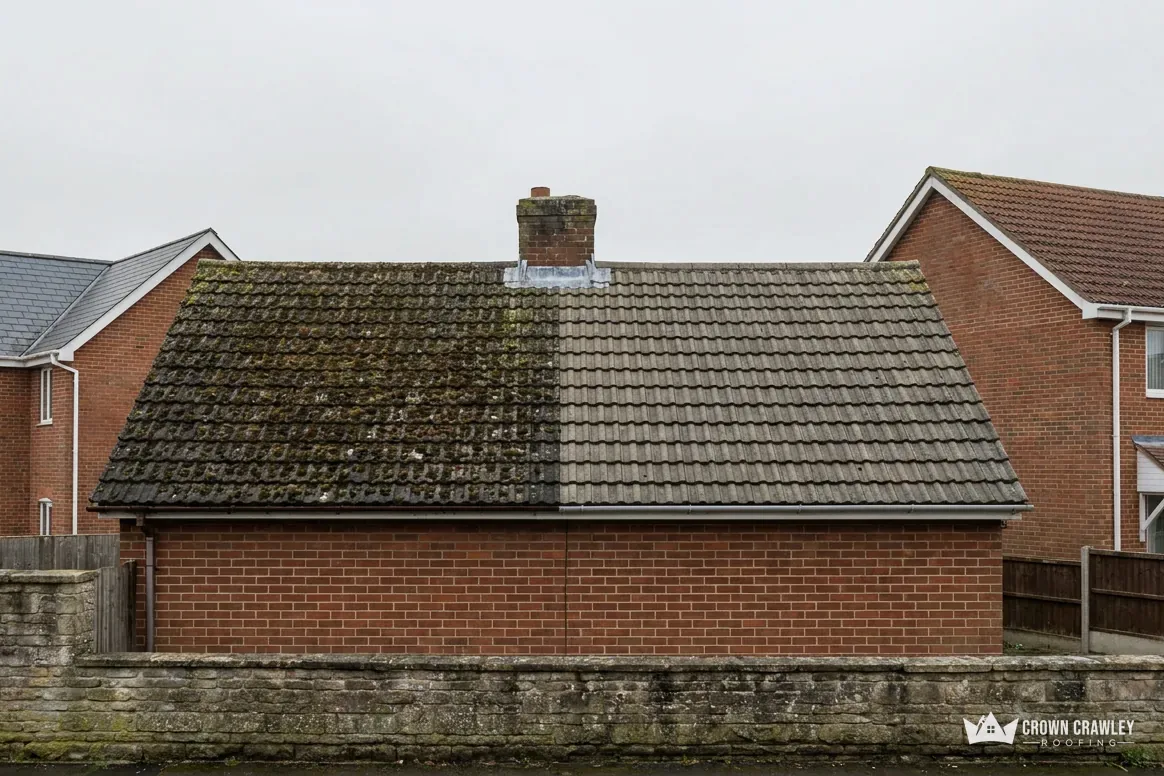
A roof clean is often pictured as a jet of water blasting the green away. A biocide treatment is quieter than that. A liquid goes on, the roof looks much the same for a while, and then the growth slowly dies, turns brown or grey and lets go of the tiles. Because nothing dramatic happens on the day, homeowners often wonder whether the treatment has failed. It has not. It is working at the speed the growth dies.
This guide explains what a biocide is, which products are allowed on a roof and who may use them, how the liquid is applied, and why a roof can look worse before it looks better. It also covers the sensible precautions around plants, ponds and pets, the checks for bats and nests, and what the work costs as a national guide. Biocide is one part of a roof clean, usually paired with removing the heavy growth first, and the sections below show how the two fit together on a pitched roof.
What a roof biocide actually is
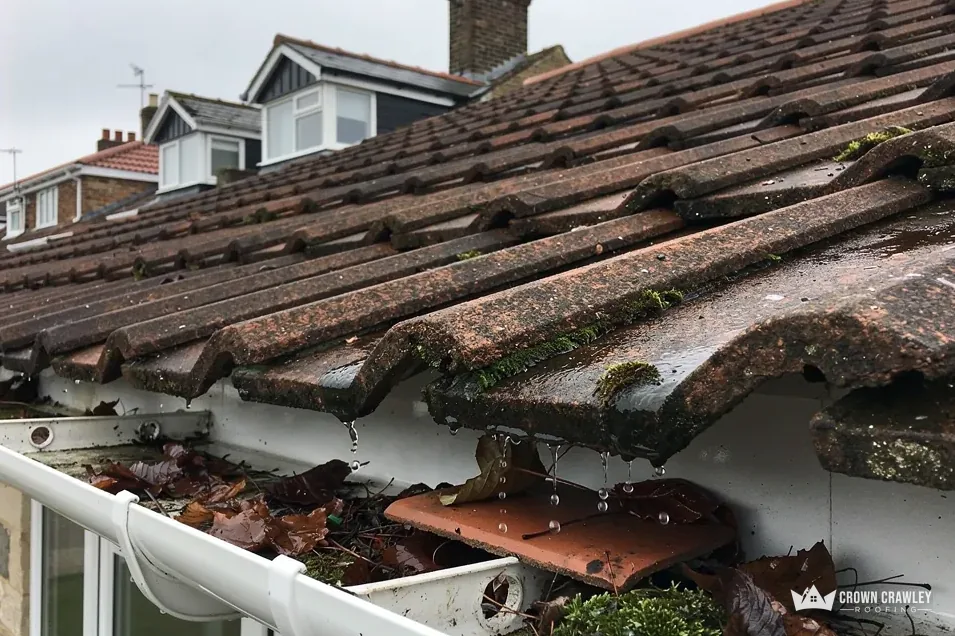
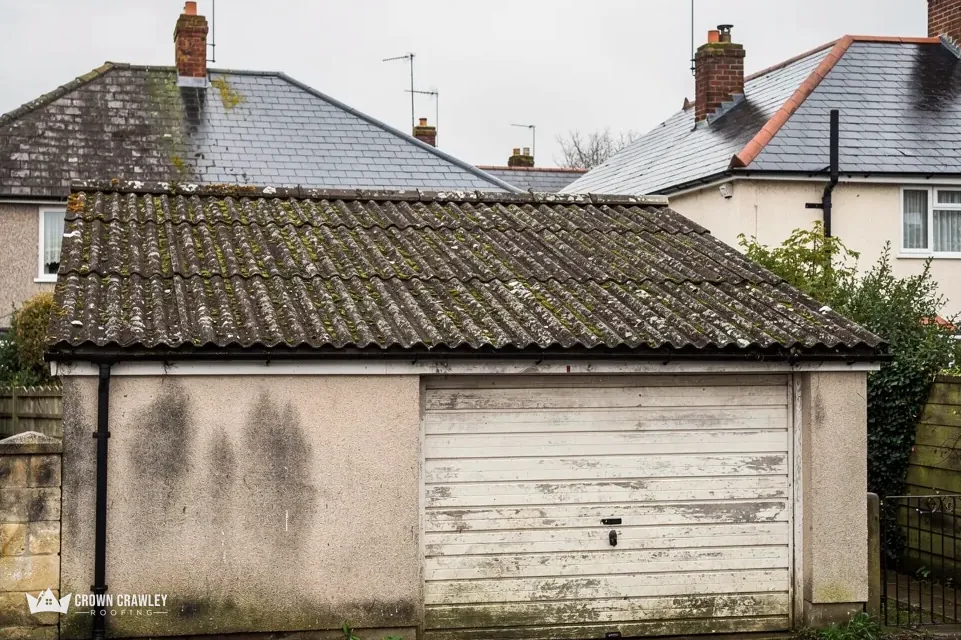
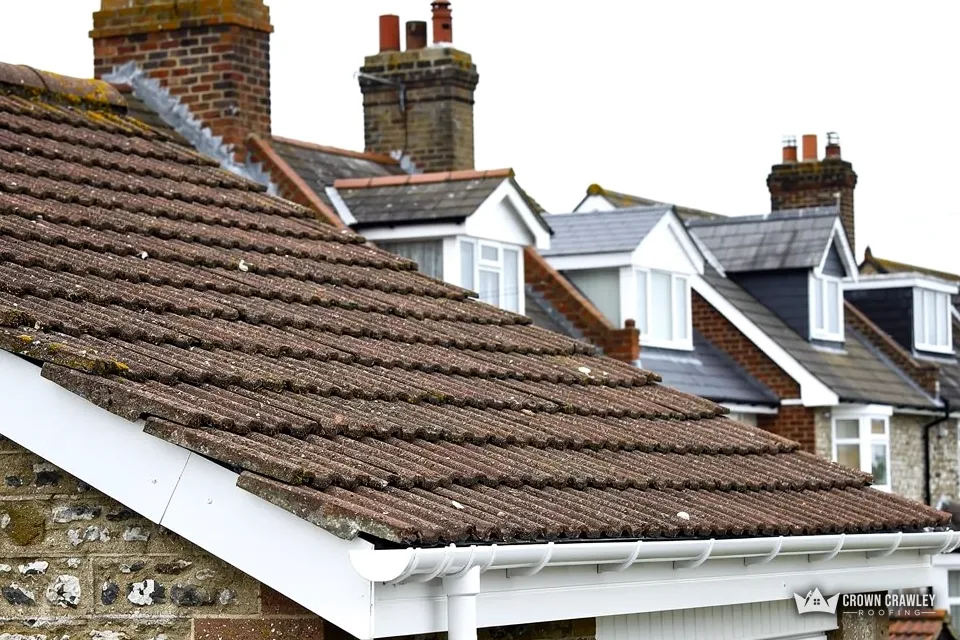
A biocide is a product made to kill living organisms. On a roof those organisms are moss, algae and lichen, the three growths that settle on tiles and slates wherever the surface stays damp. Moss is the bulky green cushion that holds water against the covering. Algae is the thin black or green film that streaks a slope. Lichen is the flat grey or orange crust that grips the surface and is the hardest of the three to shift. A biocide treatment is aimed at all of them.
Does a biocide remove the growth?
No. It kills the growth, which is a different job from removing it. Dead moss still sits on the tiles until rain, wind and a little brushing carry it away. That is why a sensible clean has two parts: take off the loose and heavy growth by hand first, then treat the surface so that whatever is left dies and cannot restart. Our guide to scraping moss off by hand covers the first part.
Does it stop the moss coming back?
It can slow regrowth, but no product makes a roof immune. Moss returns wherever the covering stays shaded and wet, which is why the north-facing slope and the patch under an overhanging tree go green again first. Some products leave a residue that holds growth back for a time, and how long depends on the product, the weather and the shade. We read the data sheet for the product in use and tell you what it says, rather than quoting a promise nobody can keep. A roof that stays damp will always give moss a foothold, so the treatment slows the problem down without ending it.
Which products are allowed on a roof
Biocides are regulated in Great Britain, and the rules apply to exactly this kind of work. The retained Biocidal Products Regulation, article 17(5), requires a product to be used within the conditions of its authorisation and in line with its labelling. In plain terms, the label on the container is not friendly advice. It is the rule, and using a product in a way the label does not allow is a breach.
Can a homeowner use any roof treatment?
No. The Health and Safety Executive warns that products intended only for professional users are off limits to the general public, and that for some professional products the user must hold specific certification. Products sold to the public are a different matter, but they carry a label too, covering how to dilute the product, how to apply it and what to protect while you do.
What does approved really mean?
Under HSE guidance, a product that has not been approved cannot lawfully be used or kept for use, and it cannot be sold or advertised either. The HSE also tells advertisers not to describe a product as 'HSE approved'. For that reason you will not hear us describe a product that way. Our approach is plainer: products that are authorised for roof use, applied exactly as the label directs.
You can check this yourself. Ask the roofer for the product name before the work starts, then read the label and the data sheet. A roofer who cannot name the product, or who mixes something from an unmarked drum, has told you what you need to know. Treat this as general guidance, not legal advice, and use the HSE biocides pages if you are unsure about a particular product. If a contractor offers to leave you a spare tub to top up the job later, ask what the label says about who may use it, since the answer depends on the product.
How the treatment is put on the roof
The order of work matters more than the liquid. On a tiled roof it normally runs like this: access is set up, loose and heavy growth is scraped or brushed off, the debris is cleared from the slope and the gutters, and only then is the biocide applied to the cleaned surface so that it reaches what is left.
Why is the growth taken off before the spray goes on?
A thick cushion of moss soaks up liquid and shields the roots underneath. Spray it and the top layer may take the dose while the base is barely touched. Scraping first leaves a thin layer for the product to work on and shows the true state of the tiles, such as cracks or slipped courses, which a green carpet hides. When the survey and the clean turn up damage, we photograph the damaged tiles and show you what we found before going any further.
How is the liquid applied?
Most products go on with a low-pressure sprayer or a brush, working across the whole slope in even passes rather than dabbing at patches. Patching leaves untreated bands where growth restarts, and these show up as stripes within a season. The roofer works from safe access, keeping the liquid off roof windows, solar panels and painted surfaces where the label says to. The weather matters too. Labels usually call for a dry spell after application, so a roofer will pick the day with the forecast in mind, not just the diary. A treatment put on ahead of heavy rain may be washed off the surface before it has done its work.
Why the results take months
Mechanical cleaning gives an instant result: the moss is on the ground and the tiles are visible. A biocide works the opposite way. It starts a process inside the growth and then leaves nature to finish the job. That is why a roof treated on a Monday can look no different on Tuesday.
What happens to the moss after treatment?
The growth dies where it sits. Green moss turns brown, then grey or black, and dries and shrivels. Algae streaks fade slowly as the film breaks down. Lichen, with its tight grip, is the slowest to loosen. Dead material then has to be washed or blown off the tiles, and that depends on rain and wind, neither of which keeps to a timetable. A sheltered, shaded slope clears more slowly than an exposed one, and a roof can look blotchy while one side catches up with the other.
Is it normal for the roof to look worse first?
Yes. A roof that was green can look dark and patchy for a spell, and homeowners sometimes assume the product has damaged the tiles. It has not. You are looking at dead growth waiting to fall away. Winter slows the process, since cold and damp hold everything in place, which is worth knowing if you book a clean in the colder months and expect a clean-looking roof by spring.
If you want a roof that looks clean straight away, say so at the survey. The answer is more hand work, with the treatment following behind to keep the surface clear afterwards.
Safe use around plants, ponds and pets
What runs off the roof goes into the gutters, the downpipes and the ground below, so the people and creatures around the house matter as much as the tiles. The label is the starting point for every precaution, and a roofer should be able to tell you what it says.
What gets protected on the ground?
Plants, shrubs, ponds, water butts, cars and washing are the usual concerns. A roofer will cover or move what can be moved, keep the liquid away from open drains where the label requires it, and ask you to shut windows and keep children and animals indoors or away from the work area. Our answer on whether roof biocide is safe for pets covers animals in more detail. Both the pond question and the pet question rest on one rule: follow the label for the specific product, and ask for the data sheet if you want to read it.
What about bats and nests?
Look before any product goes on. Bats get strict legal protection, and so do the roosts and breeding spots they use. Official bat guidance flags roof work as a risk to them. Nesting birds are covered too. A nest holding eggs or chicks, or one still being built, is protected from deliberate damage under the Wildlife and Countryside Act 1981, so it stays untouched. If a roofer spots a bat, droppings or a busy nest, the sensible move is to stop, leave everything as found and take advice. A short delay costs far less than a breach of the law, and your roof can wait.
What it costs and what to ask
Roof cleaning is priced mostly by area, access and the state of the roof. Checkatrade's roof cleaning guide, in its April 2026 table, lists £8.50 to £14 per m² as typical for the country, and hand removal followed by a biocide at about £11.50 per m². A semi-detached house comes out at £637.50 to £862.50 in the same table, and scaffolding adds around £18 per m² where the roof cannot be reached safely without it.
Is that what a roof clean costs here?
No. Treat those figures as a yardstick, not a quote for your house. What sets your own figure is the roof's area, the height of the walls beneath it, the thickness of the growth and whether scaffold is needed. The survey ends with one written total, and our page on roof cleaning cost explains what moves the number.
What should you ask any roofer?
Ask for the product name and the label, how the loose growth is being removed first, how the gutters will be cleared, and what happens if the survey finds cracked tiles. See whether VAT and any scaffold sit inside the total. Ask when the roof will look its best and what the follow-up looks like, since a fair answer is months, not days. The full list of services sits on our roof cleaning and moss removal page. To start, send us the address and a note of which slopes are greenest, and we will look at those first on the survey.
Part of our Roof Cleaning & Moss Removal in Crawley
Biocide treatment, answered
Does the roof need rinsing after a biocide treatment?
That depends on the product, and the label settles it. Some products are left on to keep working, while others call for a rinse of particular surfaces. Never assume. A roofer should tell you which applies before they start, and what they will do to keep the liquid off windows and plants.
Why do patches of my roof look black after treatment?
Dead moss and algae darken as they dry out, so a treated slope often looks patchy for a spell. The growth is waiting to be washed off by rain and wind. If it does not clear, or if you see cracked tiles beneath it, tell the roofer and ask them to look again.
Will one treatment be enough?
It depends on the shade, the tree cover and how much growth was there. A slope that stays damp will green up sooner than one in sun and wind. A roofer should look at your roof again after the weather has done its work and tell you plainly whether another treatment would help.