A gutter is a narrow trough at the bottom of a slope, and everything that comes off the roof arrives there sooner or later. Rain carries grit from the tiles, wind drops leaves and seeds, birds add twigs, and moss adds the greatest bulk of all. Left alone, a green, soggy mass settles in the trough, sits over the outlet and turns into a bed where new plants take root. Homeowners then spot a tuft of grass growing from the gutter and wonder how it got there.
This guide explains how the moss reaches the gutter in the first place, why a blocked gutter causes more trouble than it seems to, and how the gutters are cleared as part of a roof clean. It also looks at what an empty gutter shows about the state of the joints, falls and brackets, how nests and wildlife affect the work, and what you can reasonably expect to pay as a national guide. The order of work matters here, since clearing a gutter too early only means clearing it twice.
How moss reaches your gutters
Moss grows on the slope, but nearly all of it ends up at the eaves. The eaves are the lower edge of the roof, where the tiles overhang the wall and drain into the gutter. Gravity and water do the rest, and several routes lead the same way.
Does rain wash it down?
Yes, steadily. Every shower loosens a little growth and carries it, along with grains from the tile surface, down the slope. Moss that has died back is the easiest to shift, because it dries out, becomes brittle and breaks into small flakes. Those flakes travel down the tile courses and drop into the first thing that catches them. In winter, frost swells the damp moss, so it lifts and then falls in the thaw.
What happens when the roof is cleaned?
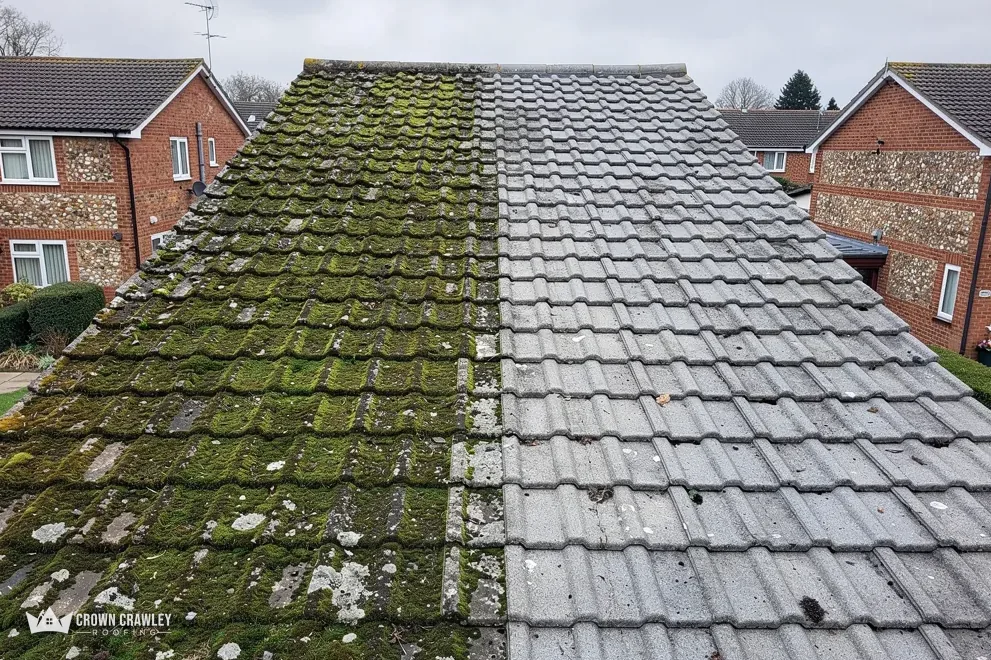
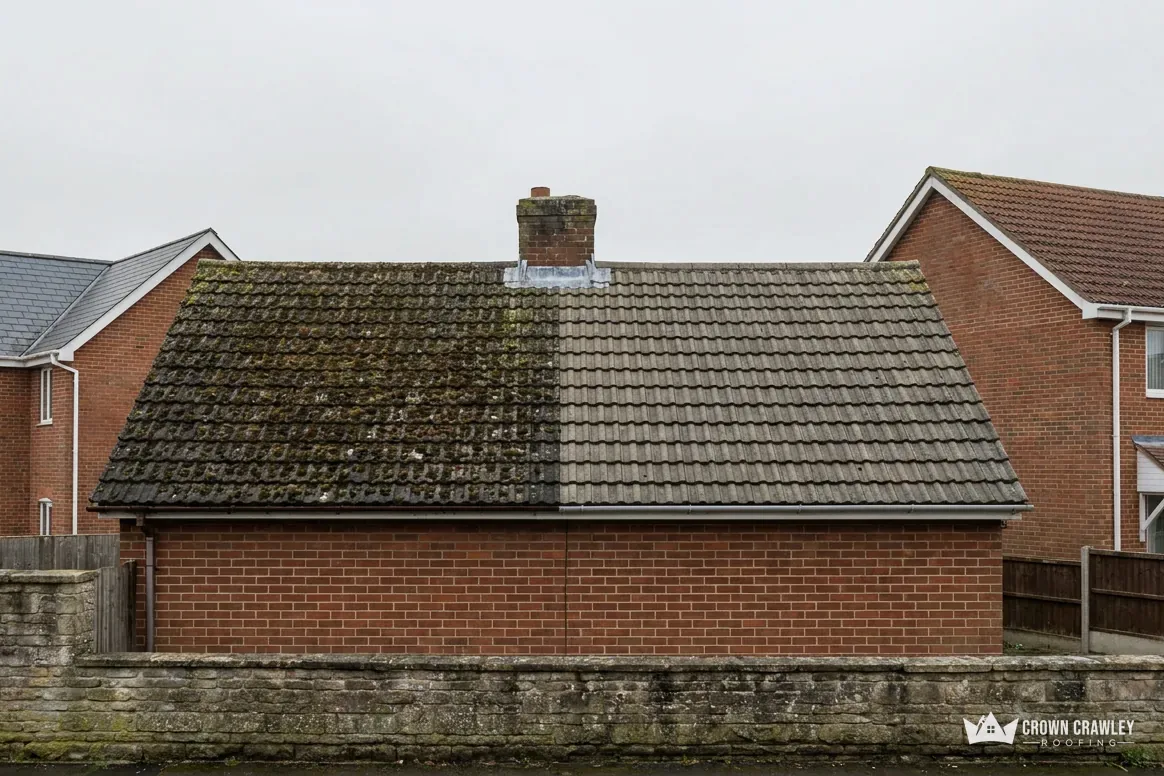
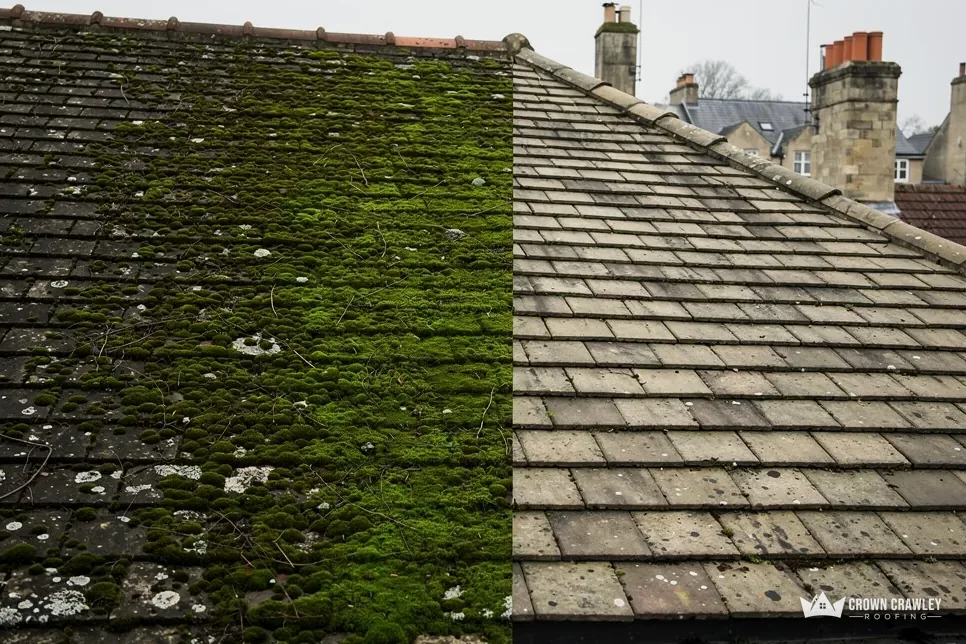
A clean sends the entire stock of moss to the gutter in a few hours. Scraping, brushing and sweeping all push material down towards the eaves, so even a careful roofer deals with a large heap. Spray treatments do the same more slowly, and both ways add up: the dead growth comes away over the following months and lands in the trough as it falls. Our guide to how biocide roof treatment works explains that slow release, and why it means gutters need another look after a treated roof has had time to shed.
Gutters are also a trap for the moss that grows in them. Damp debris holds water, and a gutter that stays wet grows its own moss without any help from the roof.
Why a clogged gutter does harm
A gutter that is full of moss may look like a tidy-up job. It is more than that. The trough is designed to carry water sideways to a downpipe, and anything that interrupts that flow sends the water somewhere less suitable.
What happens when water has nowhere to go?
It spills over the front lip, runs down the wall face and lands on the ground beside the foundations. In a heavy downpour it may also creep back beneath the bottom row of tiles and soak the felt and the fascia board behind the gutter. The fascia, the long board at the eaves that carries the gutter, rots when it stays damp. Timber at the eaves, including the ends of the rafters, can then be affected without anyone noticing from the ground.
Can moss in the gutter lead to a leak indoors?
It can, though usually by a roundabout route. Water that backs up beyond the gutter finds its way behind the fascia and into the wall or the loft edge, and shows up as a damp patch in a ceiling corner or on the wall near the eaves. A mossy roof also holds moisture against the covering. Our answer on whether moss can cause a roof leak goes through the ways it happens.
Weight is a smaller concern, yet a gutter loaded with wet moss and silt can drag on its brackets, pull the joints apart and leave a dip where water pools. A full channel is heavier than an empty one, and plastic that has gone brittle in the sun is less forgiving of it. Fixing those faults costs more than clearing a trough would have.
Clearing gutters as part of a roof clean
The sensible order is roof first, gutters second. Clearing the gutters before the slope is cleaned wastes the effort, because the scraping then fills them again. A roofer who plans the job well keeps the gutter clear of debris as the work goes on, then does the final clearing once the slope is finished.
How are the gutters actually cleared?
By hand, in most cases. The roofer works along the run with a small scoop or gloved hand, lifting out the moss and silt and bagging it as it comes. Hosing it down the downpipe is a bad habit, since it only moves the blockage to a bend lower down. After the bulk is out, the trough is rinsed with water from a hose, working towards the outlet, to see how it drains.
Why does the downpipe get tested?
An outlet can look clear from above and still be blocked below. Running water down the trough and watching it leave at the bottom shows whether the downpipe is moving the flow. If water backs up or runs slowly, the roofer can rod the pipe or lift it away from the wall to find the plug. This test takes a few minutes, and without it a job can end with a spotless gutter that still overflows on the next wet day.
On tall or awkward houses the gutter is cleared from the same scaffold or access tower used for the roof. Reaching over from a ladder at full stretch is a common cause of falls, and not something we do.
What an empty gutter tells you
Once the moss is out, the gutter shows its true condition. This is the best moment to look, because debris hides faults that matter, and the roofer is already there with access.
Are the joints and fixings sound?
Look for staining at the joints, drip marks on the wall below, brackets that have loosened and gutter sections that have sagged. Joint seals dry out over time and let water weep. Brackets that have rusted or pulled out of the fascia leave the gutter hanging. A small fault caught now may only need a new seal or a bracket, while an ignored one tends to spread along the run.
Does the gutter still fall to the outlet?
Gutters are fitted with a slight slope so water runs to the downpipe. One manufacturer, Brett Martin, advises a fall of 1mm for every 600mm of gutter. A run that has sagged flattens or reverses that slope, and water then sits in the low spot, which is also where moss and silt collect first. Tipping a cupful of water in at the high end and watching it travel is a simple test.
What about older concrete gutters?
Some 1950s houses have concrete Finlock-type gutters built into the eaves. The RICS record on them says leaking joints are the known weakness, and that removal should not automatically be assumed, because careful examination can show which ones are still sound. If the gutter is concrete, the roofer should look at the joints and tell you what they find before anything is suggested. Our gutters, soffits and fascias page covers repairs and replacement.
Nests, wildlife and what to leave alone
A gutter full of debris is an attractive place for small creatures. Birds use the dry sheltered corners where the gutter meets the wall, and sparrows, starlings and others will tuck a nest at the end of a run or behind a fascia gap. Wasps and mice can also move in.
What happens if there is a nest?
A nest in use is protected. The law is aimed at deliberate harm, and a roofer who finds eggs or chicks stops work on that stretch. The sensible course is to clear the rest of the run, mark the nest and come back once the birds have left, or to ask a wildlife body for advice. A short delay is an easy price to pay.
Could bats be in the roof edge?
Bats sometimes use gaps at the eaves and under fascias, and they are strictly protected along with the places they rest. Signs include droppings under a gap or staining at the entrance. If anything of the kind turns up, the roofer pauses and takes advice before any work on that spot. Our survey includes a look for such signs, and anything we spot is shown to you at once, with photos, so you can decide what comes next.
Once the gutter is clear and wildlife has been dealt with, a gutter guard or leaf mesh may be worth considering. Guards cut down on leaves and twigs, but they do not stop fine grit and moss flakes, so the trough still needs checking now and then.
Cost, timing and what to ask
Gutter clearing during a roof clean is usually part of the job and not a separate bill. If you are only after the gutters, cost is shaped by the length of the run, the height of the house and how much is stuck in the channels. A house with a long run on two storeys costs more than a bungalow with a short one, because of the access.
What do the national guides say?
For context, Checkatrade's gutter replacement guide, in its October 2026 table, gives £650 to £1,700 for 15 to 20 metres of guttering with three downpipes, averaging £1,000. That is the cost of renewing a run, which is where a neglected gutter may end up. Its roof cleaning guide, in an April 2026 table, lists £8.50 to £14 per m² for the roof itself. These are national guides and not a price for your house, and VAT may be extra. Our page on manual moss removal shows where the hand work fits.
What should you ask before booking?
Ask whether the price includes clearing and flushing the gutters and downpipes, how the waste is taken away and whether the gutters are checked again after the roof treatment has had months to work. Ask what happens if the gutters turn out to be failing. The survey ends with a single written total that says what is covered. Before it, send a photo of any gutter that overflows, with a note of where the water spills, and we will begin with that stretch. The wider job sits under roof cleaning and moss removal.
Part of our Roof Cleaning & Moss Removal in Crawley
Gutter moss, answered
Why is there grass growing in my gutter?
Silt, moss and leaf mould build up into a damp layer, and seeds that land on it sprout. Grass in the channel means debris has sat there for a long time. Clear it by hand, bag it and flush the trough, then check the outlet is running so the layer cannot rebuild.
Should gutters be cleared before or after the roof?
After. Cleaning the slope pushes moss and grit down to the eaves, so a gutter cleared first just fills again. A good order is roof, then gutters, then a water test on the downpipes. If a biocide has been used, another look after some months catches what has since fallen.
Can I clear moss from gutters myself?
From a safe, stable position on the ground floor or a low extension, with gloves, a scoop and a bag, many people can. Higher up, the risk of a fall is real, and reaching sideways from a ladder is the usual cause. For anything above the first storey, ask a roofer to work from scaffold or a tower.