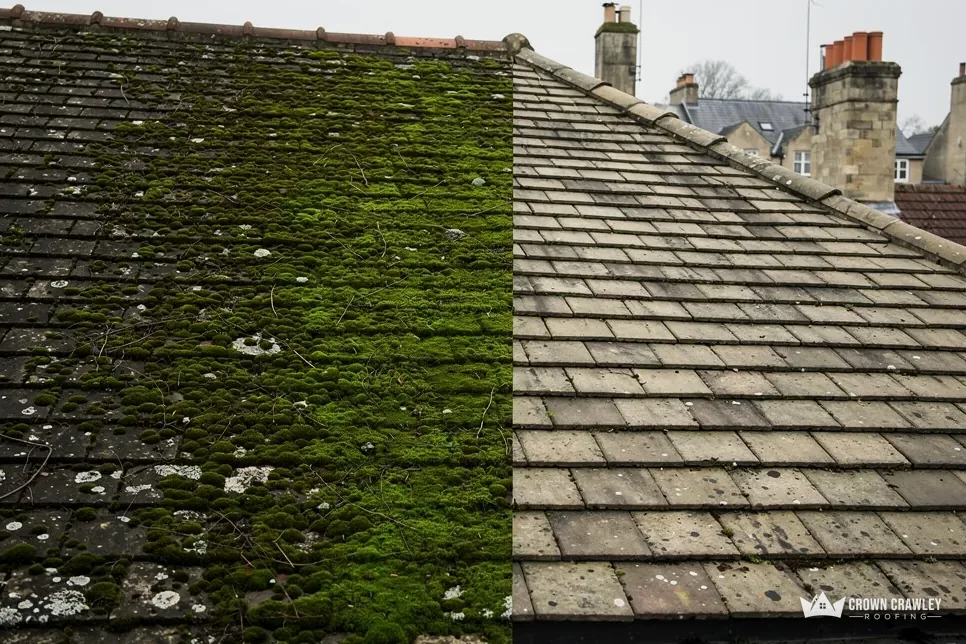
The pictures are tempting: a strip of grey, mossy tiles with a clean stripe cut through it. Pressure washers are common, cheap to hire and satisfying to use, so it is no surprise that people point them at roofs, and some firms build a whole business around them. The trouble is that a roof is not a patio. A patio is flat, solid and built to take water from above at any force. A roof is a layered, overlapping covering designed to shed gentle rain downhill, and it is not built for a jet fired at it.
This guide covers what a hard jet does to the surface of a tile, how water gets forced beneath the overlaps and into the roof, why old and brittle coverings are the most at risk, and where fragile materials such as asbestos cement fit into the picture. It also explains what low pressure means in practice, what the alternatives are, and how to judge a roofer who turns up with a jet washer and a quick price.
What a hard jet does to a tile surface
A tile's top surface is part of how it works, not just how it looks. On a concrete tile, the face is a dense skin that sheds water and resists frost. On a clay tile, the fired face does the same job. On slate, the surface is smooth and tight. When that skin is intact, rain beads and runs off. When it is damaged, the material underneath is rougher and more absorbent.
Does pressure really remove the surface?
Tile maker Marley takes a clear line. Its advice is against powerful jet washing, because the jet can scour the face of the covering and shorten its working life a great deal. That is a manufacturer warning homeowners off the very thing people do with a hire machine. A jet strips moss, but it also scours the face, and the damage often shows as a pale, rougher patch where the stripe was. Grit that comes off the tile ends up in the gutters, which is one more sign that the surface itself is being lost.
What happens once the surface is rough?
A rough face holds water longer and gives moss more to grip. The roof that was cleaned in a weekend turns green again faster than it did before, and each repeat clean does the same harm again. People then conclude moss is unstoppable when the real culprit is the method. A roof treated gently keeps its protective skin and gives growth less purchase. For the gentler route, see our guide to manual moss removal, which keeps the surface intact.
How a jet forces water under the laps
Tiles overlap in rows, each course lapping over the one below. The overlap is called the lap, and its depth is set by the tile and the pitch of the roof. The design assumes rain falls from above and runs down the slope, which is why gravity is the roof's friend.
Why does direction matter so much?
A pressure washer fires water at a speed no storm matches, often at an upward angle as the operator works up the slope to shift the moss. Water driven that way travels up and under the laps, past the nibs and into the gaps between tiles. On a normal day a lap sheds rain. On a day with a jet pointed at it, the lap becomes a funnel.
Where does the water end up?
Under the tiles lie the battens, the strips of timber that carry the covering, and the underlay, a membrane that acts as a second line of defence. Forced water soaks the battens and the underlay and can run to the loft side, wetting insulation and ceilings. The damage does not always show itself while the roofer is still on site. A faint brown stain on a bedroom ceiling a few days later is a typical sign, and by then the roofer has gone and the connection is easy to miss. Older underlay, torn or brittle with age, offers little resistance. If the jet leaves a house with new damp patches, the cost of the damp can exceed the cost of the clean.
Roof windows, flashings and the pointing around chimneys are weak points as well. Water fired at the junction between a roof and a wall can find a way through where rain never would.
Old, brittle and fragile coverings
The older and more weathered the covering, the worse a jet does. Aged tiles lose strength, plain clay tiles have thin edges, and slate can be laminated and brittle at the tail. A jet can chip, split or lift all of them. Slipped tiles also come loose, and a tile that is already cracked may break under the force and fall into the gutter.
What about asbestos cement roofs?
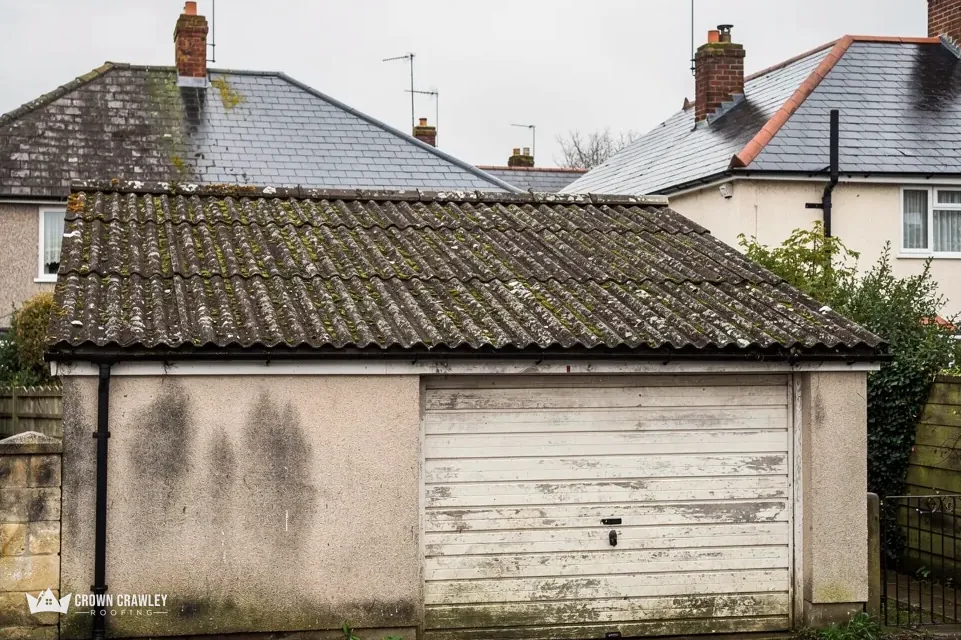
This is where the stakes are highest. Garages, outbuildings and some older house extensions may have a corrugated sheet roof made of asbestos cement, and a pressure washer should never be used on one. The Health and Safety Executive describes such roofs as always fragile, and says that once the sheet begins crumbling and giving off significant dust, the work becomes notifiable non-licensed work. Its starting position on any property built or refurbished before 2000 is to assume asbestos is present. So if a roof might be asbestos cement, we stop, explain why and point you to the next step, and nobody washes it.
Is it safe to walk on a roof being washed?
No. Moss is slippery when it is wet, and a jet makes everything wet. Someone with a pressure lance on a sloping roof is pushed backwards by the recoil, and a fall from a roof can be fatal. This, as much as the damage to tiles, is why we keep high-pressure equipment off roofs.
Our roof cleaning and moss removal service is built on gentler methods for these reasons, and we look at the covering first before choosing one.
When low pressure is used
Low pressure does have a place on a roof. The aim is to carry a cleaning liquid onto the surface or rinse debris away, not to blast anything off. The force is similar to a garden hose, or a little more, and the water is aimed so it runs down the slope, never up under the laps.
What is soft washing?
Soft washing is the name for applying a cleaning solution at low pressure and letting it work, then rinsing gently. It leans on the chemistry, not the force. Because it uses a treatment product, the rules on biocides apply to it, and the label has to be followed to the letter, including any limits on what can reach drains and plants. Our guide to roof soft washing goes through how it is done and where it suits a roof.
What do we do on a roof?
We do not jet-wash tiles at high pressure. Where water is used, it is at low pressure and directed downhill, and the heavy growth comes off by hand first. The treatment then does the slow work, and the rinse is light. This is slower than a blast and the results arrive over weeks and months, but the tile keeps its surface and the roof stays dry underneath.
A fair question to ask any roofer is what pressure the water leaves the lance at, and which way it is pointed. A clear, specific answer is a good sign, and a shrug is not. If the answer is vague, get a second opinion before the work starts, since a washed roof cannot be unwashed.
Mess, runoff and the neighbours
A pressure washer on a mossy roof throws a lot of debris. The moss, grit and loosened granules all go with the water, and the spray carries well beyond the roof.
Where does it all go?
Into the gutters first, where moss and grit settle and block the downpipes, then onto windows, cars, paths and the neighbours' washing. A garden below can be covered in green slurry, and a pond beneath the eaves can fill with it. Spray drifts in the wind, so a gusty day carries it further, over the fence and into the next garden. A roofer using this method needs sheets, planning and a lot of clearing up afterwards. Our guide on moss in gutters shows how to deal with the part that always ends up in the trough.
What about the cleaning products in the run-off?
If a treatment or detergent has been used, the run-off carries it too. Labels set out what to keep away from drains, ponds and plants, and they apply to anyone using the product, whatever the method. A roofer should be able to name the product and tell you what the label says. Without that, ask them to explain what happens to the water when it leaves the roof.
Noise and neighbours matter too. A pressure washer is loud, and a morning of it can try patience on a terrace or a cul-de-sac. A short word with next door before the work starts is only courteous, and a roofer working carefully is glad to wait while you do it.
Judging a quote that relies on a jet
Some roof cleaners advertise a low price for a quick jet-wash. The low price is possible because the method is fast, and the speed is where the risk comes from. A roofer who is honest about the job will explain what the method does to the surface before taking your money.
What should you ask?
Ask what pressure is used and where the water is aimed. Ask whether the moss is removed by hand first and what will be done about the debris in the gutters. Ask what product, if any, is going on the roof, and ask to see the label. Find out if scaffold and VAT are in the figure. Ask what happens if damaged tiles are found, and whether you will be shown them. A confident roofer answers all of these in a few sentences.
What does a clean cost nationally?
Checkatrade's roof cleaning guide, in its April 2026 table, lists a typical national range of £8.50 to £14 per m², with scaffold at around £18 per m² where it is needed. These figures describe the market and are not our price for your roof. A cheap jet-wash may undercut them, but a few replaced tiles and a repaired ceiling can wipe out any saving.
For a plain answer on your own roof, we survey it, share photos of the covering and give a written total for the method that suits it. Send us a clear photo of each slope and a note of any previous cleaning, since earlier jet-washing can leave a roughened surface that changes what we advise.
Part of our Roof Cleaning & Moss Removal in Crawley
Pressure washing, answered
Can I use a pressure washer on concrete tiles?
Tile makers advise against strong jets because they can wear the surface and shorten the tile's life. The face of a concrete tile is part of how it sheds water. If you want to clean your own, remove moss by hand and leave heavy cleaning to someone who can work from safe access.
How do I know if a jet-wash let water into my loft?
Look at the ceilings below and the loft insulation in the days afterwards. Brown rings, damp patches and a musty smell all point to water getting in. Photograph them with the date, and contact the roofer promptly. Damp that appears after a clean is worth reporting early, while the cause is still fresh.
Is it ever fine to use a hose on the roof?
A gentle hose pointed downhill is fine for rinsing away loose debris, and it is how a low-pressure rinse works. What matters is the force and the direction. Never aim water up the slope, and never use a hose or washer on a roof you suspect is asbestos cement.