A roof clean looks like a job that stays on the roof. It does not. The treatment is sprayed on, left to work, and then every drop of water used on the day runs down the slope, along the gutters, through the downpipes and out at ground level, where your borders, lawn, pond and drains are waiting. What is in that water, and where it ends up, is part of the job even though you never see it from the street.
This guide follows that water. It explains what the cleaning products are, who is allowed to use which ones, how a careful crew keeps run-off away from plants, ponds and drains, and what to do about the birds and bats that may share your roof. It also ends with a short list of questions to put to any roofer before they start, so the answers are on paper and not left to chance on the day. If you want to understand the treatment itself first, our page on how a biocide roof treatment works covers that, and the roof cleaning and moss removal service page shows the whole job.
What is in the products used on roofs
Most roof cleaning has two parts. First the growth is removed, either lifted off by hand with brushes and scrapers or washed away at low pressure. Then what is left is treated, so that algae, lichen and the black staining on tiles die back and are slower to return. The liquid used for that second step is normally a biocide, which just means a product made to kill living things such as moss spores and algae. The word sounds alarming, but it covers a wide family, from moss killers on a garden-centre shelf to concentrates sold only to trained professionals.
Why does the label matter more than the brand?
Under the biocide rules that still apply in Great Britain, a product's authorisation and its label set the limits of lawful use. The label covers the dilution, the method of application and the surfaces the product is meant for. A bottle mixed at double strength, or sprayed on a roof above a pond because it seemed quicker, falls outside the label even if the product itself is a perfectly good one. Labels also carry handling and disposal directions, which is why they are worth reading in full.
What should you ask to see?
Get the product name from the roofer ahead of the day, then read the label or data sheet yourself. A genuine contractor hands the name over without fuss and will not mind you looking it up. An answer such as "it is our own special mix" is a reason to keep asking. You are entitled to know what is going onto your roof and, through the gutters, onto your garden.
Who is allowed to use which product
Not every product on the market is meant for a householder with a pump sprayer. The HSE warns that members of the public should steer clear of biocides sold for trade use only, and that for some trade products the user must hold a specific certificate. A strong concentrate bought online, with no training behind it, is exactly the case that warning has in mind.
What does "approved" actually mean?
The HSE's guidance on its approvals scheme for certain biocides makes advertising, selling, supplying, storing or using a product without approval an offence. The same guidance bars adverts from carrying wording such as "HSE approved". So a flyer or van that advertises HSE-approved chemicals is using words the HSE itself tells traders to avoid. That does not prove anything is wrong, but it tells you to ask for the product name and read the label for yourself. We look for the name and the label, not the badge.
What about doing it yourself?
Householders can buy products made for general sale, and if you use one, the same rule applies: follow the label, in the strength it states, on the surface it names. Do not decant it, mix two products together or top up a sprayer with something stronger. Climbing onto a roof with a bottle in one hand is also a fall risk, and our page on removing moss from a roof yourself sets out what is involved before you try it.
Where the run-off goes
Water leaves a roof by one of three routes. Most of it enters the gutter and drops down the pipes to a gully, a soakaway, a water butt or a surface drain. Some overshoots the gutter where it is blocked or sagging and falls straight onto the ground below. A little blows sideways off the tiles in the wind. Each route lands somewhere different, and a plan for the day should cover all three.
What happens to the gutters and downpipes?
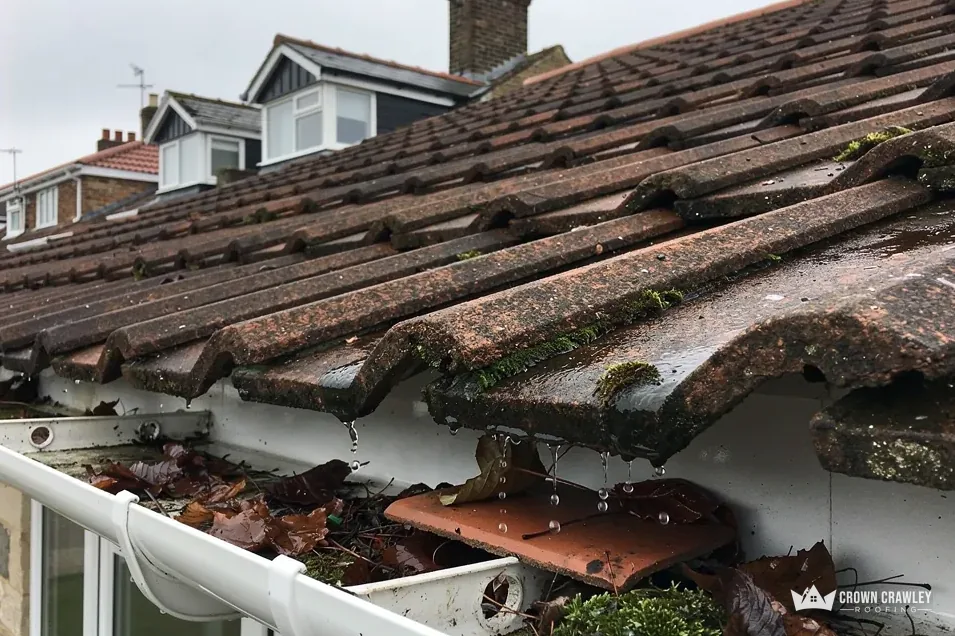
Gutters are usually the first thing to check, because a blocked run sends dirty water over the front instead of down the pipe. Moss and debris washed off the tiles collect in the gutter, so they get cleared during the job and are not left to wash down at the next shower. Our page on moss in gutters explains why that debris builds up. A water butt connected to the downpipe needs disconnecting first, so the water from the clean does not fill it with treated run-off that you later pour on vegetables.
Which drain does it reach?
Ask where your downpipes finish. Some run to a combined drain, some to a surface water drain and some simply discharge onto a patio or into a border. Neither you nor your roofer can tell which without looking. The answer decides whether gullies need covering and whether run-off needs to be caught and taken away. If the downpipes drain to a pond or ditch, say so on the survey visit, because that changes how the clean is done.
Protecting plants, lawns and ponds
A garden does best when the planning happens before a single tile is wet. A good crew walks the ground on the survey visit and points out what needs protecting, which is a better way to find a problem than a brown patch on the lawn a week later.
How are plants protected?
Beds under the eaves and against the walls take the heaviest run-off, so these get attention first. Pots and furniture are moved away from the house, and delicate plants are covered with sheeting that is weighted down. Borders can be watered thoroughly before the work starts and rinsed with clean water afterwards, which dilutes anything that lands there. Lawns near the drip line are covered or rinsed in the same way. Ask the roofer to show you which sheets and hoses they use; the answer tells you how seriously they take it. Bring washing in, close every window and trickle vent, and keep the outside tap reachable for rinsing.
What about a pond?
A pond is the part of the garden where mistakes cost most, because fish and plants have nowhere to go. If the pond sits close to the house, cover it with sheeting before work begins and keep the downpipes and any spray away from it. If run-off from a downpipe feeds the pond, the pipe should be diverted into a container for the day. Do not rely on a pump or a net. Raise the pond at the survey visit and agree the plan in writing, so the crew who arrive on the morning know where it is.
What about pets, children and the vegetable patch?
Keep animals indoors until the product label says the wet areas are safe, and ask the roofer how long that is for the product in use. Protect any bed under the eaves where food grows. Our page on whether roof biocide is safe for pets covers the day in more detail.
Birds, bats and nests on the roof
A roof is also somebody's home. Birds nest in gaps under tiles and in gutters, and bats roost in roofs of every age. Roof cleaning disturbs the roof, so the law on wildlife applies to it as it does to any other roof work.
What does the law say about nests?
The Wildlife and Countryside Act 1981 protects active nests, so deliberately harming one that is occupied or still going up breaks the law. The intent matters, and so does the timing: an old, empty nest is treated differently from one with eggs in it. If you see a nest under construction or occupied, tell the roofer, and the clean waits until the birds have finished. GOV.UK adds that there is no licence available simply to permit building or construction work, so planning around the birds is the only route.
What about bats?
On GOV.UK, the guidance on bats says the animals and their roosts are legally protected, and that roof repairs and re-roofs are among the jobs that can disturb them. The Habitats Regulations 2017 make it an offence to deliberately disturb a protected animal or to damage or destroy a place where it breeds or rests. Roof cleaning is less invasive than a re-roof, but it can still disturb a roost, and spraying products into gaps where bats shelter is a poor idea. If you have seen bats, or found droppings in the loft or on the ground below the eaves, say so before work begins. A roofer should pause and take advice rather than carry on.
Questions to ask before you book
Cleaning is priced by the area of roof, and a national guide puts that into context. Checkatrade's April 2026 table puts roof cleaning at £8.50 to £14 per m², hand work with biocide near £11.50 per m² and scaffold, where needed, near £18 per m². Those are typical UK figures and not a price for your roof. We give one written total once the survey visit is done, and the paperwork should name the product and the plan for run-off and the garden, not just the sum.
What belongs on the list?
- Which product will be used, and can I read the label or data sheet?
- Where do my downpipes finish, and how will the run-off be handled?
- How will the pond, borders and lawn be protected?
- What happens if it rains soon after treatment?
- What will happen if a nest or a bat turns up?
- Does the price include scaffold or access, and is VAT included?
How do you know the answers are good?
Compare them with what this guide has covered, and write the answers down. A roofer who names the product, mentions downpipes unprompted and asks about your pond is thinking about the whole job. If cost is the worry, the roof cleaning cost page sets the national figures against what drives a price. To get a written price for your own roof, tell us where the downpipes end and whether there is a pond, add a few photos of the slopes, and we will cover both at the survey.
Part of our Roof Cleaning & Moss Removal in Crawley
Run-off, ponds and product rules
Can roof treatment run-off harm a garden pond?
It can if it reaches the water, which is why the pond is covered, the downpipes are kept away from it and any pipe that feeds it is diverted for the day. Raise the pond at the survey and agree the plan in writing, so nothing is left to the morning.
Can I use any moss killer I buy online on my roof?
Only a product meant for your use, in the strength and manner its label states. The HSE says the public should steer clear of trade-only biocides, so if a seller cannot show you a label or an authorisation, leave the product on the shelf.
What if there is a nesting bird or a bat in the roof?
Stop and tell the roofer. Harming an active nest on purpose breaks the law, and bats, with their roosts, are protected too. The clean can wait, and advice should be taken before any work goes ahead on that part of the roof.