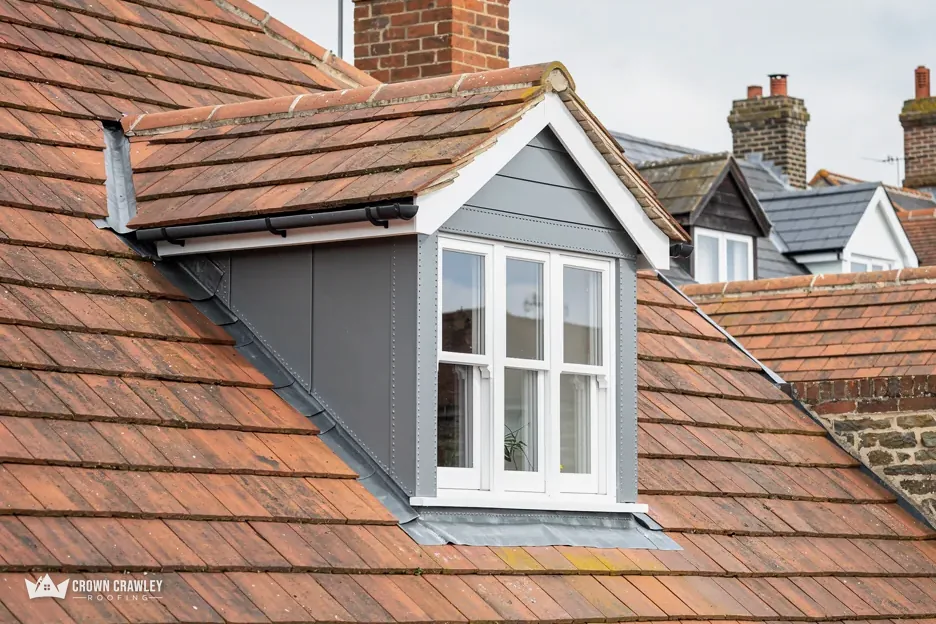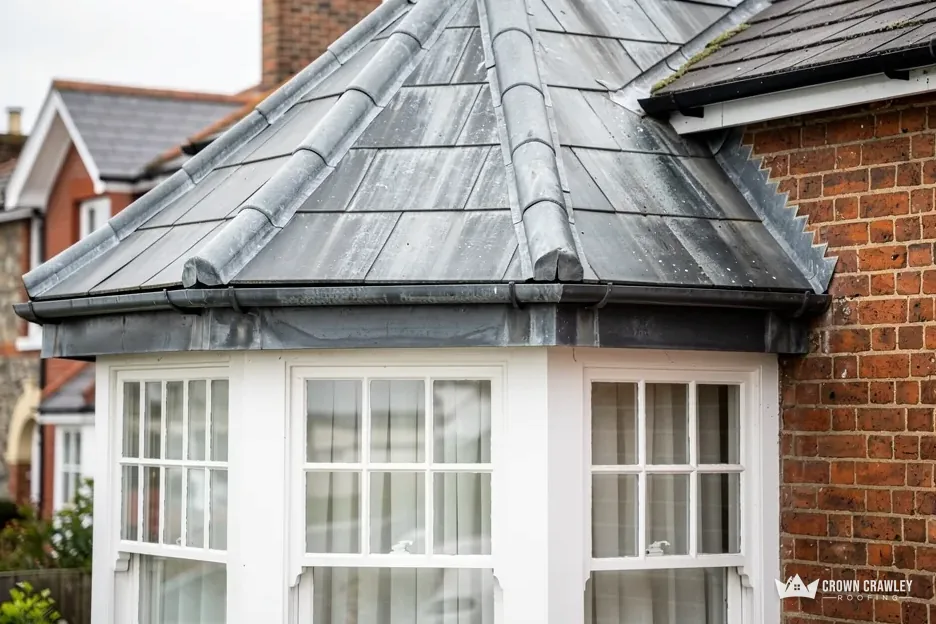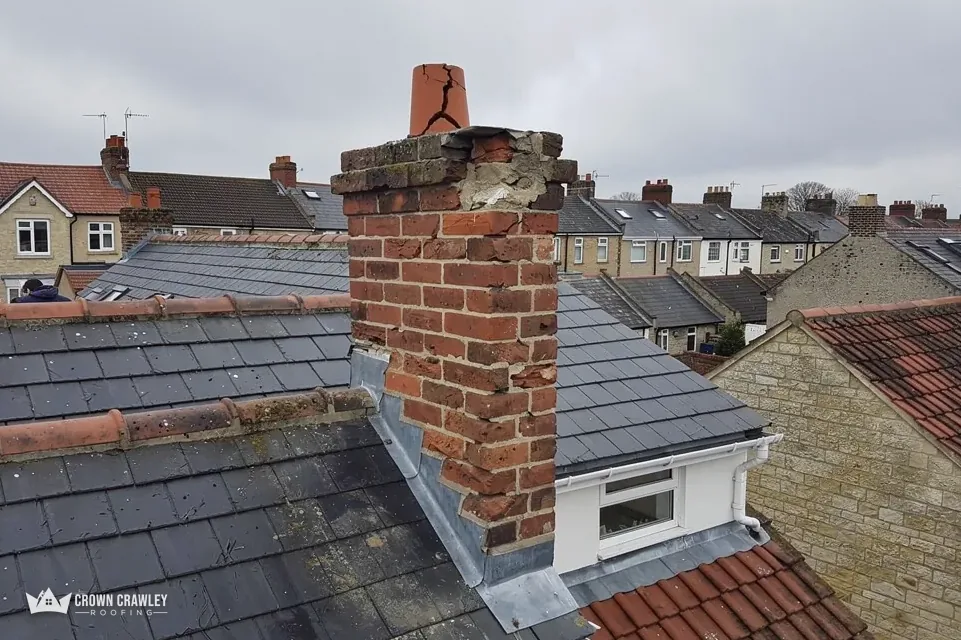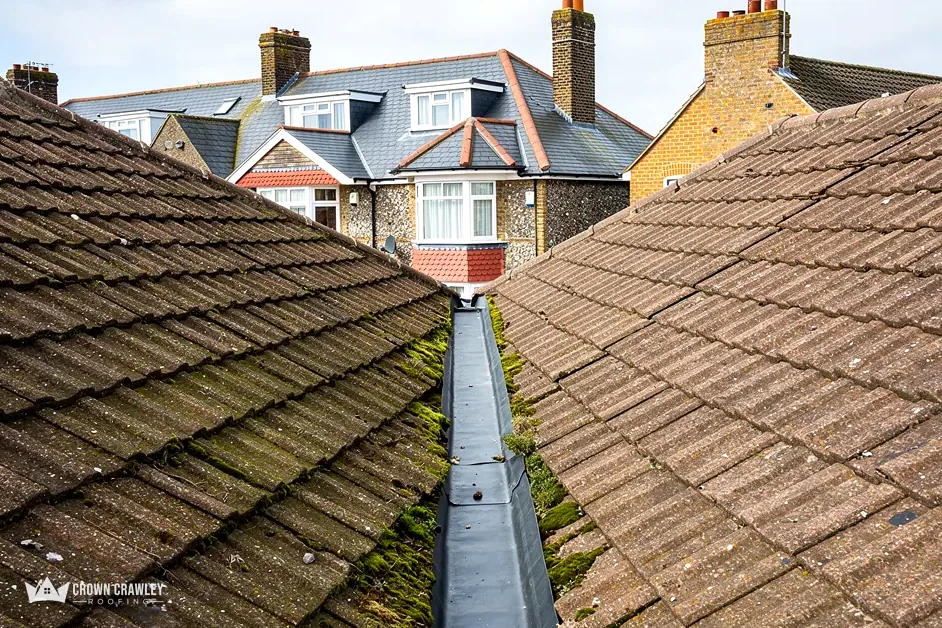
A lead flat roof is a different thing from a lead flashing, and it is judged by different rules. Instead of a narrow strip bridging a joint, the lead is the whole waterproof surface. You see it over porches, canopies, small extensions, bay roofs, dormer tops and the flat parts of period buildings. These areas are small enough that lead is practical, and they sit where appearance and long life count.
The rules of laying it are firm. The roof needs a fall so water runs off. The lead is cut into bays, and joints between bays run either along the fall as rolls or across it as drips. Those joints let the metal move as it warms and cools. If any of that is skipped, the sheet cracks, buckles or lets water through at the seams.
Below we cover how a lead flat roof is built, why falls and bay sizes matter, what drips and rolls do, how long lead lasts, what the options are and what the rules say about renewing one.
How a small lead flat roof is built
From the underside up, a lead flat roof has a structure of joists, a deck, a separating layer and then the lead itself. Each layer has a job, and skipping one is a common reason lead roofs fail.
What sits under the lead?
The deck is usually plywood or boards laid over joists cut or furred to a slope. On top goes an underlay or separating membrane that stops the lead snagging on the rough surface and lets it slide slightly as it moves. Without it, nails and splinters can wear holes in the underside of the lead over time. Insulation, if there is any, goes either beneath the deck or on top of it, which changes how the roof is ventilated and how damp is kept from the timber. Many small canopies have none at all, and that is fine where there is no room below to heat. Our page on warm roof against cold roof explains that choice.
What is the lead sheet like?
Royston Lead's brochure lists Code 5 to Code 8 for parapet and box gutter uses, which is the nearest guide to a lead surface that carries water. Heavier codes cost more, resist wear better and carry more weight on the deck beneath. The roofer should name the code in the written price. The full code table sits in our lead sheet guide. This page is one of several on lead work.
Falls: why water must run off
No flat roof is truly level. A slight slope, called a fall, sends water to the edge and into the gutter. Lead is a forgiving metal, but standing water still tests every joint and speeds up corrosion on the underside if the deck below is damp.
What fall should a small flat roof have?
The flat roof code BS 6229:2025 is written for flexible membranes, not lead sheet, yet it is a fair yardstick for drainage. It keeps a finished fall of 1:80 as the least acceptable for ordinary roof areas, and 1:80 works out at 12.5mm of drop in each metre. IKO, discussing the previous edition, recommends drawing the roof at 1:40, because deflection and building tolerances use up part of the slope before the job is finished. Our guide to the minimum fall for a flat roof covers the numbers in more depth.
How do you spot a roof that has lost its fall?
Look for water still sitting a day after rain, a dark tide-mark where it stood, or a belly in the middle of the deck. On lead, ponding lets the water find any weak seam. Fixing it usually means relaying the deck to a better slope, not just patching the lead. See flat roof ponding water for how that is judged.
A canopy over a front door is often fixed to the wall at one side and drains away from the house, which suits a single sheet with a flashing at the back and a drip at the front. If the lead stops short of the gutter, or the gutter is lower than the lead edge, water can wash back to the wall.
Bay sizes, drips and rolls
Lead moves a great deal for a metal that looks so still. A large sheet laid in one piece will creep downhill over many seasons and finally tear or buckle. To prevent that, the roof is divided into bays, and the joints between them take up the movement.
What are rolls?
A roll is a joint that runs up and down the slope. A strip of timber, called a wood core, is fixed to the deck. The edge of one lead sheet is dressed over the core, and the next sheet is dressed over that and around, so the two overlap on top of the roll. Rolls take up sideways movement and keep water from crossing a seam. Our page on lead drips and rolls shows each shape.
What are drips?
A drip is a step in the deck, a small drop across the slope, where one bay ends and the next lower bay starts. The upper sheet laps over the step and into the lower bay. Drips take up movement along the fall and let water pass without finding a flat seam.
How big can a bay be?
The lead industry's guidance sets a maximum bay length and width for each code, and it varies with the code and the position on the roof. We do not guess these figures, and you should be wary of any roofer who does. Ask what bay size the quote is based on and what code it assumes. A small canopy may need only one or two bays; a longer porch roof may need a drip partway along.
Why lead flat roofs fail
When a lead roof fails early, it is almost always one of five things. Knowing them helps you read a roofer's explanation of what went wrong.
Cracking at the folds
Repeated heating and cooling fatigues lead that has been bent sharply or fixed too tightly. Cracks begin at corners and at the line of the nails. Our page on why lead flashing cracks goes into the mechanism.
Oversized bays
A sheet that is too long creeps down the slope, bunches at the bottom and splits at the top. This is a design fault that no patch cures, so the fix is to relay it in properly sized bays.
Wrong or missing underlay
Lead laid straight on rough boards wears through, and certain timbers can attack lead from below. The wear can hide for years and then show as a weep.
Poor falls and blocked outlets
Ponded water does the damage, and a clogged gutter or outlet backs up on a flat surface fast. Check these first, because they cost little to clear. Many a leak blamed on the lead turns out to be a gutter full of leaves holding water against the edge of the sheet.
Theft
Lead is valuable, and exposed lead on a low canopy is a target. If sheets have been taken, a temporary cover keeps water out until the work is done; our page on lead stolen from a roof sets out what to do first.
MyJobQuote says sound lead flashing can pass 80 years. Read that as what sound lead can reach, not a promise, and remember that the deck below and the joints in between wear on their own timetable.
When another covering is the better choice
Lead has real strengths: it lasts, it suits old buildings and it can be shaped to any outline. It is also heavy, dearer than some alternatives and more of a target for thieves. On a plain rectangular roof with no awkward shapes, another covering may be the sensible buy.
What are the main alternatives?
EPDM, a synthetic rubber sheet, is laid in one piece with few joints. GreenSpec lists its service life as 20 to 30 years, and Checkatrade's rubber roofing guide, dated September 2026, puts it at £80 to £100 per square metre, with felt at £50 to £80. A cost guide from Less, updated March 2026, gives GRP 25 to 40 years and felt 10 to 20 years. Zinc is a second metal option, and VMZinc points to an environmental declaration that states 100 years for it. We compare the two metals in zinc against lead roofing.
How do you choose?
Look at the shape and the setting. A listed or period building often calls for lead, and our page on lead roof repairs on a listed building explains why. A modern single-storey extension with a clean rectangle may suit EPDM or GRP. Cost, weight, appearance and theft risk all count. A fair quote names the covering it proposes and the reason, and offers a second option when there is a real choice. Ask how the new roof will be finished at the edges, since the trims and flashings decide whether water gets behind it, and ask what happens to the old covering, which can sometimes stay under a new layer and sometimes cannot. Our flat roofing page covers the other coverings.
Rules, costs and getting a price
A small lead roof is simple to describe and detailed to build. The price follows the area, the code, the number of joints, the state of the deck and the access, and only a survey can fix it.
Do Building Regulations apply?
Approved Document L classes the renewal of a flat roof's waterproofing as renovation. The document sets a major renovation at 25 per cent of the external envelope's surface, and requires the element itself to be upgraded when over half of it is renovated. A canopy or porch is a small part of a house, so it seldom reaches either figure, though your building control body can confirm. Our page on building regulations for flat roofs goes through it, and a roof next to a boundary or a party wall may bring in other questions that your building control body can answer.
What should the quote show?
One written total after the survey, naming the lead code, the fall you are getting and the bay layout. Ask whether VAT and any scaffolding are inside it. A low canopy may be reached from the ground or a tower, which keeps access costs down. Where the roof sits over a first-floor window or beside a neighbour's wall, full scaffold is more likely, and the survey will say which.
To start, send photos of the roof edge, any stains indoors and a note of what covers it now. We will tell you what we would test first, usually the fall, the joints and the gutter line.
Part of our Lead Work & Lead Flashing in Crawley
Lead flat roof queries
Is it safe to step onto a lead canopy?
Occasionally, to clear leaves, if you stay on the lead and wear soft shoes. Regular foot traffic dents the sheet and breaks the seams over time. If the roof needs routine access, a roofer can add timber duckboards over a protective layer. Never step on rolls or drips, because they are the weakest points.
Why has my lead roof gone white?
Lead forms a pale carbonate layer when it reacts with air and rain. That layer is normal and protects the metal, so it is not a sign of failure. If the white deposit runs down walls, it may be staining; our lead run-off page explains the cause. A cracked or leaking sheet looks quite different.
Is it cheaper to replace lead with felt or EPDM?
The covering itself often costs less per square metre, but the total depends on the deck, the edges and the access. Lead's longer life can change the balance over time. Ask for a price on each option, written as one total, and check what each includes before you compare them.