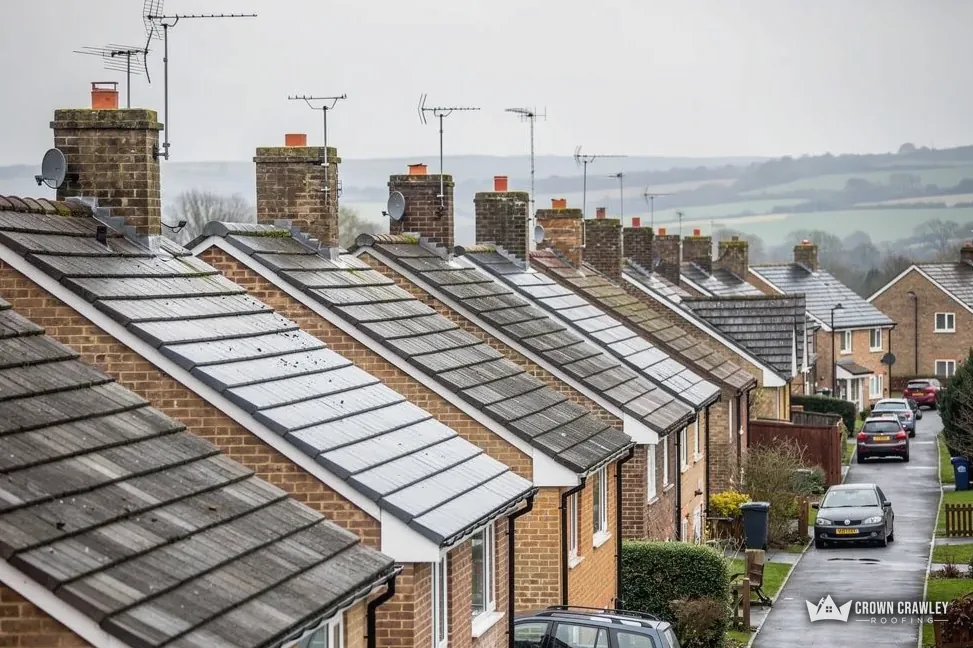
The first wave
West Green, Three Bridges and Tilgate were built between 1949 and 1958.
Roofers who read Crawley street by street.
Crown Crawley Roofing is a roofing company Crawley households can call about a slipped tile, a dripping valley or a roof that has simply had its day. We look first, share photos, then price it in writing.
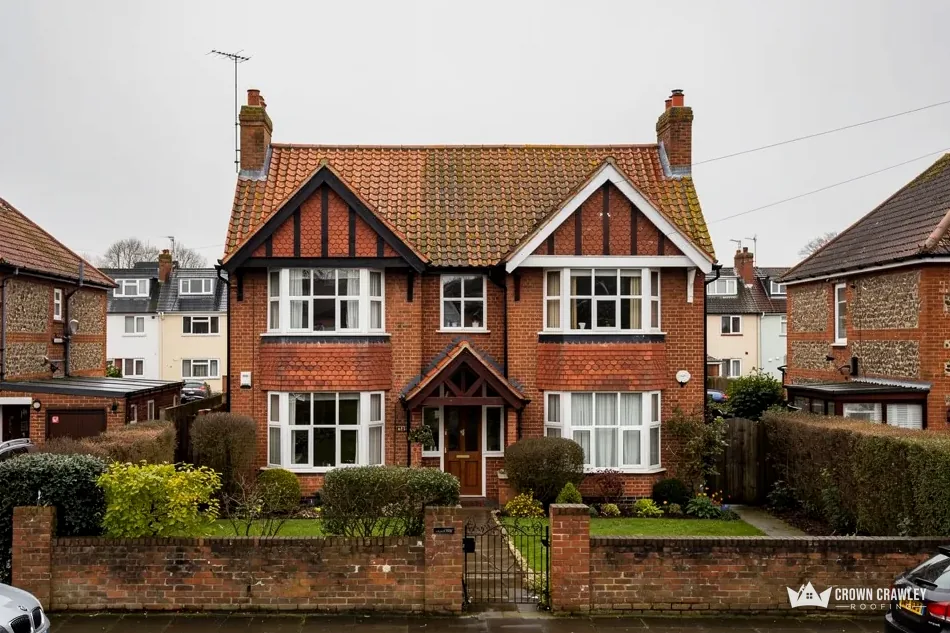
West Green, Three Bridges and Tilgate were built between 1949 and 1958.
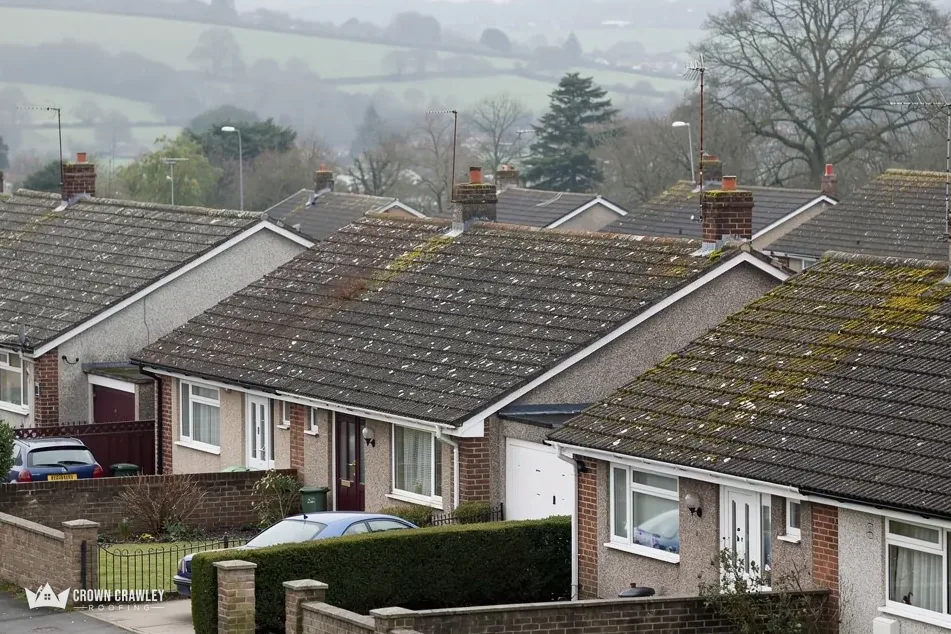
Furnace Green, Broadfield and Bewbush followed, Bewbush with houses set around courts and walkways.
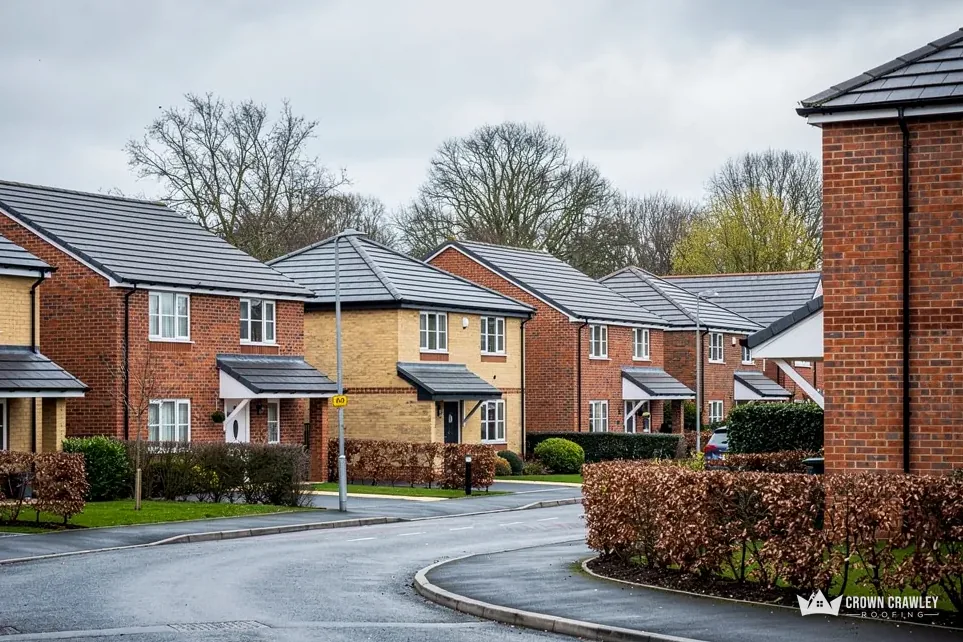
Maidenbower began as a private scheme announced in 1986; Forge Wood is the newest neighbourhood.
The Crawley roof diary
Eight stages of a roof job in a planned town, from working out when your street was built to the checks we make before we leave.
Stage 01 · First look
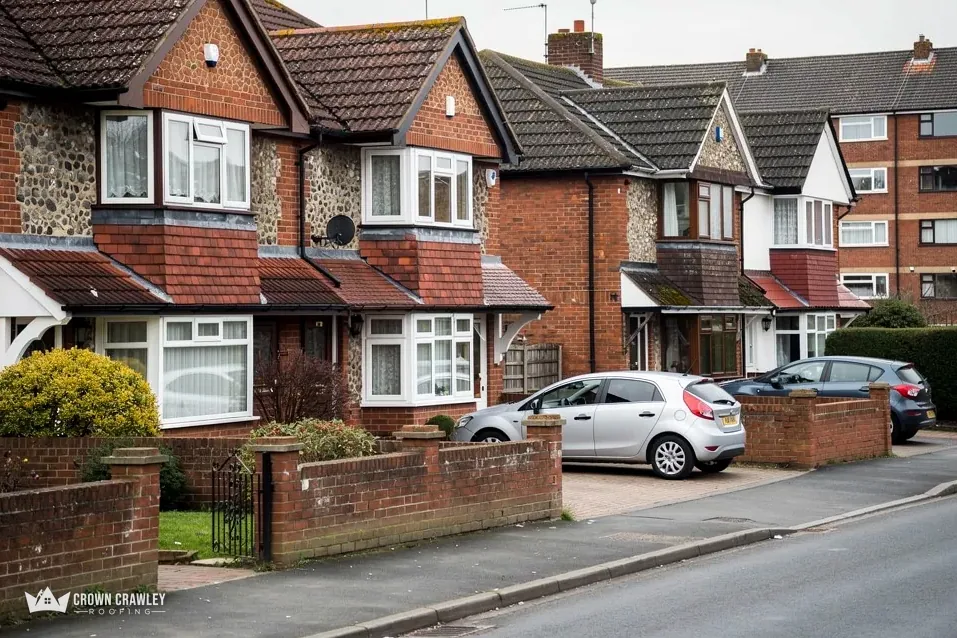
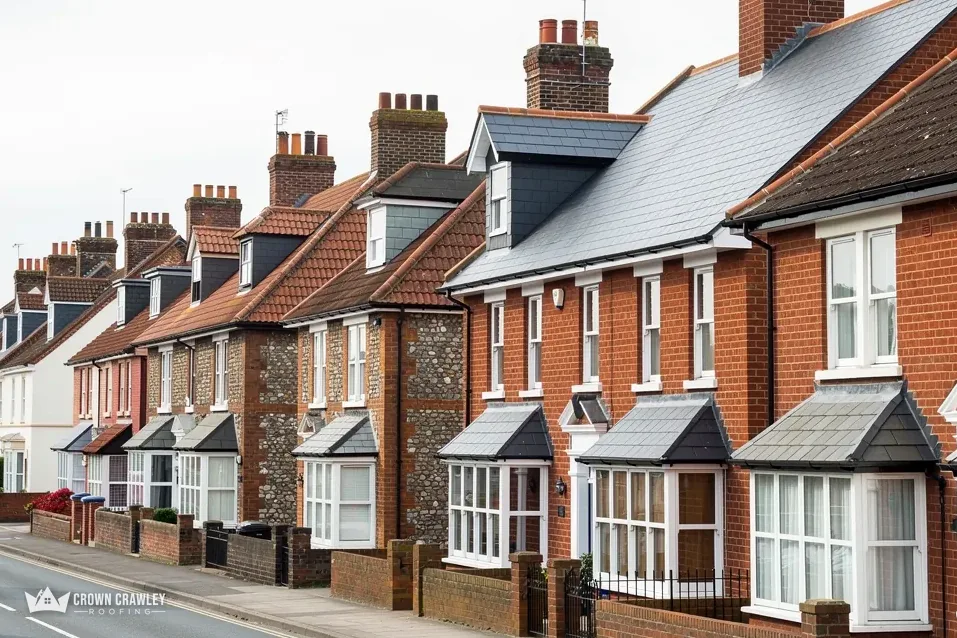
Crawley was designated a new town in January 1947 and grew one planned neighbourhood at a time, so your street's age says a lot.
Before anyone climbs a ladder we ask a simple question: when was the house built? In Crawley the answer is easier to pin down than in a town that grew by accident. The masterplan set out nine self-contained neighbourhood units around an expanded town centre, and the Development Corporation built them in turn until it was wound up on 31 March 1962. Later schemes carried on outwards, and Forge Wood in the north east is now the newest of the town's 14 neighbourhoods. Each neighbourhood went up over a few years, so the roofs along one street often share their materials and have aged together.
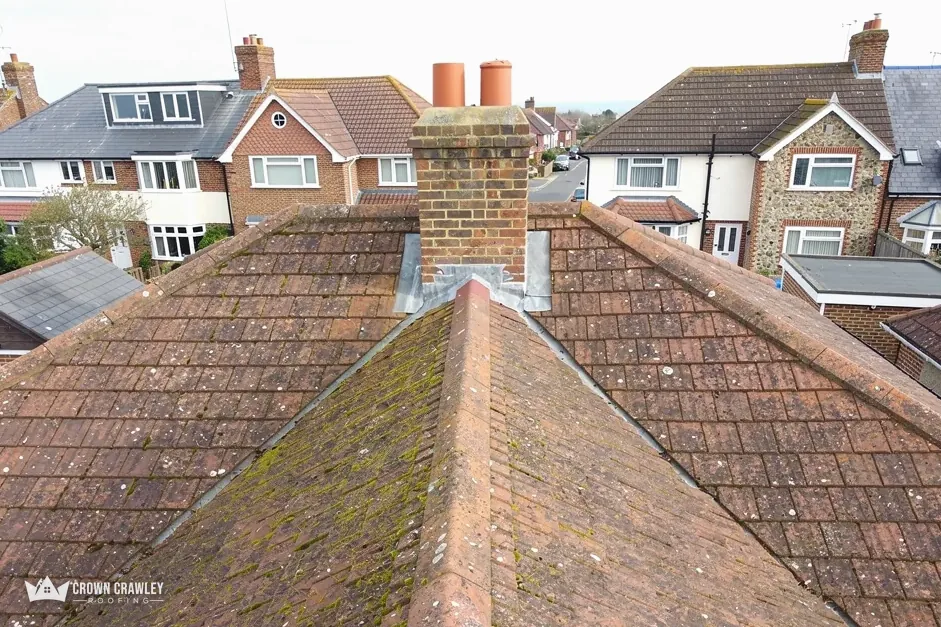
Roofs age in step with the walls under them. A house from the first wave, when West Green was going up by 1949 and Three Bridges had 982 new houses by 1955, may be on its second covering or still wearing its first. A Bewbush house, first occupied in 1976, sits on a different clock, and a Maidenbower home from the private scheme of the late 1980s on another again. The era tells us which fixings, underlays and ridge details were in fashion when the roof went on, and so which faults to look for first. It also tells us what may be hidden. HSE's advice is that a building built or refurbished before 2000 should be assumed to contain asbestos, so we look at soffits and outbuildings with that in mind.
From the pavement we read the ridge for dips, the verges for missing mortar or loose plastic caps, the slopes for slipped or odd-coloured tiles and the chimney for leaning pots and lifted flashing. Flashing is the strip of lead that seals the roof to a wall or stack. We also note whether next door has been re-roofed, because a shared ridge or valley on a semi or terrace changes how any repair is done. None of that replaces a survey, but it means we turn up with the right materials. Our guide to Crawley roofs by neighbourhood walks through each area in turn.
Stage 02 · Survey
One slipped tile does not mean a new roof. We decide on evidence from the slopes and the loft, and you see it too.
Every roof we price goes through the same test, whatever its age. That is how we approach roof repairs: Crawley houses from 1949 and houses from last decade get the same questions, and the answer comes from what we find, not from what would make the bigger invoice. The photos you get from the survey show the reasons, so you can judge the call yourself. If two roofers tell you different things about the same roof, photos of the actual tiles and timbers are what let you weigh them up.
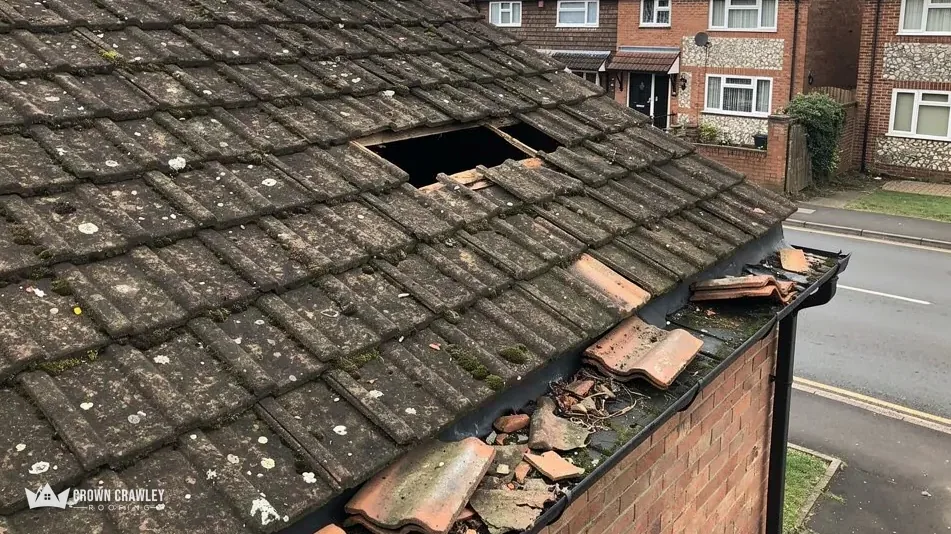
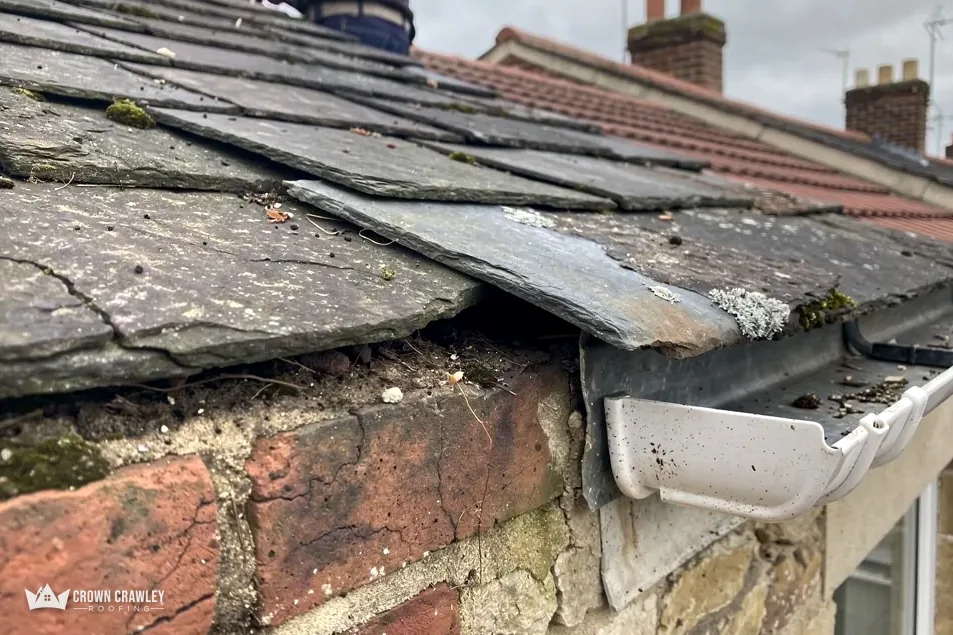
If the tiles are sound and the battens under them are dry and firm, a repair is the sensible first step. Battens are the timber strips the tiles hang on. A few slipped or cracked tiles, a loose ridge, a tired lead flashing or a leak at a valley can all be put right without touching the rest of the slope. Concrete tiles carry a manufacturer's life figure of around 60 years, and Marley says plainly that this is not a guarantee of how long they will last. Age on its own is never the reason we give for a new roof.
Signs a repair will hold
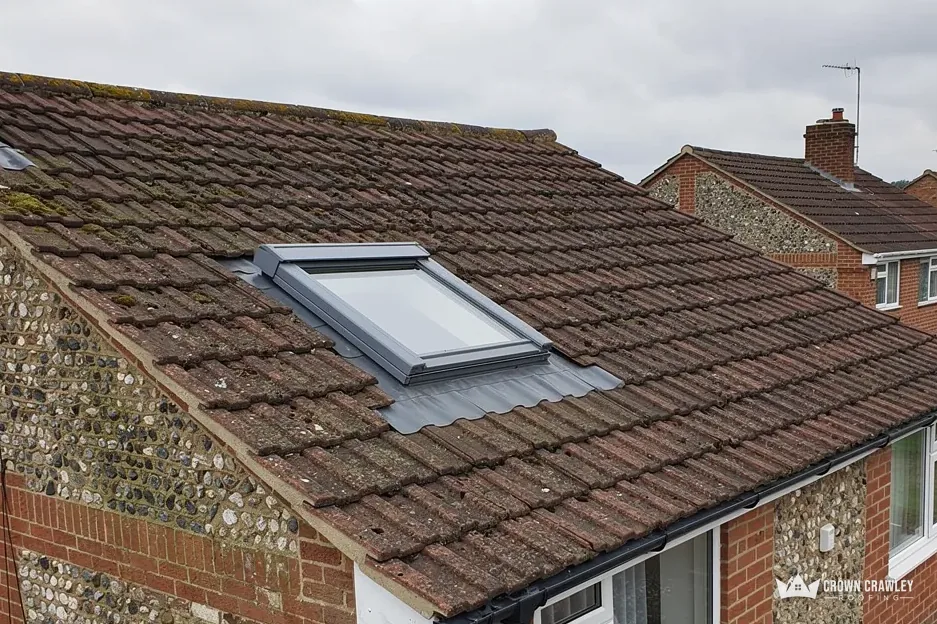
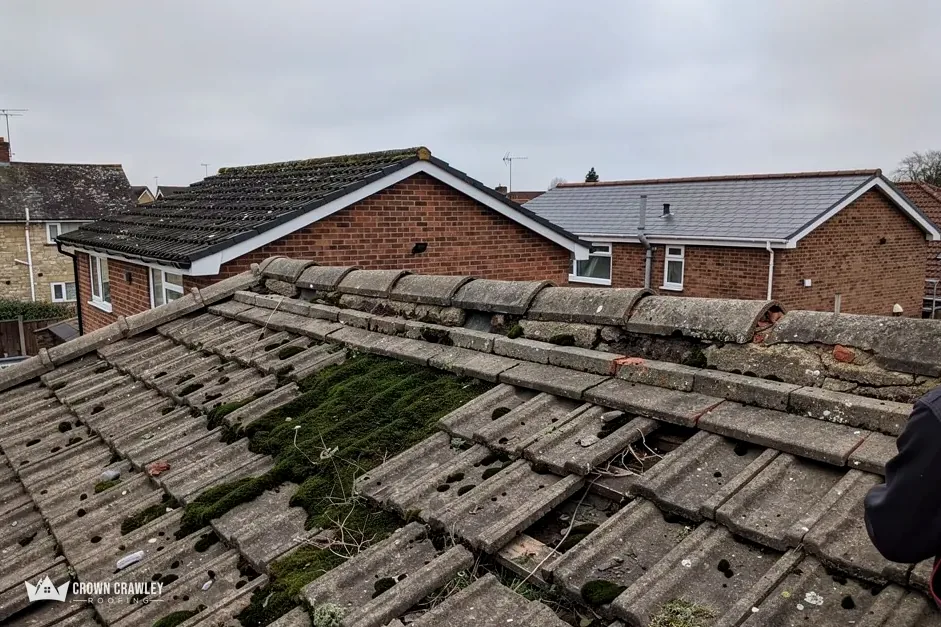
The balance tips when the same faults keep returning across a whole slope. Tiles whose nibs have crumbled, battens that have gone soft, underlay hanging in shreds in the loft and nails rusted through all point the same way. Underlay is the sheet laid under the battens as a second line against wind and rain. Patching a roof like that buys a winter or two at best. Then a re-roof of that slope, or the whole roof, is the better use of your money, and our roof replacement page explains how that job runs. Sound tiles from a stripped slope can often be set aside for repairs elsewhere on the house. For a single fault on a sound roof, emergency and general roof repairs is the place to start.
One slipped tile is a repair. A roof shedding tiles every winter is asking for more.
The loft settles many of these questions. With a torch we look for daylight between tiles, dark stains on the battens, damp insulation under a valley and underlay that has torn or sagged between rafters. We photograph what we find, and if we cannot reach the loft we note it in the written price rather than guess. A dry loft under a roof with a few slipped tiles is good news. A wet one under a roof that looks fine from the road tells us to look harder.
Stage 03 · Close look
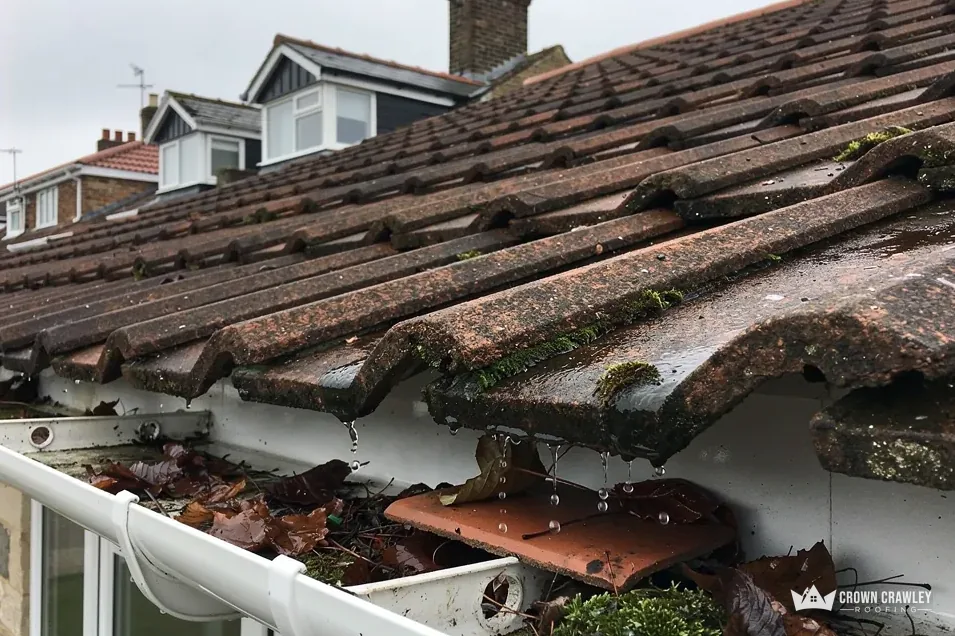
Some 1950s houses were built with concrete gutters cast into the eaves. They let in damp, but they are not always a lost cause.
Look up at the eaves of some early post-war houses and you will not find a plastic gutter on brackets. You will find a chunky concrete trough that is part of the wall itself. These are Finlock-type gutters. The surveyors' body RICS records them on a 1950s local authority-built house and does not mince its words: leakage through the joints "has caused serious deterioration in numerous cases and brought this form of construction into disrepute".
From the ground, a Finlock gutter looks like a deep, square-edged concrete band running along the top of the wall, often painted, with the downpipe dropping straight out of it. There is no separate fascia board behind a bracketed gutter. Inside, the giveaway is damp on the ceiling or wall just below the eaves, or stains above the upstairs windows. That is because concrete laid in the inner trough forms a lintel over those windows, and RICS notes it is vulnerable when water gets through the joints. If you are not sure what you have, a photo of the eaves taken from the garden is usually enough for us to tell.
Eaves words
The same RICS record makes a point that saves people money: careful examination will separate gutters that need major work from those that "will remain sound if properly managed", and "the need for removal should not automatically be assumed". Linings fail too. RICS describes a gutter lined with stainless-steel sections whose lining now needs replacing itself. So we check the joints, any old lining and the concrete around the window heads before we suggest anything. Where the gutters do come off, the eaves are rebuilt with timber and new guttering, which our gutters, soffits and fascias team handles. Where a new lining is the answer instead, we explain what it involves and what it cannot fix, such as concrete that has already cracked above a window.
Stage 04 · Outbuildings
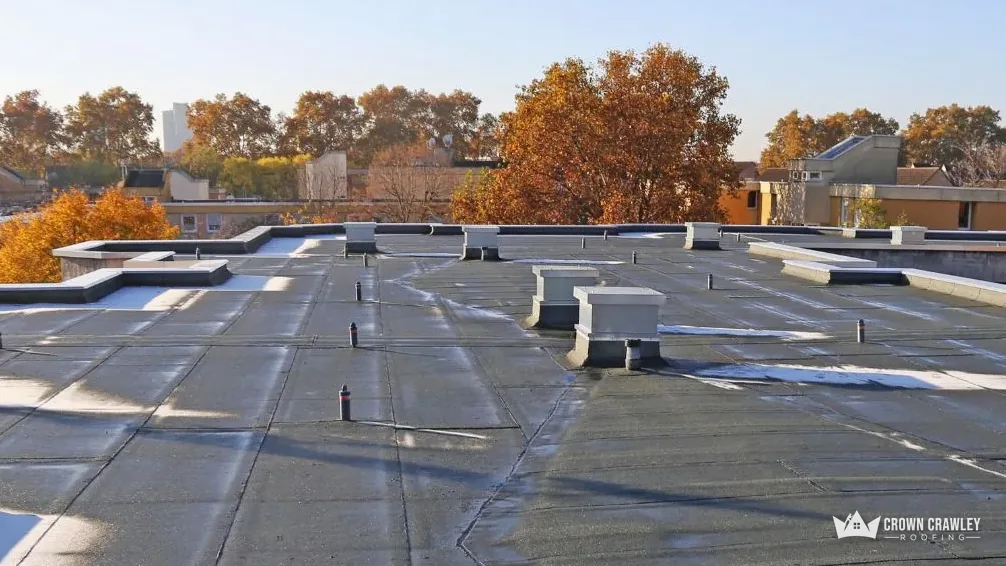
Flat-roofed garages, on their own or in rows, wear out faster than the house roof and can hide asbestos cement sheets.
Garages were part of the plan in parts of Crawley. At Furnace Green, 460 "standard II" houses had been built for rent by 1962, each with a garage. Garages, whether attached, detached or in a block behind a terrace, are easy to forget, especially when the roof is flat and out of sight.
It depends on the covering. A cost guide from Less, last updated in March 2026, puts torch-on felt at 10 to 20 years and GRP, the glass-fibre finish, at 25 to 40 years. GreenSpec gives EPDM, the rubber membrane, an expected service life of 20 to 30 years. Those are typical figures, not promises. A felt roof that ponds water or has cracked at the edge trims will fail well before its time, and a well-laid one in a sheltered spot can beat it. Puddles that sit for days, blistered felt, a soft patch near the door and daylight round the edge trims are all worth a photo.
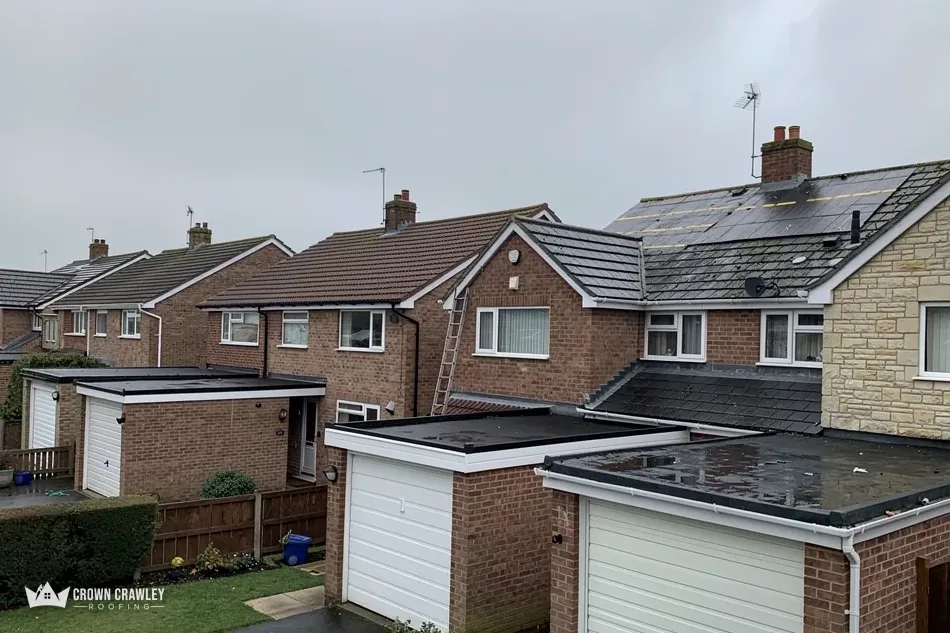
A garage roof is easy to ignore until the damp reaches whatever you keep inside it.
Garage roof checks
Corrugated sheets on older garages may be asbestos cement. HSE advises that if a building was built or refurbished before 2000 you should assume asbestos is present. Work on asbestos cement roof sheeting can be non-licensed when the sheets are handled and removed without breaking up, but HSE is also clear that "AC roofs are always fragile", so nobody should walk on one. We look first, tell you what we think the sheets are and set out the safe way to deal with them. Sound sheets can sometimes stay where they are and be kept dry. If they are cracked or leaking, removal is planned properly, with the waste double-wrapped and labelled as HSE's guidance requires.
In a shared block each owner usually answers for their own bay, so we can price one garage on its own. For the coverings and how we fit them, see our flat roofing page.
Stage 05 · Detail
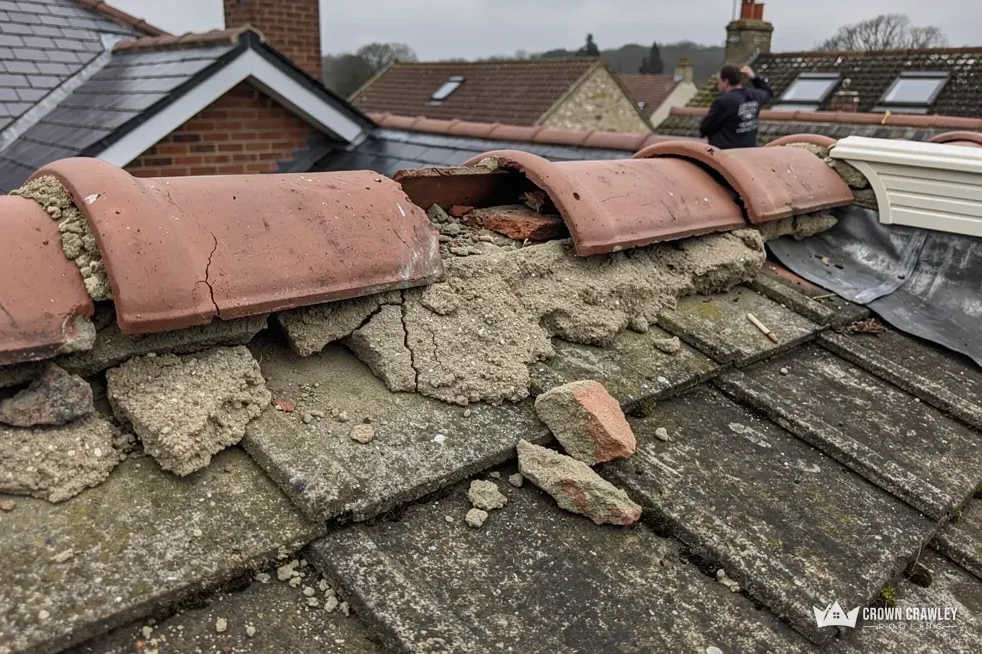
On the newest Crawley houses, ridges and verges may be held by screws, clips and plastic caps, which wear out differently from mortar.
Walk round Forge Wood, the newest of Crawley's neighbourhoods, and then round a 1950s street, and the edges of the roofs look different. Older roofs tend to have their ridge tiles and verge edges bedded in sand and cement. Newer ones may have neat plastic caps down the verge and a ridge fixed with screws over a roll of breathable material. That change has a reason behind it. Neither way is better on every roof; they fail differently and need different fixes.
Marley explains that the 2014 revision of BS 5534, the British Standard code of practice for slating and tiling, made it clear that the strength of mortar alone could no longer be relied on to hold ridge and hip tiles, and that bedded tiles and fittings should also be fixed mechanically. BS 8612 is the test specification for dry verge, hip and ridge systems. Marley also points out that installing to BS 5534 is not required by law, so a roof built before then is not illegal, just built to older thinking. The practical point for you is that when a mortar ridge is rebedded today, it should go back with mechanical fixings as well as mortar, not mortar alone.
Ridge and verge words
Dry systems fail in their own way. Verge caps split or work loose and drop into the garden, end caps go missing at the eaves, and ridge units can lift if a fixing was missed. The answer is usually to replace just the affected units rather than the whole run of them. On a terrace the verge caps sit only on the end houses, so one loose cap is a short job. A ridge needs checking from end to end, because a single missed screw lets the wind work at the units either side. Our dry ridge and dry verge page covers both systems.
On an older roof, cracked mortar on the ridge or verge gives you a choice. We can rebed the ridge in fresh mortar with mechanical fixings added, which keeps the look of the house, or change to a dry-fix system. Neither is right for every roof. On a house where the neighbours have bedded ridges and the street has a uniform look, rebedding often suits. Where the mortar keeps failing at an exposed gable, a dry verge can end the cycle. We show you both before you decide.
Stage 06 · Planning
Safe access is planned before the price is fixed: scaffold, any highway licence and, if a job needs one, a crane permit near Gatwick.
How we reach a roof is part of the job, and part of the price. A tile on a bungalow may need only a ladder and a roof ladder hooked over the ridge. A valley on a two-storey semi needs scaffold or a tower so that we can work safely for as long as the job takes. We decide this at the survey, and the written price covers the access we have chosen. Scaffold is a real part of the cost. Checkatrade's roof replacement guide (October 2026) puts scaffold for a new roof at £700 to £1,300 as a national figure, so we plan the work to keep it up no longer than needed. We also tell the neighbours before it goes up and keep shared paths clear.
Only if it stands on the highway, which includes the pavement. West Sussex County Council says a licence is required to put scaffolding on a public highway and asks for a minimum of 10 working days' notice between the application and the day the scaffold goes up. Its fee for one month of scaffolding is £266. We arrange the licence with the scaffolder and build that notice into the start date. A scaffold on your own drive or garden is on private land and needs no highway licence.
Gatwick Airport says you need its permit to use a crane within 6 km of the airport, unless the crane or equipment is under 10 m high or shielded on all sides by taller trees or buildings. Applications go to the airport by email alongside any notice to the Civil Aviation Authority, and a standard Level 1 permit costs £300 plus VAT. The airport's page talks about cranes and tall lifting equipment, not ordinary scaffolding. If a big re-roof or a commercial job calls for lifting gear, we check the rule before we plan the lift. Our guide to crane permits near Gatwick covers the detail.
Stage 07 · Pricing
You get one total in writing once we have seen the roof. Here is what moves it, and what to check on any quote.
Our quotes are one figure, the total, in writing, after a survey. That figure is good and fair because it is built on what we saw on your roof, not on a guess made over the phone. Four things move it more than anything else: how we get up there, how much roof is involved, what the roof is covered with and what the survey turns up underneath.
Checkatrade's cost guides give useful national context. Its table from June 2026 puts a roofer at £35 to £45 an hour or £280 to £360 a day. Its October 2026 table puts replacing slipped or broken tiles at £170 to £500 for up to five tiles, with the top of that range covering jobs that need scaffold. Those are typical UK ranges, not our prices, and Checkatrade notes its repair figures exclude VAT. The standard rate of VAT is 20%. Guides like these help you spot a figure that is wildly out, high or low, but no guide can price your roof, because none of them knows how your valley was built or what state the battens are in.
Check whether any quote includes VAT and scaffold. A total that leaves them out is not a total.
Words on a quote
Ask whether the total includes VAT and any scaffold. Ask what happens if the survey could not see something, such as the timbers under a valley. Make sure the quote names the work in words you understand, and that the business behind it has a landline or address as well as a mobile. Be wary of a price given from the drive with nobody going up, or of pressure to sign on the spot. If you sign a contract at home after a visit, the law usually gives you 14 days to cancel. Our guide on how to tell a dodgy roofer lists more checks that work on anyone who calls or knocks. You can find more on how we approach pitched roofing jobs on tiled and slate roofs.
Stage 08 · Sign-off
The last hour on site is for checking our own work, clearing up and showing you what was done, with photos to keep.
A roof job is not finished when the last tile goes on. Before the scaffold comes down we walk the work again, check every fixing we touched and look along the gutters for mortar, broken pieces and offcuts. Inside, we check the loft under the repair for daylight and damp. Then we send you photos of the finished roof alongside the ones from the survey, so you can see what changed. If anything on the neighbour's side of a shared ridge or valley was disturbed, we check that too and let them know.
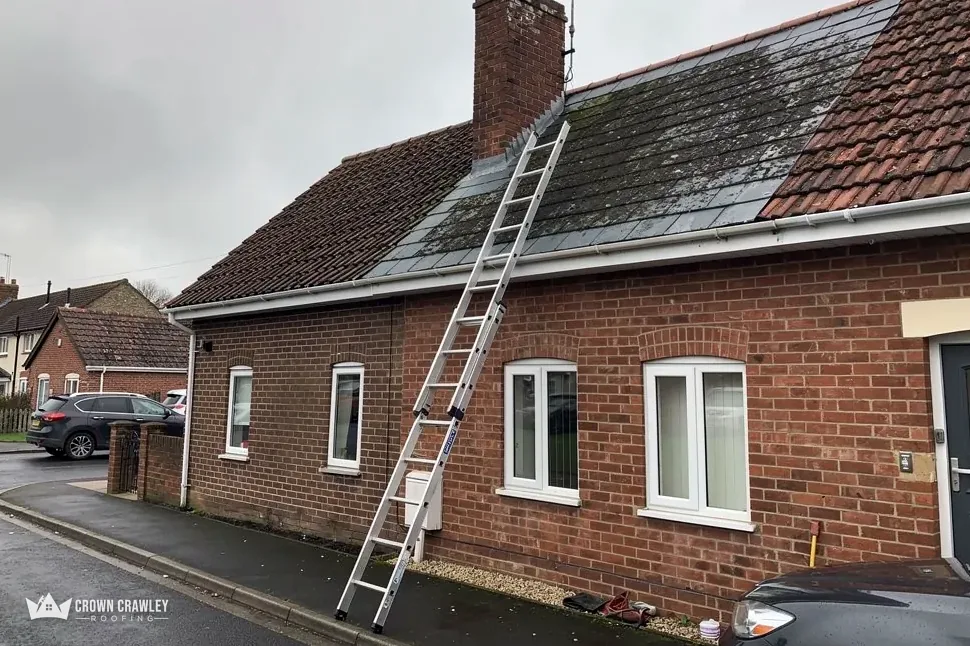
Before we pack up
Sometimes. Crawley Building Control lists repairing or replacing more than 25% of the surface area of a roof among the domestic jobs that need its approval, so on larger re-roofs in the borough we check with them first. The national test on the Planning Portal is different: approval is not normally needed where less than 25 per cent of the building envelope and less than 50 per cent of the roof is affected. A heavier new covering can also bring in Building Regulations, and the Planning Portal advises a check with a structural engineer or surveyor before work starts. On a like-for-like repair none of this normally comes up, but it matters once a job grows. If we think approval is needed, the written price says so and explains how it will be handled.
Government guidance says all bat species, their breeding sites and resting places are fully protected, and it names repairing or replacing a roof as an activity that can affect them. Nests of wild birds are protected while in use or being built. If we see signs during the survey, we stop and talk it through with you before any work is planned. The work may need to wait for an ecologist's advice, and that is far better known at the survey than halfway through a job.
The easiest way to start is from the ground. Take a photo of the slope or the problem from your garden or the pavement, note your postcode and tell us when you first noticed it, for example a stain after a windy night or a tile on the lawn. Send that by WhatsApp or the form, and we will book a survey and take it from there.
Map of the area we cover: a 24-mile circle around Crawley, with the towns that have their own page.
Send a photo from the ground, your postcode and what you have spotted, and we will book the survey.
| Work | Guide price |
|---|---|
| Roof repairs | £150 to £1,000 |
| Guttering, soffits and fascias | £1,000 to £3,000 |
| Roof replacement | £5,000 to £12,000 |
| Flat roofing | £50 to £100 per m² |
These ranges are our own guide figures. Your actual price is one written total, set once we have been up and surveyed your roof.
Plain answers on costs, permissions, grants and checking a roofer, written for houses in Crawley and the towns within 30 road miles.
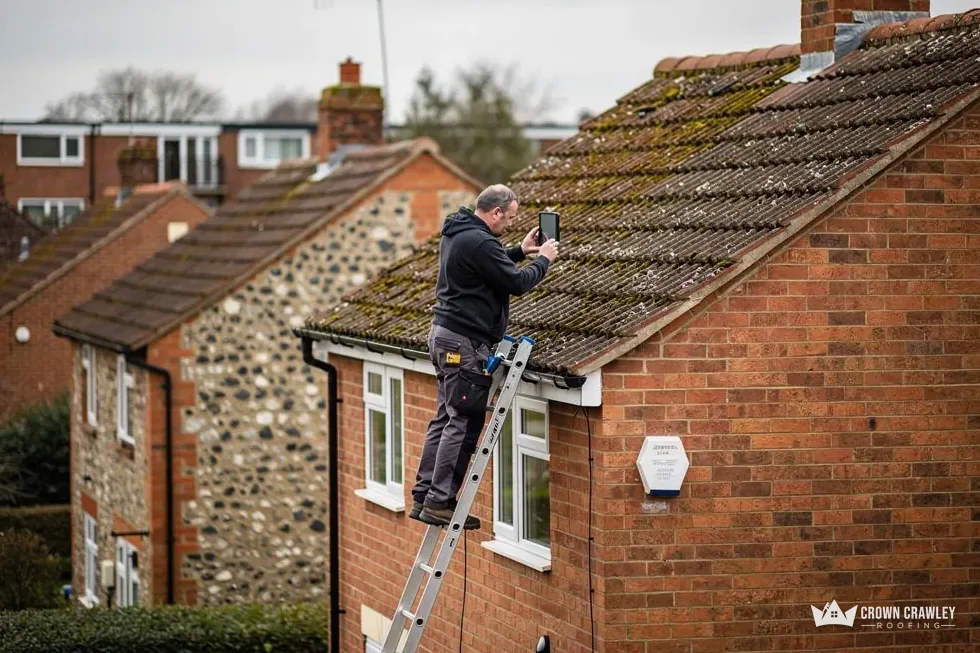 How to Tell a Dodgy Roofer: Warning Signs to CheckA bad roofer is easier to spot before the work than after it. These checks work on any firm that quotes for your…Guide · 9 min read
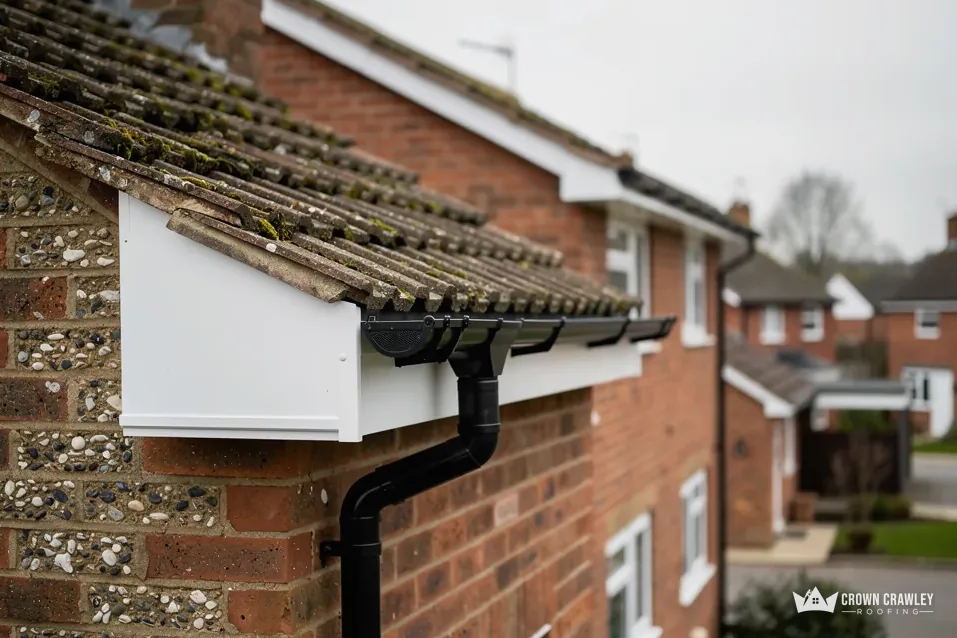 Crawley Roofs by Neighbourhood: What Is on Your HouseCrawley grew one neighbourhood at a time from 1947, so the age of your street is the best clue to what sits over your…Guide · 9 min read
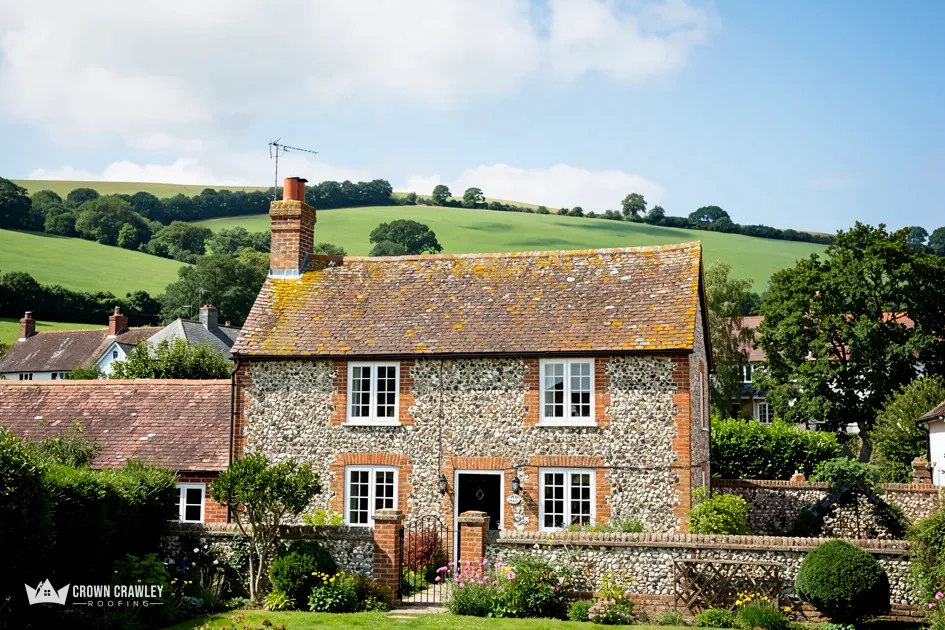 Roof Work Costs: A UK Guide to Typical PricesRoof prices vary far more than most home costs. This guide sets out typical UK ranges for each kind of job, names…Guide · 9 min read
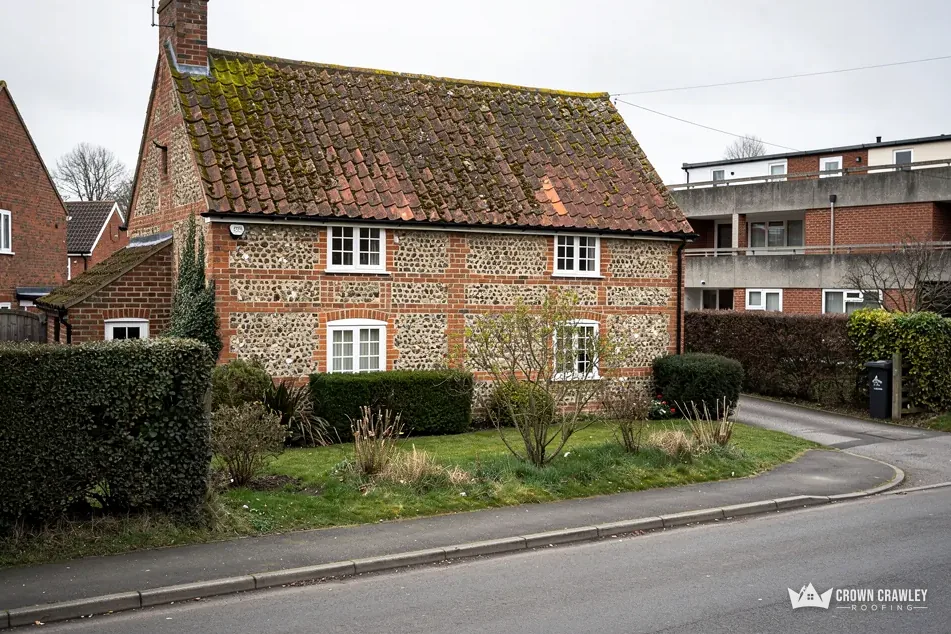 Roof Work Rules: Building Regs, Planning and ConsentsWhether a roof job needs a consent turns on the size of the job, the covering chosen and the address. This guide maps…Guide · 9 min read
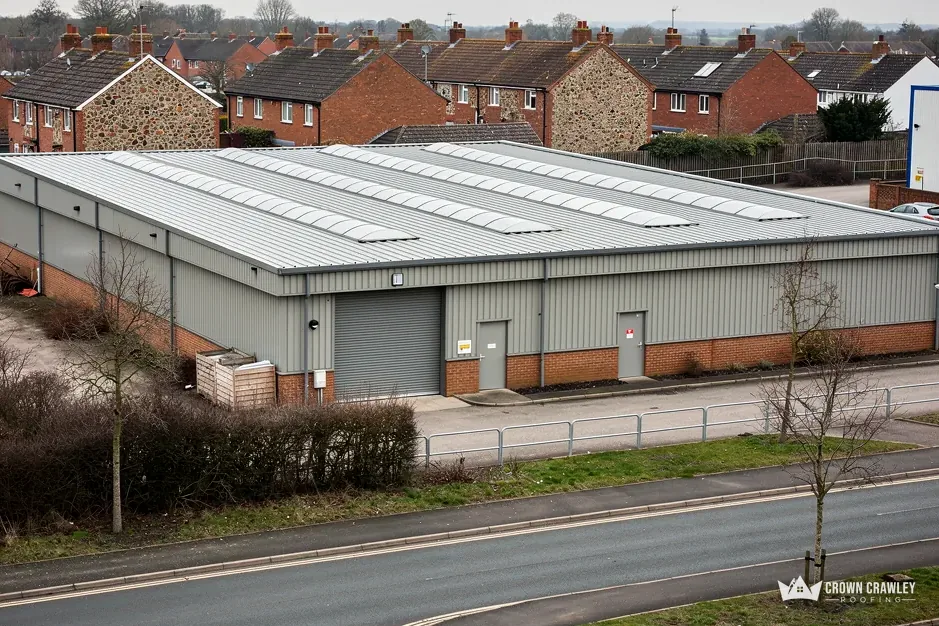 Cranes and Tall Equipment Near Gatwick: Roof Work RulesMost house roofs never need a crane, but a lifting lorry or a tall platform near Gatwick can. Here is what the…Guide · 9 min read
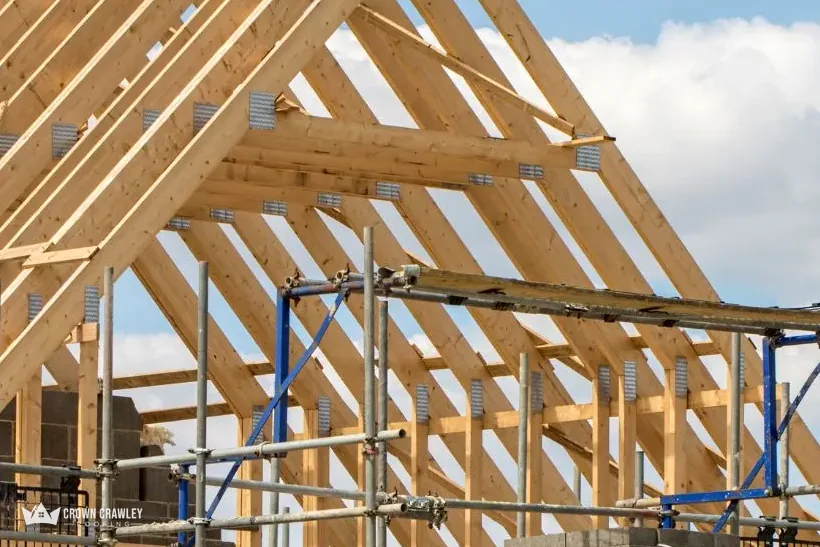 Roofing Options: Choosing a Durable, Good-Looking RoofTile, slate, flat membrane or metal: a UK house can carry any of them, and each behaves differently over a lifetime.…Blog · 10 min read
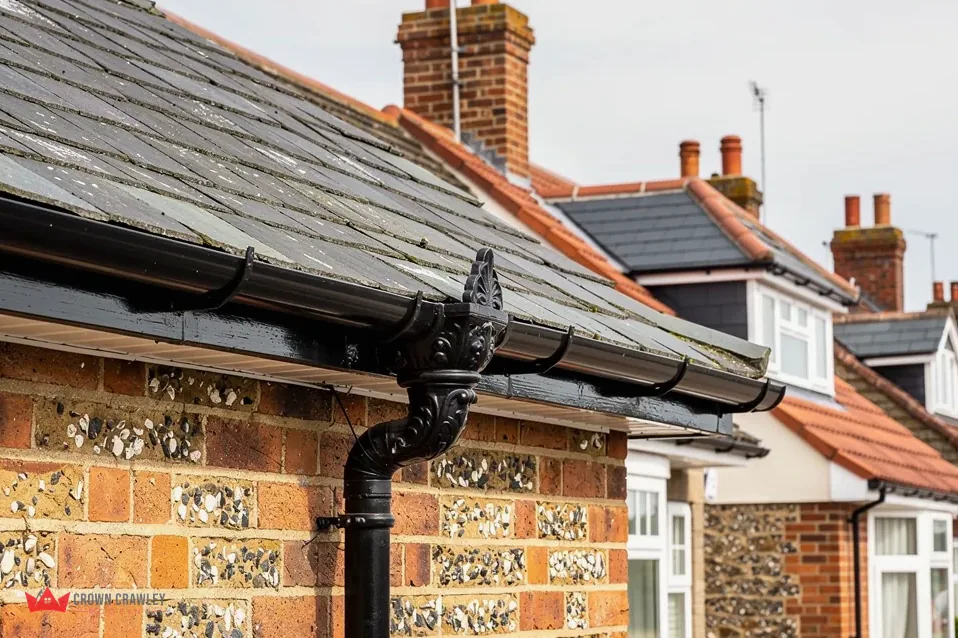 The Role of Professional Roofing Services in Your Roof's HealthA roof needs different help at different ages: a look, some upkeep, a repair and in the end a renewal. Here is what a…Blog · 9 min read
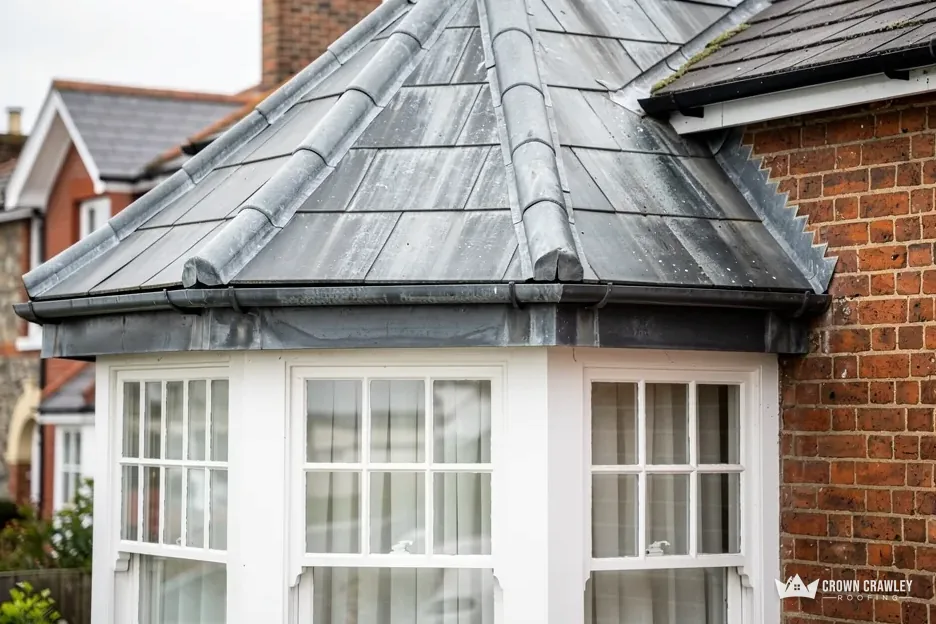 Finding the Right Roofing Service: What to Consider for Your HomeChoosing a roofer is mostly a matter of getting things on paper: the work, the price, the payment terms and the…Blog · 9 min read
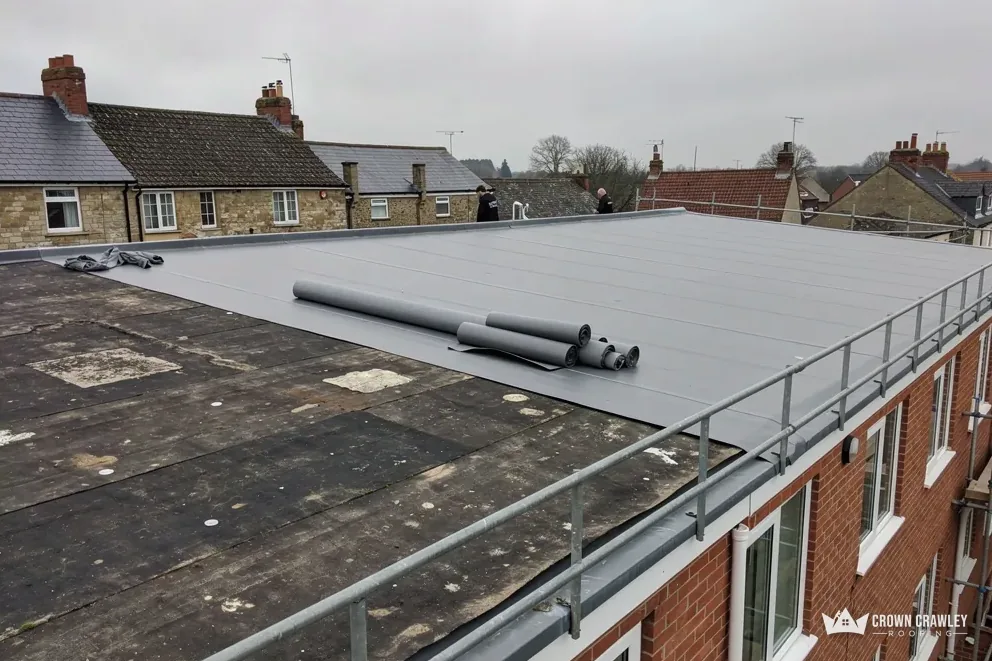 The Importance of Regular Roof InspectionsA roof fails slowly and out of sight, and the warning is often a ceiling stain. A regular professional inspection…Blog · 9 min read
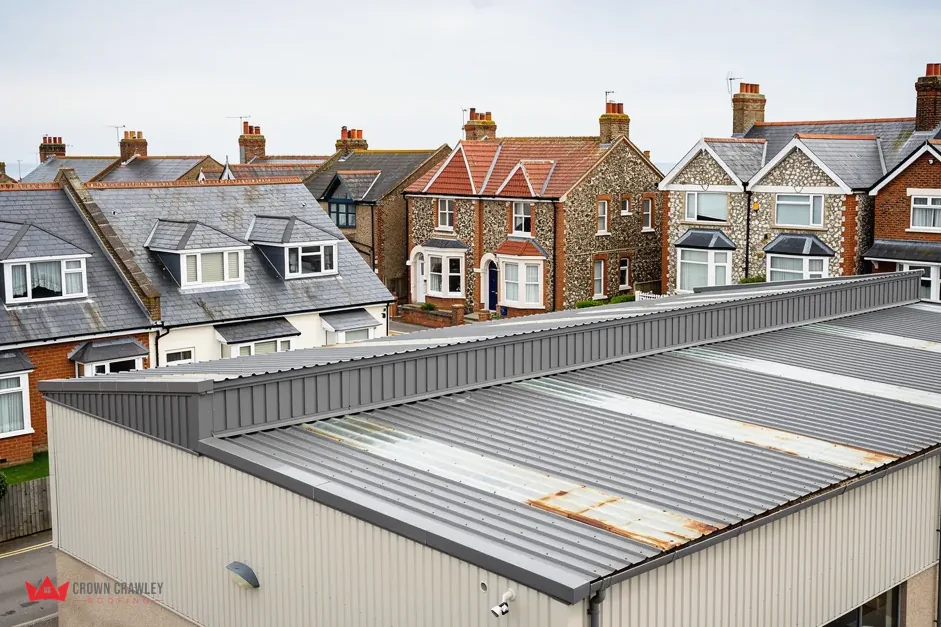 Crown Crawley Roofing: Our Business VideoOur short business video introduces Crown Crawley Roofing. Below it, in plain words, is how one of our jobs runs…Blog · 9 min read
 Best Places to Visit in Crawley (and the Roofs Worth a Look)Crawley rewards a slow walk. These are the parks, ponds, streets and churches we would send a visitor to first, with…Blog · 9 min read
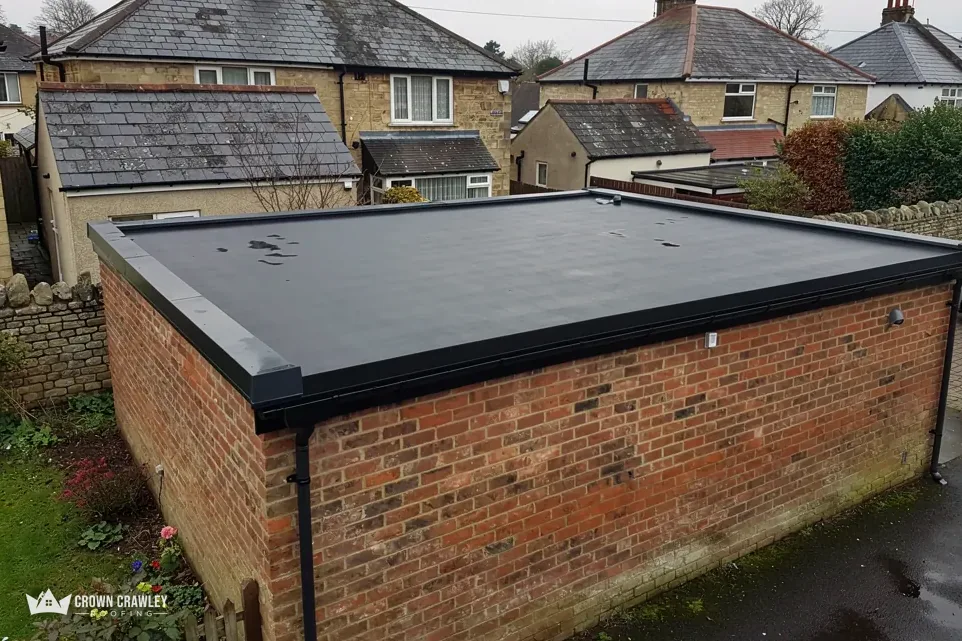 Barbers in Crawley: Where to Find a Good Cut, Neighbourhood by NeighbourhoodCrawley grew as a ring of neighbourhoods, each with its own parade of shops. Here is how to find a barber in each…Blog · 9 min read
Use the same checks on any roofer, Crawley-based or not, including us. Citizens Advice suggests written quotes from at least three traders, checking any claimed membership on the scheme's own website, and speaking to recent customers, since written references are not always genuine. Be wary of a mobile number and nothing else. Check the company on the Companies House register too, and ask to see their insurance.
No national scheme pays for re-roofing or roof repairs. Current schemes fund insulation and heating: ECO4 runs until 31 December 2026, and the Warm Homes: Local Grant covers wall, loft and underfloor insulation for homes rated EPC D to G where household income is usually £36,000 or less. Check the current position on gov.uk and with Crawley Borough Council before you plan around any scheme.
Checkatrade's cost guide, in a table dated June 2026, gives £35 to £45 an hour or £280 to £360 a day. Day rates are a useful yardstick, but a roof job is better priced as a whole once someone has looked at it, because access, materials and waste vary so much. We give you one written total after the survey.
It depends on the height, the pitch and how long the work takes. A single tile on a bungalow can often be done from a ladder and roof ladder; a valley or chimney on a two-storey house needs scaffold or a tower. If the scaffold has to stand on the pavement, West Sussex County Council needs at least 10 working days' notice for the licence.
Yes. We work as roofing contractors, Crawley and the surrounding towns included, for landlords, shops, small industrial units and owners of garage blocks as well as householders. The approach is the same: a survey, photos of what we find and one written price, with access and working hours planned around the people using the building.
Yes. We cover the towns and villages within about 30 road miles of Crawley, across West Sussex, Surrey and the edges of East Sussex and Kent, including Horsham, Horley, Reigate and East Grinstead. Each place has its own page on our areas list, with the council, the planning authority and what we know about its roofs.
Message us on WhatsApp