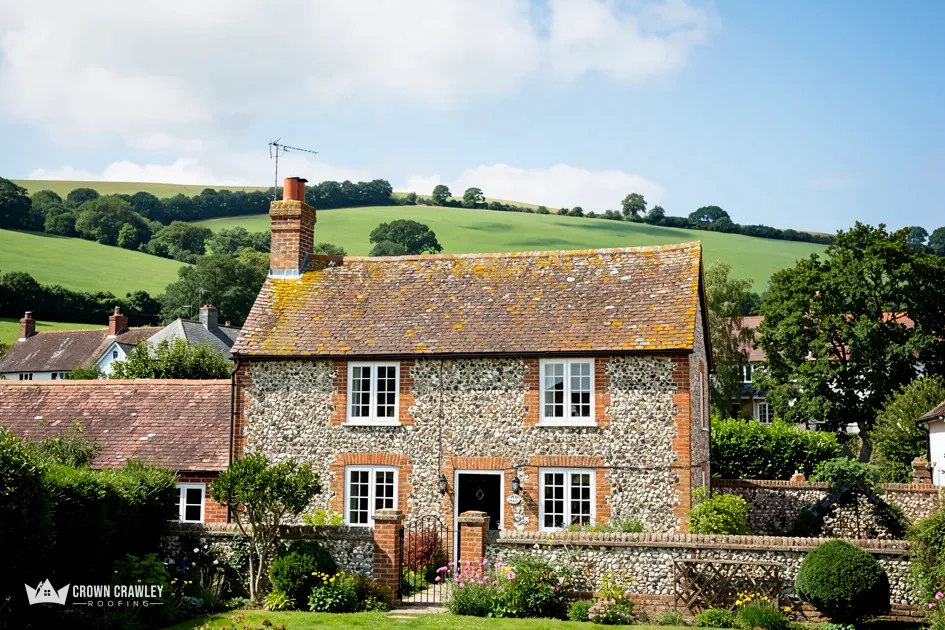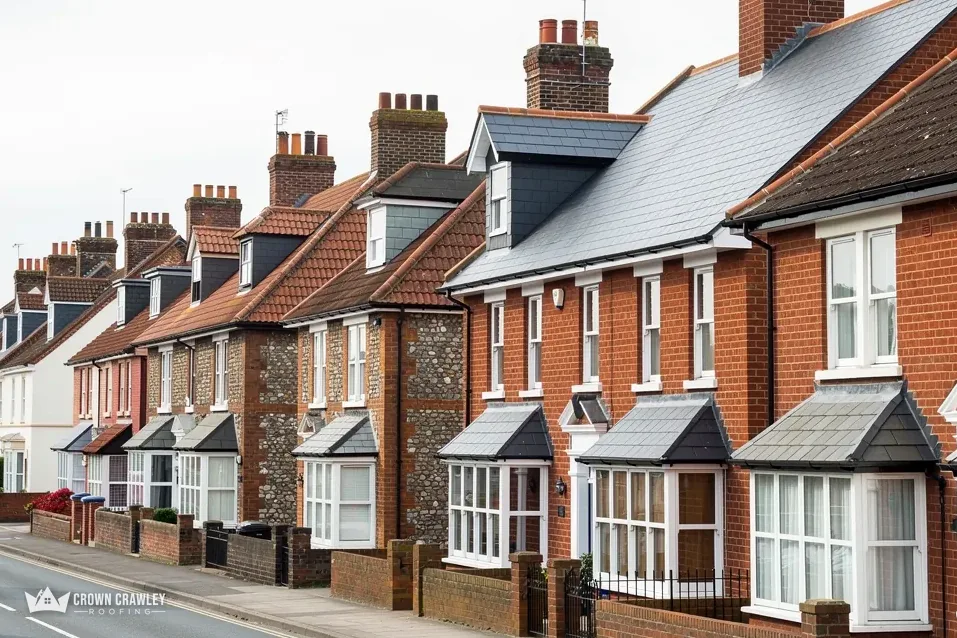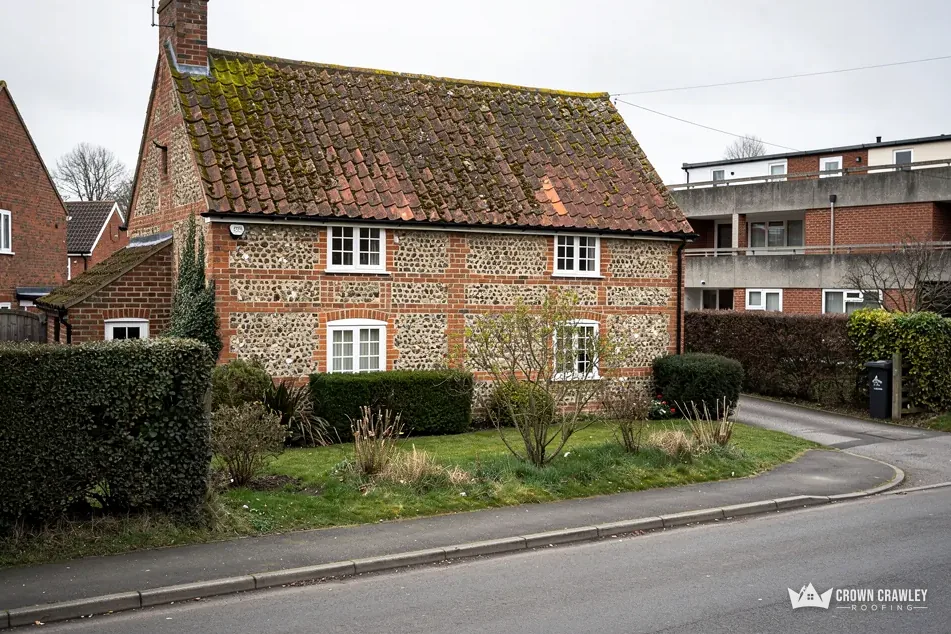
Ask three people in Crawley where they get their hair cut and you will hear three different parades. That is down to how the town was made. It was built as a post-war new town, neighbourhood by neighbourhood, and every neighbourhood got its own small centre so residents did not have to cross town for the basics. A barber is usually one of the shops in that row, somewhere between the newsagent and the chemist.
This guide takes the High Street, Three Bridges, Broadfield and Pound Hill in turn and gives you a way of choosing, rather than a list of names. We would rather you checked a shop's own website, its opening hours and its prices than took our word for it, and a list of businesses goes out of date quickly. We are a roofing contractor, so we also look up. Shops in a row share a roof, and the roof over a barber's chair tells you quite a lot about whether the building is being looked after.
Why each Crawley neighbourhood has its own parade
The British History Online account of the new town, drawn from the Victoria County History, describes neighbourhoods being planned and built one after another. West Green was the first, with houses going up by 1949. Three Bridges followed, with work starting in 1952 and 982 houses built by 1955. Pound Hill began around 1953. Broadfield came much later: it was planned in 1967 and begun in 1969, and between 1976 and 1980 its own parade went up beside a big supermarket, with a community centre close by.
What does that mean for a haircut?
It means you do not need to head into the town centre. Each neighbourhood's parade is built around the people who live within walking distance, so a barber there depends on regulars, and regulars tend to notice when standards slip. A shop that has kept the same customers for a long time is usually doing something right, though that is a judgement for you to make on the day, not a claim we can make for any named business.
Which parade is closest to you?
If you are not sure which neighbourhood your street belongs to, our areas we cover pages place each one on a map. Pick the nearest parade first. A barber you can walk to is one you will actually use.
The parades were built in different decades, so the shop fronts, the pavements and the roofs above them differ from one to the next. That becomes useful later, when we get to what sits above the shutters.
The High Street and the old town
Crawley High Street is the oldest part of the town. The Victoria County History notes that West Green, near the High Street, was named as a green by 1532, and that numbers 60 and 62 Ifield Road are a late-16th-century timber-framed house. So when you stand in the High Street you are standing among buildings of very different ages, some of them far older than the new town around them.
What to expect from a High Street barber
Old streets mean small units, narrow frontages and sometimes a few steps up from the pavement. If step-free access matters to you, ring ahead and ask. Appointments are worth asking about too, because a central shop fills quickly on Saturdays and before bank holidays. Many shops take bookings through their own website or by phone, and a few only take walk-ins. The shop's own page will say which, so read it before you set off.
What is above the shop?
On an older street the building above a shop may be a few hundred years old or Victorian, with a pitched tiled roof behind the parapet, or a later flat-roofed extension at the back. We cannot tell you which from a pavement, and neither can anyone else, which is exactly why a roofer starts with a survey and shares photos of the roof itself. If the building is listed or stands in a conservation area, ask Crawley Borough Council's planning team before any change to the outside, because the rules differ.
Three Bridges and the parades near its station
Three Bridges began as a village of its own, Crawley Borough Council explains, before the new town grew around and over it. Old and new sit side by side here, and the neighbourhood's church is a yellow brick building from the 1950s.
Choosing a barber near a station
A parade close to a railway station sees commuters at the start and end of the working day, so opening hours matter more here than anywhere else. Some shops open early, some close late, and some close one weekday altogether. The only reliable way to know is the shop's own website or a phone call. Look for a clear price list as well. A barber who publishes prices has nothing to be vague about, and you can set the number against what you expect to pay before you sit down.
Questions worth asking before you book
Ask whether the shop does the style you want, whether it cuts children's hair, and how long a standard cut takes, so you can fit it around a train. Ask whether you can book a regular slot. Those four questions will tell you more than any list of names, and they cost you thirty seconds.
Parades near a station tend to be some of the busiest in a neighbourhood, so the roof over them takes the same weather as everywhere else and has more people walking beneath it. A loose coping or a blocked outlet on a roof like that is an issue for the landlord or freeholder, but a customer tends to spot it first, as a bucket or a stained ceiling tile.
Broadfield and its 1970s parade
Broadfield is the youngest of the big neighbourhoods in this guide. The Victoria County History says it was the first neighbourhood of the 1961 scheme and was intended to cover 562 acres with 4,000 dwellings. Its shopping parade, with a large supermarket, was built between 1976 and 1980, so the buildings are a generation younger than the Three Bridges or West Green shops.
What is different about a newer parade?
Practically, parking and access are easier. A modern parade usually has a service yard or a bay at the front, so a barber there can take walk-ins without the street being full. Layouts built in the late 1970s also tend to be open and level, which helps if you use a pushchair or a wheelchair. Check with the shop itself for the specifics of its own front door.
Roofs on a parade of that age
Buildings put up in the 1970s and 1980s often finished the shop row with a flat roof, because it was a fast and economical way to cover a long, wide building. Without looking we cannot say that of any particular unit, and a pitched roof or a mix of both is just as possible. If a flat roof from that era is still there, its covering has probably been renewed since it was built, and what sits on it now may be felt, EPDM, which is a synthetic rubber sheet, or GRP, which is glass-reinforced plastic laid as a liquid and cured hard. If the roof above a shop you use looks tired, the owner can ask for a survey.
Pound Hill and the roads to the east
Pound Hill started around 1953, and the Victoria County History says the planners had a more prosperous neighbourhood in mind, with unsubsidised homes reserved for its northern end. The later 1970s pushed it out towards the M23, and Crabbet Park finished the job by 1984. So the housing around this parade was built over about three decades, in several different styles.
A quieter kind of barber
Neighbourhood centres on the edge of town tend to be smaller than the High Street, with fewer chairs and more regular faces. That suits some customers and puts off others. If you like to chat, it is ideal. If you want to be in and out in fifteen minutes with no conversation, say so politely at the start; a good barber will take the hint.
How do you tell a careful shop from a careless one?
Look at the basics. Are the tools kept clean and the floor swept between customers? Is the price on the wall? Does the barber ask what you want before they start, and check with you before they finish? None of that needs a verdict from us, and none of it needs a review site. You can see it in the first two minutes.
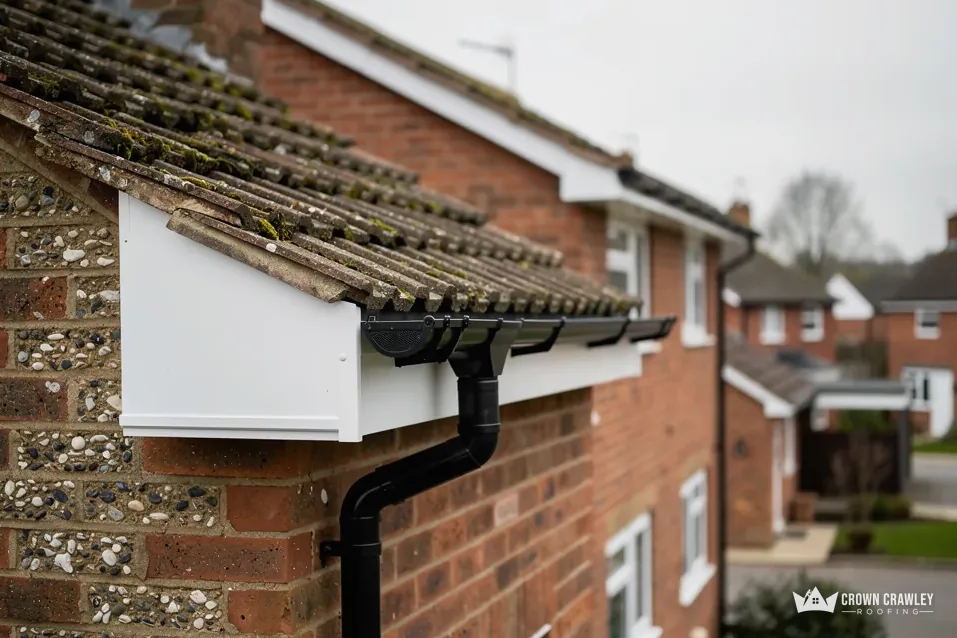
It is also worth glancing at the state of the building itself. Peeling paint under a gutter, a damp patch on the soffit above the door, or a downpipe that discharges onto the pavement are small signs that rainwater is not being carried away properly. Our gutters, soffits and fascias page explains what each part does.
The flat roof above the parade
This is the part a roofer cannot help adding. A shop unit may have a flat roof over some or all of the building, and nobody thinks about it until water arrives.
When is a flat roof covering due a survey?
Typical figures are published, and they are ranges, not promises. For EPDM, GreenSpec quotes an expected service life of 20 to 30 years. Less, a home-improvement cost site, updated in March 2026, gives GRP as 25 to 40 years and felt as 10 to 20 years. The figures depend on the installation, the weather and the upkeep, so treat them as a rough guide to when a survey becomes sensible.
Who looks after it?
If you rent a unit, the lease decides who must keep the roof watertight, so read it before you pick up the phone. A tenant running a barber's can ask the freeholder to arrange a survey, or arrange one themselves once permission is given. Our page on shop flat roof repair covers the usual steps, and our commercial roofing service starts with a survey and photos, then one written price.
No flat roof is truly level, because water needs a slope to reach the outlet. The current code of practice, BS 6229:2025, sets a minimum finished fall of 1:80 over the main roof areas and along any internal gutters. Puddles that are still there a day after rain suggest the fall is not doing its job, and that is worth showing to a roofer. If you look after the building yourself, our flat roof maintenance post sets out what to check each season.
If you came here for a haircut, the next stop might be a walk. Our guide to places to visit in Crawley picks out the parks, ponds and old churches worth an hour. And if a roof over a shop or a home needs a proper look, start at our Crawley roofing homepage.
Part of Roofers in Crawley: the full guide
More about barbers and the roofs above them
Should I check a barber's own website before visiting?
Yes. The shop's own page is the most reliable place for current opening hours, prices, booking arrangements and contact details. Directory listings and old blog posts, including our own earlier version of this one, can fall out of date. A quick phone call to confirm that a shop is open takes less time than a wasted trip.
Who is responsible for a leaking flat roof over a shop?
That depends on the lease or the ownership of the building. Some leases give the freeholder the structure and roof while the tenant keeps the unit, but the paperwork decides. Read the lease first, tell the landlord promptly and keep dated photographs of any water marks or drips.
Does a leaking shop roof need patching or recovering?
A local fault such as a split seam, a lifted edge or a blocked outlet can be a repair. Where the covering is worn across the whole roof, repair after repair stops making sense. A survey with photos shows which applies, and the written price that follows covers the whole job.