Roofing is a trade where the customer cannot see the work. The fault is above your head, the repair happens out of sight, and a poor job may take a winter to show itself. That gap is what makes the trade attractive to the wrong sort of caller, and it is why the checks below matter more than they would for a kitchen or a fence.
None of these checks needs a qualification. Each one is a question you can put to any roofer, by phone or at the door, and the answers tell you a good deal. Some are about who the firm is, some about the paper they give you, and some about how they behave when you say you want time. A firm that passes all of them has not proved it will do a good job, but a firm that fails two or three has told you what you need to know. They run in the order you meet them in practice, starting at the first call and ending with the final payment. Keep the answers, because a firm's replies are worth as much as its prices.
Who is turning up, and can you find them?
Start with the plainest question: if something goes wrong in a month, how would you reach this person?
Do they give a landline or business address?
Citizens Advice cautions against traders who offer nothing but a mobile number. A mobile alone proves nothing, but a firm with no address, no landline and no business name on its paperwork is one you cannot easily find again. Ask for a trading address and a company or business name, and make sure both appear in writing on the quote. A van with only a phone number on the door is a prompt to ask more, not a reason to walk away at once. Ask how long the firm has the same number, where materials are stored and who will be on site each day. Straight answers come quickly. Vague ones come slowly, or not at all.
Can you check the business name?
If the firm calls itself a limited company, search for it on the Companies House website at find-and-update.company-information.service.gov.uk. Check that the name matches the quote and that the registered address is the one you were given. If the firm is not a company, the written address and a phone number that gets answered matter even more.
Should you look the firm up elsewhere?
Yes. Search the firm's name and the town, and read what comes up with a cool head. Our own contact details sit on every page of this site: a phone number, WhatsApp and an enquiry form, along with a Google Business Profile you can find us on. Expect that kind of openness from whoever you ring.
The written quote: one total, in writing
A verbal price is not a price. Whatever is said on the doorstep, nothing binds either side until it is on paper.
What should a quote contain?
It should name the firm and give its address, describe the work in plain words, state one total price, and say whether VAT is included. The standard VAT rate is 20%, which on a large job is a big sum, so a quote that leaves it out is not comparable with one that includes it. It should also say whether the scaffold, the waste removal and the clear-up are inside the total. If any of that is missing, ask for it to be added before you say yes.
How many quotes should you get?
Citizens Advice suggests getting written quotes from at least three different traders before deciding. Compare the totals and what each one covers, and be curious about any figure far above or far below the others. A very low price can mean the work is not the same work, and a very high one can mean the firm is pricing your worry rather than your roof. See also how many roofing quotes to get.
Does a quote bind you?
Not until you accept it. Take your time, read it at the kitchen table, and ask the firm to explain anything you do not follow. A good firm answers without sighing. It is also fair to ask who will actually do the work, since a quote from one firm sometimes ends up carried out by another, and you are entitled to know who is on your roof and who is responsible for them.
Show me the fault: photographs and proof
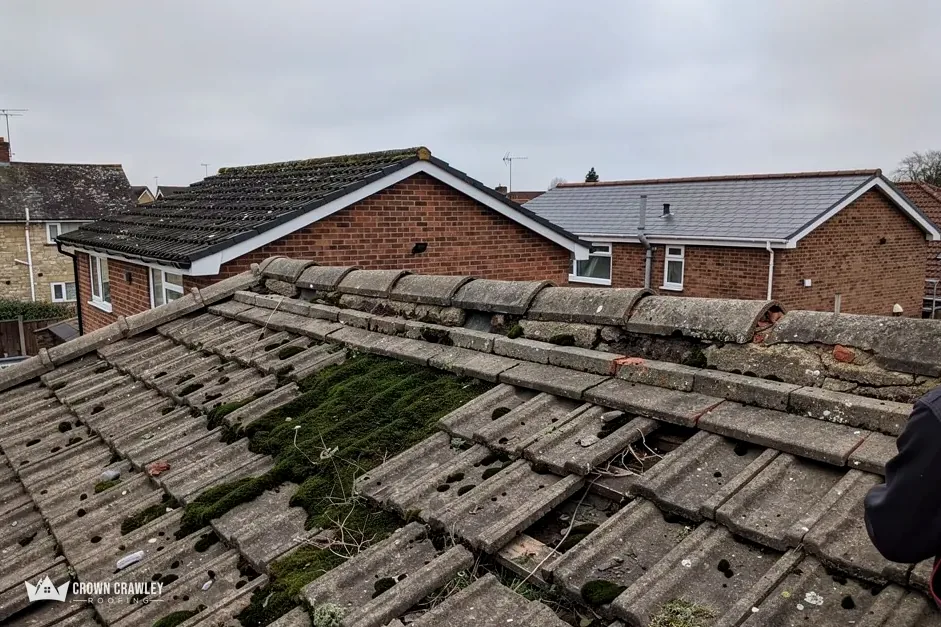
This is the check that cuts through most nonsense. A genuine fault can be shown. Cracked tiles, a lifted flashing or a rotten fascia can all be photographed, and the person who found it should be glad to show you.
What should you ask to see?
Ask for photographs of the problem on your own roof, taken during the visit, and ask the roofer to point out where each one is. Ask which slope, which tile, which corner. A roofer who has been up there will answer in seconds. One who has not will talk about how bad it looks without showing anything, or will show pictures that could be from any house.
What should make you suspicious?
Be careful when a caller says they spotted a problem while passing, when the fault they describe is dramatic and cheap to fix today only, or when they offer to start on the spot. Roof faults rarely become more dangerous in the hour it takes you to make a phone call, and a second opinion costs a short conversation. If the roof is leaking, a temporary make-safe is a reasonable first step; a full replacement agreed on a doorstep is not.
What do we do?
Our jobs start with a survey, and the pictures of your roof come to you before any price is named. Our guide to what happens at a roof survey explains the steps, and it is a useful yardstick for any firm.
Cash, deposits and getting paid on paper
How a roofer asks for money is a strong signal. Honest firms are used to being asked about it and have a ready answer.
Is a cash-only price a warning sign?
It is worth asking why. A firm that will only accept cash, will not give a receipt or an invoice, or offers a lower price for cash is leaving you without a paper trail. If the work goes wrong, that makes any complaint harder and any guarantee harder to enforce. Ask for a receipt for every payment, and a final invoice that matches the quote. Paying by bank transfer or card leaves a record, and our answer on paying a roofer a deposit covers what is reasonable to hand over and when.
Should you pay before the work starts?
Be cautious about large payments up front, particularly demands for the whole sum before anything is done. If a deposit is asked for materials, ask what it is for, ask for it in writing, and ask what happens to it if the job does not go ahead. Never pay in full for work that has not been completed to your satisfaction. Hold the last payment until you have walked round the site, looked at the photographs of the finished work and seen that the waste has gone.
What about cover after the work?
Ask any roofer what cover they give after the work, how long it lasts, what it includes and who stands behind it, and get the answer in writing. A promise on the doorstep is only as good as the paper it is written on. Paper is the minimum, not the whole answer, because no warranty turns a bad repair into a good one.
Pressure, cold calls and your cancellation rights
High-pressure selling is the oldest tactic in the book, and the law gives you some protection against it.
What does pressure look like?
Phrases like a price that is only good today, materials left over from another job, or a danger that cannot wait are all designed to stop you thinking. A decent firm gives you a quote, leaves it with you and lets you decide. Say you will think about it and see how the answer changes. A calm reply is a good sign, and a sudden price drop for a signature today is a bad one. Our answer on what to do when a roofer knocks on your door gives a calm script, and the home page shows how we run a job.
Can you cancel a contract signed at home?
Often, yes. A contract made anywhere other than the trader's own premises, your living room included, counts in law as off-premises. You usually have 14 days, counted from the day you make the contract, and no reason has to be given. Where the trader never told you about the right, the period can stretch by up to 12 months. If you want work to begin inside those 14 days, ask for it in writing, by letter or email, so that the request is recorded.
Is there an exception?
Yes. The rights fall away when you yourself requested a call-out for urgent repair or maintenance, though anything extra sold during that visit stays covered. If you are unsure which category your visit falls into, ring the Citizens Advice consumer service, which deals with individuals.
Claims to check, and when work goes wrong
Good firms make claims that stand up. The trick is to check them.
How do you test a membership or a reference?
If a roofer says they belong to a trade body or a scheme, you can find a list of members on the website of the relevant association or scheme, so look their name up there yourself. If they offer references, remember that Citizens Advice warns that written references are not always genuine. Ask for recent examples of work, and contact the customers yourself. Drive past if you can, and ask the owner what was agreed, what happened on the day and whether anything had to be put right afterwards. Our own site does not reproduce reviews or state a rating, so you will not find us quoting any here.
What about insurance?
Citizens Advice advises that both you and the trader should have insurance in place. Ask to see the certificate rather than being told it exists, and look at the dates and the type of cover. Check your own buildings policy too, as it may affect what happens if work damages the property, and tell your insurer if you are unsure.
What can you do if the work is poor?
The Consumer Rights Act 2015 says services must be performed with reasonable care and skill. Write to the firm with photographs, keep copies, and give them a fair chance to put it right. Citizens Advice can pass information about complaints to Trading Standards for you. Under the Digital Markets, Competition and Consumers Act 2024 a trader must tell you about any alternative dispute arrangement that is available. Our complaints guide takes you through each step.
Part of Roofers in Crawley: the full guide
Checks and warning signs
Is it a bad sign if a roofer only has a mobile number?
It is a reason to ask more questions, though not proof of a problem on its own. Request a trading address and a business name, and check that both appear on the written quote. A reachable address matters most if something needs putting right later.
Can I cancel a roof contract I signed at home?
Often you can, for 14 days after the day the contract is made, without giving a reason. If nobody told you about the right, the window can reach 12 months. One exception covers a call-out you asked for to deal with urgent repairs. Citizens Advice can help you work out where you stand.
Should I get three quotes?
Citizens Advice recommends three written quotes at the least, from different traders. Compare the totals and what each covers, including whether VAT, scaffolding and waste removal are in the price. Do not simply pick the lowest. A figure far below the rest may be for different work, or may be missing something you will pay for later.