Look up at a chimney stack and the part you notice least is often the part doing the most work. Under each pot sits a shaped cap of mortar, called flaunching, that grips the pot at its base and slopes outwards so rain runs off the stack instead of soaking into it. It is exposed to frost, sun, wind and rain on every day of the year, and it is rarely looked at until a damp stain appears on a bedroom chimney breast.
When flaunching fails, water finds its way into the brickwork and down the flue. A pot that rocks in its bed can also come down in a gale, which is a danger to anyone standing below. This guide covers what flaunching does, why it cracks, how to spot trouble safely from the ground and the loft, what rebedding a pot involves and when the repair turns out to be bigger than the top layer. It ends with what to ask for in writing before anyone climbs a ladder.
What flaunching does for a chimney stack
Flaunching is the mortar laid across the top of a chimney stack, around the base of each pot. It does three jobs. It holds the pot upright, it seals the gap between the pot and the brickwork, and its sloping face throws rainwater outwards and away from the flue opening. Without it, the top course of bricks would take rain straight onto the middle of the stack.
How is flaunching different from a chimney cap?
The two are easily mixed up. Flaunching is mortar, shaped by hand and bedded around pots that stay open to the air. A cap is a slab or cover that closes the top of a flue no longer in use. If your chimney has pots, it has flaunching. If it was capped, the slab is a separate part with its own faults, and our page on capping a disused chimney covers that choice.
Where does it sit on the stack?
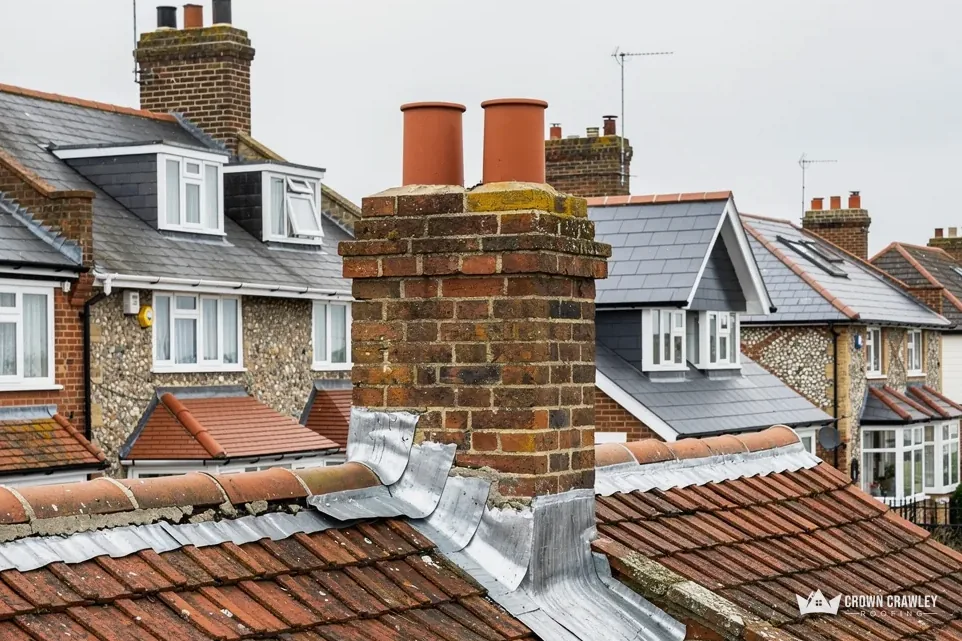
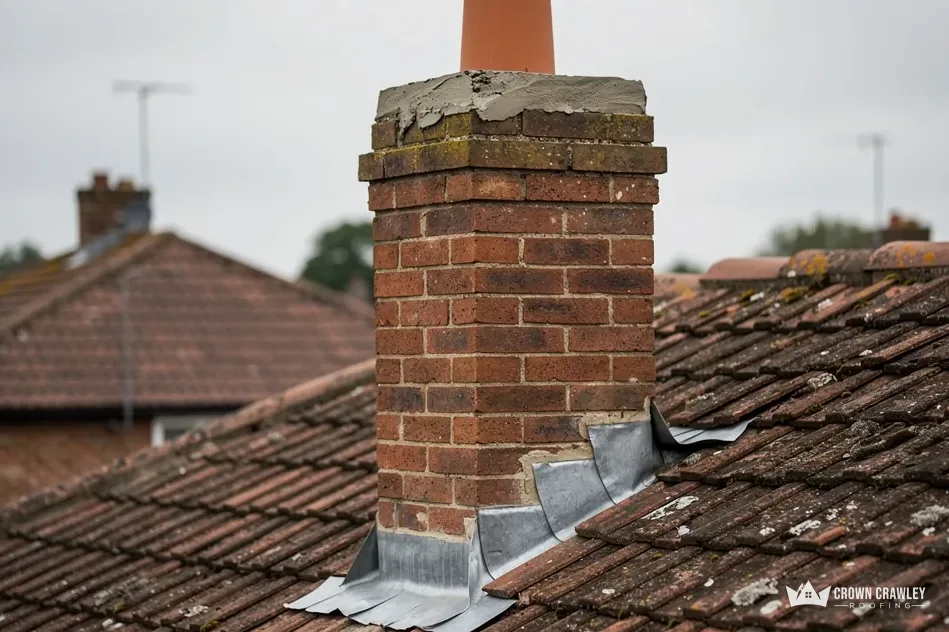
Picture the stack in layers from the roof upwards. Lead flashing seals the joint where the stack meets the slope. Brickwork rises above it. The top few courses carry a thick bed of mortar, and the pots stand in that bed. The flaunching is the shaped upper surface of the mortar. A stack with two flues has two pots and either one wide flaunching or a separate collar round each, depending on how it was built. The mortar should be thickest at the pot and fall away to the stack edge, so that water cannot sit in a hollow.
It is the highest mortar on the house, and it stands in open air, tilted into the wind. That exposure explains most of what follows, and it is why this is a job for a roofer who works at height, not a task for a ladder on a windy afternoon.
Why flaunching cracks and lets go
Mortar is a hard, brittle material, and a thin sloping skin of it on a windswept stack has a hard life. Nothing is wrong with the original work when it fails; it has simply been asked to do a difficult job for a long time. A few causes account for nearly every failed flaunching a roofer finds.
Frost and water
Water soaks into any small crack. When it freezes, it expands and widens the crack, and the next thaw lets in more. Over several winters a hairline split becomes a gap, and pieces of the surface fall away. Once the mortar is open, it holds water like a sponge instead of shedding it.
Movement between pot and stack
Clay pots, brick and mortar expand and shrink at different rates as temperatures change. The joint between pot and flaunching is where those differences show up, so a ring crack round the base of the pot is common. Wind adds to it, because tall pots act like levers, rocking slightly in every gust.
A weak mix or poor workmanship
A flaunching mixed too wet, laid too thin at the edges or left unfinished at the top of the pot ages quickly. A repair done in a hurry with a patch of fresh mortar over loose old material may last only a season, because new mortar will not bond to a crumbling surface. The old flaunching has to come off, down to sound brick, before the new one goes on.
Something else leaking into the same spot
Sometimes the flaunching is a symptom. Eroded brick joints below it, a leaning stack or a failed flue lining can let the top of the stack move so that the mortar splits. Treating the flaunching alone in those cases only moves the next failure a few months down the line.
Signs of failing flaunching, seen from ground and loft
Nobody should climb onto a roof to inspect a chimney. Most of the signs show from the ground with binoculars or the zoom on a phone, and the rest show inside the house.
What can you see from outside?
Look at the base of each pot. Visible cracks that run round the pot, a band of mortar that has crumbled away so the pot looks like it is sitting on bare brick, and pieces of mortar on the roof tiles or in the gutter below are the clearest signs. A pot that leans, even slightly, is a warning. Moss and green staining on the top courses suggest water is sitting there instead of running off. If part of the flaunching has dropped away, the edge will look ragged or stepped rather than smooth and sloping.
Pieces of mortar on the tiles, a pot that has shifted or a chimney that looks different from last year are reasons to stay off the area below and get the stack looked at soon.
What can you see inside?
Water that gets down a stack tends to show on the chimney breast. Look for brown or yellow patches on the plaster, damp that comes and goes with the weather, wallpaper lifting on the breast, or salt marks drying to a white powder. In the loft, shine a torch at the stack where it passes through. Damp brickwork, dark staining on the timbers beside it or a musty smell can all point to water entering from above. Take dated photos of anything you find, because they help whoever comes to look at it.
Not every damp patch on a chimney breast comes from the top. Flashing, a failed cowl or condensation from an unused flue can all produce similar marks. The survey is how those causes get separated, rather than guessing at the first thing that seems likely.
Rebedding pots: what the repair involves
Rebedding means taking the pot off its mortar, preparing the top of the stack and setting the pot back with fresh flaunching. It sounds simple, and on a sound stack it is a contained job, but it has a set order that is worth knowing so a quote makes sense when you read it.
Access first
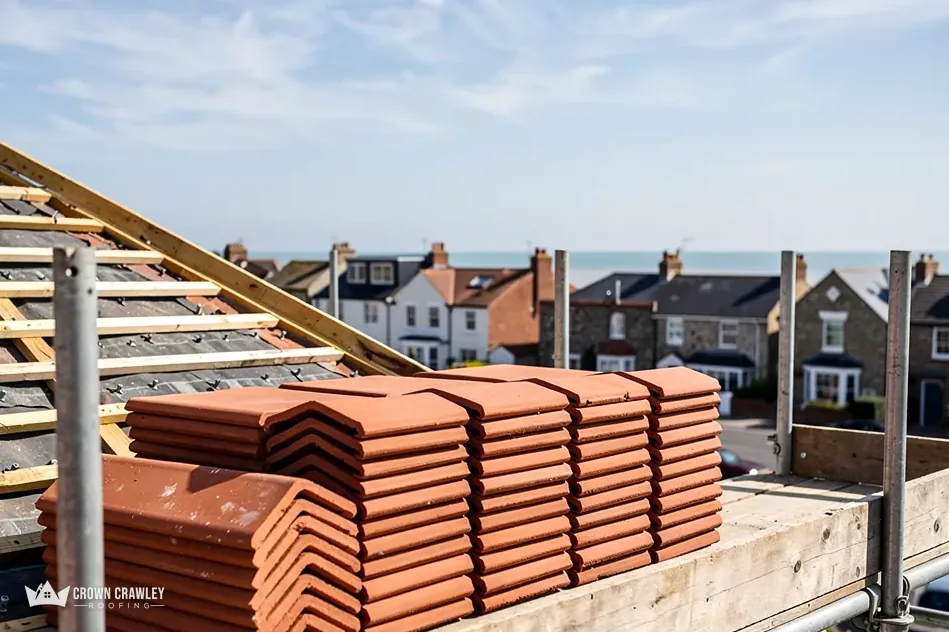
Chimneys stand high and the work is done at the very top, often with both hands busy, so safe access matters more than anything. Depending on the house, that may be a roof ladder, a tower or scaffold. On a low rear roof a hook-on ladder system may be enough. On a tall stack above a steep slope, scaffold is the safer way, and a stack above the pavement means asking who applies for the highway licence.
Taking the pots off
Before pots are lifted, the roofer checks for nesting birds. Under the Wildlife and Countryside Act 1981, it is an offence to intentionally damage or destroy a wild bird's active nest, so an occupied pot waits. Once clear, the pot is lifted away, the flue opening is covered so that debris does not fall down the flue, and the old flaunching is chipped back to sound brick.
Bedding and shaping
The top course is cleaned and wetted, a fresh mortar bed is laid, and each pot is set level and plumb with its base well bedded. The flaunching is then built up round it and finished with a smooth slope that falls to the edge of the stack. A good finish has no hollows, no thin feathered edges and a tight joint where the mortar meets the pot. Cracked or chipped pots are replaced at the same time, since lifting a weak pot often breaks it anyway.
When the repair goes beyond the flaunching
Most flaunching repairs stay at the top, but a few turn into something larger once the pots are off and the roofer can see the brickwork properly. It helps to know the possibilities before the day, so that a change to the plan never comes as a shock.
Loose or eroded top courses
If the top bricks have lost their mortar joints, or the bricks themselves are flaking, there is nothing sound for the new flaunching to grip. The roofer will usually propose repointing the stack as well, or rebuilding the top few courses. The first is covered in our guide to chimney repointing. Where the damage runs deeper, the top courses may need rebuilding.
Flashing and cowl problems
While up there, the roofer checks the lead at the foot of the stack, because water that runs down one part of the stack often gets in at another. A tired flashing is usually better dealt with in the same visit, because the scaffold or access is already in place.
Is repair always the right answer?
Not always. A stack that is leaning, cracked right through or holding up a badly broken flue lining may be beyond a top repair. If the chimney is no longer used and nobody wants it, taking it down below the roof line may make more sense than repeated repairs; chimney stack removal sets out what that involves. We would rather tell you that after a survey, with photos of your own stack, than quote for a patch that will not last.
Access, cost and what to ask for in writing
The price of a flaunching repair depends mostly on how the stack is reached, how many pots there are and what lies under the old mortar. A single pot on a low roof is a short job. A stack with six pots, high above a steep roof, is a different one.
What do national cost guides say?
Checkatrade's chimney repair guide, in its April 2026 table, gives a typical national range of £180 to £520 for a chimney cap and £300 to £1,000 for repointing. Flaunching on its own has no national figure to quote. What sets your price is the number of pots, the access and the condition of the top of the stack, and the written quote follows the survey. Treat these as national guides rather than your price, and note VAT at 20% may be extra.
What should a written quote say?
Ask for one total price in writing. Check it names the pots being rebedded, says whether any are replaced, and states whether access, scaffold and VAT are in the total. Ask what happens if the brickwork beneath the old mortar proves loose, because that is where a small job can change shape. A fair answer is that the roofer will show you photos and agree the extra before going ahead.
What happens next?
Photos of the stack from the garden, taken with your phone zoomed in, are the most useful thing you can send us. They show whether the cracks run round the pots, whether any have shifted and how many flues there are. We then book a survey, inspect the stack up close and send you photos of it. Our chimney repairs page lists the full range of work on stacks, pots and flashings.
Part of our Chimney Repairs in Crawley
Flaunching questions
Can flaunching be repaired with a patch of mortar?
Sometimes a small chip can be filled, but a patch rarely lasts when the surrounding mortar is crumbling, because new material will not bond to loose old mortar. A reliable repair removes the failed flaunching back to sound brick and builds it again with a smooth slope. That is why the survey looks at the whole top of the stack first.
Does a rocking chimney pot always mean the flaunching has failed?
Mostly it does, because the pot is only held by its mortar bed. A pot can also rock if the top courses of brick beneath it have loosened, or if the pot itself has cracked. Keep clear of the area below and have it looked at soon, since a pot that moves can fall in strong wind.
Do I need scaffold to rebed a chimney pot?
Not always. On a low roof with safe ladder access, the work can be done without it. A tall stack, a steep slope or several pots usually call for scaffold or a tower, and that is a safety decision made at the survey. On private land no scaffold licence is needed; on the pavement one is.