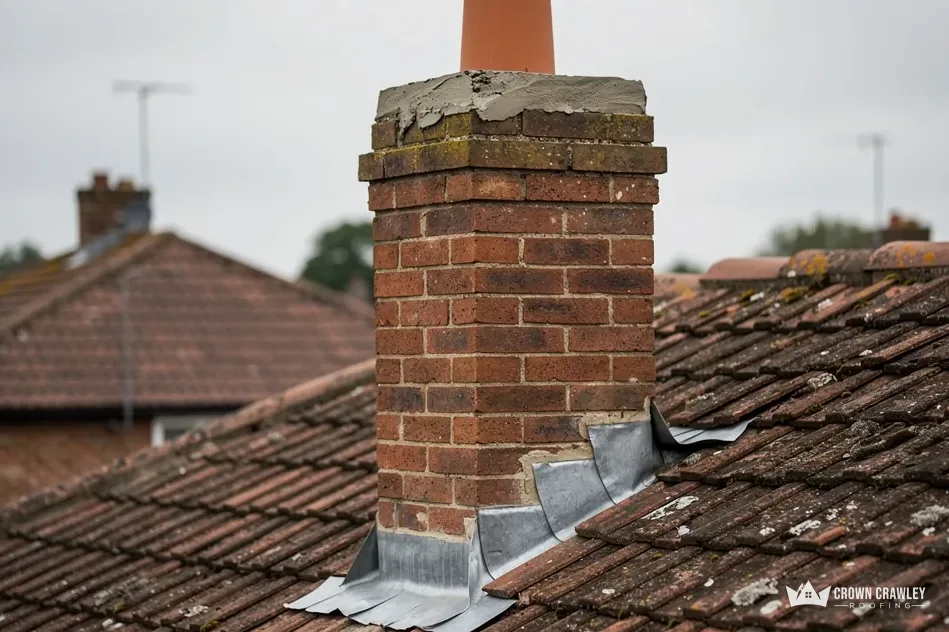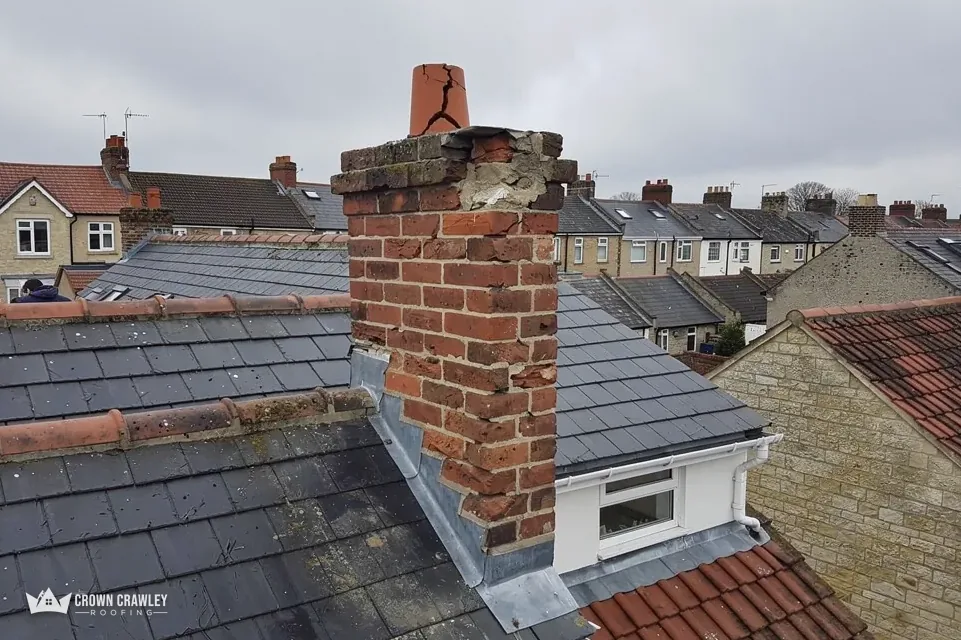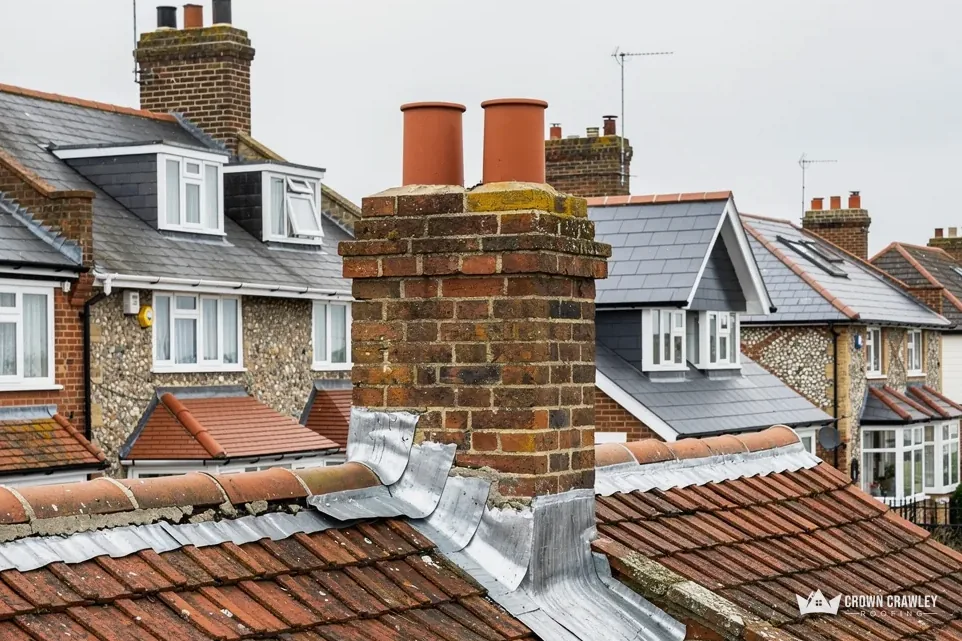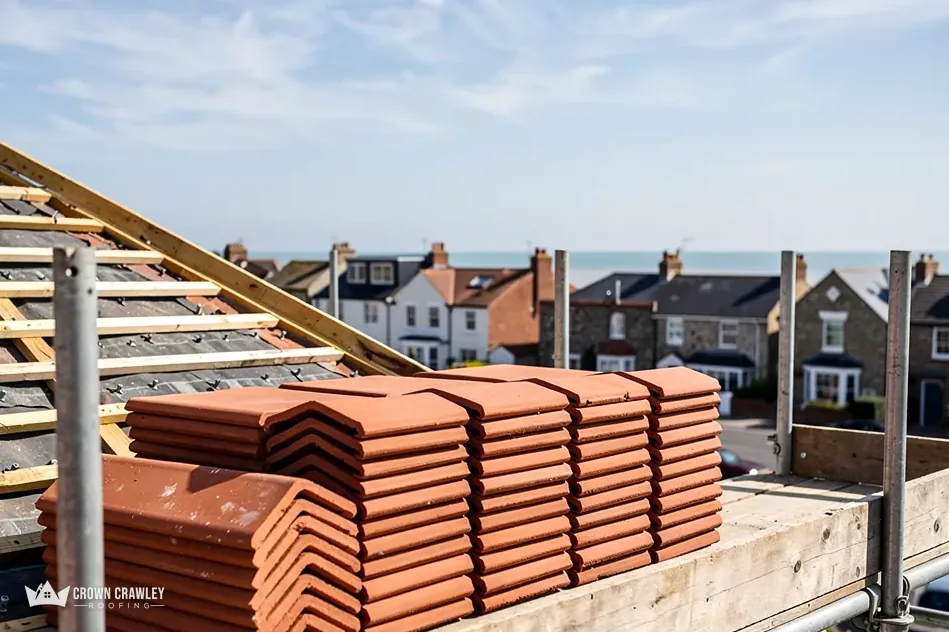
A chimney stack pushes up through the roof like a post through a table, and the join around its base has to stay watertight in every wind and frost. That job falls to flashing: strips of lead tucked into the brickwork and laid over the tiles, shaped so that water runs down and over them instead of getting underneath. Once the flashing goes, a brown stain tends to spread across the ceiling or the breast in the room below.
Around a stack, flashing is not a single piece. It is a set of five or so parts that overlap each other, and each does a different job: the front, the sides, the back, and the lead woven in under the tiles. This page explains what they are called, how a failed one shows itself, why a roofer will usually renew the lot together and not patch one part, how the work is done, and what national cost guides say about price. For the broader picture of looking after the whole stack, see our chimney repairs page.
What flashing does around a chimney
Flashing is a waterproof strip that bridges the gap between two surfaces which move differently: here, the brick stack and the tiled roof. Brickwork and roof timbers shift a little with weather and age, so the join cannot simply be filled with mortar. Mortar cracks and lets water in. Lead can bend and stay put, which is why it has been used for centuries.
Why lead and not something else?
Lead is soft enough to be dressed into corners and over the shapes of tiles, and it lasts. MyJobQuote gives lead flashing a life of over 80 years, a typical figure and not a guarantee. Modern alternatives exist, including self-adhesive strips and rubber sheet, but a lead set remains the usual choice for a brick stack on a tiled roof. Our lead work page explains the wider use of the metal.
How does flashing fail?
In several ways. Lead can crack at a fold after years of heating and cooling. The mortar that holds its upper edge into the brick can wash out so the lead hangs loose. A strip can lift in wind, or be pulled away when a stack leans. Sometimes it is simply not there any more, because someone replaced it with a thick smear of sealant or bitumen paste, which dries, cracks and lets the water in all over again.
What does a leak look like indoors?
A stain on the ceiling near the chimney breast, damp wallpaper above a fireplace, or a patch that darkens in heavy rain and fades when it dries. The cause is often the flashing, but the flaunching (the mortar bed the pot sits in) and the stack's own joints can be at fault as well, so the survey looks at all three.
Apron, steps, back gutter and soakers
Roofers use different names from the rest of us, and a quote that mentions all four is easier to read when you know them.
What is the front apron?
The apron is the flashing along the face of the stack that sits lowest on the slope. It is a single wide piece of lead, tucked into a mortar joint above and dressed down over the tiles below, so that water running down the roof towards the chimney is led round it.
What are the step flashings?
Along each side of the stack, where the brickwork rises through a sloping roof, the lead is cut in a series of steps that follow the brick courses. Each step is turned into a joint and dressed down onto the tiles. This is why you see a saw-tooth edge on the side of a chimney. Our page on step flashing and cover flashing compares the arrangements.
What is a back gutter?
On the high side of the stack, the roof slopes towards the chimney, so water collects behind it and has nowhere to go. A back gutter is a small trough of lead which catches that water and carries it round to either side. It needs a fall, and its upstand against the brick needs to be high enough that water does not spill behind it.
What are soakers?
Each soaker is a short sheet of lead, bent to an L, that lies under every course of tiles beside the stack and under the step flashing above. It stops water seeping through the joint where the roof covering meets the brick. Soakers are fitted course by course as tiles are laid, which is why replacing them means lifting some tiles. See what lead soakers are for more.
Why the whole set is renewed together
Homeowners often ask whether one failed part can be mended alone. Sometimes it can. More often a roofer will recommend the full set, and the reasons are practical.
Do the parts depend on one another?
Yes. Each piece overlaps the next, with the apron over the soakers, the steps over the soakers and the back gutter carrying water into the sides. Replace the apron and leave tired steps, and water finds the weak overlap instead. The new lead can also be mismatched with the old in thickness and age, so the joins between them become the new weak point.
Does the age of the lead matter?
It does. Lead grows brittle and thin after decades of movement, and the older pieces around a new one tend to crack at their folds. Once the roofer has the stack open to fix one part, the access, scaffold and tile lifting are already paid for, so renewing the rest adds little compared with coming back in a year.
Which code of lead is used?
Lead is sold in numbered codes, each a thickness. Royston Lead's cast lead brochure recommends Code 3 for soakers only, Code 4 for soakers and flashings, and Codes 5 and 6 for flashings and gutters. On a chimney, Code 4 or 5 is a common choice. Our guide to the lead code for flashing explains how the numbers translate to thickness and weight.
Ask your roofer to name the code in the written quote, and whether the price includes repointing the joints the lead is fixed into. Those two details separate a proper set from a hurried one.
How a flashing replacement is done
The sequence is fixed, and knowing it makes the day easier to follow from the garden.
Stripping and checking
Scaffold or a safe working platform goes up first, since lead work on a stack involves kneeling, cutting and carrying heavy rolls. The old flashing is lifted out and the tiles next to the stack come off, exposing the soakers. Now the roofer can see what was causing the leak. The joints in the brickwork, the flaunching, the battens and the underlay around the stack are all checked, and anything rotten or crumbling is dealt with before lead goes back.
Forming the new set
The back gutter goes in first, shaped to a fall and tucked up behind the stack. Soakers follow, one per tile course, then the steps and the front apron. Each upper edge is turned into a raked-out joint, held with lead wedges and pointed up in mortar, so it cannot slip. Lower edges are dressed over the tiles with clips where needed so wind cannot lift them.
Finishing
The tiles are relaid, the pointing is made good and nothing is left open to rain overnight. New lead is a bright silver at first and weathers to a dull grey within a few months. Some people ask whether it can be painted; our page on that subject is can you paint lead flashing.
While the stack is open, the roofer may suggest related repairs: repointing the brickwork, replacing a cracked pot or relaying the flaunching. These make sense at the same visit because the access is already in place. Our page on flaunching repair explains that part of the job.
What chimney flashing costs
Prices for flashing are quoted in a few different ways, so compare like with like.
What do national guides say?
Checkatrade's chimney repair cost guide (April 2026) gives £250 to £1,000 for chimney flashing. MyJobQuote, in a guide updated on 22 September 2026, gives £350 to £460 for a full set of chimney leadwork without scaffold, and £700 to £920 with it. Checkatrade's roof repair guide, in its June 2026 table, prices plain lead flashing repair at £50 to £70 per metre, with stepped flashing in Code 5 lead at £80 to £120 per metre.
What changes the figure?
Access is the biggest variable. A stack on a low roof is quick. A tall house, or a stack standing mid-ridge, may need scaffold. Checkatrade's repointing table (October 2026) names about £1,000 for a mid-terrace stack on the ridge where scaffold is required. The size of the stack matters too, since a wide one needs more lead. So does the code, because heavier lead costs more per metre, and whether tiles must be lifted and relaid to reach the soakers.
Those are national ranges, so none is a price for your stack, and VAT may or may not be in them. We give one written total after the survey. Ask any quote whether it includes VAT and scaffold, which lead code is being used, and whether pointing is included. Our page on chimney repair cost sets out the other jobs in more detail.
If it is only a small area that has failed, a repair can be sensible. A set is the better buy when more than one part is tired.
Deciding between repair and renewal
Not every flashing needs replacing. The question is how far the damage runs and how old the rest of the lead is.
When can a repair hold?
If one step has lifted but the lead is sound, the joint can be re-pointed and the strip re-fixed. A short crack in an otherwise good apron can sometimes be repaired by a lead worker. Sealant smeared on top is a different matter: it dries out and fails, and it hides the real fault from the next person who looks.
When is renewal the better answer?
When the lead is split in several places, hanging loose, thin with age or patched before, a new set is cheaper in the long run. It is also the sensible moment if the stack is being repointed or the roof is being re-tiled, because the lead has to come out for that anyway. Replacing flashing without lifting the surrounding tiles rarely works, since the soakers lie under them.
Does stolen or damaged lead change anything?
Lead has value as scrap, and exposed stacks are sometimes targeted. A roofer will tell you if the metal has been taken, in which case a temporary cover is the first job and your insurer should hear about it. Our page on lead stolen from a roof goes through the steps.
To get a clear answer, email us a picture of the stack from the loft or the ground, and say where the stain shows indoors. The survey then checks the flashing, flaunching and brickwork, and we explain what a repair gains you against a new set.
Part of our Chimney Repairs in Crawley
Flashing questions
Can chimney flashing be sealed with mastic instead of replaced?
Only as a short-term measure. Sealant dries, shrinks and cracks, and it often hides the real fault. A proper repair either re-fixes sound lead into the joints or renews the set. If a roofer proposes sealant, ask how long they expect it to last and what happens when it fails.
How long does new chimney flashing take to fit?
It depends on the stack, the access and what the survey finds. A small stack is a short job, while a large one with extra repointing takes longer. The roofer should give the timing before work starts and leave nothing open to rain overnight.
Is chimney flashing covered by home insurance?
Seldom for wear and tear, because most policies exclude slow deterioration. Where a storm or a theft damaged the lead, the insurer may cover it. Tell them first, photograph the damage and hold on to receipts for temporary repairs. If you disagree with a decision, the Financial Ombudsman handles complaints.