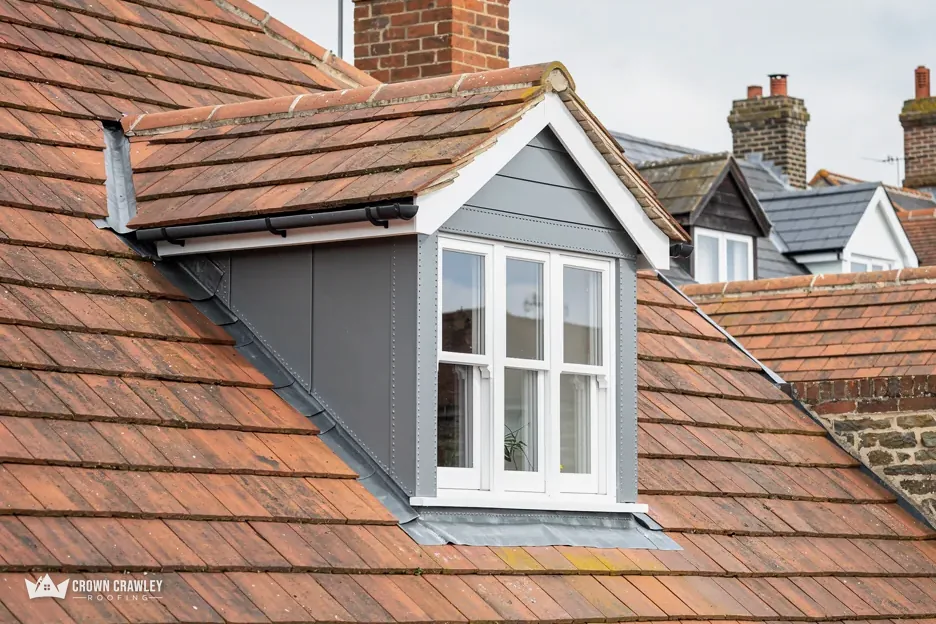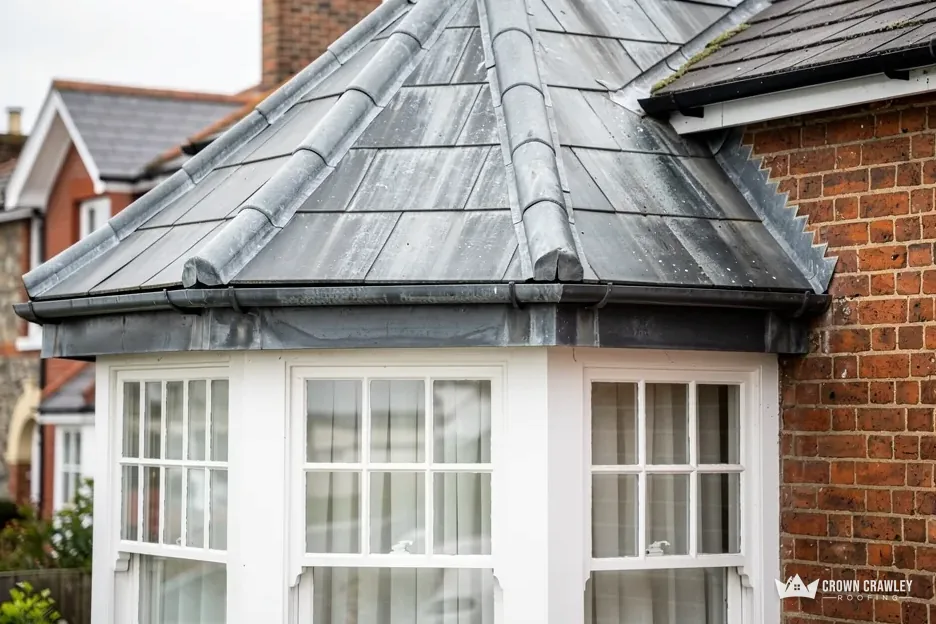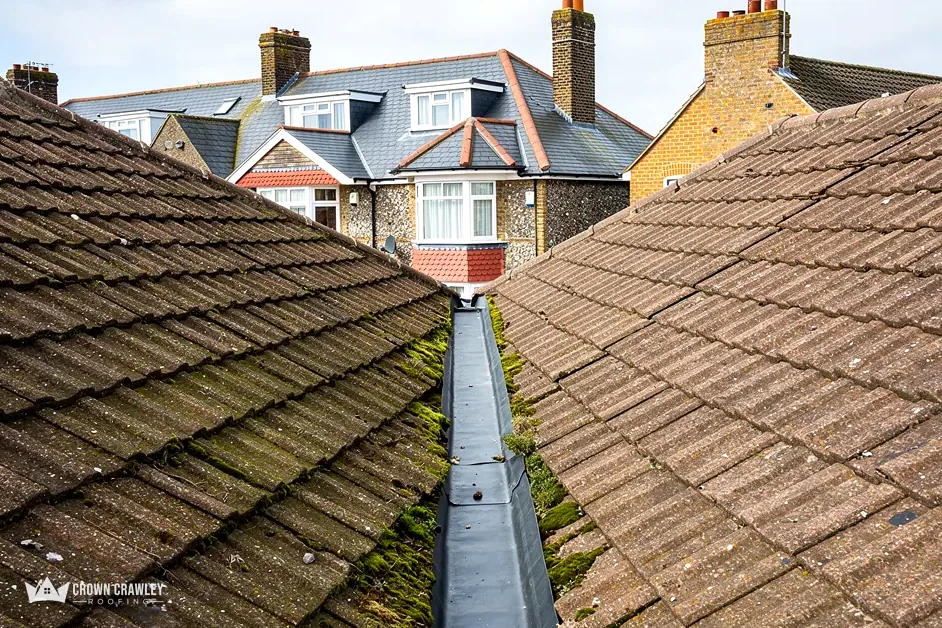
Plenty of roofs finish against a wall that carries on upwards: the side of a chimney, the flank of a taller extension, the party wall between semis. Each of those leaves a joint that rain will find if it can. Roofers close that joint with layers of metal, nearly always lead, and the trade has several names for the pieces. Step flashing, cover flashing, soakers and aprons get used loosely, even on quotes, which makes it hard for an owner to know what is actually being offered.
This guide sorts out the words. It shows how the parts sit one over another, where each belongs on a pitched roof, why a stepped edge looks the way it does and how a roofer chooses between repointing, patching and replacing. It also gives typical national prices, so a written quote reads clearly. Our lead work page covers the wider range of leadwork jobs.
Where a roof meets a wall
Flashing is waterproof metal that bridges the joint between a roof covering and anything rising above it. The spot where tiles end against a wall is called an abutment. A typical house has three kinds. A side abutment runs up the sloping edge of a roof, for example where a lower extension roof meets the wall of the main house. A head abutment sits at the top of a slope, where the covering finishes against a wall that continues upwards. A chimney is an abutment on all four faces at once, which is why chimneys are where flashing trouble turns up most often.
Why does the joint need metal at all?
Brick and tile move at different rates. Walls soak up water and dry out, roofs flex in wind and shift with the temperature, and a mortar fillet laid in the corner cannot follow that movement. It tends to crack along its edge as the two surfaces drift apart, and then rain runs behind it. Metal that has been shaped to the roof and tucked into the wall can flex without opening. Roofers favour lead for this job. It can be dressed by hand around a tile profile or a brick course, and it has a long working life: MyJobQuote's chimney guide puts lead flashing at over 80 years.
Do the different names mean different materials?
No. Each name describes a job. Soakers sit beneath the tiles. A stepped flashing runs up a sloping wall edge like a staircase. A cover flashing hangs over the top edge of another layer so that water falls past it. An apron lies over the tiles in front of a wall or chimney. The next sections follow the order in which water meets them, from the roof surface up to the brickwork.
What soakers do under the tiles
A soaker is a small rectangle of lead bent into an L. One leg lies flat under the edge of a tile or slate, and the other stands up against the wall. There is one soaker for every course of tiles along the abutment, and each overlaps the one below, so together they form a watertight edge that follows the slope. The name fits the job: the soaker takes the water that gets under the tile and carries it back onto the next course down.
Where are soakers used?
Soakers belong with small covering units, such as plain tiles and slates, because each course can be matched with its own piece. A roof of large interlocking tiles is different. The tiles are broad and profiled, so the wall edge is often finished with a continuous strip of lead or a made-up trim instead. If you meet an older house with plain clay tiles, expect soakers; on a 1950s estate roof of interlocking concrete tiles, a roofer will tell you what they find once the survey is done, not before.
Why are soakers hard to inspect?
Because they are buried. Once the roof is tiled, you can see only the edge of the lead that is tucked into the wall, never the soakers themselves. A failure often shows as a damp patch on an internal wall or ceiling near the abutment, with nothing obviously wrong outside. Americans use the phrase step flashing for what UK roofers call soakers, so a web search can mix the two meanings up. To make sense of the lead gauge used for each piece, our guide to what lead soakers are goes through the detail, and the section on codes below shows which thickness suits them.
Step flashing: following the brick courses
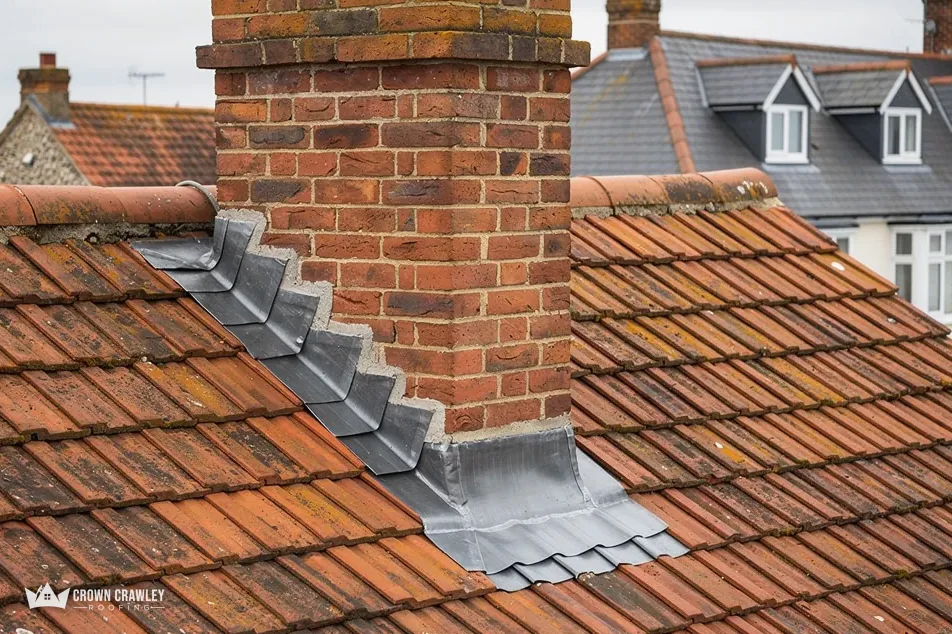
On a sloping wall edge the visible lead is cut in steps. Each step is a separate piece, or a long strip folded to a stair shape, with its upper edge tucked into a groove in the mortar joint and its lower edge hanging over the soakers. Because brick walls are built in horizontal courses and a roof edge slopes, a straight strip could not follow the line. The steps let the lead rise with the wall while staying in the same mortar joint at each stage.
How does the lead stay in the wall?
The roofer cuts or rakes a groove into the mortar joint, called a chase. The top edge of the lead, bent into a small return, goes into that groove, is wedged with lead wedges and is then pointed with mortar. Wedging matters more than the mortar, since the wedges hold the lead tight while the pointing seals the gap. This is also why a flashing that was only pushed into a joint and covered with filler can slip out again.
Is step flashing the same as cover flashing?
On a sloping abutment, yes, in effect. A stepped flashing is a cover flashing that has been cut in steps. The phrase step flashing in a quote usually means a lead strip laid over soakers along the roof edge, and cover flashing is the wider category it belongs to. The words only compete when someone is comparing a stepped cut with a plain straight one, which is what happens at the top of a slope, covered next.
Cover flashings and aprons above the tiles
A cover flashing hangs over another waterproof layer, with its upper edge fixed into the wall and its lower edge draped over the thing below. Water meets it first, runs down its face and drops clear of the joint beneath. At a head abutment, where the slope finishes at the foot of a taller wall, the cover flashing is a straight strip, not a stepped one, because the wall courses run level with the top of the tiles.
What is an apron flashing?
An apron is a piece of lead that lies on the tiles below a chimney or wall, in the direction the water flows. Its upper edge is tucked into the brickwork and its lower edge is dressed over the tile profile, so water running down the slope goes straight over the lead onto the tiles. The face of a chimney that faces down the slope is the usual place, and our page on lead apron flashing explains how the edge is shaped over different tiles.
Why does the chimney need more than one piece?
A chimney sits across the slope, so water arrives from above as well as the sides. The face on the high side needs a gutter-like tray that guides water around the stack. The two sides need stepped cover flashings over soakers. The low side takes an apron. A good chimney job therefore combines all the parts in this guide, joined and lapped so that the upper piece always covers the lower one. When a roofer says the whole chimney needs re-flashing, that is the set they mean. The flaunching, the mortar cap holding the pots, is a separate item and not part of the lead.
Spotting a failing abutment
Most of the signs are visible from the ground or from the loft, with binoculars if you want a closer look. Please do not climb up to check; lead is soft and a ladder against it can bend it, and roofs are slippery.
Look from the ground or through the loft hatch only. A damp mark on a chimney breast or party wall, with a dry roof surface outside, is a strong hint that a hidden soaker or the back of a flashing has let go.
What does a worn flashing look like?
Lead that has lifted away from the wall leaves a dark line between the metal and the brick. Cracks in the pointing, especially open joints above a step, mean the wedges may have gone. Lead that has creased, split along a fold or slumped down the slope has usually moved with the building and fatigued. A bright, newly cut patch on an old roof may point to earlier repairs, and a smear of grey mastic or a band of cement suggests someone has tried to seal a gap that needed proper flashing.
When does a repair do and when does it need replacing?
Where the metal is intact and only the mortar has gone, fresh pointing and new wedges may be all it needs. If the lead has split along folds or been patched with mastic more than once, replacing that run is the better buy, because a patch over tired metal fails at the edge of the patch. If the soakers beneath have corroded or were never fitted, the tiles beside the wall have to come off so that new ones can go in, which is a bigger job than the visible lead suggests.
Lead codes, lifespan and typical prices
Each roll of lead carries a code number that fixes its thickness and weight. Royston Lead's cast sheet brochure lists Code 3 (1.32mm, green) as recommended for soakers only. Code 4 (1.80mm, blue) is listed for soakers and flashings, and Code 5 (2.24mm, red) for flashings, valley gutters and dormers. Which code goes on your roof is the roofer's call after the survey, since exposure and the length of each run count too. Our guide to lead sheet codes compares them side by side.
How long should flashing last?
MyJobQuote's guide to chimney leadwork, last updated 22 September 2026, quotes an over-80-year life for lead flashing. Treat that as a typical range, never a guarantee: movement, weak pointing and poor fixing can finish a flashing long before the metal itself wears out. How the lead is held tells you more than its age.
What do typical national prices look like?
Checkatrade's roof repair guide, in its June 2026 table, puts lead flashing repair at £50 to £70 per metre and stepped flashing at £80 to £120 per metre in Code 5. MyJobQuote's chimney leadwork guide gives £350 to £460 for a full chimney without scaffold and £700 to £920 with it. Those are typical UK ranges from third-party cost guides and do not price your roof. VAT at the standard rate of 20% may need adding, and access changes the total a great deal. Our own total comes in writing after the survey. Whoever quotes, ask them to say in words which parts are being replaced and which are only being repointed.
Part of our Lead Work & Lead Flashing in Crawley
Flashing queries
Can a leaking abutment be fixed with sealant or mastic?
Sealant can hold for a short time, but it cannot follow the movement between a roof and a wall, so it usually splits again. A durable fix reseals the joint with wedged and pointed lead. Treat any mastic you find as a temporary measure and send us photos of the area before it is covered again.
Do soakers get replaced along with the flashing?
Only when they have failed or the tiles beside the wall are coming off anyway. Fresh flashing over sound soakers is a common repair. If damp keeps returning after new lead, the soakers underneath are the next suspect, which needs the tiles lifted to check.
Is lead flashing the only choice for a roof abutment?
Lead is the long-established choice, but other metals and some manufactured trims are made for the job. They need different fixing, and the choice depends on the roof and the wall. Ask which material is quoted and whether the maker's fixing instructions will be followed on your roof.