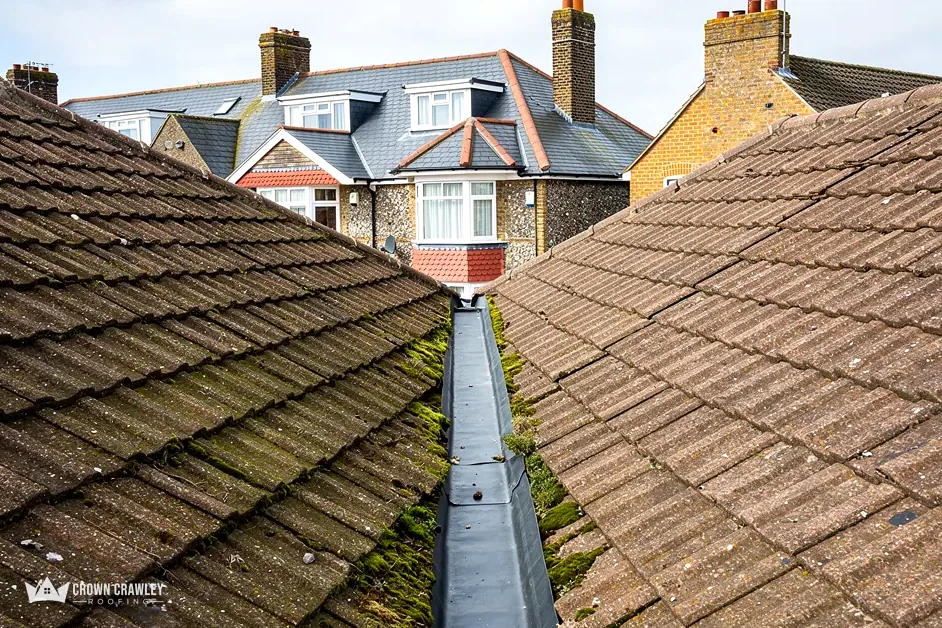
Where two roof slopes meet at an inward angle, rain from both runs into the gap between them. That gap is the valley, and on many older houses it is lined with lead, laid in a channel under the edges of the tiles or slates on each side. Everything that falls on those two slopes ends up there, which makes the valley the busiest drain on the house.
When it works, you never think about it. When it fails, the leak often shows far from the cause, as a stain on a ceiling several feet away. Lead has a long working life, but a valley is a harsh place for it: constant water, leaves and moss, heat and cold, and the occasional foot of someone cleaning a gutter. This guide explains how long lead valleys can last, what makes them fail early, how to spot trouble safely, and how to choose between patching, relining, full replacement and a GRP trough.
How long does a lead valley last?
There is no single figure for valleys. The nearest published number is for lead flashing, and the MyJobQuote cost guide, last updated on 22 September 2026, puts it at "over 80 years". That is a figure for good lead in a good position, not a promise, and a valley is more demanding than a flashing.
What changes the answer?
Four things matter most. The first is the code, meaning the thickness of the sheet. The Royston Lead brochure lists pitched valley gutters in Codes 4 to 8, with parapet, box and tapered valley gutters in Codes 5 to 8. Heavier sheet has more in reserve. The second is the fall, because a valley that drains well dries out quickly. The third is the care taken over joints, laps and fixings. The fourth is upkeep: a valley that is cleared of debris lasts far longer than one left to hold a wet mat of leaves.
Is the lead or the roof around it failing?
Often it is both. A valley lined in lead can outlive the tiles beside it, or the other way round. Marley's page on tile life gives around 60 years for concrete while stressing it carries no guarantee, and clay has a published minimum of 60 years as well. If the slopes either side are near the end, relining the valley alone may be a poor spend, since the tiles must come up at the edges to do it.
For the shorter version of this question, see our answer on how long lead flashing lasts.
How lead valleys fail
Lead rarely wears out evenly. It fails at particular points, and knowing them tells you whether you have a small repair or a big one.
Cracks along folds and laps
Lead expands and contracts with every change of temperature. A long unbroken run, or lead that has been fixed too tightly so it cannot move, fatigues along its creases and eventually splits. The splits are fine, often hairline, and they let water through long before the metal looks bad from the roof edge.
Too light a code
A valley fitted in a lighter code than the roof demands will crack sooner. If your valley is a big one, carrying a large slope or a wide catchment, a thin sheet has less margin. A code-by-code table is on our page about sheet thickness and weight.
Debris and moss
Leaves, moss and silt pile up in the channel and hold moisture against the metal. Water backs up behind the blockage and can rise over the edge of the lead and under the tiles. Standing water also feeds corrosion and keeps the timber boards below wet.
Poor workmanship and damage
Nail holes through the lead, tiles cut too tight to the channel, rushed laps and footprints from trades working on the roof all leave small weaknesses. A cracked patch of mortar or a slipped tile at the edge of the valley can be the real source.
Last, lead can be stolen. If the valley has gone missing, our page on lead stolen from a roof sets out what to do.
Signs of trouble from the ground and the loft
You can look for most of the warning signs without leaving the ground. Keep off the roof, since walking on a tiled slope breaks tiles and a valley is a slippery place to stand.
What can you see from outside?
Scan the line of the valley from the garden or the pavement. Look for tiles at its edge that have slipped or cracked, a green line of moss or weeds growing in the channel, or a dip where the boards beneath have softened. Overflowing water at the lower end during heavy rain can mean the channel is blocked. Dark streaks on a wall where the valley discharges point to water finding a path it should not.
And from inside the house?
Pick a dry afternoon, take a torch up the hatch and look at the underside of the roof beneath the valley. Dark staining on rafters or boards, damp insulation, drips in rain and a musty smell are all signs. Mark the location against something fixed, such as the distance from the party wall or the chimney, so a roofer can go straight to it.
What about the ceiling below?
A brown ring that grows after rain suggests an active leak. Water can travel along timbers, so the stain may be a metre or two from the true source. Photograph it and note the dates. If the roof was recently fitted with new underlay or insulation, mention that, because it changes how moisture moves.
Tell us what you see and where, and send the pictures. Ahead of the survey we can tell you which of the options below is likely.
Patch, reline or replace
The right repair depends on how far the damage reaches and how old the surroundings are.
When will a patch do?
If the lead is sound apart from a single split, lifted edge or stolen section, a localised repair can work. A roofer lifts the adjoining tiles, cuts out the damaged piece, fits new lead with a proper lap and puts everything back. A patch makes sense when the rest of the valley is in good order. It is a poor idea when cracks are scattered along the whole length, because you then pay for access again and again.
When do you reline?
Relining means stripping the old lead out of the valley and laying new lead in the same channel, usually after checking and renewing the boards below. It suits a valley whose boards are sound but whose lead is tired throughout. Tiles at the edges must be lifted and refitted, and a slipped or broken one replaced.
When is the whole detail renewed?
Where the boards are rotten, the fall is wrong or the roofs on each side are being stripped anyway, the valley is rebuilt as part of that work. The sensible time to renew a valley is when the roof beside it is open, because the access is already paid for.
Whatever the route, you get one written total after the survey. Check that it names the code of lead, and that it tells you where VAT and scaffold stand.
GRP troughs and other valley options
Lead is not the only lining for a valley, and on some roofs it is not the best.
What is a GRP trough?
GRP is glass-reinforced plastic, also called fibreglass. A valley trough in GRP comes as a moulded channel that sits in the valley and carries the water between the tiles. It is one piece or a few joined ones, with no folds to fatigue. The flat roof guide at Less, updated in March 2026, gives GRP 25 to 40 years, a shorter span than the figure for lead. That is a flat roof figure, so treat it as a guide to the material rather than a promise for a valley.
Where does a GRP trough work well?
On a straightforward valley where speed and a low cost matter, or where lead theft is the worry, since GRP has no scrap value. Its appearance is plainer than lead, and on a listed building or in a conservation area it may not be accepted. Check with the council's planning team before agreeing a change of material. See also lead-free flashing against lead.
What about zinc?
VM Zinc's FAQ gives 100 years for zinc under its Environmental Product Declaration. It can form valleys, though it is worked differently from lead. Its trade-offs against lead are set out in our guide to zinc and lead roofing.
The honest summary is that lead is the longest-lived and the most adaptable. A GRP trough is a sound alternative when the valley is simple and the aim is to stop water now at a lower price.
Keeping a valley working
A valley that is looked after can outlast the tiles beside it.
Clear it, safely
Leaves and moss should come out of the channel at least once a year, and after storms and autumn leaf fall. Do not do it yourself from a ladder on the roof edge. A roofer can clear it from safe access, and the same visit lets them check laps, tiles and the condition of the lead. Ask how they will avoid walking on the lead itself, since foot traffic kinks and cracks it.
Keep the edges tidy
Tiles beside the valley should sit properly and not be cut tight to the channel. Cracked or slipped tiles at the edge feed water under the lead, so they are worth replacing early. A broken tile costs far less to replace than a rotten board.
Watch what is above
Overhanging trees shed leaves and twigs straight into the channel. Cutting them back, or fitting a guard to the gutter at the foot of the valley, cuts the build-up. A gutter that backs up into a valley outlet is worth checking, too.
Plan around other work
If the roof is going to be stripped, relayed or re-roofed in the next few years, put the valley on the list. The Planning Portal test is less than 25 per cent of the building envelope and less than 50 per cent of the roof, while Crawley Building Control lists replacing more than 25% of a roof's surface as needing its approval, so your roofer should confirm the rule with the right body before a bigger job starts. Start from our lead work page for the full range of jobs.
Part of our Lead Work & Lead Flashing in Crawley
Valley questions
Can I clear a lead valley myself?
Not from a ladder at the roof edge, and it is better left to someone with proper access. Walking in a lead valley can kink and crack the metal, and a fall from a roof edge is a serious risk. A roofer can clear it and check the lead and tiles at the same visit.
Why does my ceiling leak when the valley looks fine?
Water often travels along timbers before it shows, so the stain can be some way from the true source. Hairline splits in lead folds are hard to see, and a cracked tile at the valley edge can feed water in. A survey from the loft and roof usually traces it.
Is a GRP valley trough cheaper than lead?
It often costs less to fit, but price depends on length, access and what the survey finds, so we give one written total after looking. GRP has no scrap value, which helps against theft, though lead lasts longer. Ask about the code, the lifespan and what VAT and scaffolding add.