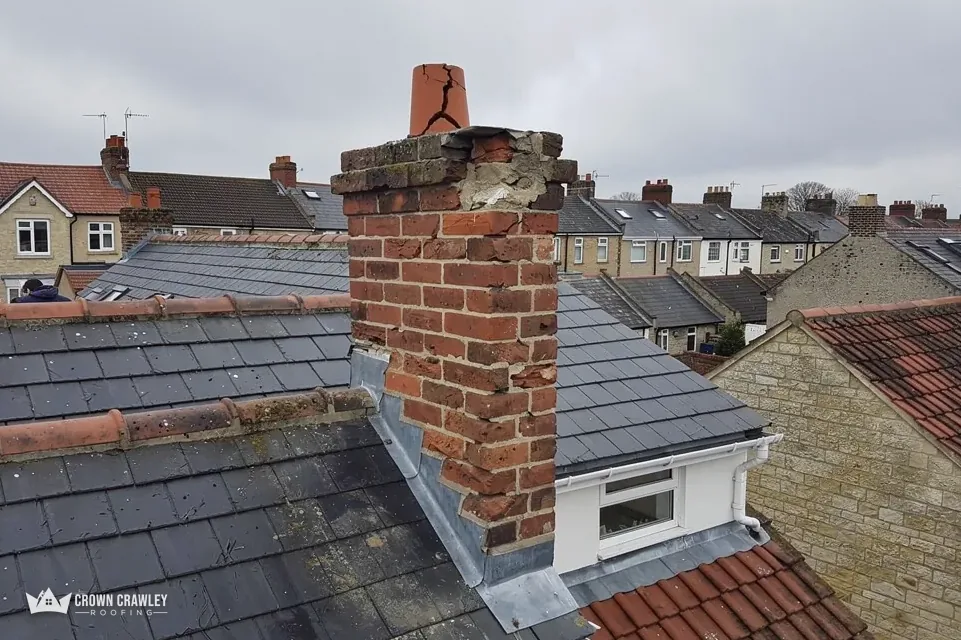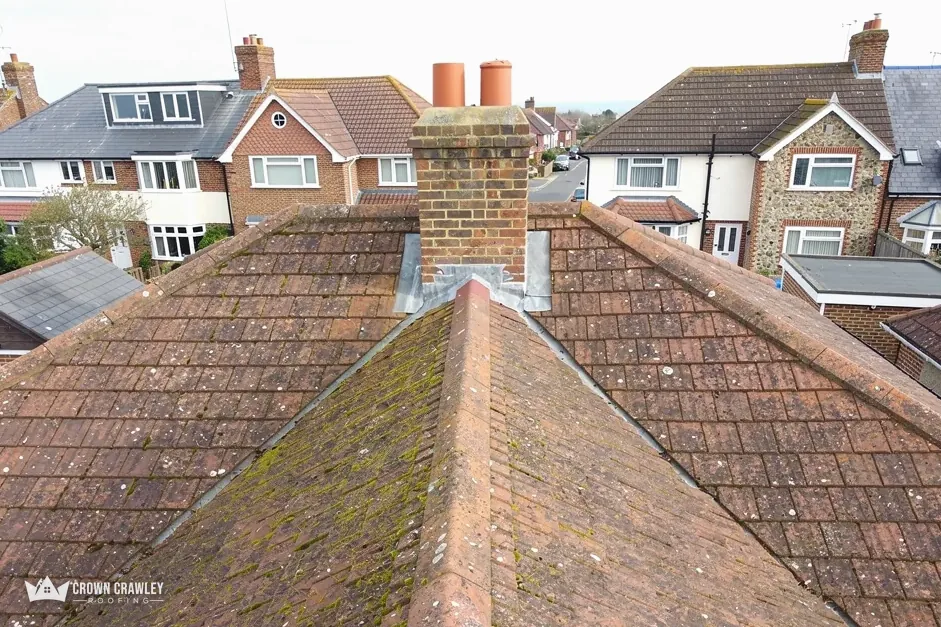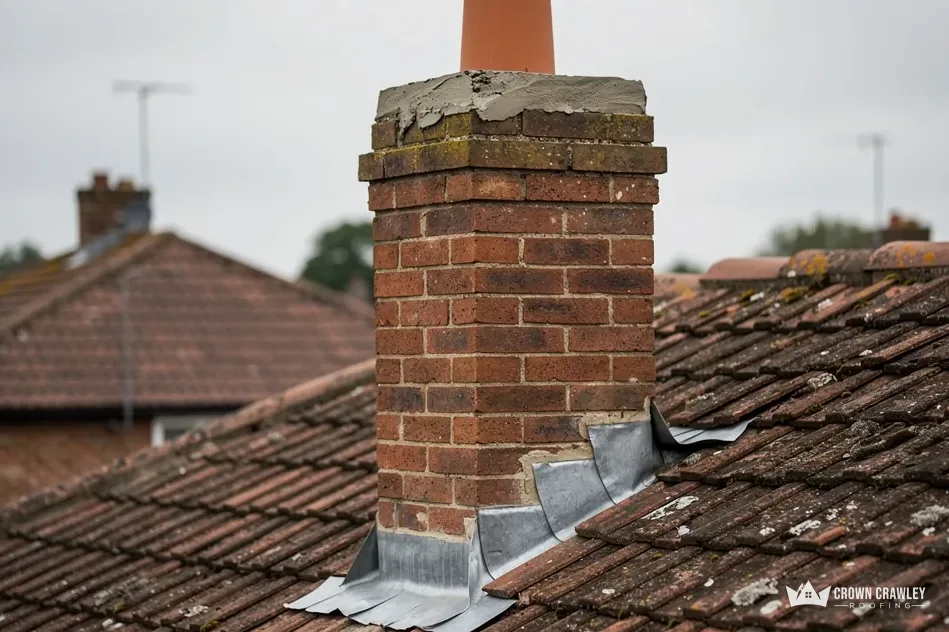
A chimney stack sits at the highest point of most houses, usually on the ridge or the gable, with a steep slope between it and the nearest safe ground. Repointing, flashing and pot work all mean standing beside the stack for hours with both hands busy and heavy materials close by. That is why the first question on any chimney job is not the repair at all. It is how the roofer gets up there, and stays up there, without risk to themselves, the people below or your roof.
Access also shapes the price, and the paperwork. Poles and boards that overhang the pavement bring in the highway authority, while a scaffold wholly inside your own boundary does not. A crane near Gatwick may need a permit where an ordinary lift would not. This guide covers the main ways of reaching a stack, when each is a sensible and lawful choice, what the licence rules are for the councils around Crawley, and how to read a quote so that access is clearly accounted for. It is written for homeowners who want to know what they are paying for, rather than for people who build scaffolds.
Why access comes before the repair
A chimney is hard to reach in a way that other roof jobs are not. A slipped tile can often be dealt with from a ladder at the eaves. A stack rises above the ridge, so the person working on it is at the highest point of the building with a drop in several directions.
What does the roofer need on a stack?
A level, stable place to stand, something solid to hold, edge protection so a slip does not become a fall, and room for the materials. Mortar, bricks, lead and pots are heavy, and passing them up a ladder by hand is slow and risky. The work area also has to be clear of the people below, because tools and brick fragments fall.
What makes one stack harder than another?
The height of the house, the pitch of the roof, the position of the stack on the ridge or gable, and what stands at its foot all matter. A stack on a bungalow ridge with a flat garden below is a different job from a tall stack on a steep three-storey roof over a narrow side passage. Roofs with delicate coverings such as old slate or clay need care too, because walking on them breaks them. Our guide to chimney repair without scaffolding looks at the small jobs where a scaffold is not needed.
We settle the access at the survey, and it sits inside the one written total. Comparing quotes is easier when each one states the method of reaching the stack.
Scaffold, tower, roof ladder or platform
There are four usual ways to reach a stack, and each suits certain jobs. None is right for every house, so the choice follows the stack, not a habit.
Full scaffold
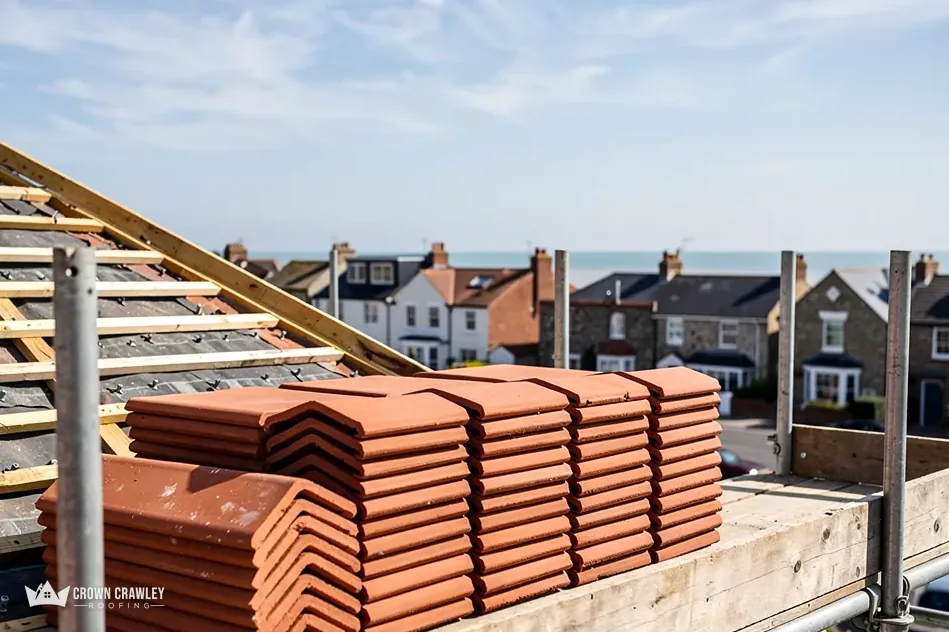
A scaffold built up the side of the house, with a working platform at the right height beside the stack, is the safest option for stack work of any size. It gives room to work, guard rails round the platform and a safe route up and down. It is the right choice for repointing, flashing replacement, rebuilding and any job that takes more than a few hours. It costs the most, because the scaffolders need to erect it and take it down.
Scaffold tower
A freestanding tower works on low houses and flat ground, such as a bungalow, a rear extension roof or a small outbuilding. It needs firm, level ground, and it cannot be used on a slope or over soft soil. A tower is cheaper and quicker than a full scaffold, though it only reaches so high and it does not give a roof-edge safety line.
Roof ladder and crawling boards
A roof ladder hooks over the ridge and lets a roofer climb a slope without bearing on the tiles. It is used for inspections and short, light jobs such as checking a flaunching or photographing a flashing. It is not a place to stand all day with heavy tools, so it should not be the plan for repointing or a rebuild.
Mobile platform
A cherry picker, or access platform, can reach a stack from the ground where there is room for it to stand. It suits a one-day job on a clear plot. A drive too narrow, a soft lawn or overhead cables rule it out. Our page on chimney repair costs shows how access affects the figure.
When is a scaffold licence needed?
Scaffolding on your own property needs nothing from the council. The rules bite when it stands on or over a public highway, and that includes the pavement. Section 169 of the Highways Act 1980 bars anyone from erecting or keeping scaffolding that obstructs a road or footway without a licence from the authority responsible for that road.
Is a licence needed on private land?
No. Croydon's licensing pages state that scaffolding on private land requires no licence or consent. A house set well back behind a front garden, with the scaffold kept inside the boundary, falls on the safe side of that line. Lorries that block the road are a separate matter, and the council may have to suspend parking bays.
Who applies?
It varies by council. Kent County Council is the one that spells it out: its page says the scaffold firm, as the party responsible for the structure, makes the application for the householder. The pages for West Sussex, Surrey and East Sussex stay silent on the point, as does Croydon's. For those areas we line the licence up with the scaffolding firm, and whoever you hire should tell you who is applying and by when.
What goes wrong without one?
A scaffold left on the highway unlicensed invites charges and a retrospective licence on top, and West Sussex publishes a daily charge for unauthorised scaffolding. Scaffolders know this, but ask before a date is fixed. Licences take time, so a job that needs one cannot start the day you ring.
Lead times and published fees around Crawley
The highway authority decides the fee and the notice period, and each one publishes its own. The figures below are as the councils publish them at the time of writing, and they change, so confirm with the authority before relying on them.
West Sussex, Surrey and East Sussex
West Sussex County Council covers Crawley, Horsham and Mid Sussex. It sets a minimum of 10 working days between applying and erecting, and lists one month of scaffolding at £266. A tower scaffold has its own entry, at £95 for one week, and a fast-track route is offered for an added fee. Surrey County Council also asks for 10 working days, charges £208 per 28 days, and wants a certificate showing liability cover of £10 million or more. East Sussex Highways lists £127 for 28 days, notes a 2.77% fee rise from 1 April 2026, and asks for any extension to be requested a minimum of five working days before expiry.
Kent and Croydon
Kent County Council wants applications in five working days ahead of a start, and lists £52 per week for 2026 to 2027. Croydon sets a minimum licence of one month, at £488 per four weeks for each elevation. Other London boroughs set their own terms, so ask the borough.
What does this mean for timing?
Allow for the licence before you fix a start date. If the stack is leaking and cannot wait, say so at once, because a temporary make-safe from inside the boundary, or a mobile platform that does not touch the highway, may buy time while the licence is processed.
Cranes, lifting and Gatwick
Some chimney jobs call for a lift, not a climb: a crane to put a heavy stack section or pots in place, or to lift materials onto a high roof where there is no room for a scaffold hoist. Near Gatwick, that can bring in a permit.
What does the airport say?
Gatwick's guidance sets a 6 km radius round the airport inside which a crane needs the airport's permit. Two exceptions are named: kit lower than 10 m, and kit that taller trees or buildings enclose completely. The application runs in tandem with any aviation authority paperwork, and conditions can cover hours, height and obstacle lighting. Applications carry a charge, starting at £300 plus VAT for the basic level without technical assessment.
Does an ordinary scaffold need a permit?
The airport's crane page does not mention ordinary scaffolding, so do not assume one is needed. We do not state which villages lie inside the 6 km line, because the distance depends on the exact address. If your house is close to the airport and a lift is planned, ask your roofer to check the address against the airport's guidance, and allow time for the application.
When is a lift worth it?
On a rebuild of a tall stack, a lift can save hours of carrying, and the lifting equipment may stand on your drive. On a repoint or a flashing, a lift is rarely needed. The roofer should explain why one is proposed and whether a permit is involved.
What access adds to the quote
Access is one of the biggest things that moves a chimney quote, and it is also the part people understand least. The same repair can cost very different amounts depending on how the roofer reaches it.
What do the published figures show?
Checkatrade's repointing guide, October 2026 table, sets a modest low-roof repoint near £300 and a terraced ridge stack, scaffold included, at £1,000. Its roof replacement guide gives £700 to £1,300 for the scaffold on a whole new roof, for comparison. MyJobQuote's chimney leadwork guide, updated 22 September 2026, shows £350 to £460 without scaffold and £700 to £920 with it. They are national yardsticks, not prices for your house.
How can you keep the access cost down?
Bundle the work. If gutters, fascias, a ridge or roof tiles on that side need attention, do them while the scaffold stands. Ask whether VAT at 20% is in the total, and whether the scaffold and any licence are in it too. Our chimney repairs page shows the other jobs that often share an access.
What should the survey tell you?
Which method is proposed and why, who arranges any licence, how long the scaffold stays, and what happens if the weather delays things. Our price is one total in writing, sent once the survey is complete, and the access is inside it. If a quote mentions a vague scaffold charge, ask what it covers.
Ask every roofer the same question: how will you reach the stack, and who arranges the licence if the scaffold crosses the pavement?
Part of our Chimney Repairs in Crawley
Access questions
Can a chimney be repaired from a ladder alone?
Only for light checks. A ladder against the eaves does not reach a stack safely, and a roof ladder is for short inspections. Repointing, flashing work and rebuilding need a stable platform with edge protection, so a roofer who proposes a ladder for those jobs should explain how the work will be done safely.
Who pays for the scaffold licence?
That depends on the quote. The licence fee is part of the cost of the access, so it should be in the total or clearly stated. Ask who applies, who pays and how long the licence runs. Kent states that the scaffolding firm applies for the customer, while the councils nearer Crawley do not say.
Is a licence needed if the scaffold stands in my front garden?
Not while every part of it stays inside your boundary, since the licence rule covers the public highway. A single pole on the footway, or boards that hang over it, change that. A roofer can check the boundary at the survey, and the highway authority can confirm the position.