A chimney is the tallest, most exposed part of a house, and it is also the part with the most joints. Lead meets brick, brick meets mortar, mortar meets clay, and the whole thing stands in the weather from every direction. When water gets into any one of those joints, it travels. It runs down the inside of the flue, along a timber, across the loft and down a wall, and by the time it shows as a stain upstairs it can sit a metre from where it entered.
That makes chimney leaks easy to misread and expensive to guess at. This page works from the evidence you can gather yourself, from the garden and the loft, towards the likely cause. It covers the five usual suspects in the order a roofer checks them, what each repair involves and the price ranges national cost guides quote. Stay off the roof: every check below works from the ground or the loft. If the cause is a roof fault elsewhere, our chimney repairs page explains the wider work.
Is the water really coming from the chimney?
Before blaming the stack, rule out the other things that stain a ceiling near it. A cracked tile, a worn valley, a blocked gutter and condensation can all show up in the same place, and they need quite different repairs.
What does a rain-only leak look like?
A chimney leak tends to follow the weather. The stain appears or grows within hours or days of heavy rain, and it is worse when the wind pushes rain towards the stack. Look at the chimney breast, the part of the wall that carries the flue inside the house. A brown or yellow tide-mark on the breast, wallpaper lifting along it, or damp that creeps down from the ceiling around it all point towards the stack above.
How do I tell it from condensation?
Condensation does not care about rain. It forms when warm, damp air meets a cold surface, so it shows on cold, still, dry mornings as well. A disused flue with no ventilation can sweat on its inside face and stain the breast. If the damp is there on dry days, or sits in a cold corner behind furniture, look at ventilation first. The marks left by chimney water are patchy and track the rainfall.
What can I see from inside the loft?
On a dry day, take a torch and look at the point where the stack goes through the roof. Dark staining on the timbers around it, wet or flattened insulation, and light at the flashing line all narrow the search. Photograph everything, including the dry areas, so that a roofer can compare. A pole camera or a long lens from the garden will show the stack's top without anyone climbing.
Flashing and the back gutter
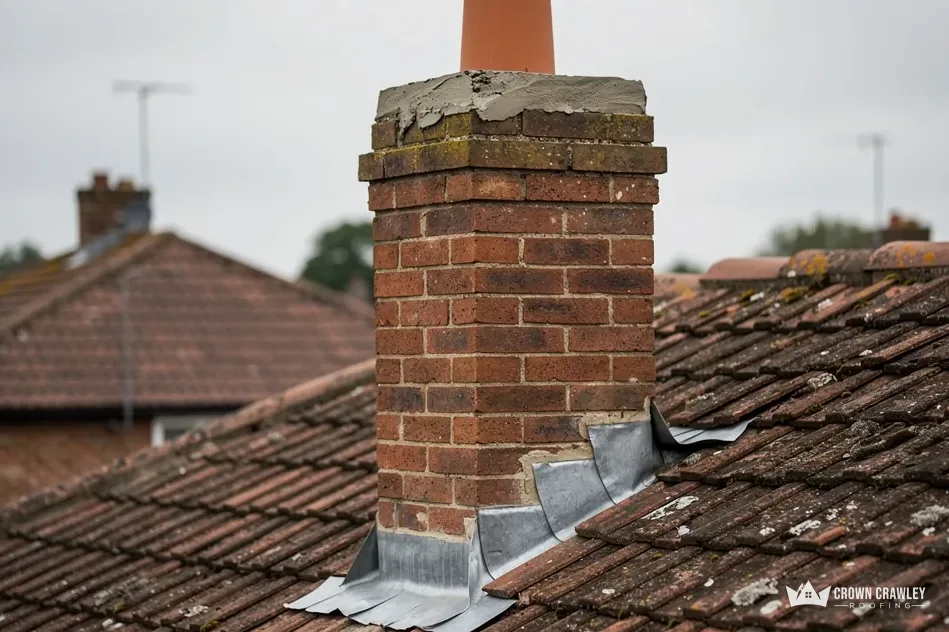
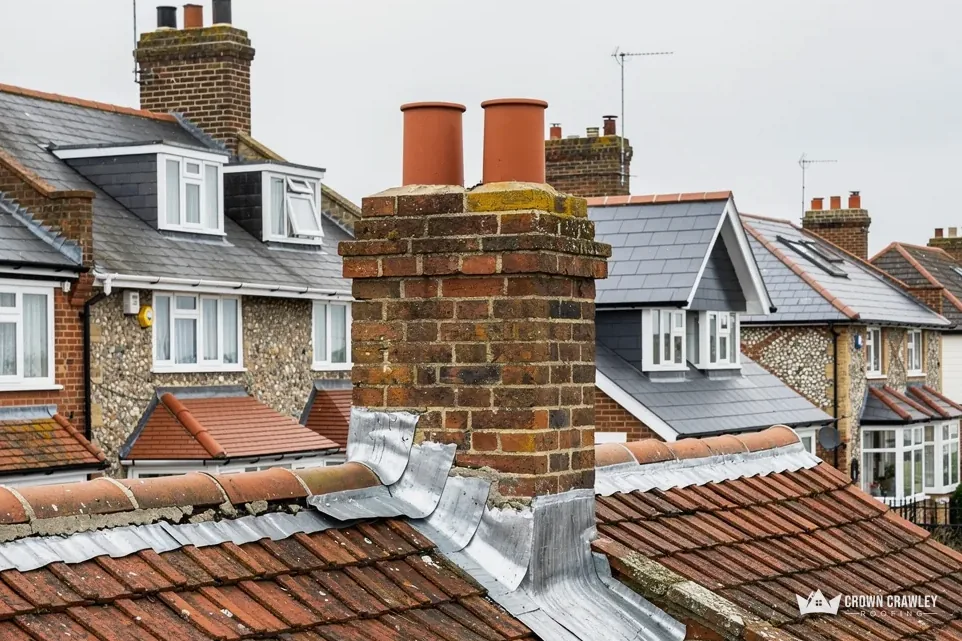
Flashing is the strip, normally lead, that closes off the gap where the chimney meets the roof. It is the most common source of chimney leaks that are not about the pots, and it is where a roofer starts.
What are the parts of a chimney flashing?
Four elements work together. An apron covers the low side of the stack, where water runs into it from above. Stepped flashings follow the slope up each side, tucked into the mortar joints of the brickwork. A back gutter, a small sloping lead trough set into the roof just upslope of the stack, carries water round to either side so it cannot pool against the brick. Soakers, small lead sheets bent to fit under each tile, hold it all in place. The joints between them are where leaks start.
How does flashing fail?
Several ways. Lead can lift at the edge, split along a fold where it has flexed with the temperature, or pull away from a wall where the pointing in its slot has crumbled. In some older repairs a mortar or sealant fillet was used instead of lead, and fillets crack and let go. Royston's lead brochure lists Codes 4, 5 and 6 as suited to flashings, and a cost guide dated September 2026 says well-fitted lead flashing can last for over 80 years, so a failure on a younger roof usually points to workmanship or movement rather than age.
What does it cost?
Checkatrade's April 2026 chimney repair guide gives flashing as £250 to £1,000 typical across the UK. MyJobQuote, updated 22 September 2026, gives £350 to £460 for chimney leadwork without scaffold, and £700 to £920 with it. Our guide to chimney flashing replacement sets out the work step by step.
Flaunching: the mortar crown
Right at the top, the pots sit in a bed of mortar that slopes outwards to the edge. That bed is the flaunching. Its job is simple: to hold the pots firm and to throw rain off the top of the brickwork rather than into it.
What does failed flaunching look like?
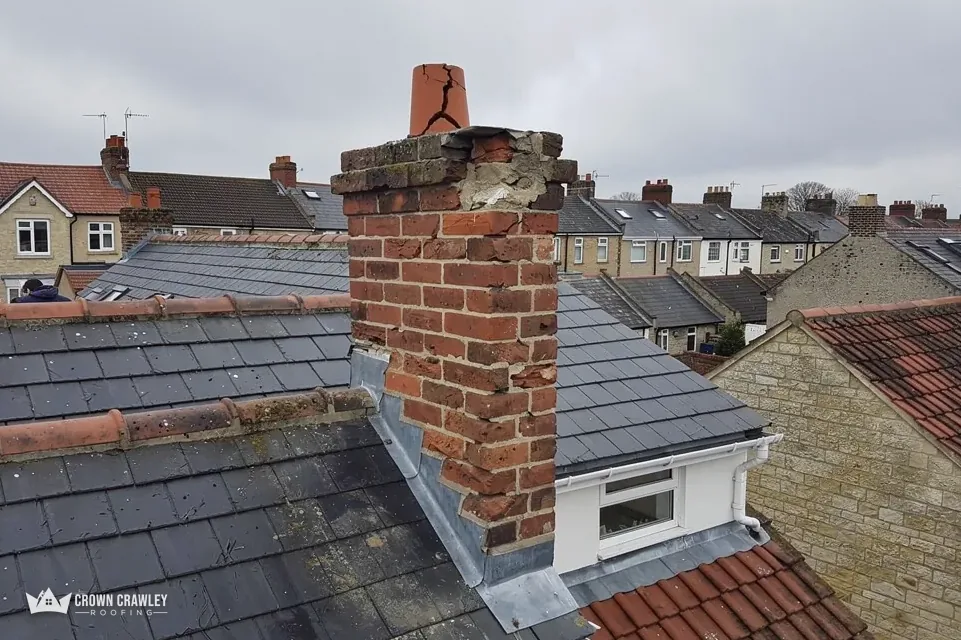
Cracks across the mortar, gaps between the mortar and the pot, a surface that crumbles to powder when pressed, and a pot that rocks slightly in a gust. Any of these lets water into the top of the brickwork or straight down beside the flue liner. You can see most of it with binoculars from the garden. A stack with failing flaunching often shows green growth or darker brick on its upper courses, where the water has been sitting.
How is it repaired?
The pots are lifted off, the old mortar is chipped out, and the top is rebuilt with a fresh bed shaped to fall away from each pot on all sides. The pots are then reset and left to cure. It is a short job, but it needs safe access to the top of the stack, so it is often combined with repointing or a new cowl while the scaffold is up. Because flaunching is such a small element, no national guide we trust prices it on its own; the written price after the survey covers it, along with whatever else the stack needs. Our guide to chimney flaunching repair goes through the stages.
A pot that is cracked, not just loose, will let water down the flue however good the flaunching is. It should be replaced rather than patched.
Brickwork and pointing: when the stack drinks water
Brick is not waterproof. It is meant to shed most rain from its face and to dry out in between showers, and it manages that when the faces and mortar joints are sound. A chimney stack has it harder than a wall because it is exposed on all four sides and has no roof overhang to protect it.
What are the signs of a porous stack?
Mortar joints worn back from the face of the brick, bricks whose faces are flaking or crumbling, a white salt bloom, and damp patches on the breast that match the weather outside. Where the mortar has gone, rain runs straight into the joint and can find its way down the inside of the stack. The damage is slow, which is why the leak may seem to come and go.
What is the fix?
Repointing: raking out the failed joints to a good depth and filling them with fresh mortar of the right strength for the brick. Sound repointing is a well-understood job, and a cost guide dated October 2026 gives an average of around £750, while Checkatrade's April 2026 chimney repair table gives £300 to £1,000 typical across the UK. Bricks that have spalled badly, or a stack that leans, are a bigger question, and sometimes a rebuild above the roofline is the better route. Our guide to chimney repointing explains how that decision is made.
Should I paint on a waterproofing coat?
Ask before anyone does. A coating over damp, failing brick can trap water in, and it does nothing about a broken flashing or loose pot. The cause comes first, then the coating, if it is needed at all.
Pots, cowls and open flues
The simplest route for rain is straight down the top. A flue is a tube that goes right through the house, and an open pot gives rain a direct line to the fireplace below.
Does an unused chimney need a cap?
Usually it needs something. A flue nobody uses any more should not be left open to the weather. A cap or a cowl on the pot stops rain going down, keeps birds out and, if it is vented, allows air to move through the flue so the breast stays dry. A cap that seals the flue completely, with no vent, can lead to damp from condensation inside, so ask what is being fitted and why. Checkatrade's April 2026 table puts a chimney cap at £180 to £520 typical across the UK.
What about pots that are cracked or leaning?
A cracked pot channels rain into the stack wall instead of out of the top, and one that leans has usually lost its bedding. Both are quick jobs when the stack is being worked on anyway, and awkward to do any other time. Old pots can be very heavy, so the roofer will use proper lifting gear.
What if birds are using the pot?
Nesting birds can block a flue and bring debris down with them. A nest with birds using it has legal protection, so a roofer should check before capping or clearing anything. If you hear or see activity in the pot, say so at the survey, and the work can be timed around it.
Fixing it in the right order
Chimney leaks often have more than one cause, and a repair that tackles just one of them leaves the stain still growing after the next storm. The sensible order runs from the top down, so that nothing done lower is spoiled by water still entering above.
What is the usual sequence?
Pots and flaunching first, because they are the highest point and the simplest for rain to get past. Then the brickwork and pointing. Then the flashing and back gutter, which can be checked and tested once the stack above is sound. Lastly, the roofer looks at the tiles around the stack and the loft to see whether any water has done damage. If water is pouring in today, making the roof safe comes ahead of the rest of the plan.
Does the stack need scaffolding?
Often. Checkatrade's October 2026 repointing table quotes around £1,000 for a mid-terrace ridge stack once scaffold is needed. Where the poles would stand on a pavement, a licence must be granted by the highway authority. Around Crawley that means West Sussex County Council, and with the application we settle between us and the scaffolders. Private land needs no licence. Small jobs can sometimes be reached from a tower instead.
What do I get in writing?
We survey first and share pictures of your stack. A single total price in writing for the whole job follows. Ask if the price takes in VAT and the scaffold. Where a neighbour shares the stack, mention it early, because who pays and who gives access should be agreed before work starts.
Part of our Chimney Repairs in Crawley
Chimney leaks: three quick questions
Why does my chimney only leak in driving rain?
Wind pushes rain sideways into joints that stay dry when it falls straight down. A gap in the flashing, a hairline crack in the pointing or a worn edge on the flaunching can all behave that way. Note which side of the house the stain is on and which way the wind was blowing, and tell the roofer.
Will a dab of mastic stop the leak?
Rarely for long. Sealant on a lifting flashing or a crumbling joint may hold for a few weeks, but it hides a movement problem, and the water simply finds the next gap. It is fine as a stopgap on a ladder-length job, not as a repair. A proper fix addresses the cause, and a roofer can show you photos of it.
How long can a chimney leak wait?
Water keeps working the whole time. It can wet timbers, ceilings and the chimney breast, and damp timber loses strength. Photograph the stain, put a bowl under any drip, and have the stack looked at before the next heavy rain. If water is coming through now, ring us and we will make the roof safe first.