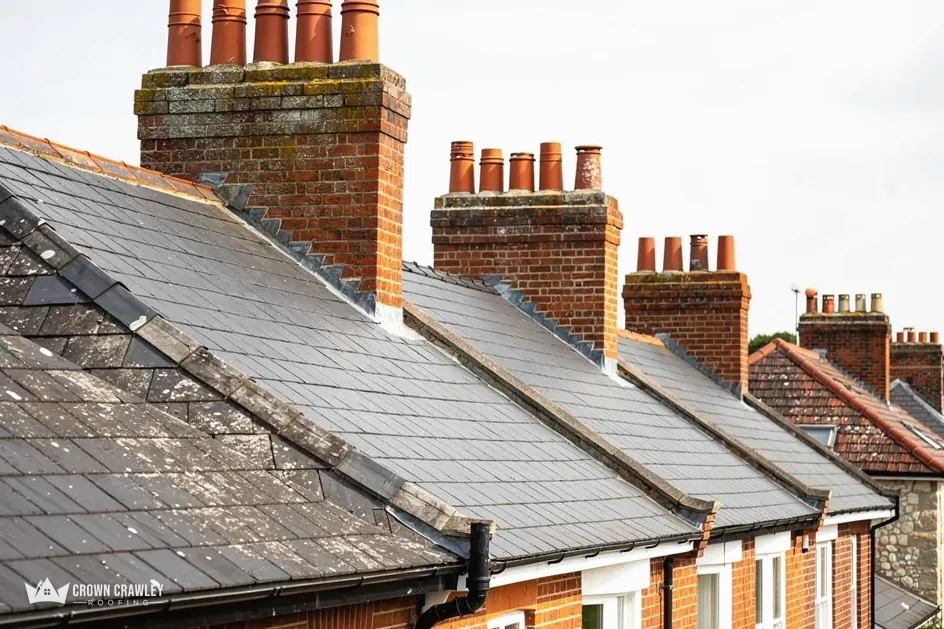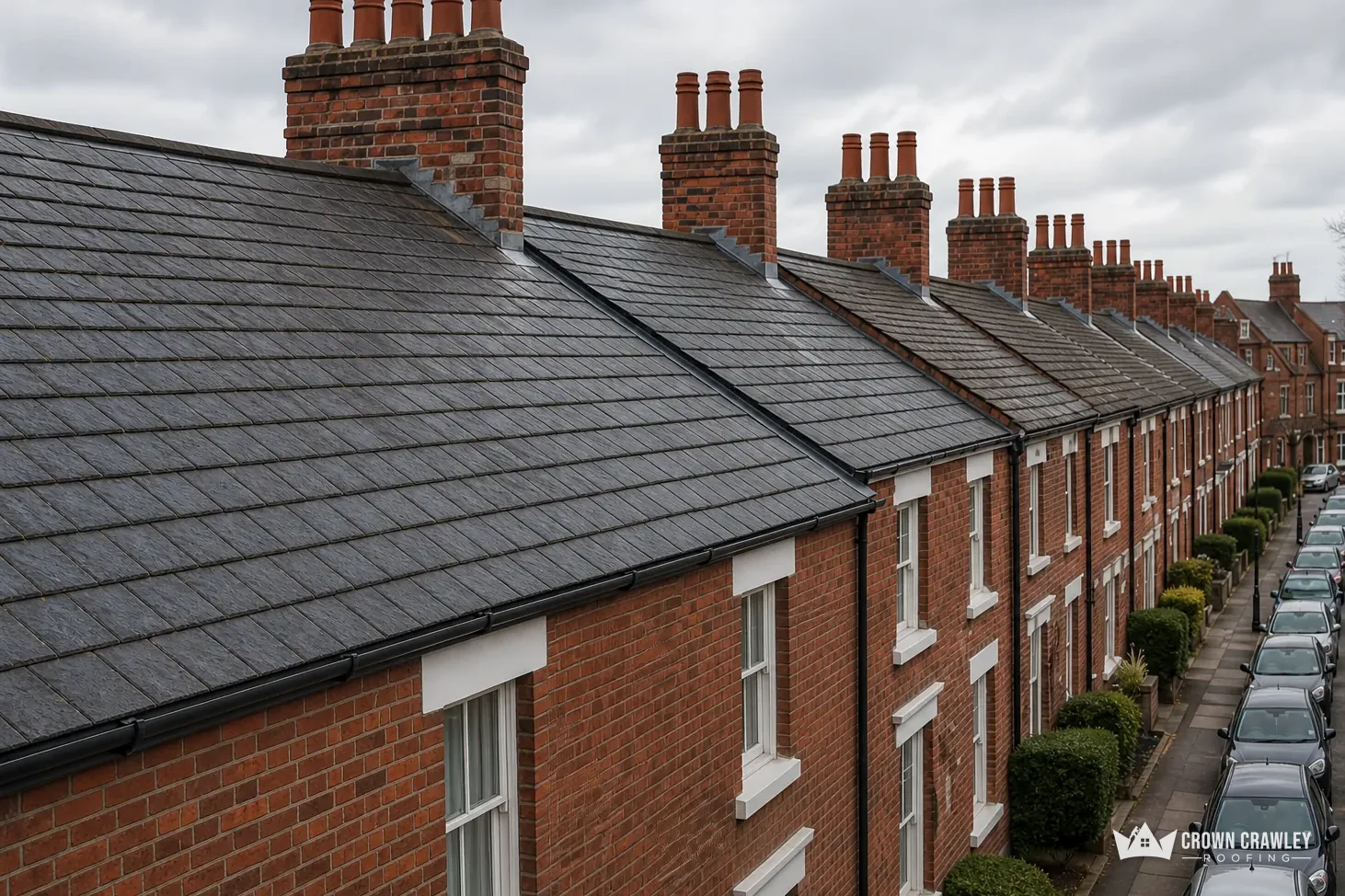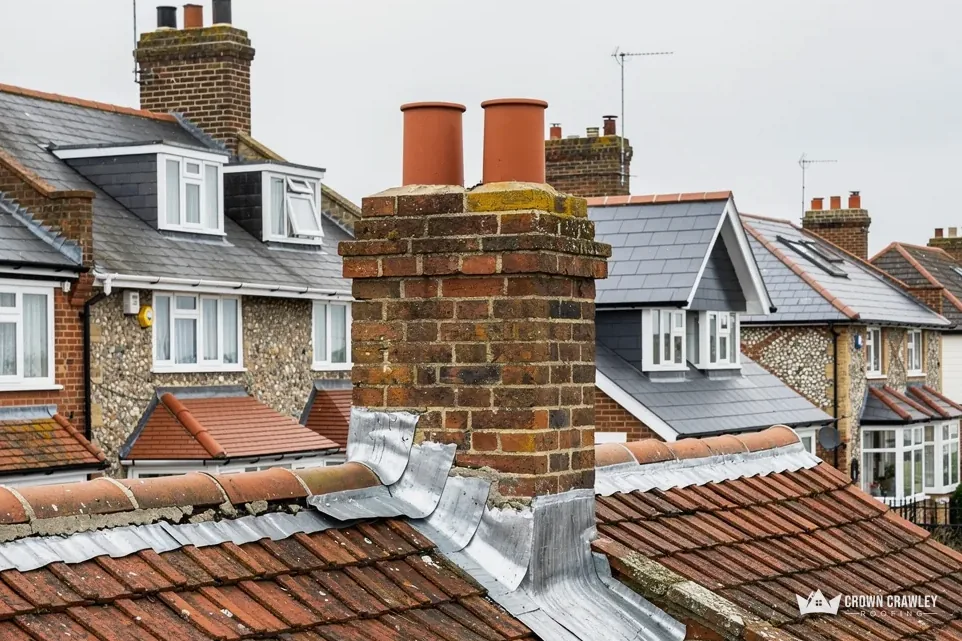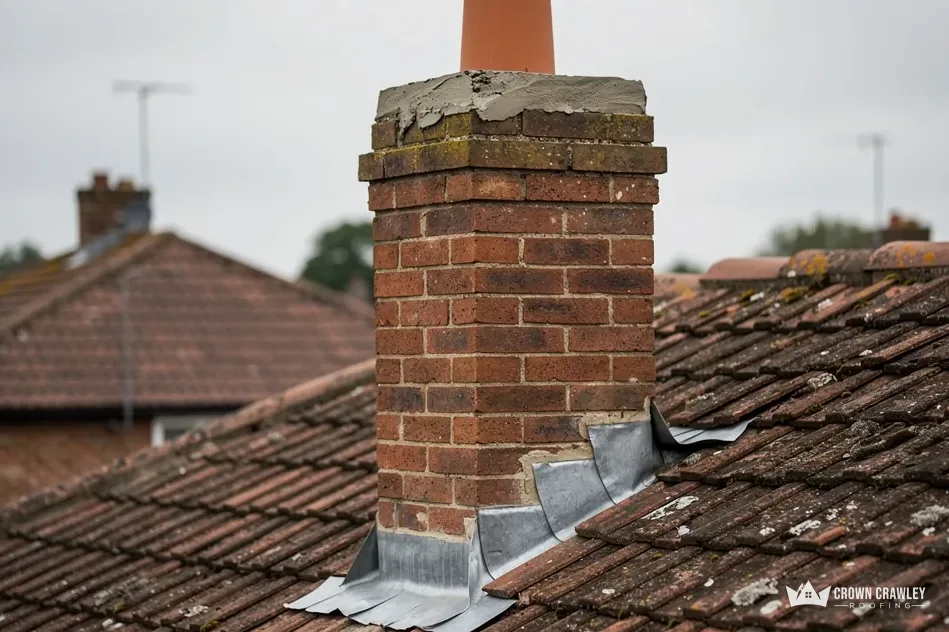
A chimney stack on a Victorian terrace, a Tudor farmhouse or a village cottage is often the most handmade part of the roof. The bricks may be soft and uneven, the pots may be a pattern nobody makes any more, and the mortar between them may be older than the tiles around it. Repairing that kind of stack asks for a slower approach than a modern one, because what you change cannot easily be put back.
On a listed building there is a legal side as well. Work that alters the character of the building needs listed building consent before it starts, and doing it without can be an offence. This guide explains how to tell whether your stack is protected, how repairs and alterations are treated differently, what lime mortar and matching materials mean in practice, and what to have ready before you ask a roofer or the council. This is general guidance rather than legal advice, and the decision on your own building rests with the council.
Listed, in a conservation area, or just old?
Three different situations get lumped together, and each carries its own rules, its own paperwork and its own person to ask. Start by working out which applies to you, because that decides who has to be asked.
A listed building
A listing covers the whole building, not only the front. The chimney stacks and pots are part of what is protected, whether or not the list entry mentions them, and that includes stacks at the back that nobody sees from the road. The National Heritage List for England is searchable by address, or you can ask your council's planning team, who keep the records for their area.
A conservation area
A house in a conservation area is not listed, but the area has extra planning controls. The permitted development order treats a conservation area as article 2(3) land, which narrows some rights. Some councils have also made an Article 4 direction, which withdraws chosen rights across a defined area. What a direction covers varies by street, so ask the planning team whether one applies to yours.
An older house that is neither
Plenty of old brick chimneys sit on unlisted houses outside any protected area. No consent is needed for ordinary repair, but the same craft sense applies: the old fabric rewards careful handling, and a repair that suits a modern stack can look wrong, or fail early, on a century-old one.
If you are unsure, email the address to the council's planning team and ask outright. File the written reply with the job paperwork, because it is exactly the sort of record a future sale can call for.
Does repairing a listed chimney need consent?
Section 7 of the Planning (Listed Buildings and Conservation Areas) Act 1990 prohibits demolition, alteration or extension that affects what makes a listed building special, unless someone with the power to do so has authorised the works. The words that matter are character and alteration. Repair that leaves the character alone is treated differently from change.
Where does repair end and alteration begin?
The South Downs National Park Authority publishes the line that routine maintenance and small repairs done like for like, in place, need no listed building consent. That is one authority's wording for its own area, and each council applies it to its own cases. Rebedding a pot with the same mortar type is usually the sort of work it describes. Swapping clay pots for modern ones, rebuilding a stack in different brick, or changing its height is the sort that raises a question. When a roofer says "like for like", ask what it means for your stack and get it confirmed by the planning team before the scaffold goes up.
Do listed houses keep permitted development rights?
Yes, for the classes that apply to houses, but listed building consent is needed on top when the works touch the building's character. One does not cancel the other. Class C of the permitted development order also leaves chimneys out of its roof-alteration right, so any chimney change should go to the planning team first.
What about churches?
Places of worship follow their own route. An Anglican church in use goes through the faculty system, and certain other named denominations have their own approval processes. A church chimney is a case for the body that runs the building, whose own approval route comes first, and outside work can still call for planning permission.
Why the mortar mix matters on old stacks
Mortar on a historic stack is more than glue. It is the softest, most sacrificial part of the wall, and it is meant to take the weather and the movement so that the brick does not have to. That is the idea behind repointing old brickwork in a mortar that is no harder than the bricks.
Why not simply use a standard cement mix?
A very hard cement mortar can hold water behind it and push the stress into the brick faces, which then flake. On a stack, where the brick is exposed on every side, that damage can show within a few winters. Lime mortar is softer and lets the wall dry out through the joints. For an old stack, the usual advice is to match what is there, and to ask the roofer to say which mix they propose and why, in writing.
How is the right mix chosen?
A good repointing starts with looking at the existing joints: their colour, width, profile and the sand in them. A small sample patch in an out-of-the-way place shows whether the new mortar looks right once it has dried. The joints are raked out by hand to a sensible depth rather than ground out with a power disc, which can score the brick edges. Damp, frosty or very hot weather affects how lime sets, so the timing of the job matters more than on a modern stack.
Lime also takes longer to cure, so a lime repoint is rarely a one-visit job on a large stack. Our guide to lime mortar chimney repointing covers the method, and chimney repointing sets out the usual signs and the standard job. The wider chimney repairs hub links the rest.
Keeping and matching pots, bricks and lead
On an old stack the details are the history. Before anything is taken down, photograph the stack from every angle you can reach, and ask for the same from the roofer once up close. Those pictures become the record of what was there if a part has to be copied, and they also help the planning team understand your request without a site visit.
Chimney pots
Old pots come in many patterns, and a mismatched pot is easy to spot from the street. Some are plain red clay, some are buff, some are tall and decorated, and a terrace may have several kinds along one roofline. If one is cracked beyond saving, the aim is to find a reclaimed or newly made pot of the same shape, height and colour rather than the nearest catalogue item. Sound pots should be lifted off carefully and rebedded, not thrown away.
Bricks and corbelling
Decorative brick courses, corbels and cappings are costly to rebuild, so the first thought is to repair them. Individual bricks can be cut out and matched, while a face that has crumbled across its width may call for rebuilding. Local materials can be part of a place's character: the High Weald National Landscape describes sandstone, bricks and tiles used widely because of the geology underneath. A match that looks right in colour and texture matters, and a new brick that is too regular will show.
Lead and flaunching
Lead flashing at the base of the stack is normally replaced in lead, never swapped for a bitumen strip, on a protected or older building. Flaunching is a mortar job and follows the same mix reasoning as the joints.
Removing or altering a stack on a protected building
Taking a chimney down or reducing its height is not a repair, and on a listed building it is the clearest example of an alteration that affects character. A stack is part of the roofline that makes the building recognisable, and removing one can change how the whole house reads from the street.
What needs asking first?
For a listed building, ask the council's planning team before any removal, partial or full, and expect to apply for listed building consent. Say clearly if the stack serves a neighbouring property, since a shared stack raises extra questions. In a conservation area, ask whether consent or planning permission applies, and whether an Article 4 direction removes any rights. Do not rely on a roofer's assumption; the answer comes from the council.
What about Building Regulations?
On chimney breasts, the Planning Portal is plain: Building Regulations approval always applies, as a breast forms part of the structure. That is separate from listed building consent and from planning permission, and each may be needed. Your building control body, usually the council's own service, can tell you what it needs to see.
Can the alternative be a repair?
Often. A stack that leans or looks unsafe may be repaired or carefully rebuilt using the original bricks, which keeps the profile while making it sound. Our page on chimney stack removal covers the process for ordinary houses, and it is a starting point only; on a listed building the consent comes first and the method follows what has been approved.
If a roofer tells you consent is not needed for a removal on a listed house, ask them to put the reasoning in writing and check it with the council yourself.
Access, wildlife, cost and what to prepare
Older stacks need good access more than most, because the work is slow, careful and done by hand. Scaffold is usually the right answer on a tall or fragile stack. If it stands over the pavement, the highway authority issues the licence, so ask who applies for it; scaffold that sits entirely on your own ground needs none. For scale, Checkatrade's repointing table gives about £1,000 for a mid-terrace ridge stack that needs scaffold, and a wide listed frontage can cost more.
Bats and nesting birds
Old buildings are more likely to hold wildlife. Older roofs are likelier to shelter wildlife. The GOV.UK page on bats names roof repair as an activity it covers, because the law protects bats and their roosts fully. An occupied bird's nest is covered too, so mention anything you have seen around the chimney before work starts.
What does it cost?
Checkatrade's chimney repair guide, in its April 2026 table, gives national ranges of £300 to £1,000 for repointing and £250 to £1,000 for flashing. Its repointing guide, October 2026, gives a rebuild above the roof line as £1,000 to £3,500. These are national figures for ordinary houses. A hand-raked lime repoint and matched materials take more time, and the written quote that follows our survey fixes the price for your stack. VAT at 20% may apply, so check whether it is included.
What should you gather?
Pull together the address, the listing or conservation area status, any earlier consents and a few garden photos. Send them by WhatsApp or the enquiry form, and the survey that follows looks at the stack up close, with photos and a view on which parts can be mended in place.
Part of our Chimney Repairs in Crawley
Older chimney questions
Do I need permission to repoint a listed chimney?
Not always, and it depends on the building. Small repairs that restore what was already there can fall outside consent, and the South Downs authority says as much for its area. A different mortar, brick or height may count as alteration, so ask your council's planners and keep their answer.
Is lime mortar always required on an old stack?
No rule says so for every house, but matching the existing mortar is sound advice for old brickwork, and a listed building may have conditions. Ask the roofer to name the mix and explain the choice in the written quote. The planning team can confirm whether it expects a particular mortar on your building.
Can I replace an old clay pot with a modern one?
On a listed building that is a change of appearance and may need consent, and on any older house a mismatched pot is easy to spot from the road. The better route is to rebed sound pots and copy a failed one in the same shape, height and colour. Ask the council before swapping styles.