Roofers in Slinfold

Roofs of Horsham Stone, handmade clay tile and Victorian slate.

Slinfold's oldest houses wear Horsham Stone or handmade clay tile, and the village centre was made a conservation area in 1976. We read the roof and the paperwork before we quote.

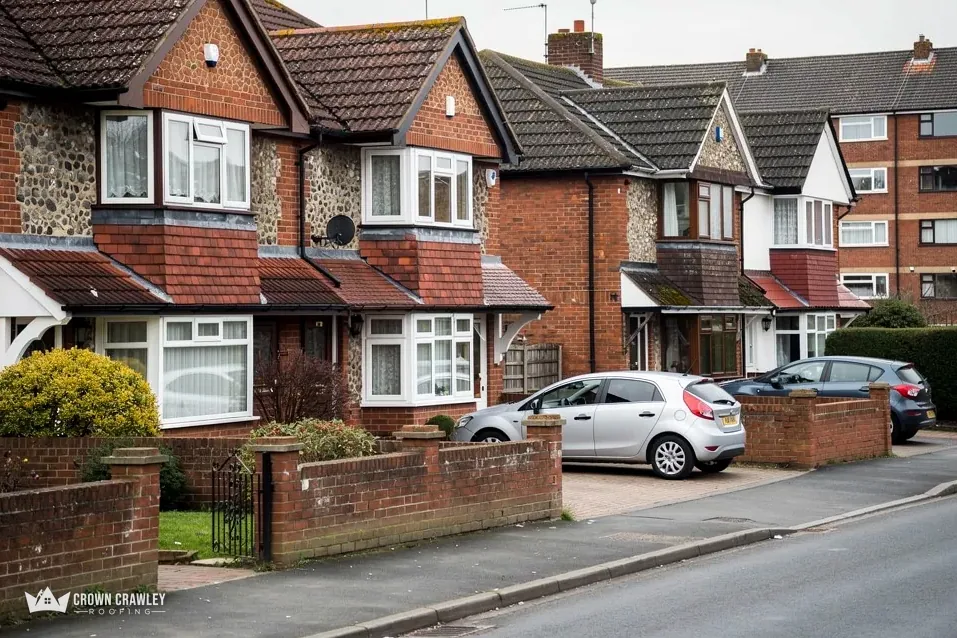
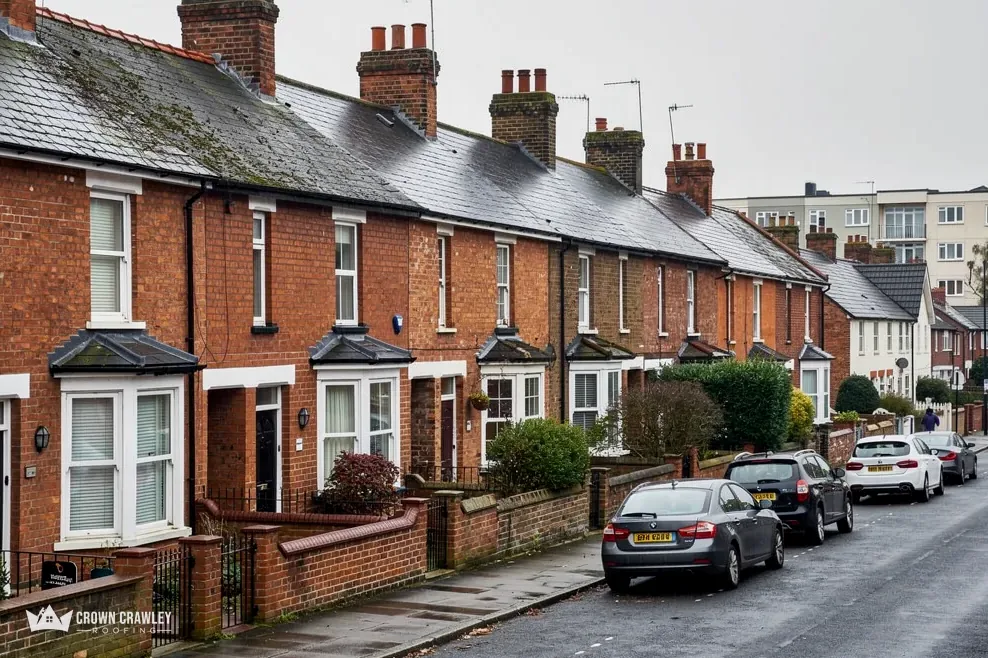
Brick semi-detached houses with tiled roofs and parked cars

Roof styles you will spot in Slinfold

Brick chimney with lead flashing on a clay tiled roof

Timber frames under stone and clay

The council's appraisal puts Horsham Stone or handmade clay tile on the village's oldest buildings. We handle both as heavy coverings laid by hand: lifted with care, sorted and relaid, with spares matched.

Old stone and tile gable roof

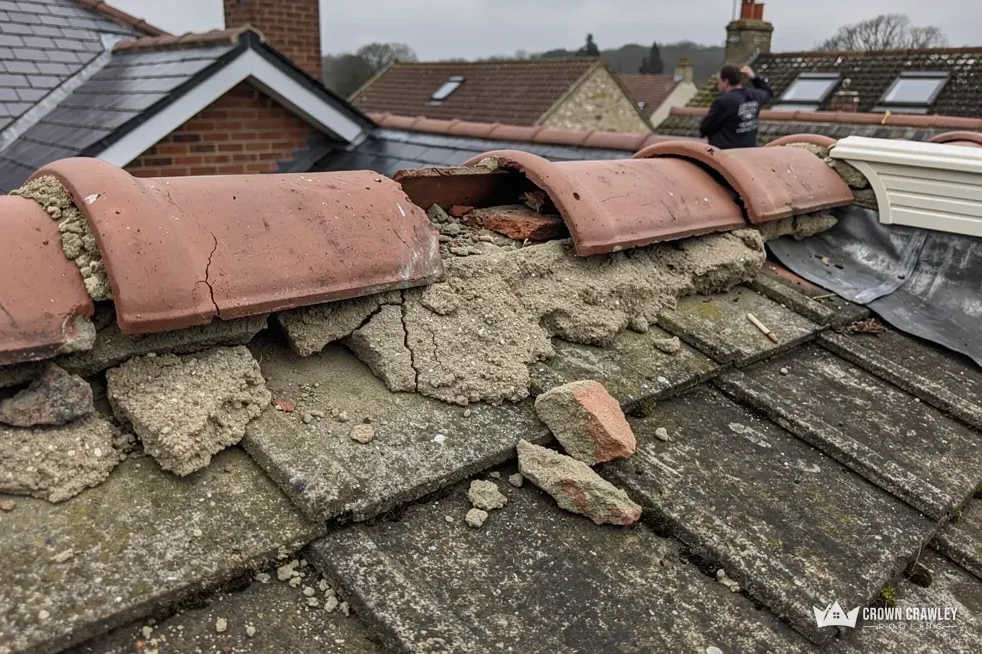
Crumbling mortar and cracked ridge tiles on a roof

Georgian hips

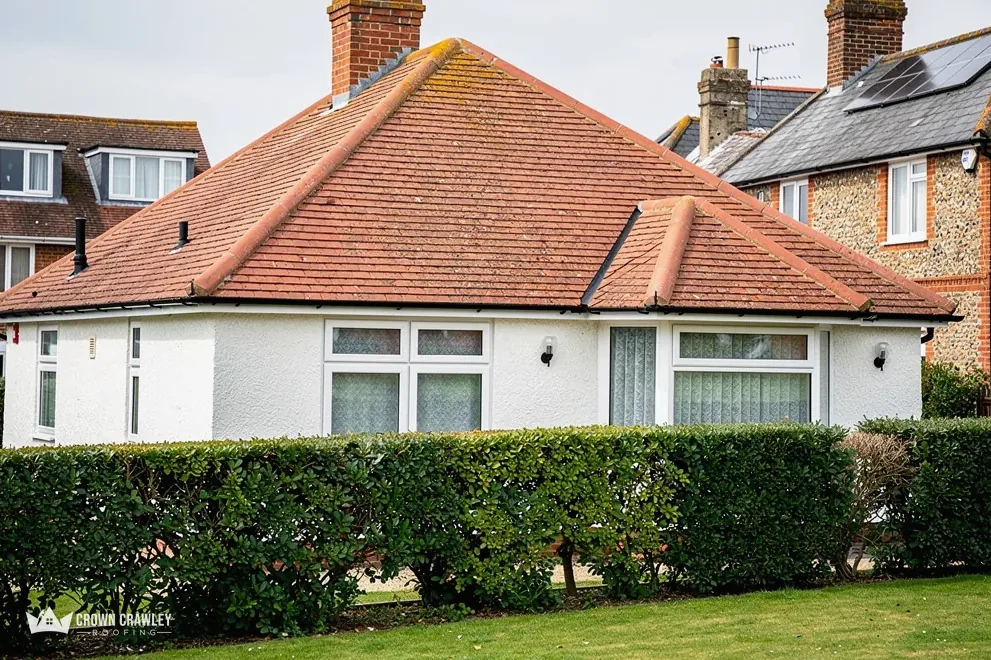
Slinfold's Georgian houses have hipped roofs, with clay tile named in the appraisal. A hip is the angled line at an outward corner, and its tiles and bedding take the weather from two sides.

Hipped tiled roof on a brick house

New slate-effect roof on a bungalow with white fascias and guttering

Victorian gables and bargeboards

Victorian houses here have gabled roofs in tile or slate with plain and patterned bargeboards. Those boards are the timber trim along the gable edge, and they rot from the top down.

Gable end with decorated bargeboard

Slinfold, in a dip of the Low Weald

Map of Slinfold and the neighbourhoods around it, with Crawley for reference.

Slinfold sits in the Low Weald, in a natural dip, with the River Arun running north of the village.

Distance
11.8 road miles from Crawley, to the west
Drive
About 19 minutes
Council
Horsham District Council and West Sussex County Council
Planning authority
Horsham District Council
Conservation area
Slinfold Conservation Area (designated 1976)
Article 4
A direction applies; ask Horsham DC
Population
1,163 (Census 2021, Slinfold built-up area)
Building control
Horsham District Council, Sussex Building Control
Get a free quote

Notes from Slinfold

A village roofed in stone, clay and slate

Stone slabs and old clay first, then Georgian and Victorian roof shapes, then the 1976 conservation area and what it asks of a larger job.

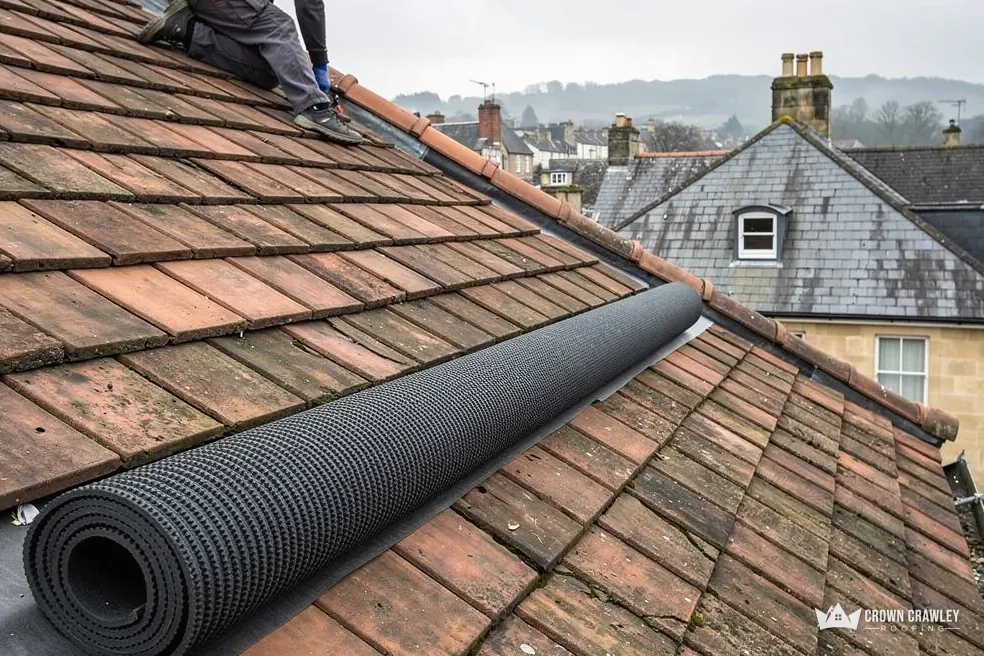
Roll of roofing membrane lying on a clay tiled roof

Stage 01 · Old coverings

Horsham Stone and handmade clay

The Weald Clay under Slinfold yielded Horsham Stone, and both that stone and old handmade clay tile reward slow repair.

Slinfold stands on Weald Clay. Horsham District Council's conservation area appraisal, adopted in 2020, explains that this ground produced a local building material, Horsham Stone, a flaggy sandstone that contains lime and was used on roofs as well as floors. Timber-framed buildings with gables are the village's oldest, and the same document tells us they were covered with that stone or with handmade clay tile. For a roofer this is a useful warning. A Slinfold survey can turn up heavy coverings laid by hand, carried on old timbers and repaired many times over.

Checks on an old covering

Slabs or tiles
Split, delaminating or sliding
Fixings
Oak pegs gone, nails rusted
Timbers
Rafters sound under the weight
Bedding
Ridge and hip mortar sound
Salvage
Original pieces set aside for reuse

How do you repair a covering that cannot be bought new?

Slowly, and by keeping as much of the original as possible. Stone slabs and handmade tiles come off one at a time, are sorted into those that can go back and those that cannot, and return to the same courses. Pieces that fail are replaced from a salvage match, so the new ones do not stand out from a lane. A replacement is never a casual swap, because size, thickness and colour vary from one roof to the next. The job takes longer than laying machine-made tile, and the quote explains why, with photographs of each slope taken before anything is moved. Because stone and handmade clay vary so much, the price also reflects how many sound pieces can be reused, which we count slope by slope during the survey.

Can the roof timbers carry a different covering?

Not until someone has checked. Stone is heavy, and old rafters were cut for the load they carried. On weight, the Planning Portal gives a clear line: a new covering at least 15 per cent heavier brings building control approval into play, and the Portal advises taking the opinion of an engineer or surveyor on structure beforehand. So we steer away from swapping one covering for another without looking at the frame. Under the covering we look at the battens and at the underlay along the eaves, where damp tends to settle. Our pitched roofing page describes how we handle tile, batten and underlay faults, and our dry ridge and dry verge page covers the fixings that replace bedding in mortar. Original pieces that come off sound are kept for reuse, and anything that has to go is shown to you first so you can see why.

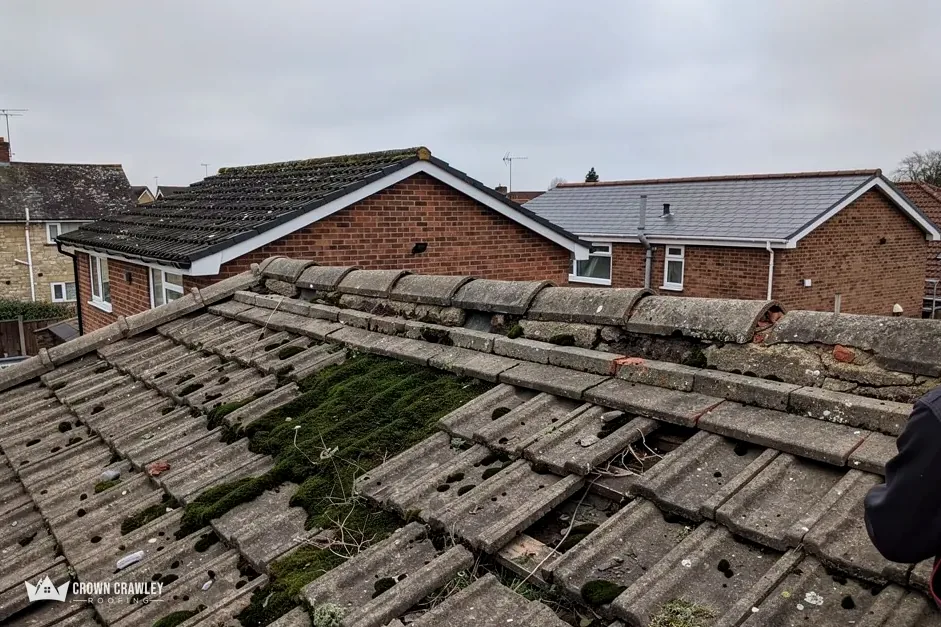
Aged concrete roof tiles with moss on the slope

Stage 02 · Georgian and Victorian

Hips, gables and slate

Georgian hips, Victorian gables and slate each fail in their own way, so each gets its own checklist at the survey.

The 2020 appraisal records that Slinfold's Georgian houses have hipped roofs with clay tiles, while its Victorian houses have gabled roofs of tile or slate and plain or patterned bargeboards. It also says that in the 18th and 19th centuries brick became the main building material, as earlier timber buildings were replaced or extended. That gives us three roof shapes to know well, and each has its own weak points.

What goes wrong on a hipped Georgian roof?

The hips. A hip follows the external angle where neighbouring slopes join, and it is a long line of bedded tile that takes weather from both sides. The mortar joint between hip tile and field tile cracks, the iron hook at the foot of the hip can rust, and the cut tiles beside it slip first. The Building Research Establishment publishes 60 years as the minimum life expectancy of clay tile, and that figure applies to clay only, so a Georgian roof that has been re-covered in clay may be sound for a long time yet. When a hip does fail we rebed it with a mechanical fixing, as the 2014 revision of BS 5534 expects for bedded fittings, and we mention whether a mechanically fixed dry ridge could be a fair alternative for that particular roof.

Roof shapes in Slinfold

Hipped roof
Slopes on all sides, no gable
Gable
Triangular wall at the roof end
Bargeboard
Trim board along a gable edge
Soaker
Small lead sheet under tile and flashing

Rot starts at the top of a bargeboard, long before it shows.

Why do Victorian bargeboards and slate need separate attention?

Bargeboards sit at the edge of the gable, wet from above and damp from the wall behind. Paint hides early rot, and by the time it shows, the end of the board has usually gone soft. Slate behaves differently. The Confederation of Roofing Contractors (CoRC) says well-kept slate can last more than 100 years, and BS 5534 indicates a minimum pitch of 20 degrees for natural slate. A slipped slate usually means a corroded fixing, not a failed slate, so we re-fix it before we replace it. Where slate meets a wall or a chimney, we study the lead. One published guide says lead flashing can last more than 80 years, so a leaking strip is often a joint problem and not an age problem.

If a Victorian gable has lost part of a patterned board, we copy the pattern from what remains and from neighbouring houses, and we paint the cut ends before they are fixed. Leaks here often start at a joint where the board meets the wall, so we seal that line properly and check the gutter nearest to it as well. A replacement board primed on every face, ends and back included, outlasts one painted only where it shows.

Stage 03 · Permissions

Inside the Slinfold conservation area

Slinfold was designated a conservation area in 1976, and the council adopted a fresh appraisal in September 2020, so bigger jobs start with a question.

The Slinfold Conservation Area was first designated in 1976 and reviewed in December 1997, and Horsham District Council adopted a new appraisal and management plan in September 2020. That appraisal is the best single guide to what the council values in the village, and it is where our facts on local materials come from. It also describes St Peter's church, rebuilt in 1861 to a design by Benjamin Ferrey in Wealden sandstone and Horsham stone, with a stone spire.

What does the conservation area change for a roof?

It sharpens the council's interest in any change a passer-by would notice on a Slinfold roof, such as a new covering, a roof window on a front slope or an altered chimney. An Article 4 direction also applies to land in the Slinfold Conservation Area. Such a direction takes away named permitted development rights inside its boundary, so before any outside change we ask Horsham District Council exactly which rights it removes and whether the job in hand is affected. Our post on planning permission for roof work sets out where to look. Where the survey leads toward stripping the lot, our roof replacement page follows a whole job through its stages.

Victorian brick terrace with bay windows and parked cars

Slinfold, step by step

Planning
Horsham District Council
Conservation area
Designated 1976, appraised 2020
Church
St Peter's, rebuilt 1861
Highway licence
West Sussex County Council
Notice
10 working days at least

Who handles approvals and scaffold?

Horsham District Council runs building control, trading as Sussex Building Control. For scaffold, West Sussex County Council requires a licence where poles stand on a public highway. It wants at least 10 working days' notice and charges £266 for one month; for fast track applications it aims to process within 1 working day, with £52 added, and asks you to email first. Its page does not name who applies, so the scaffold firm and we sort out the licence between us and tell you once it is granted. A scaffold kept wholly within your own boundary is not on the highway, and we look at where it can safely go when we visit the house. A lane without a pavement may leave little room, so the access plan is part of the written price. We also tell neighbours what is happening and when, so the first they hear of the job is not a scaffold lorry.

Old Slinfold lofts with gaps under the tiles can suit bats, whose roosts the law protects; GOV.UK counts roof repair and replacement among works that may affect them. Droppings or a live bat end our work for the day, and you hear from us straight away. To get going, photograph the whole roof from the lane or the garden, then email the pictures with your postcode, adding whatever you know about its listing.

Slinfold roofs, answered

Is my Slinfold roof covered in Horsham Stone?

Only if the building is old enough. The council's appraisal places Horsham Stone or handmade clay tile on the oldest timber-framed buildings, hipped clay roofs on Georgian houses, and tile or slate on Victorian ones. Seeing your own slopes settles it, and the pictures we take at the survey let you check our reading for yourself.

Does the Slinfold Article 4 direction cover roofs?

Horsham District Council made the direction, so its planning officers can say which permitted development rights it withdraws in the Slinfold Conservation Area. Whatever the answer, the village is still a conservation area, so put any visible change to a roof to the planners first, ideally with a sketch or a picture, and keep their reply on file.

Can a hipped Georgian roof be re-covered with different tiles?

It can, but the council takes more interest in a changed covering than in a matching one, and a heavier covering may need building control approval. Before any date is set, we bring the council the survey photos and a record of the existing tile, and we ask for a structural check wherever weight is in question.

What does a scaffold licence cost on a Slinfold lane?

West Sussex County Council lists £266 for one month, with a minimum notice of 10 working days, plus a £52 fast-track option. The scaffold firm and we handle the application together. Poles kept behind your front boundary are off the highway altogether, and at the visit we measure the strip beside the house to see whether they will fit.

Slinfold: get in touch

Text us a snap of each slope plus your Slinfold postcode and a survey date follows.

01293 974253

10-year workmanship guarantee, in writing.

Call Get a free quote