Elvey Cottage and its stack
Elvey Cottage began in the 15th century as a hall, and a chimney-stack and upper floor went in during the 16th. A stack added later to an old frame is a junction we inspect closely.
Old brick chimney on a tiled roof
Low Weald roofs on the old Brighton road, with brick behind them.
Sayers Common grew along the main road to Brighton, with a 15th-century cottage and a brickworks in its past. Each roof gets its own survey, with photos and one written price.
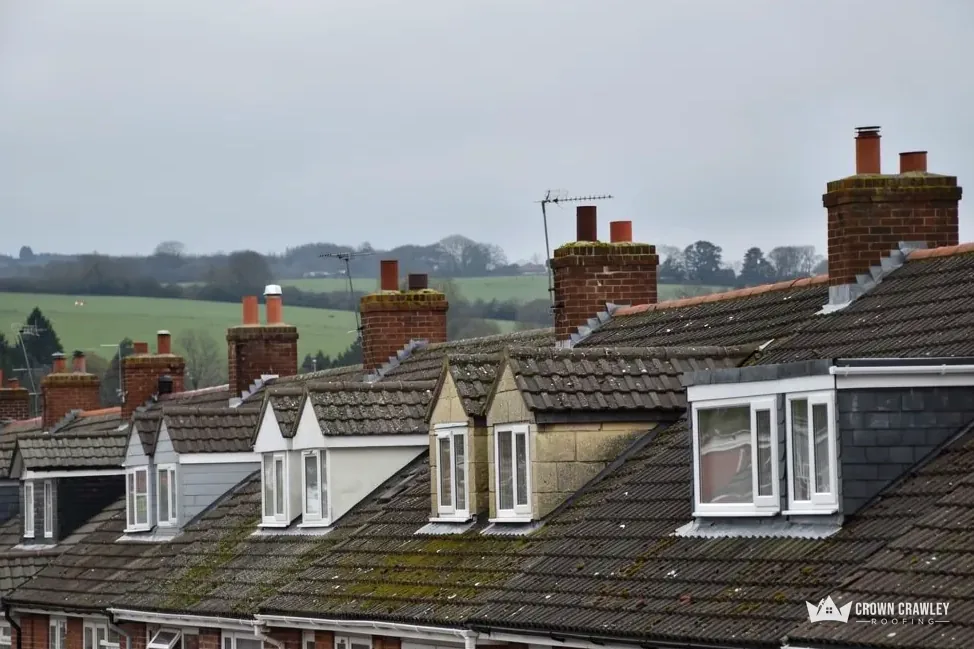
Elvey Cottage began in the 15th century as a hall, and a chimney-stack and upper floor went in during the 16th. A stack added later to an old frame is a junction we inspect closely.
Old brick chimney on a tiled roof
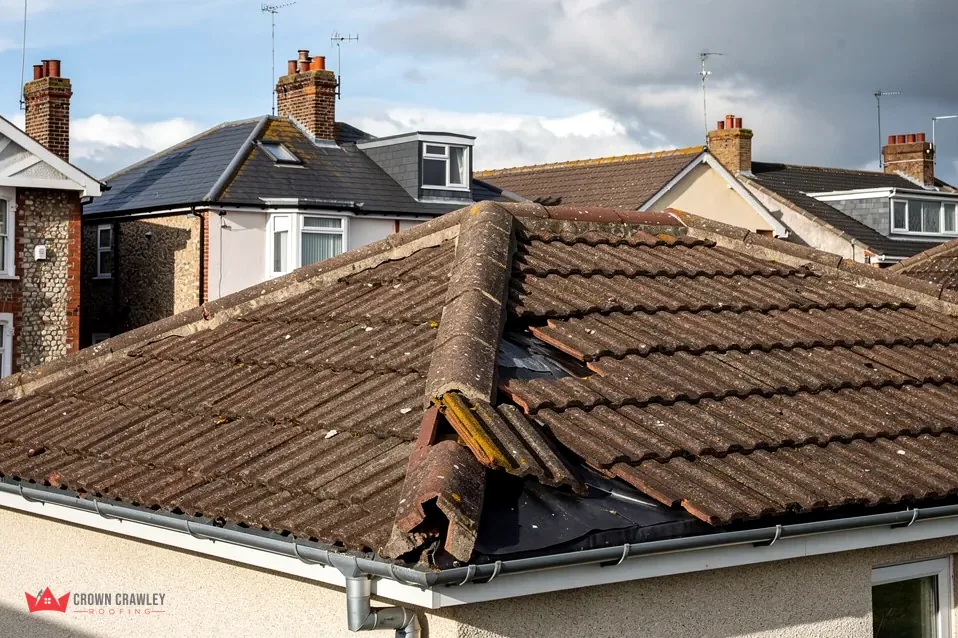
One of the parish's three brickmaking sites in the 19th century was at Reeds Lane. That says something about brick, not about your tiles, so we read the covering we actually find.
Brick wall meeting a tiled roof

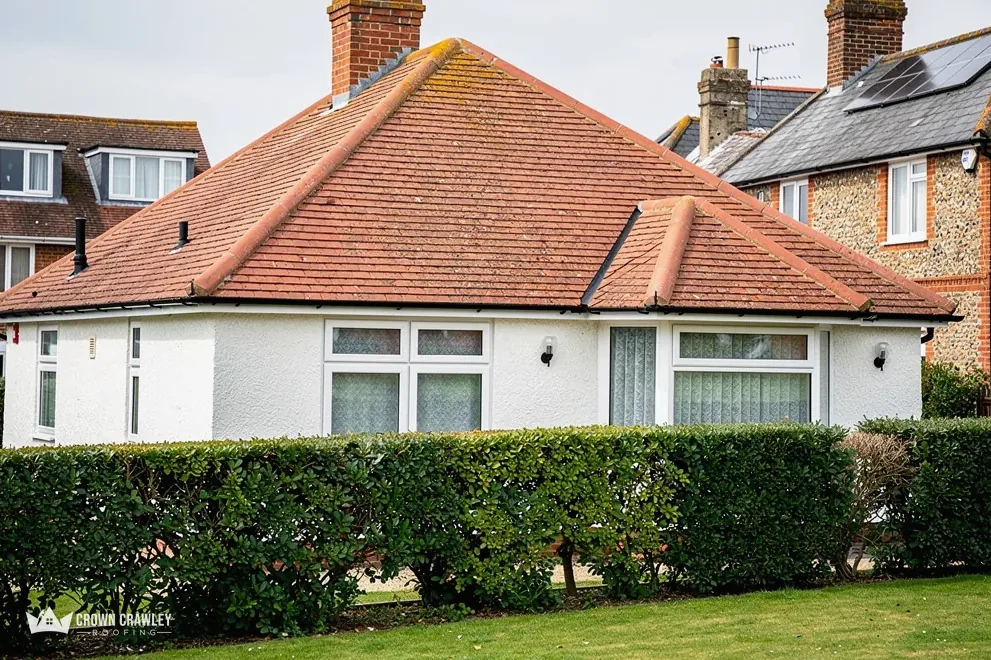
Elvey Cottage stands by the main road to Brighton, and the village grew along it. Gutters and the lowest courses of tile get a close look on every roadside survey.
Roadside house with a pitched roof
Map of Sayers Common and the neighbourhoods around it, with Crawley for reference.
Sayers Common lies in the Low Weald on the old London to Brighton road, inside Hurstpierpoint parish, and has its own Christ Church.
Stage notes: Sayers Common
Three short chapters on a parish created in 1881, the brick and old frames behind its roofs, and the district and county rules for a bigger job.
Stage 01 · Background
Sayers Common only became its own ecclesiastical parish in 1881, so its buildings were added to an older settlement in stages.
Sayers Common became an ecclesiastical parish in 1881, with the vicarage of Christ Church in the gift of the rector of Hurstpierpoint, according to the Victoria County History. The village sits in the Low Weald on the old London to Brighton road, within Hurstpierpoint parish. That points to roadside building and small additions over time, and not to one planned estate with a single roof pattern to expect. So on every call we begin with the roof in front of us and let it tell us what it is. Driving rain finds the weakest point first, so that is where we look.
Three things decide the outcome of a job: what covers the roof, the way the ridge and edges are fixed, and what the loft is doing underneath. Tiles can slip, crack or lose their grip with no obvious sign from the ground. A look from the garden finds the plain faults, and a walk across the roof finds the rest. We take photos as we go so you can see each fault for yourself, and we explain which are cosmetic and which let water in.
Close checks in Sayers Common
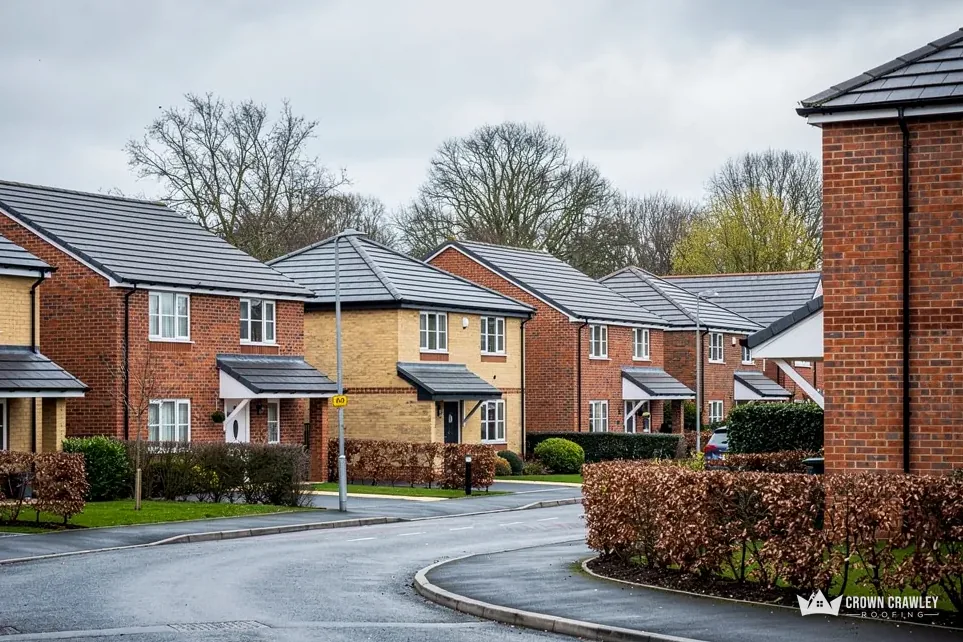
That is the question we try to answer in writing. Checkatrade's October 2026 guide shows replacing up to five tiles at £170 to £500, depending on access and scaffold, and gives around £12,000 for a new roof on a typical three-bedroom semi. Both are typical UK figures from a national guide and neither is our price. Repair wins where the battens and underlay are sound and the fault is local. A re-roof earns its cost where fixings or timbers have given up across a whole slope. Your roof gets a straight answer on that, with the photographs beside it. A good survey will sometimes say that a small repair is the sensible buy, and we write that down too.
Concrete or clay, one rule holds: a roof is more than its tiles. For concrete tiles Marley quotes around 60 years but calls that no guarantee. The Building Research Establishment's minimum of 60 years was written for clay alone. What gives way first is often the ridge, the verge or the felt beneath. Our pitched roofing page covers those repairs in full, and if a leak is active, we stop the water first and discuss the longer fix afterwards.

Stage 02 · Older buildings
A hall house from the 1400s and a brickworks on Reeds Lane make Sayers Common a place where brick and old frames meet the roof.
Elvey Cottage stands on the west side of the main road to Brighton, and it is of 15th-century origin: a hall into which a chimney-stack and upper floor were put in the 16th century. A Mid Sussex District Council appraisal for Hurstpierpoint adds that one of the parish's three brickmaking sites in the 19th century was at Reeds Lane, Sayers Common. Neither fact settles what covers your own house, so we check rather than presume. They do show a village with old frames, local brick and chimneys added after the event.
Because it is a join between two structures. A chimney put into an older roof has to be sealed where it comes through, and that seal is lead flashing, the strip dressed over the slope and into the brick. Over time the lead lifts and the joints crack, while the flaunching, that collar of mortar seating the pots, lets water in. Each is a repair on its own, and we find which one is leaking before we suggest anything. Checkatrade's April 2026 guide lists flashing repairs at £250 to £1,000, a national range that moves with access.
Brick and stack words
A verge is the sloping edge where a gable roof ends. On older roofs it is often held by mortar alone. Marley explains that the 2014 revision of BS 5534 stopped treating mortar's own strength as a reliable fix for ridges and hips, and says anything bedded in mortar should also be fixed with a clip, nail or screw. We check the bedding, add fixings when we rebed, and say if a dry-fix system, which clips the tiles down without mortar, would suit better. Dry systems are tested to BS 8612. Our dry ridge and dry verge page explains both.
Gutters complete the picture, and on a village road they matter more than owners expect. Leaves, moss and old sealant all collect in the joints, and a joint that weeps for a winter can stain the wall below and rot the board behind. We clear and test a run before deciding whether it needs replacing. A sagging length tips water down the wall instead of into the downpipe. We check falls, joints and brackets as part of the survey, and write what we find into the price. Our gutters, soffits and fascias page shows what a replacement involves.
Stage 03 · Permissions
Matching repairs at Sayers Common are simple, but a larger job brings checks, from area status to building control.
Straight swaps of slipped tiles, or a new ridge bedded where the old one stood, leave the house as it was, and that is where the paperwork ends. Checks arrive once a job grows, the covering is changed, or the poles need to go out on the highway. It helps to know which of those three your job is before the quote is written.
Mid Sussex District Council publishes its list of conservation areas, and its planners can confirm whether your Sayers Common address falls inside one. Either way, re-laying the existing covering is the plainest job. A listed house is another story, since works touching its character need listed building consent wherever it stands. Our roof replacement page traces a whole re-cover, from our first visit until the last skip leaves.
Rules that touch a Sayers Common job
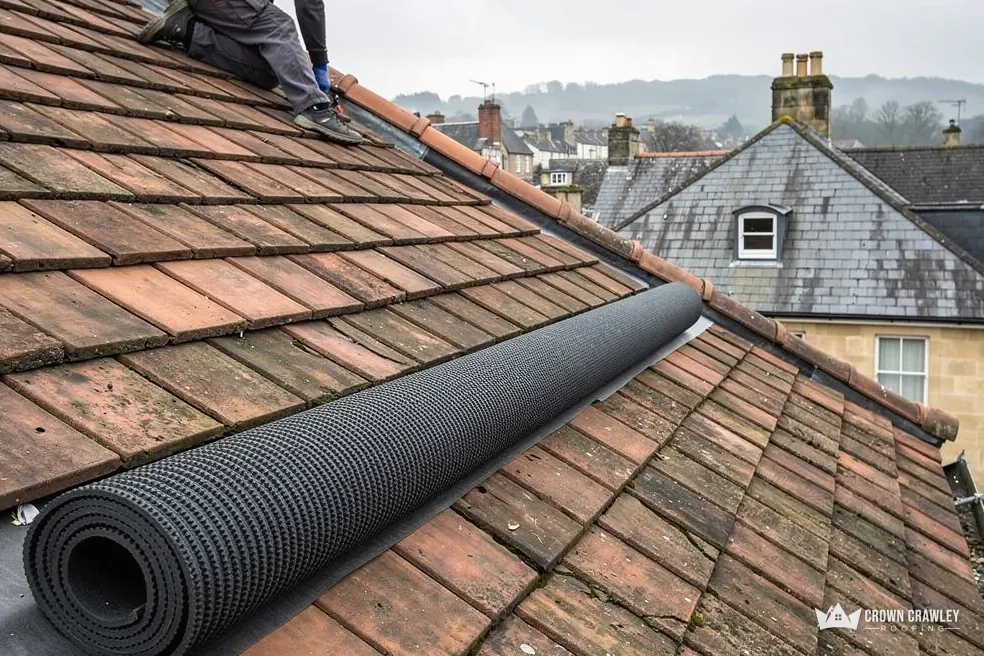
Mid Sussex District Council has its own building control service. Planning Portal guidance puts the starting threshold at less than 25 per cent of the building envelope and less than 50 per cent of the roof, and separately requires approval when the replacement covering is 15 per cent or more heavier, or performs differently in a fire. The Portal also urges owners to ask a professional about weight before a heavier covering is laid. For a large job we ask first and set dates after, and the price records the result.
Only when it occupies the public highway. West Sussex County Council asks for 10 working days' notice, lists £266 for one month, and offers a fast track, which it aims to process within 1 working day, for an extra £52. Licence arrangements are made jointly with the scaffolder, and our first day follows the date the licence is granted. Scaffold erected wholly on your plot needs no such permission, and we mark out the safe route for materials before work begins.
Bats are a legal matter for roofers. Government guidance gives full protection to the animals and to their breeding and resting places, and it includes roof work in the list of activities that can interfere. Should a survey show droppings or gaps where bats might get in, the job stops, and nothing moves until we have been through the options together. To start, send your postcode and a clear photo of whichever stack, gutter or slope is bothering you.
No. The record says one of the parish's three 19th-century brickmaking sites was at Reeds Lane, which tells us about brick and nothing about your tiles. We survey the covering, ridge, verge and loft on your own roof, show you photos, and set out one written price for what we find. Nothing is assumed from the street, the history or the neighbours.
Start by asking Mid Sussex District Council about conservation area status on your road. Matching repairs are the light case. Where the house is on the list, or a new look is planned for the roof, put the question to the council's planning team and ask for the reply in writing.
Usually at the seal. Where a stack comes through an older roof, lead flashing and the mortar crown at the top do the sealing, and both wear. Checkatrade's April 2026 guide gives national ranges of £250 to £1,000 for flashing and £300 to £1,000 for repointing. Your written price follows a survey of that stack.
Only if your own ground has no room for it. On a drive or lawn of your own, no highway licence applies. Out on the road, West Sussex County Council asks for at least 10 working days' notice and charges £266 for one month. We organise the licence with the scaffolder and warn neighbours when it goes up and comes down.
Tell us which stack, gutter or slope worries you, add your Sayers Common postcode, and expect a call to fix your survey.
Message us on WhatsApp