Roofers in Henfield

Hipped peg tile roofs, slate on Victorian villas and a greensand ridge.

Henfield's council appraisal describes hipped and half-hipped peg tile roofs on its older buildings, and slate on its 19th-century buildings. A survey comes before any figure, and the figure is a single total.

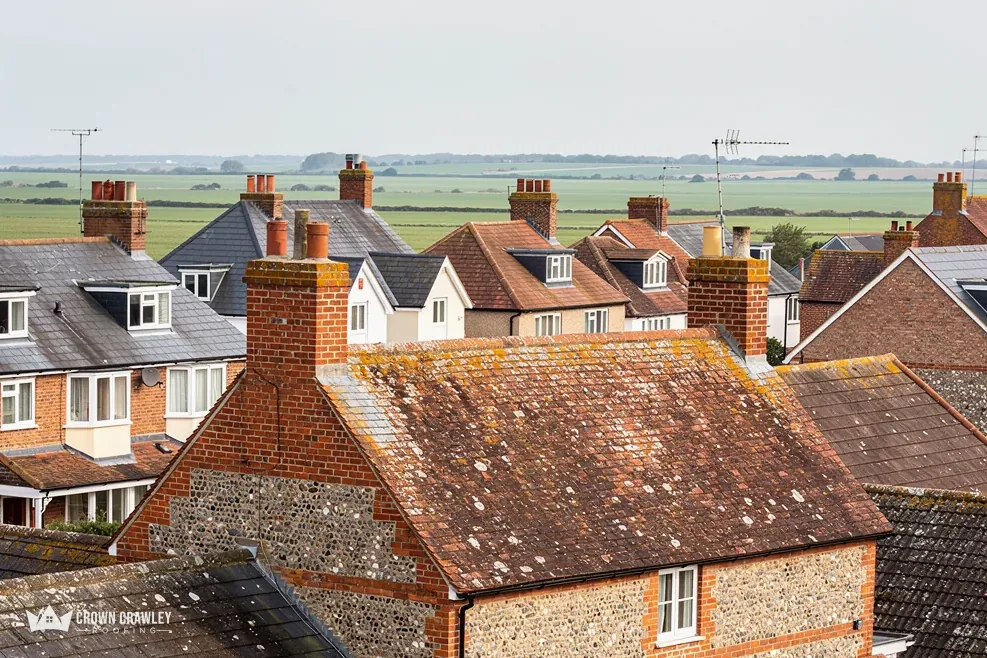
Flint-walled house with a mossy clay tiled roof overlooking fields

Roofs that define Henfield

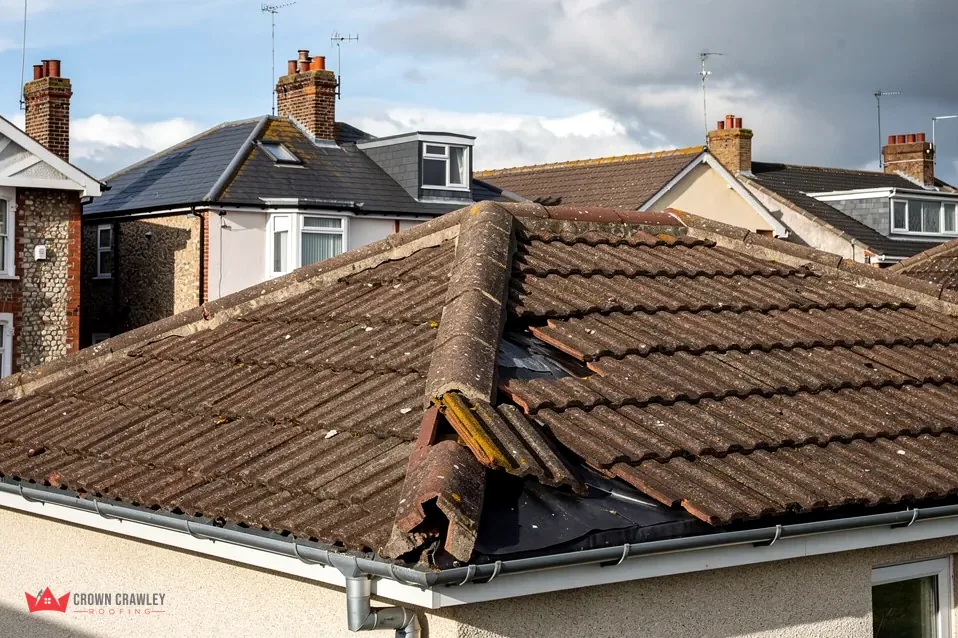
Damaged ridge tiles and exposed mortar at a roof hip

Hipped and half-hipped roofs

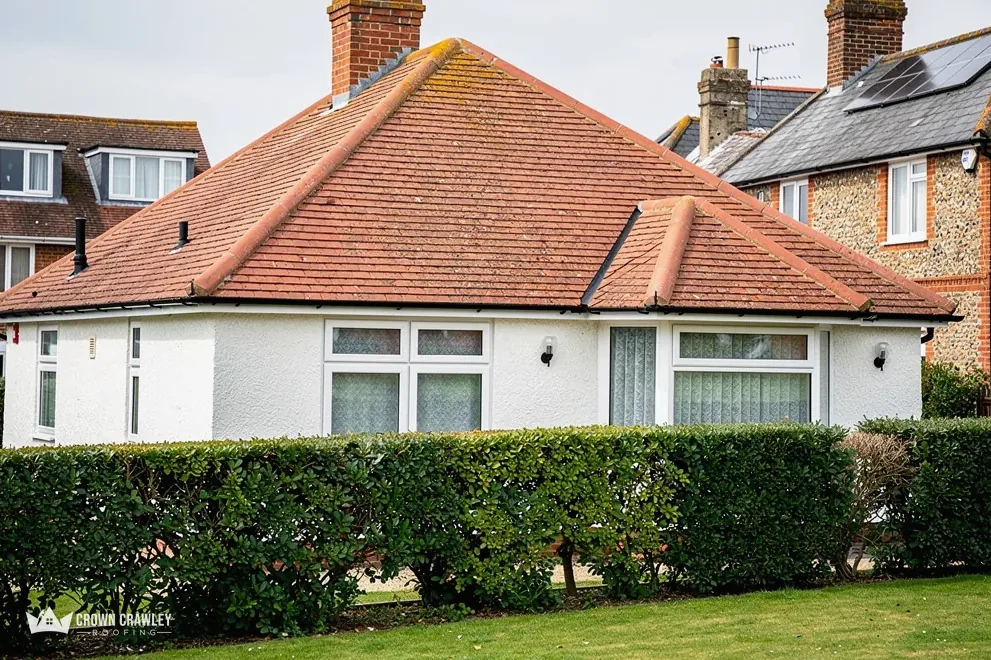
The council appraisal says many roofs of older buildings in Henfield are hipped or half-hipped, usually in peg tiles. Each hip, the angled line running down from ridge to eaves, is capped by tiles of its own that we check one by one.

Hipped tiled roof on an older house

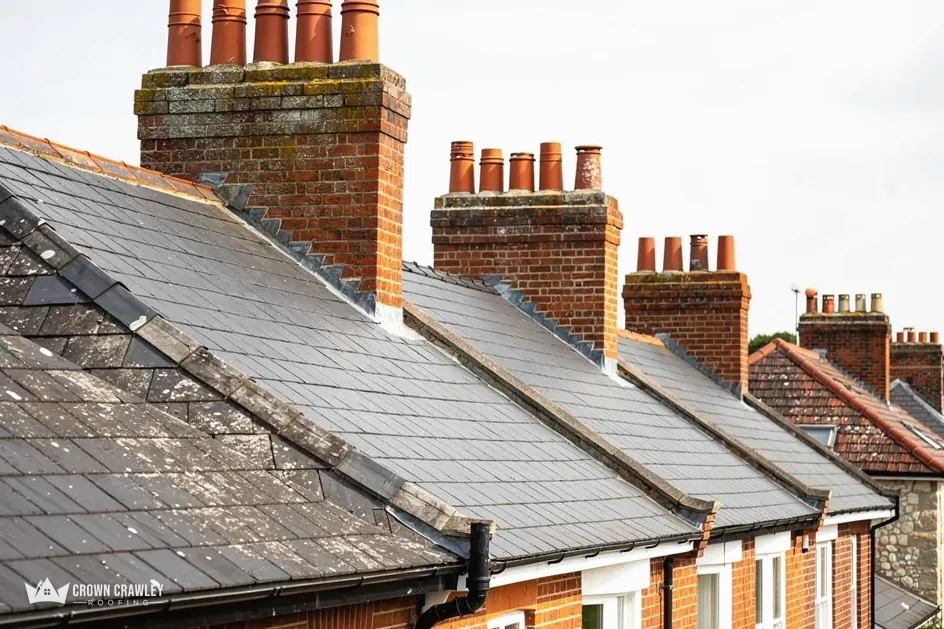
Row of terraced chimney stacks above slate roofs

Slate on 19th-century villas

The appraisal says slate is nearly universal as the roofing material on Henfield's 19th-century buildings. Slate roofs fail at the fixings first, so we look for slipped slates and rusted nails before anything else, and photograph them in close-up.

Slate roof on a Victorian house

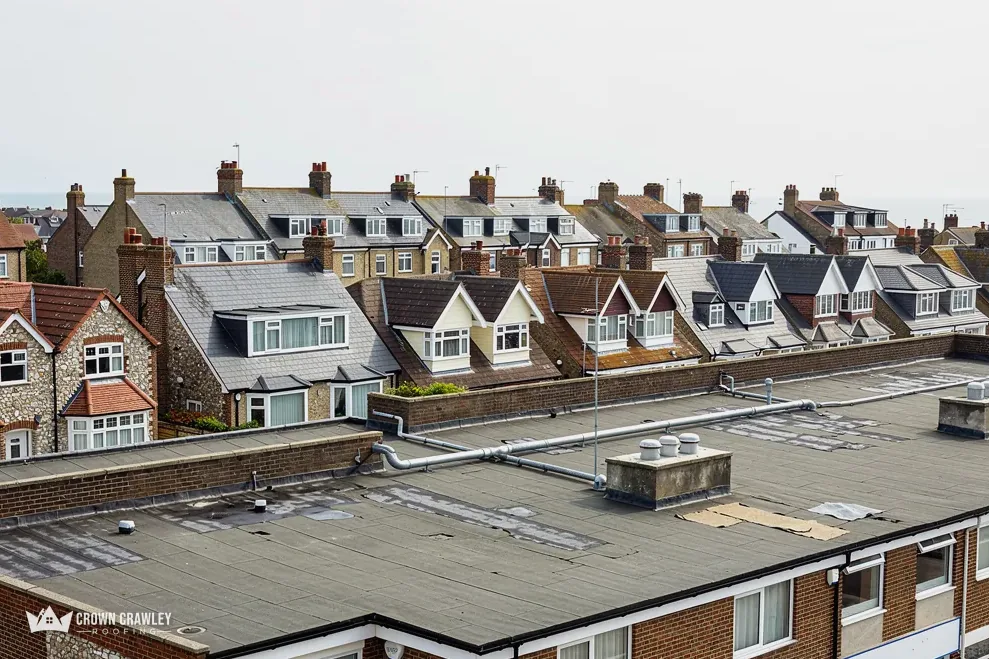
Flat roof in the foreground of a street of dormer-roofed houses

Horsham stone and thatch

Older buildings also use Horsham stone slates less often, and thatch less often again. Tipnoak on the High Street has a Horsham stone slate roof, a reminder that Henfield roofs vary and each deserves its own survey.

Old stone slab roof on a village

Henfield, on a greensand ridge above the Adur

Map of Henfield and the neighbourhoods around it, with Crawley for reference.

Henfield lies north of the South Downs, chiefly on the east bank of the River Adur, with the church on a ridge of Lower Greensand.

Distance
16.5 road miles from Crawley, to the south
Drive
About 24 minutes
Council
Horsham District Council and West Sussex County Council
Planning authority
Horsham District Council
Conservation area
Henfield Conservation Area (designated 1973)
Population
5,626 (Census 2021, built-up area)
Conservation area
Designated 1973
Building control
Horsham District Council, as Sussex Building Control
Get a free quote

Roofing in Henfield: the diary

Reading a roof above the Adur

Three short chapters on hipped peg tile roofs, the slate on Henfield's villas, and the planning and scaffold questions that arrive once a repair gets bigger.

Stage 01 · First look

Hips, half-hips and peg tiles

Many older Henfield roofs are hipped or half-hipped and covered in peg tiles, which puts the hip line near the top of our checklist.

Henfield lies north of the South Downs, on the east bank of the River Adur, with its church on a ridge of Lower Greensand above the Weald clay. Horsham District Council's conservation area appraisal says many roofs of older buildings in the village are hipped or half-hipped, usually covered in peg tiles, less often Horsham stone slates and less often still thatch. A hipped roof slopes on every side, so there is no plain gable end, and much of the work happens along its hips.

What goes wrong along the hips of a Henfield roof?

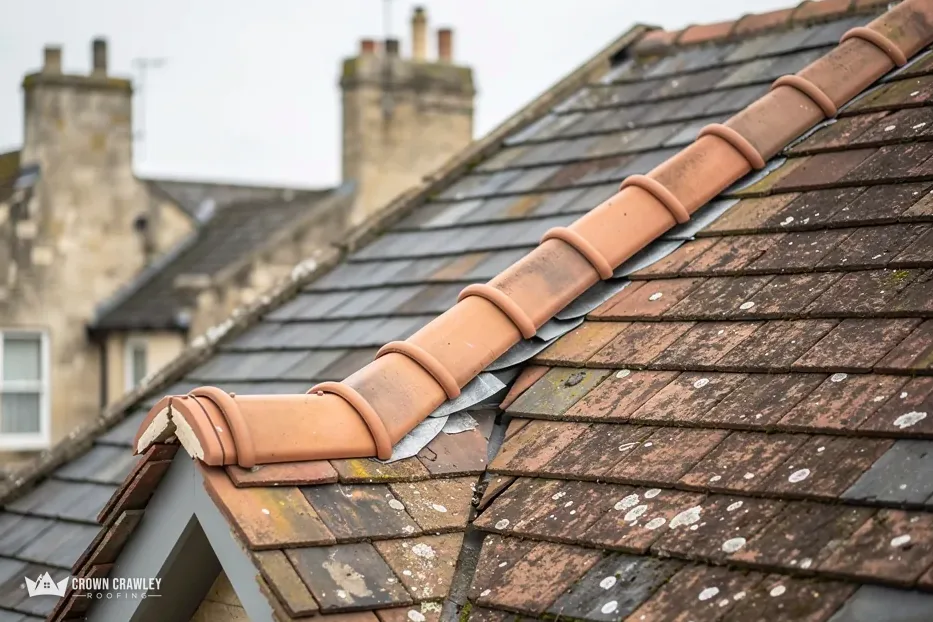
Look along the outward corner where two slopes meet and you are looking at a hip. It is closed with hip tiles, which are bedded in mortar or held with a dry-fix system. The mortar cracks, the tiles shift, and rain finds a way through to the rafters beneath. A half-hip, where the top of a gable is clipped by a small sloping triangle, adds a short hip with the same weak points. We follow each hip from the eaves to the ridge and photograph any open joint or slipped hip tile.

On a hipped Henfield roof

Hip tiles
Bedded firmly, fixings present
Peg tiles
Nibs sound, none slipping
Hip foot
Eaves end tight and dry
Ridge
Joints whole along the top
Rafters
Timber dry where the hips land
Clay ridge tiles along the hip of a weathered tiled roof

Why do peg tiles slip?

A peg tile hangs by its nib from a batten, which is the timber lath running across the rafters, and is held by a peg or nail. The nib wears, the peg lets go, and the tile slides. One slipped tile is easy to replace. A scatter of them across a slope can mean the battens are tired too. We raise a handful of tiles beside the fault and inspect the timber beneath, so the written price covers what the roof really needs.

A typical UK range from Checkatrade's October 2026 guide is £170 to £500 for up to five tiles, depending on access and scaffold. Where your job sits in that range becomes clear once we have seen the roof, and the figure you receive is one total.

The 60-year minimum life the Building Research Establishment quotes for clay tile comes with a caution from one conservation article: it is no rule for old peg tile. Where a peg tile roof is still sound, repairing the hips and replacing the odd tile is often the better buy than renewing the covering. Our pitched roofing page shows what that looks like, and our dry ridge and dry verge page explains the dry-fix options for hips and ridges.

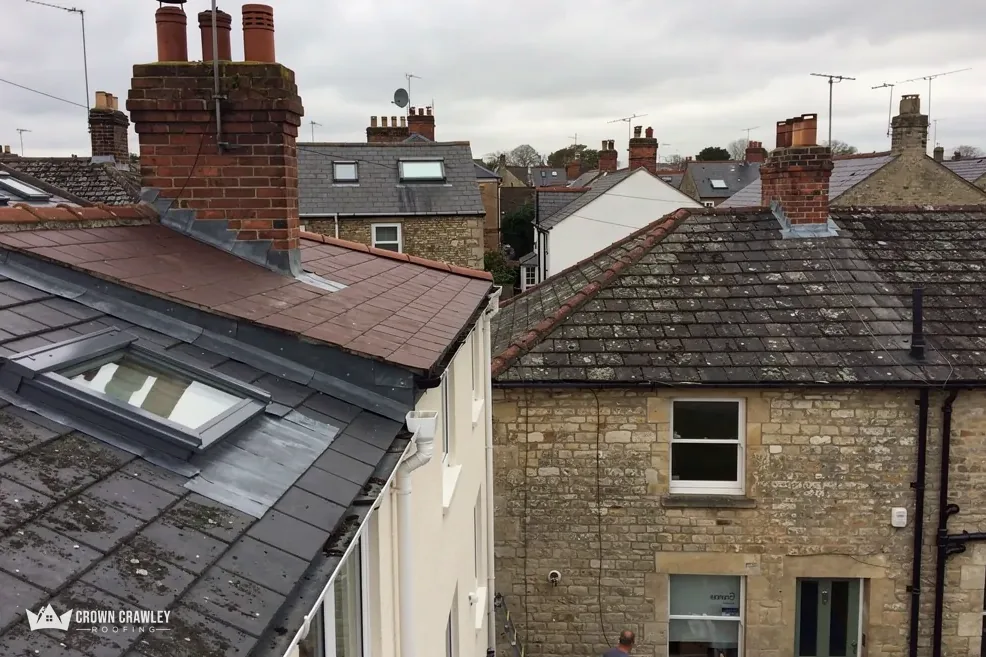
Slate and tiled roofs with a roof window beside a stone cottage

Stage 02 · Slate roofs

Slate on the Victorian villas

Slate is nearly universal on Henfield's 19th-century buildings, and a slate roof is read in a different order from a tiled one.

The appraisal says slate is nearly universal as the roofing material on the village's 19th-century buildings. A well-kept slate can last a very long time, and the Confederation of Roofing Contractors puts it at 100 years or more with good maintenance. What fails first is almost never the slate itself. It is whatever holds it up: the nails, the battens and the lead dressed into each junction, which is where a slate survey spends most of its time. Each of those can be checked from a ladder and from the loft, and the two views together give a fair picture.

Why do Henfield's slate roofs lose slates?

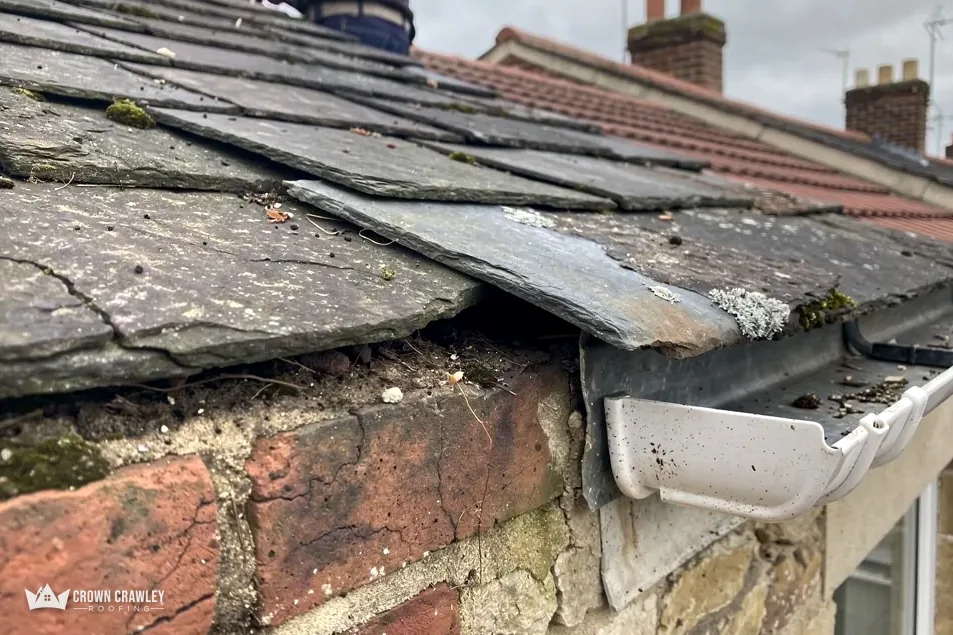
Because the nails rust. Slates hang from a pair of fixings, and when the iron corrodes the slate slips down and eventually falls. Roofers call this nail sickness. You can often see it from the pavement as a row of slates sitting out of line. Replacing individual slates is straightforward if the surrounding ones are sound, and the job is small enough that scaffold may not be needed at all. Our nail sickness on a slate roof answer describes how to tell whether it is a patch or a re-roof.

What pitch and fixing does slate need?

Cupa Pizarras says BS 5534 indicates a minimum roof pitch of 20 degrees for natural slate, and that clips of the hook type are unsuitable on any pitch under 25 degrees. Details like that decide how we replace slates, because a repair should leave the roof sound for years rather than just stopping the drip. Soakers, the folded pieces of lead tucked under slates where slate abuts a wall or a stack, are another place to look. A lead soaker that has split will let water in however good the slates are.

Is a slate roof worth repairing?

Usually, when the slates are sound and the problem is fixings, flashing or a few cracked pieces. If the slates are delaminating or the battens have rotted, a re-roof may be the better buy, and the photographs will show it. Leadwork around chimneys and walls, from soakers to flashings and valleys, is part of the same visit when a slate roof needs it, and the survey photographs show each piece.

Slate roof words

Nail sickness
Fixings rust and slates slide
Headlap
Overlap between slate courses
Hook fixing
Clip holding a slate's tail
Soaker
Folded lead under slates at a wall

The gutters need a look too, because an older roof can drain onto runs that have been patched more than once. A gutter that has sagged away from the eaves drops water behind the fascia board, the board that caps the rafter ends, and the damp rises into the timber. Cleaning and refixing the run during the same visit costs less than coming back for it.

Stage 03 · Permissions

Conservation area, planning and scaffold

Henfield's conservation area dates from 1973, and the planning and building control questions go to Horsham District Council.

Slate for slate or tile for tile, in the same place and looking the same, rarely needs a form. The questions begin as a job swells into a re-roof, as the covering or the appearance shifts, or as poles have to go up on the road.

Does the Henfield Conservation Area affect roof work?

The council appraisal records that the conservation area was designated in 1973. If your house lies inside it, put the question to Horsham District Council's planning team before changing the material, colour or look of the roof. Swapping slate for another covering is a bigger move than it appears, because weight, pitch and appearance all shift together, which is why a Victorian villa deserves a proper conversation before any change of material. Our roof replacement page explains how a full renewal is priced once the survey is in.

Reading a Henfield roof

Planning
Horsham District Council
Area
Henfield Conservation Area
Building control
Sussex Building Control
Scaffold
West Sussex licence, £266 a month
Wildlife
Pause if bats appear
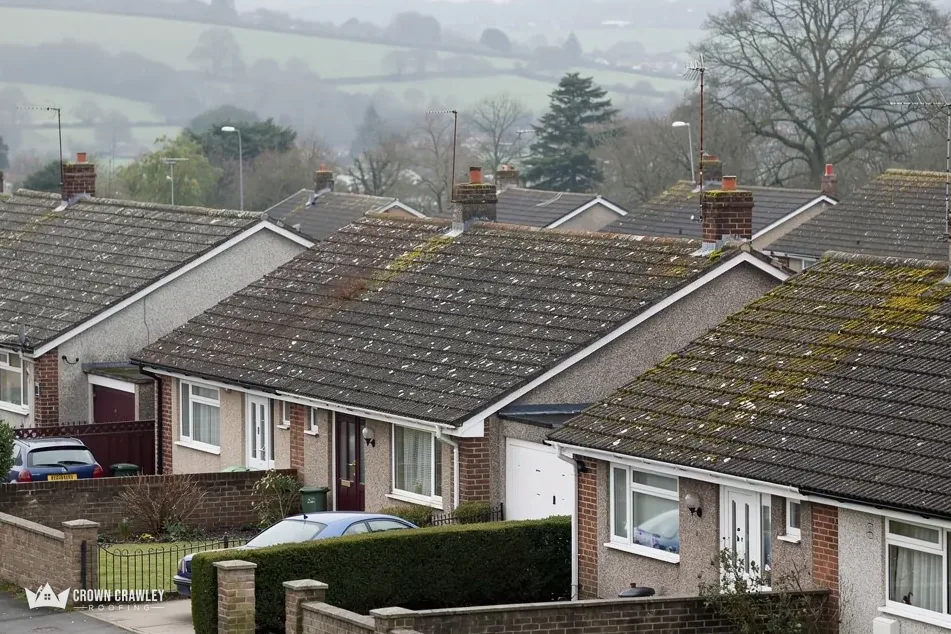
Terraced bungalows with grey tiled roofs along a cul-de-sac

When is building control involved?

Horsham District Council's service is branded Sussex Building Control. On the Planning Portal's test, a re-roof touching under 25 per cent of the building envelope and under 50 per cent of the roof is normally fine without an application, whereas a covering adding 15 per cent or more to the weight is not. For a heavier covering the Planning Portal advises checking first with a structural engineer or surveyor, and that check is worth making before the price is agreed. On a hipped peg tile roof the same thinking applies in reverse: reclaimed peg tiles are matched to the old ones in size and colour, and the survey records how many sound tiles can go back on.

Will scaffold in Henfield need a licence?

Any scaffold standing on the highway is licensed by West Sussex County Council, at £266 for a month, with 10 working days' notice required. A frame on your own front garden or driveway is a private-land matter and needs no highway licence. Our scaffolding firm and we prepare the application, so you are not left chasing the council yourself, and we give you the likely first day once the notice is lodged. Neighbours hear the dates from us before the poles arrive.

Keep reading

The law gives bats and their roosts full protection, so signs found at the survey mean we hold off and talk through the next move with you before anything is touched. A photograph of the hip, slate or gutter that bothers you, sent with your Henfield postcode, is the easiest place to begin.

Answering Henfield roof questions

Why does the hip of my Henfield roof leak when the tiles look fine?

A hip is closed with its own row of tiles, and the mortar or fixings under them are what fail. Water runs in at an open joint and soaks the timber below without any tile slipping. We trace the hip from eaves to ridge, photograph each joint, then rebed it with fixings or fit a dry system.

Is nail sickness the reason slates are dropping off my Henfield villa?

Very often, because rusted nails let slates slide. A slate roof with a row of loose slates usually needs the surrounding fixings checked, not just the fallen ones replaced. We lift a few slates beside the gap and look at the nails and battens before saying whether a patch will hold, and you get the photographs.

Must a Henfield roof be repaired with the same tile as before?

Rules vary by property, and inside the conservation area it is the council's planning team who judge what is acceptable. For a repair we match the existing tile or slate in profile and colour as closely as possible. If the finished roof would look different, the council should hear about it first, together with our written description of the work.

Who sorts the highway licence for scaffold in Henfield?

West Sussex County Council's page does not name the applicant. It requires a licence for scaffolding on the public highway, with 10 working days' notice and £266 for one month. We organise it together with the scaffolding firm and plan the first day around the notice period, so the roof work is not held up unexpectedly.

Free quote in Henfield

Photograph the hip, slate or gutter you are least sure about and send it with your Henfield postcode.

01293 974253

10-year workmanship guarantee, in writing.

Call Get a free quote