

A Grade II* hotel
Listed in 1953, the Shelly Arms Hotel stands at Grade II*. A building at that level calls for careful materials and a clear record of what is on the roof before anyone touches it.
Large old building with a tiled roof
Roofs among a Grade II* hotel and listed Weald cottages.
Nutley lies within the High Weald, with a Grade II* hotel and Grade II cottages among its listed buildings. Old roofs here earn matched repairs rather than quick patches.
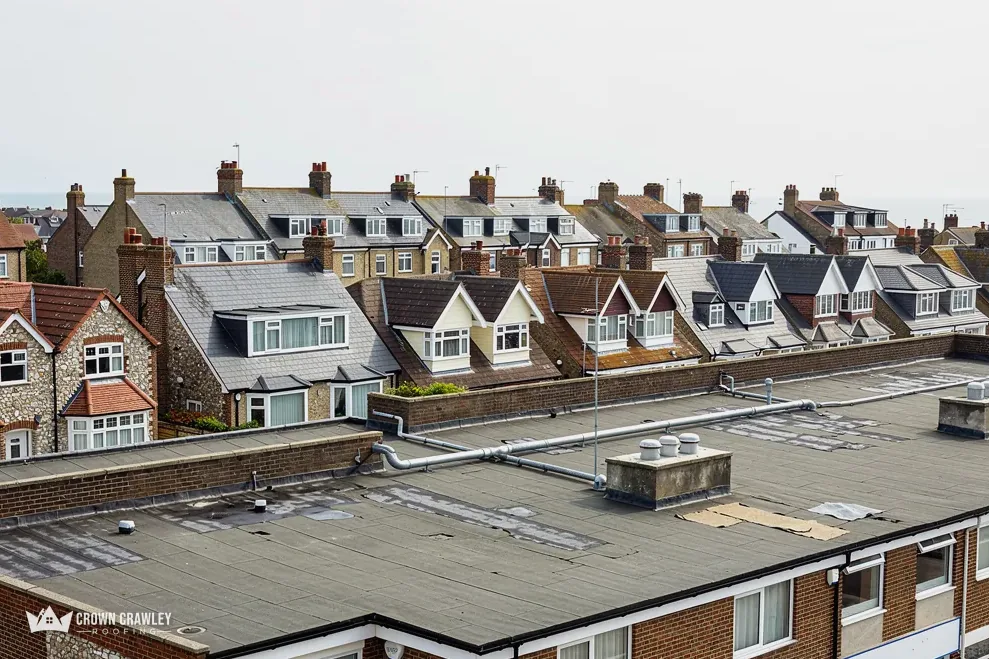
Listed in 1953, the Shelly Arms Hotel stands at Grade II*. A building at that level calls for careful materials and a clear record of what is on the roof before anyone touches it.
Large old building with a tiled roof
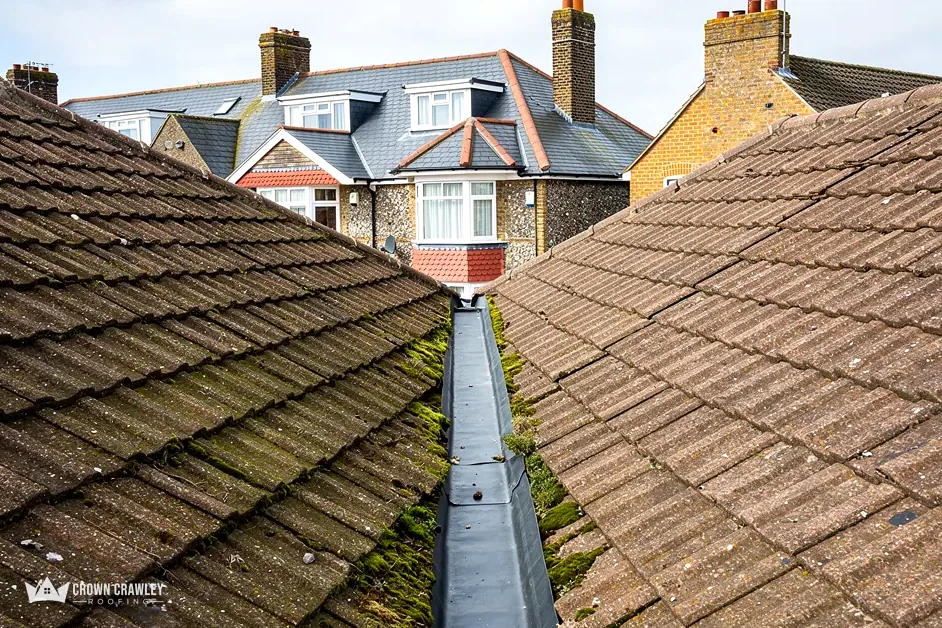
The pair entered as Comfits Cottage and Tudor Cottage, and Old Nether, are both Grade II. On any timber-framed building we look at how the roof loads the frame as well as at the tiles.
Timber-framed cottage with a roof
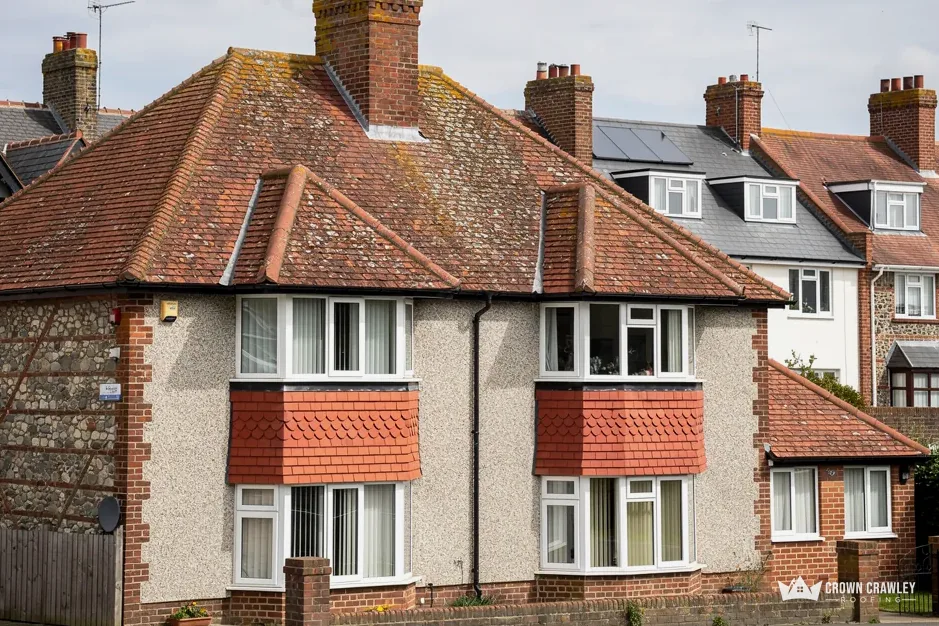
Writing about its villages, the High Weald National Landscape mentions sandstone, brick and tile beside timber frames and weatherboarding. We match tile colour and texture to what already covers your roof.
Clay tiles on a roof slope
Map of Nutley and the neighbourhoods around it, with Crawley for reference.
Nutley is a village in East Sussex, south-east of Crawley, within the High Weald and outside the South Downs National Park.
Roofing in Nutley: the diary
What a village of listed buildings asks of a surveyor, how protected countryside shapes a repair, and the Wealden and East Sussex checks that arrive with a bigger job.
Stage 01 · First look
Nutley's listings range from a Grade II* hotel to Grade II cottages, so our surveys start with the structure.
Nutley is a village where the list of protected buildings says a lot about the street. National Heritage List entries include the Shelly Arms Hotel at Grade II*, first listed on 26 November 1953, and two Grade II entries: the pair named Comfits Cottage and Tudor Cottage, and Old Nether, added to the list in 2003. A listing tells you a building matters, not what condition its roof is in, so with any of them, and with the older houses around them, the survey decides how we go about a repair.
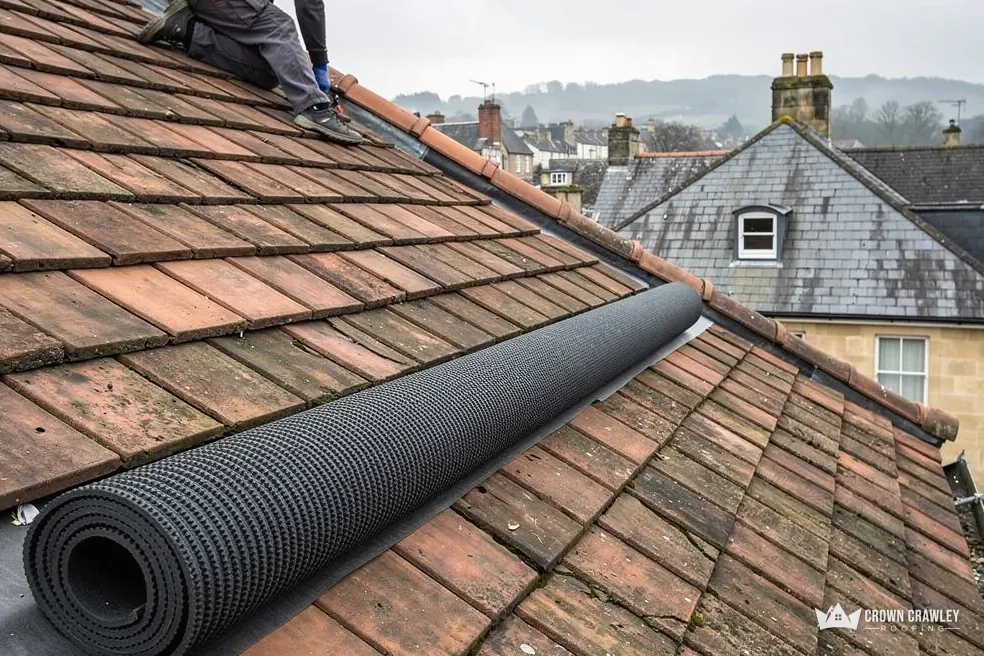
The shape comes first. From the ground we sight along the ridge, the capping that runs along the peak, to see whether it holds a straight line or dips between its supports. A gentle wave in an old roof is common and often harmless; a sudden kink beside a chimney or a wall plate points at something moving. Then we climb up and go along the slopes tile by tile, noting slips, cracks and gaps, and checking the verges, the sloping edges where a gable meets the sky. In the loft we examine the rafters and the battens, the laths the tiles are hung from, for rot at the nail holes and for daylight where there should be none.
Surveying an old Weald roof
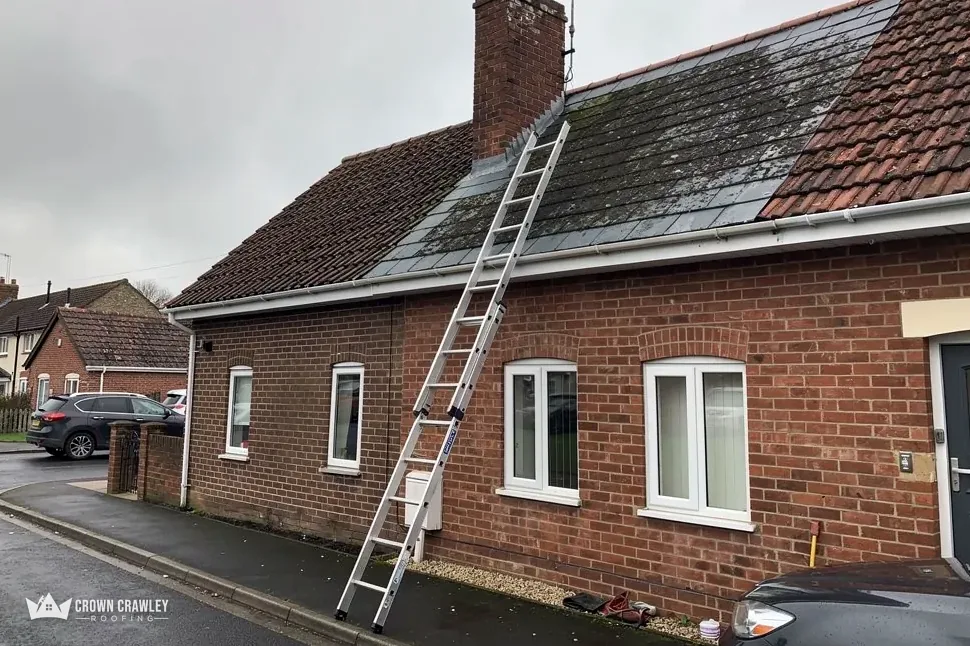
Clay tiles age in different ways. The Building Research Establishment gives 60 years as a minimum life for clay tile, while a conservation writer doubts that the number means much on old peg tile. In plain terms, the date of a house tells you little about the state of its covering. One old tile roof can be sound after centuries, while a younger one loses tiles to frost and to fixings that have rusted through. We tell you which you have, with photographs, before a price is on the table.
Beside a chimney or a taller wall, lead flashing does the sealing, and it is the first place we check on a house with a stack. One cost guide reckons lead flashing can last for over 80 years, so a worn section can be mended without disturbing sound lead around it. Our chimney repairs page sets out how we treat the stack, the flaunching that holds the pot, and the flashing at its base.
Stage 02 · Landscape
Nutley lies within the High Weald, so how a roof looks from the lane matters, and a repair should disappear into the street.
Planning data puts Nutley inside the High Weald, a protected area covering 1461 square kilometres. Its older legal label, Area of Outstanding Natural Beauty, still appears in legislation, while the name now used day to day is National Landscape. For a homeowner, the effect is that councils expect changes to be handled with restraint. Restoring a roof to how it stood seldom causes a stir. Reshaping it is where the questions begin.
Not when the repair matches what was there. Choosing a different covering, altering the roof shape or adding roof windows is where it starts to count, because some planning freedoms differ in protected landscapes. We do not settle that by guesswork. Our post on planning permission for roof work explains how the question is decided, and Wealden's planning team can answer it for your address. A listed house adds a separate matter: listed building consent applies to changes that affect the building's character, whatever the landscape around it.
Terms for a Weald roof job
The High Weald's own account of local building speaks of timber framing and weatherboarding as well as sandstone, brick and tile. That mixture tells us what may sit under or beside a roof without telling us what your own house is made of, so we look rather than assume. A weatherboarded wall that meets a tiled roof is a good example. The junction needs a neatly dressed flashing, a strip of metal folded into the wall and over the tiles, and the boards below need to stay dry, otherwise rot starts quietly behind the paint. If boards need work, you hear about it and we leave them for the right trade.
A good repair in the Weald leaves the roof looking as though nobody had touched it.
Matching is a craft in itself. We photograph the tile and note its size, colour and texture, then hold replacements against the old ones outdoors, since tiles look different wet and dry. Where sound tiles can come from a less visible slope, we reuse them and put the new tiles where they are least conspicuous. New clay looks brighter than its neighbours for a season or two before weather evens it out, and a careful mix of old and new tiles hides the change from the lane. The written price covers the repair in full, with the matching included, so there is no later surprise about the cost of getting the look right.
Stage 03 · Permissions
Nutley falls under Wealden District Council for planning and East Sussex County Council for the road, with a partnership handling building control.
Putting back what was there seldom involves paperwork, and the survey shows early whether a job will go further. Bigger jobs involve some, and in Nutley the contacts are the district council, a four-council partnership and the county highways team.
Wealden's own page explains that the East Sussex Building Control Partnership carries out the function for four authorities: the boroughs of Eastbourne and Hastings plus the Rother and Wealden districts. For a roof, the Planning Portal's line is that work on less than 25 per cent of the building envelope and less than 50 per cent of the roof needs no application as a rule, while a covering 15 per cent or more heavier brings approval into play. If the survey points past those thresholds, we ask the partnership before fixing a date, since a date fixed before their answer may have to move, and the price you receive allows for what they ask. Our roof replacement page walks through a full new roof from strip to finish.
Before a larger Nutley job
Wealden District Council can confirm whether a Nutley house lies in a conservation area. The High Weald designation and a listing are different things, and each can bear on what you do to a roof. If you are unsure which applies to your house, Wealden's planners can tell you, and it is worth asking before an order goes in for tiles, since a wrong guess costs more than a short phone call.
Scaffolding that stands on a public highway needs a licence. East Sussex Highways, acting for the county, publishes the fee and terms. Its fee page lists £127 for a 28-day licence and adds that fees rose by 2.77 per cent from 1 April 2026, so check the figure on the day. Extensions have to be sought five or more working days ahead of expiry. With no published lead time for a fresh application, we put ours in promptly. Poles confined to your own plot stay outside the scheme. If the highway is needed, we sort the licence out alongside the scaffold firm and pass the dates on.
Bats are protected together with their roosts, and the government's guidance flags roof repair as a hazard to them. Any sign of a roost makes us stop and talk it through before going further. To start, message a picture of the slope that concerns you along with your Nutley postcode.
No. It does not. Matching like with like is the simple case. The designation matters more if the plan involves another covering, a changed roof shape or new roof windows, where protected-landscape rules can differ. Wealden District Council's planners can answer that for your address, and we describe the roof in detail so the answer comes quickly.
We start from the ground, sighting along the ridge for dips, then climb up and check tiles, verges and flashings. In the loft we look at rafters and battens for rot and for daylight. Old frames move, so we separate harmless waves from real faults and show you photographs of both before suggesting any work.
We match what can be matched. We note the tile's size, colour and texture, compare replacements outdoors in daylight, and reuse sound tiles from a quiet slope where possible. Old peg tile can be harder to match than modern tile, so we say plainly where a perfect match is unlikely and how close the nearest alternative looks.
If the scaffold has to occupy the road or footway, our scaffolder and we arrange the licence jointly. East Sussex Highways publishes the fee and terms but sets no notice period for new applications, so we apply in good time. A frame on your own land needs no such licence, which keeps small jobs simple. You get the scaffold dates and a plan for each day.
Tell us which slope, chimney or flashing worries you, attach a picture and your Nutley postcode, and a survey date follows.
Message us on WhatsApp





