The chimney breast is the part of the stack you can see indoors, and it is often the first place damp shows. A stain on the wallpaper, paint that blisters in one corner, a musty smell in the bedroom above the lounge. People usually reach for damp-proof paint or a dehumidifier, and the patch usually comes back.
That is because the stain only tells you where water ended up, not where it came in. A breast sits under a stack that runs through the loft, past the roof slope and out into the weather, so the water can enter at the top, at the roof line, from inside the flue or from the wall below. This guide sets out the three common causes, how to read the patch, and how a roofer works through them in order. The rain-leak route gets the most space, because it is the one a roofer can fix from outside and the one most often behind a stain that follows wet weather. Knowing the options first also makes the survey conversation easier, whoever you ask to look.
Reading the patch before anyone climbs up
You can learn a lot from the stain itself, and you can do it from the floor of the room. Note what you see, with dates, because a roofer will ask.
Does it follow the rain?
Keep a simple diary for two or three weeks. If the patch darkens within a day or so of a heavy shower and dries slowly in a dry spell, the water is coming from outside. If it grows on cold, still mornings with no rain at all, think condensation. A patch that never quite dries and has a white powdery edge points towards salts.
Where is it, exactly?
A stain high on the breast, near the ceiling, usually means water entering at or above the roof line. A stain at the lower part of the wall, close to the hearth, can be rising from the floor, a leak in the flue, or a wet breast that has been collecting water for some time. A damp line that follows the edge of the breast where it meets the party wall or the outside wall suggests water running along the junction.
What else is happening?
Look in the loft if you can reach the stack safely. Dark tide marks on the brickwork, damp insulation around the base or drips on the ceiling joists tell the story from the inside. Take photos, with something in the frame for scale, and note whether the other side of the stack is dry. Do not lean on the stack or climb past it. Brick that has taken in water for a long time can be softer than it looks, and a stack that looks out of line is a job for a surveyor.
Rain from the top: pots, flaunching and mortar
When the patch follows the weather, the survey starts at the highest point of the stack and works down. That order matters, because water that enters at the top soaks everything below it.
Pots and flaunching
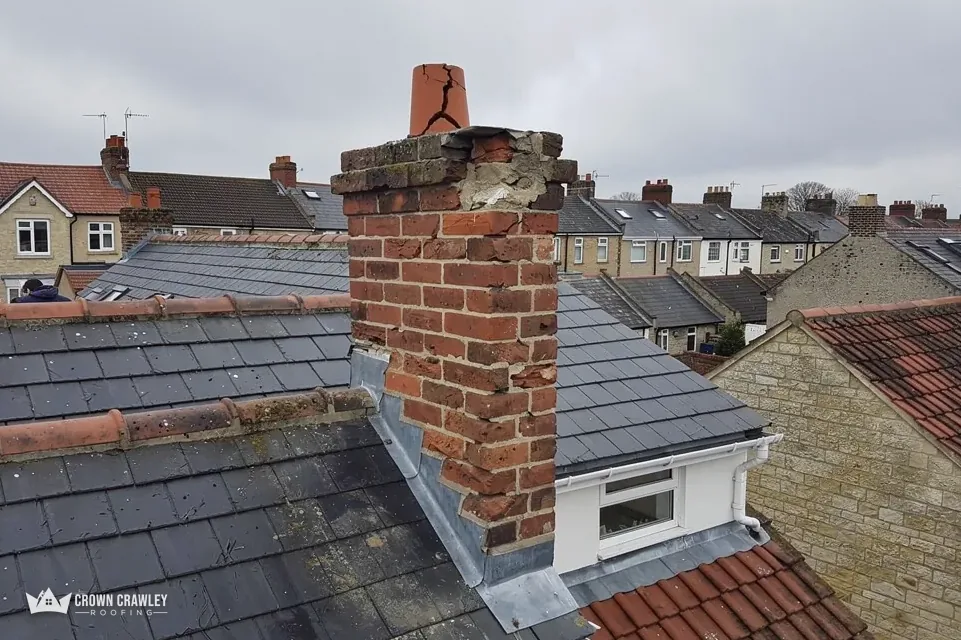
The pots on top of a stack sit in a sloping bed of mortar called flaunching, which bonds them in place and sheds rain. It faces the sky, so frost and wind wear it fast. When it cracks or crumbles, rain runs between the bed and the pot, then down the flue walls and into the brickwork. A cracked pot does the same job. Both can be seen from a ladder or a camera on a pole, and both rank among the smaller repairs. Our post on chimney leaks from flashing, flaunching or the stack sets out how a roofer tells them apart.
Brickwork and pointing
Lower down, the faces of the stack take driving rain. Mortar joints that have eroded back from the brick, or bricks with faces that have flaked away, let water in sideways. Repointing is the usual cure for sound brick, and the work is done joint by joint with the stack scaffolded or reached from a safe platform. If the brick is flaking, repointing alone will not hold, and the stack may need partial rebuilding.
What is the cap doing?
A flue that is capped can still let in rain if the cap is cracked, or if the cowl on a working flue is damaged. A roofer will check the top plate or cowl for hairline cracks as part of the same visit, with the scaffold or ladder already in place.
Rain at the roof line: flashings and soakers
Where the stack comes through the roof, water has to be turned away by metalwork. A flashing is a strip of lead, or a similar metal, that seals the gap between the brick and the tiles. This junction is a frequent place for a stain to start, and the hardest to see from the ground.
How a flashing works
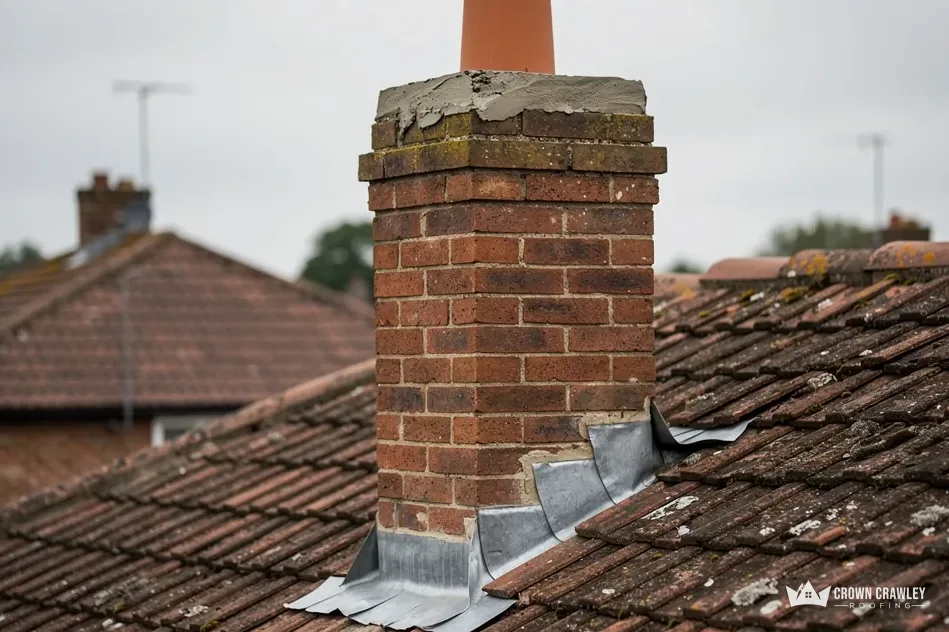
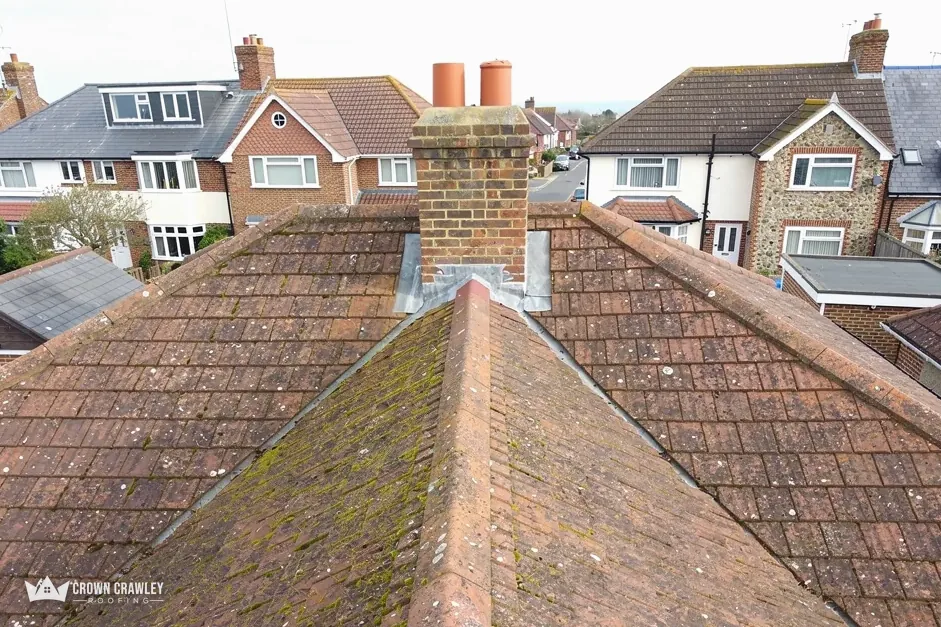
On a tiled roof the stack is wrapped in lead. Behind the stack, on the upslope side, a back gutter carries water round it. Step flashings run up each side, tucked into the brick joints and lapped over soakers, small folded pieces of lead under the tiles. A front apron covers the downslope face. Once the lead has lifted, split or pulled out of the joints, water gets behind it and into the wall. Sealant smeared along an edge buys a few weeks, not a repair.
Why do flashings fail?
Lead expands and shrinks with the temperature, and the pointing that holds its edge dries out. A flashing that has held for decades can still lift once the mortar behind it has gone. MyJobQuote puts the life of lead flashing at over 80 years in good conditions, which is a published range and no guarantee for any one stack.
Is it a repair or a renewal?
Re-dressing a loose piece, or repointing the chase, may be enough. Where the lead is split or the code is thin, a full replacement is the sound choice. Our page on chimney flashing replacement sets out how it is done.
Condensation in a capped or unused flue
Not every wet chimney breast has a leak. If you have blocked off the fireplace, sealed a flue or stopped using it, the stack can become a cold, still column of air that collects moisture.
Why does a capped flue sweat?
Warm indoor air carries water vapour. When it meets a cold surface such as brick on the outside wall of a stack, some of the vapour turns to water. A flue with no air movement keeps that damp air in place, so the brickwork stays wet. The patch tends to show in colder months and on mornings after cold nights, and it does not always match the rain. BS 5250, the code of practice for managing moisture in buildings, is the standard that deals with this kind of problem in general terms. It is current but under review at the time of writing.
What stops it?
The usual answer is ventilation. A capped flue is normally given a vented cap on top and a vent grille at the bottom of the breast, so air moves through and carries the moisture out. A roofer fits the cap; a builder or heating engineer usually deals with the room-level vent. Our guide to venting a capped chimney goes through the options, and capping a disused chimney has a page of its own.
Is a gas fire involved?
If the flue serves, or once served, a gas appliance, get a qualified gas engineer to look at it before anyone changes the flue. Do not seal or alter a flue that is still in use.
Salts, stains and the fixes that do not last
Even after the water source is dealt with, a breast can stay stained. That is where salts and old finishes come in, and where many quick fixes fail.
What are the white crusts and brown rings?
Brickwork and plaster around old fireplaces can hold deposits left by the flue over many years. When damp reaches them they move to the surface and dry as a crust, or draw moisture from the air and keep the wall damp. A brown ring around a patch usually marks where a past leak dried out. If the ring is not growing and the wall is dry to the touch, it is an old stain. A roofer can only cure the water, so once the roof side is sound, replastering and redecorating belong to a plasterer or decorator.
Why do coatings and sprays disappoint?
Damp-proof paint, masonry sealant and chimney waterproofing sprays can trap moisture behind a skin instead of letting it escape. If the real cause is a lifted flashing, the coating hides the sign and the water keeps coming. Where a spray has a place and where it does not is a question for the survey.
When is a damp specialist worth calling?
If the roof and flue have been checked and put right, and the wall stays damp for months afterwards, bring in someone who deals with salts and plaster. A good roofer will say when the roof is no longer the problem rather than keep working on it.
Putting it right: order of work, cost and access
The sensible order is top down. Fix the pot, flaunching and cap, then the pointing, then the flashings, then let the wall dry before any plaster or paint. Skipping ahead only means doing the interior twice.
What might the work cost nationally?
Checkatrade's chimney repair guide, in its April 2026 table, gives flashing at £250 to £1,000, repointing at £300 to £1,000 and a cap at £180 to £520. Its repointing guide, in its October 2026 table, puts the average at around £750. These are typical national ranges, not a price for your stack. Whatever you are quoted, ask if VAT at the standard 20% and the scaffolding are in the total.
What will a roofer want to see first?
Photos of the patch with dates, a note of how it behaves in the weather, and the room layout so they know which stack serves which breast. Our survey ends in one written total, and you get photos of your own stack, so you can see the fault before agreeing to anything. The chimney repairs page lists the range of work we do on stacks.
How long before the wall dries?
Brickwork that has been wet for a season does not dry overnight. After the repair, leave the breast alone through a spell of dry weather, keep the room ventilated and watch whether the stain stops growing. Only then call in the plasterer. Redecorate too soon and the new paint blisters, which can look like a failed repair when it is only a wall still drying out. If the patch darkens again after the next heavy shower, tell the roofer straight away with dated photos, because that points to a second entry point that the first visit did not reach.
Part of our Chimney Repairs in Crawley
Chimney breast damp: quick answers
Can a damp chimney breast be fixed from inside the room?
Only the finish can. Replastering and redecorating are done indoors, but they only last once the source is dealt with, and the source is usually the pot, flaunching, pointing or flashing outside. If the cause is condensation in a capped flue, a vent at the base of the breast is the indoor part of the fix.
Does a damp patch that only shows after rain always mean a roof fault?
Usually it points to water entering outside, but not always at the roof. Failed pointing, a cracked pot or a lifted flashing can each cause it, and a leak elsewhere can track along a joist to the breast. A survey of the stack from the top down finds which one it is, instead of guessing.
Should I light a fire or run a dehumidifier to dry it out?
Neither helps for long if water is still getting in. A dehumidifier can reduce condensation in the room, but it will not stop a flashing leaking. Do not light a fire in a flue you suspect is damaged or blocked. Get the stack and flue checked first, then dry the wall afterwards.