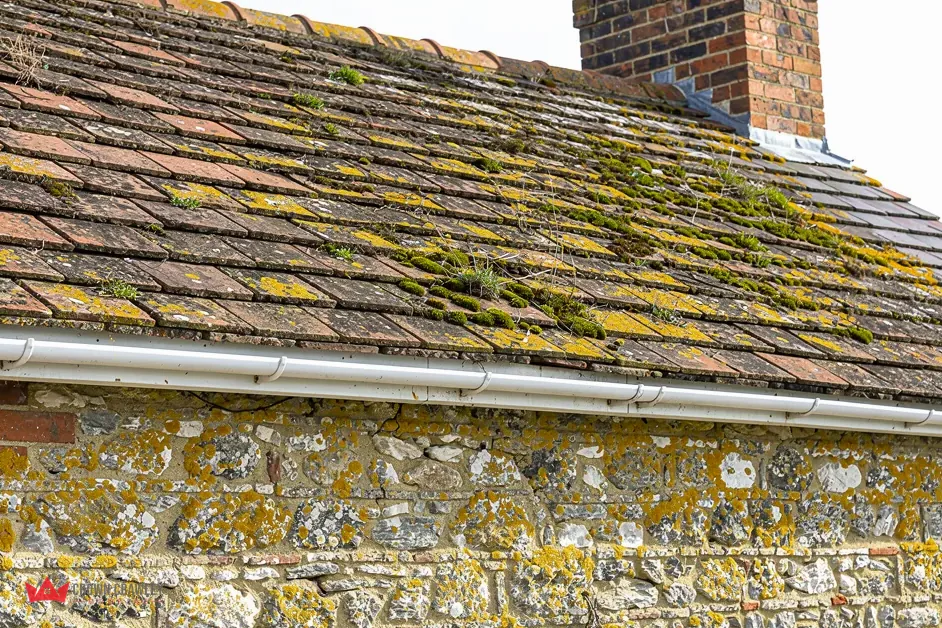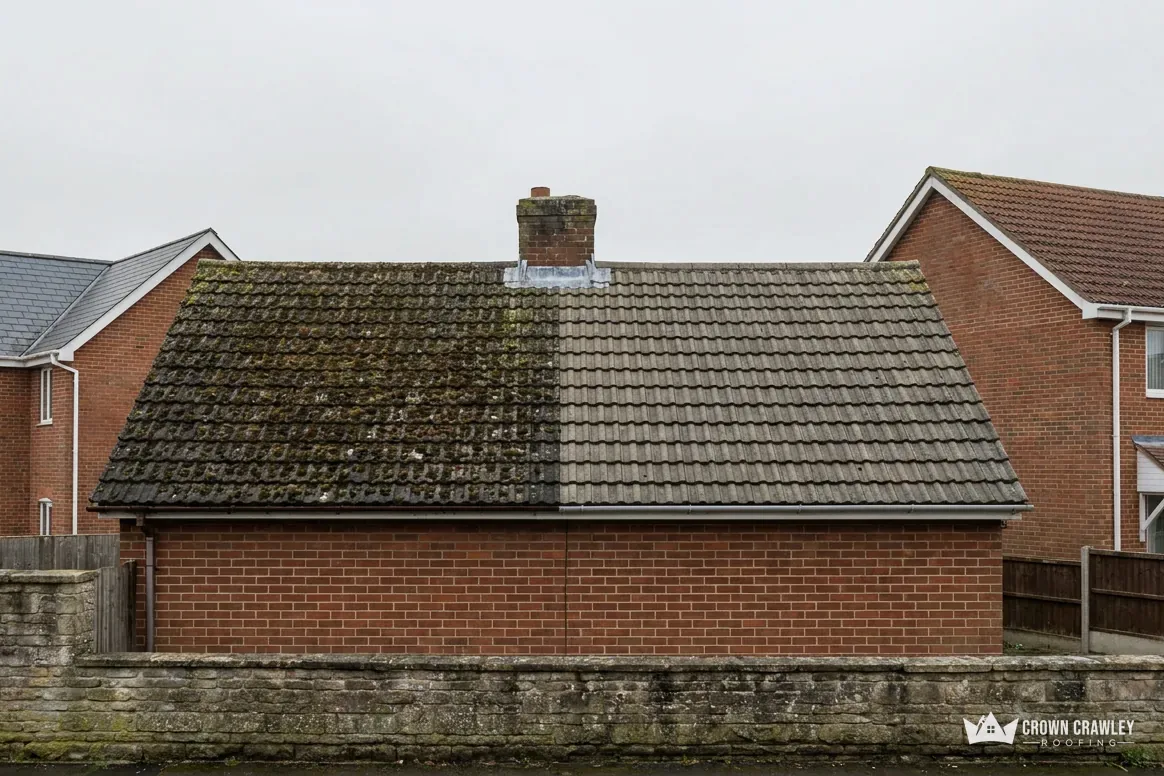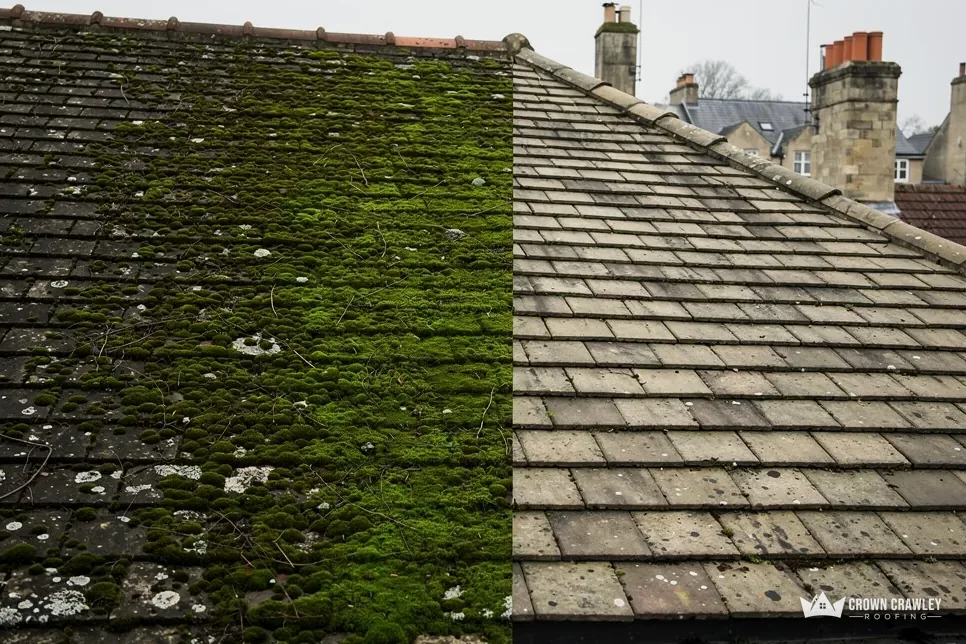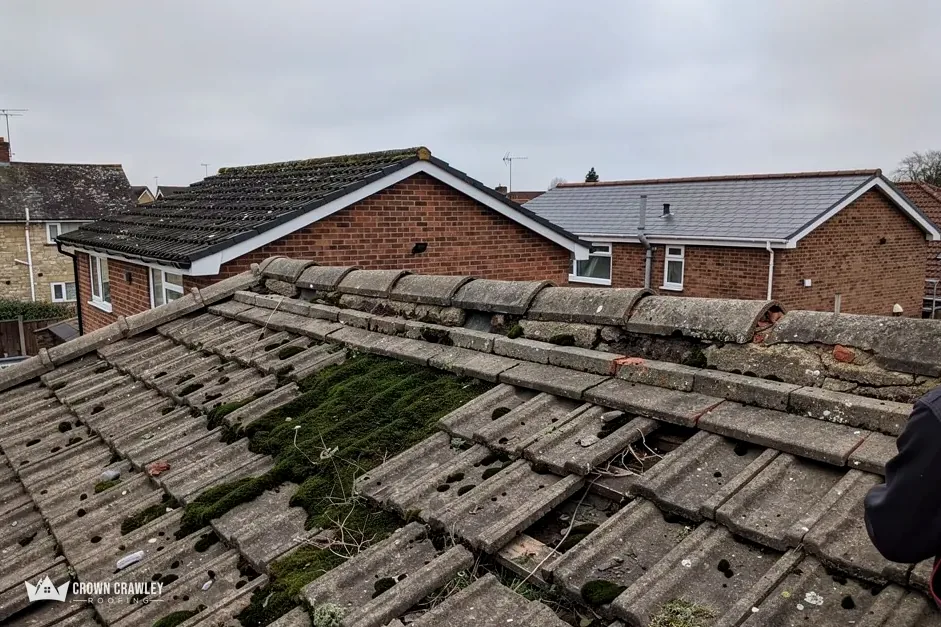
Moss on a roof divides opinion. Some people see a soft green coat and think nothing of it; others book a clean the moment the first patch shows. The truth sits between them. Moss is not a structural fault, and a few small patches on a north slope will not bring a house down. But it does hold moisture against the tiles, it grows into the gaps between them, and when clumps drop off they land in the gutters below.
This post is in two halves. The first looks at what moss does to tiles, valleys and gutters, so you can judge how urgent your own roof is. The second compares the four methods used to get rid of it: hand removal, soft washing, biocide treatment and pressure washing. Each has a place and each has a downside. We explain the trade words as we go, starting with the valley, the internal channel where two roof slopes meet and carry water down to the gutter.
What moss does to roof tiles
Moss is a plant with no true roots, but it anchors itself with thread-like growths that work their way into the rough texture of each tile and the joints between them. Once it is established it acts like a sponge, and a sponge sitting on a roof keeps the surface of the tile wet long after the rain has stopped.
Does moss actually break tiles?
Rarely in one go. The damage is slower. A tile that stays wet for weeks takes in more water, and water that freezes inside a tile in winter can chip or flake the surface. Moss also lifts at its edges as it grows, pushing the tile's overlaps apart by a small amount and giving wind-driven rain a path under the tile. How fast any of this happens varies with the tile, the shade and the weather, and we would not put a number on it. What you can say is that a roof carrying thick moss is under more strain than one that is clean.
Where does moss do the most harm?
Not on the open tile face. The expensive problems start where water is supposed to move, and the open tile face is usually the least of them. Moss in a valley slows the flow and can send water over the side of the channel. Moss against the edge of a ridge or hip tile can hide cracked mortar. Moss beside a chimney flashing, the lead strip sealing the stack into the slope, can hide a gap. Our post on roof cleaning and moss removal starts with a survey of these details, because the moss tells you where water has been lingering.
Moss, gutters and the water path
A roof moves rain from ridge to drain, and moss gets in the way at the final stage. Clumps of moss loosen in rain and wind, slide down the slope and drop into the gutter, where they mix with leaves and grit. That mix settles at the outlet to the downpipe and blocks it.
What happens when a gutter fills with moss?
Rain has nowhere to go, so it spills over the front edge or backs up beneath the lowest course of tiles. If the felt at the eaves has already perished, the water reaches the fascia board, the long timber behind the gutter, and the rafter ends behind it. Moss in the gutter also adds weight, and a gutter on aged brackets can sag under a wet load. You will often see the first sign from the ground: a green or dark streak down the wall below the gutter, or a downpipe that gushes at the joint instead of the bottom.
Is gutter moss a roof-cleaning job or a gutter job?
Both, and the order matters. Clearing the gutter first and then cleaning the roof just fills it again with debris. Clean the roof first, then clear the gutters and downpipes, and then look at the joints and the fall. Our guide to moss in gutters explains what to check once they are clear. Where Finlock-type concrete gutters were used on a 1950s house, leaking joints are the known problem, so a roofer should look at them before anything is cleaned or lined.
Method one: removing moss by hand
Hand removal means a roofer working over the roof with a scraper, a stiff brush or a plastic spatula, lifting moss off the tiles without water. It is the gentlest on the tile surface and the lowest in equipment cost, though it takes time.
When does hand removal work best?
On a roof with thick, clumped moss and relatively sound tiles. Scraping lifts the bulk away, and it lets the person doing it see every tile close up. That is the real benefit: cracked tiles, loose ridge mortar, slipped slates and missing pointing show up as the moss comes off, instead of being washed over. Hand removal also keeps the work dry, which suits cold weather when a rinse would freeze on the tiles. It suits delicate surfaces too, such as old clay or slate that you would rather not wet.
What are its limits?
A scraper takes the visible moss off, but it leaves spores and the discoloured film behind, so a hand-cleaned roof can green over again sooner than one treated with a biocide. A careless worker can also crack a brittle or aged tile, and a roof ladder is a poor place to push hard. Because it is a labour method, it is also a slow one on a large roof, and the time is what you pay for. On a small roof or a single bad patch it is often the sensible choice.
Before any cleaning, look for nests. Birds nesting on or under a roof are protected, and interfering with an active nest on purpose is a criminal matter under the Wildlife and Countryside Act.
If you find a nest in use, stop and leave it. Bats are a further consideration. Their roosts are protected, and the official guidance flags roof work as a possible cause of disturbance. Mention anything you notice to your roofer.
Method two and three: soft washing and biocide
These two are usually done together, so it helps to separate the ideas. Soft washing uses a cleaning solution put on at low pressure and rinsed away gently. Biocide treatment means applying a product that kills the moss, lichen and algae, which then dies back and is washed off by rain over the following weeks.
Is a biocide safe to use on a roof?
Used correctly, yes, but the rules matter. The biocidal products rules say a product may only be used within its authorisation and label. HSE's advice is that householders must steer clear of any biocide sold for professionals only, and that certain professional products call for specific certification. Garden ponds and watercourses are the risk, because the run-off from a roof goes to the gutter and then the drain. Our rule is to apply only products authorised for roof work, exactly as the label directs, and to plan the rinse around what the run-off needs.
How is it different from pressure washing?
The pressure is the difference. A soft wash relies on the chemistry to loosen the growth, so a low-pressure rinse is enough. That treats the tile surface more kindly than a jet. Biocide also continues working after the day ends, and the roof can look streaky for several weeks as the moss dies off before it turns pale. Do not mistake that for a failed job: the treatment is still working, and the roof usually looks better by the end of the first season. Our guides to roof soft washing and biocide treatment show what to expect, and what the first month looks like.
Method four: pressure washing and its risks
Pressure washing is the fastest-looking method. A narrow jet of water sweeps along a row of tiles and the green disappears in seconds. It is also the method most likely to do harm.
How does a jet wash treat the tile?
Marley, which makes concrete and clay tiles, advises against powerful jet washing, since it can scar tile or slate and wear it out sooner. Concrete tiles are finished with a surface skin, and a strong jet can strip it away, leaving the body of the tile open and ready to grow moss faster than before. On older clay tiles, a jet can also force water under the laps, and blast the mortar out of ridge and hip joints.
Is there ever a place for pressure?
A hose-level rinse of treated moss is fine. A jet held close to the tile is not, so we keep high-pressure jets off tiles. If someone offers a quick power-wash job at the door for a low price, ask what pressure they use, which products they apply and how they handle the run-off. Our guide to pressure washing roof tiles sets out what a safe clean looks like. A bargain clean that strips a tile surface can cost far more in later repairs than a measured one done properly in the first place. Ask to see the roof afterwards, close up, with the tiles still intact.
Which method suits your roof, and what it costs
The right method depends on the tile, how thick the growth is and what lies underneath. This summary pulls the four methods together.
| Method | Best for | Main drawback |
|---|---|---|
| Hand removal | Thick moss, sound tiles, cold weather | Slow; leaves spores and staining behind |
| Soft wash | Light to medium growth, fragile tiles | Needs correct products and run-off care |
| Biocide | Lichen, algae and regrowth control | Results appear over weeks |
| Pressure wash | Little, if any, roofing use | Can strip the tile surface |
What does a roof clean cost?
According to Checkatrade, whose table is dated April 2026, a typical UK range is £8.50 to £14 per square metre. Hand removal with a biocide treatment comes to around £11.50 per square metre, which works out at £637.50 to £862.50 for a semi-detached house. Scaffold, where the roof needs it, adds around £18 per square metre. Those are national figures, not ours. Ours is a single written total that arrives once the survey is done, and the roof area, the access and what we find on the day set it.
Should you clean or repair first?
Clean first, look closely as you go, then repair. Once the growth is off, every tile edge, ridge joint and flashing can be seen properly. If the clean exposes cracked tiles or loose ridge mortar, they should be fixed before the roof is treated. Photos of your slopes, plus the direction each one faces, are the best thing to send us. We will suggest a method before we visit.
Part of our Roof Cleaning & Moss Removal in Crawley
More on moss and your roof
Will moss grow back after the roof is cleaned?
It can. Spores arrive on the wind and settle wherever the tile stays damp and shaded, so a north-facing slope under trees tends to green over first. A biocide treatment slows regrowth, and clearing leaves and trimming overhanging branches helps. No clean makes a roof permanently moss free, and nobody honest will promise it.
Can I remove roof moss myself?
You can scrape moss off a low, accessible roof, but roofs are dangerous places to work and wet moss is slippery. Never use a ladder resting on the gutter. If you do use a treatment, read the label and keep it away from ponds and drains. Our guide to removing moss yourself covers the risks.
Does home insurance pay for moss damage?
Insurers tend to treat a storm as sudden damage and moss as slow wear, which many policies exclude. Check the wording, tell the insurer before ordering work and keep dated photos of the roof. A complaint about an unfair decision can go to the Financial Ombudsman Service.