Roofers in Capel

Roofs in a Surrey village south of Leith Hill.

Capel lies on Wealden Clay south of Leith Hill and has a recorded conservation area. We identify your covering, share the photos and give a single written figure.

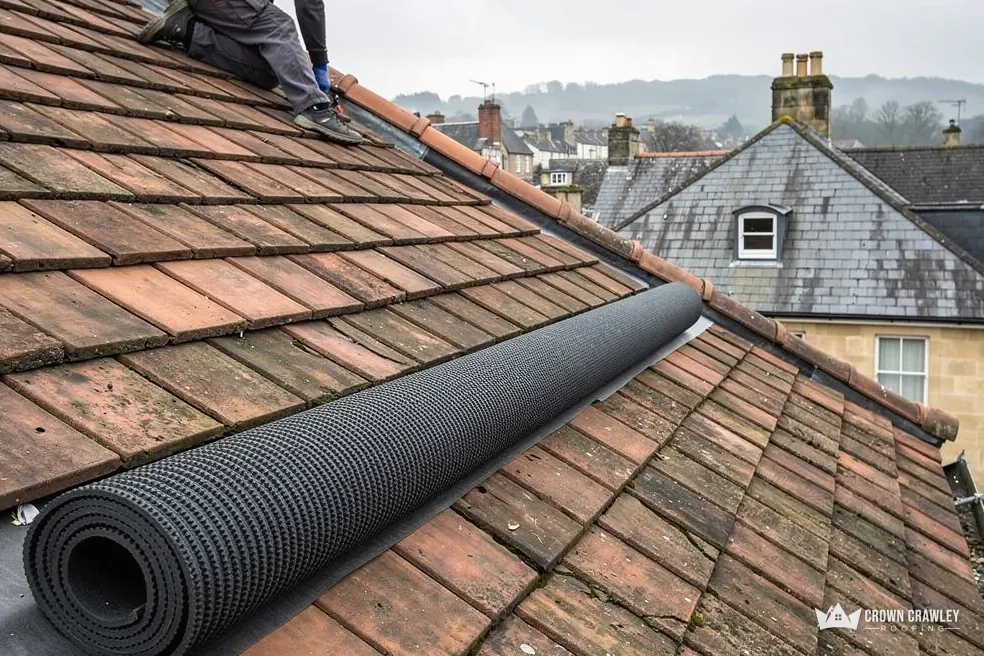
Roll of roofing membrane lying on a clay tiled roof

Capel: Horsham slabs, a meeting house and a conservation area

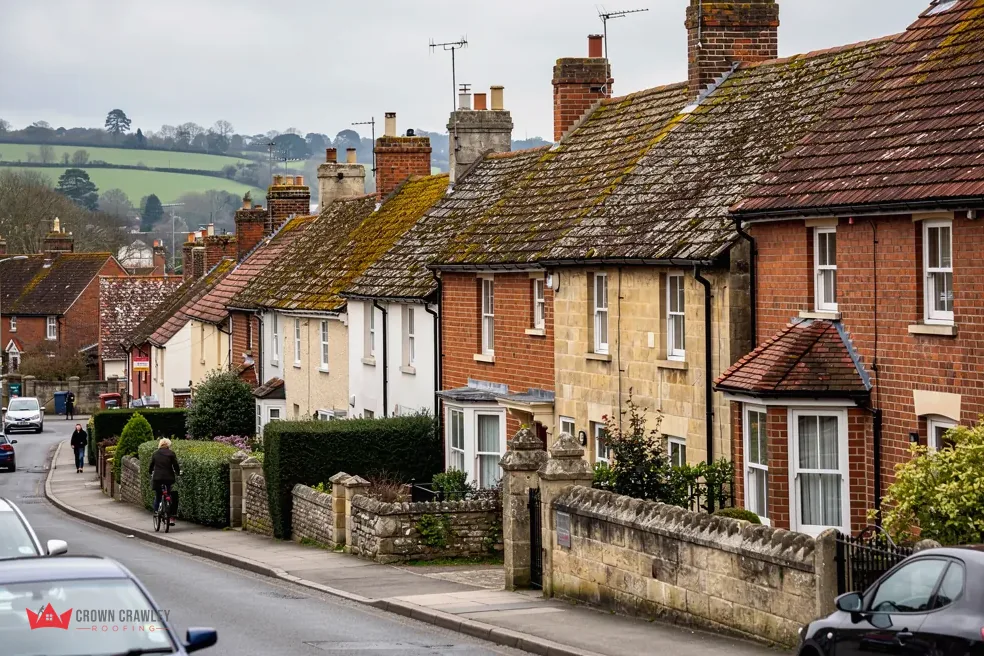
Village street of brick and render houses with old tiled roofs

Horsham slabs on the old church

Before its enlargement in 1865, the church of St John the Baptist had roofs covered in Horsham slabs. Stone slabs are heavy, so any change of covering on an older roof starts with a check of what the frame can carry.

Old stone slab roof on a church

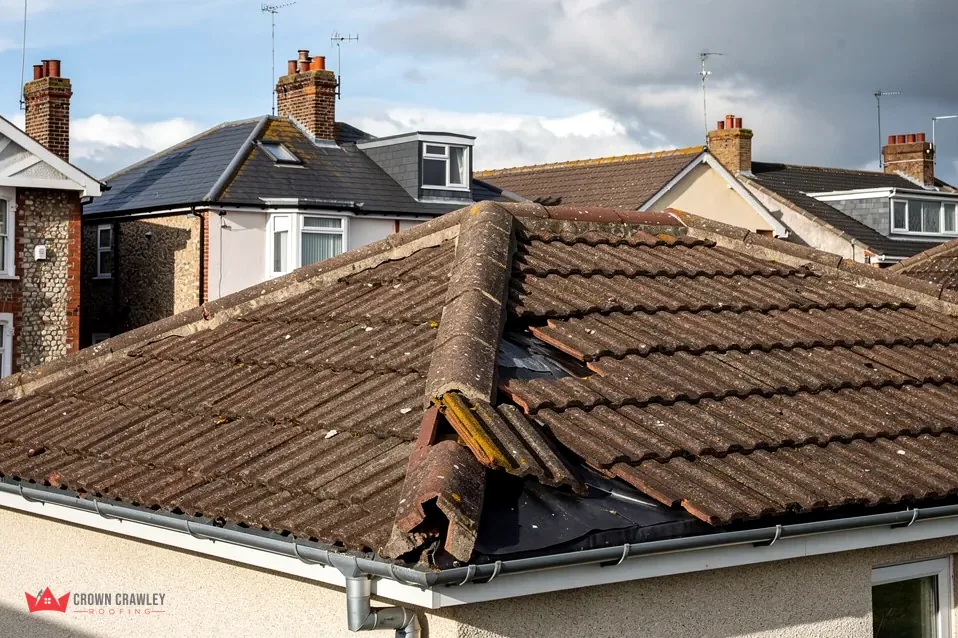
Damaged ridge tiles and exposed mortar at a roof hip

A road from 1755, a station from 1867

The Dorking to Horsham road reached the parish in 1755 and Holmwood Station opened in 1867. A village with those two dates has had reasons to grow in more than one period, so each roof gets surveyed independently.

Tiled houses on a village road

Lead-clad dormer window set into a red clay tiled roof

A listed meeting house of 1724

Capel Quaker Meeting House and Cottage, built in 1724, is listed Grade II. It is a reminder that listed buildings stand here, so we ask early whether yours is one before any covering changes.

Old brick and tile roof

Capel, south of Leith Hill

Map of Capel and the neighbourhoods around it, with Crawley for reference.

Capel is a Surrey village on the Wealden Clay south of Leith Hill, where the north-west edge of the parish meets the Green Sands.

Distance
12.4 road miles from Crawley, to the north-west
Drive
About 20 minutes
Council
Mole Valley District Council and Surrey County Council
Planning authority
Mole Valley District Council
Conservation area
Capel Conservation Area
Population
860 (Census 2021, Capel built-up area)
Get a free quote

Capel roof journal

Stone slabs, clay and a village on record

Three short chapters on the materials under Capel's roofs, the weight limits of older frames, and how a conservation area and Surrey's rules shape a re-roof.

Stage 01 · Background

Wealden Clay, green sand and tile making

Capel's ground runs from Wealden Clay to the Green Sands of Leith Hill, and small tile works once served the parish, so matching matters.

The county history describes most of Capel parish as Wealden Clay, with the north-west edge reaching the high Green Sands of Leith Hill and Coldharbour Common. It also calls the parish agricultural apart from small brick and tile works. A roofer reads that as a hint about materials in the neighbourhood and not as a promise about any single roof. Our first job in Capel is therefore to identify what you have: stone slab, clay tile, concrete tile or slate.

How do you match tiles on a patched roof?

A roof repaired by several hands over the years can carry tiles from several makers, with colour and profile drifting from slope to slope. We record the tile type as we climb. If an exact match is hard to find, we lay out what is possible: reclaimed tiles from a slope out of sight, a close new tile, or renewing the slope. You choose before a total price goes on paper. Colour on an older slope can also fade or weather unevenly, so we compare new and old tiles side by side on the roof itself rather than from a catalogue sheet.

What we check in Capel

Covering
Material, profile and fixings noted
Ridge and hips
Held by more than mortar
Flashings
Sound at chimneys and walls
Gutters
Clear, level and secure
Slopes
Any sag or dip recorded
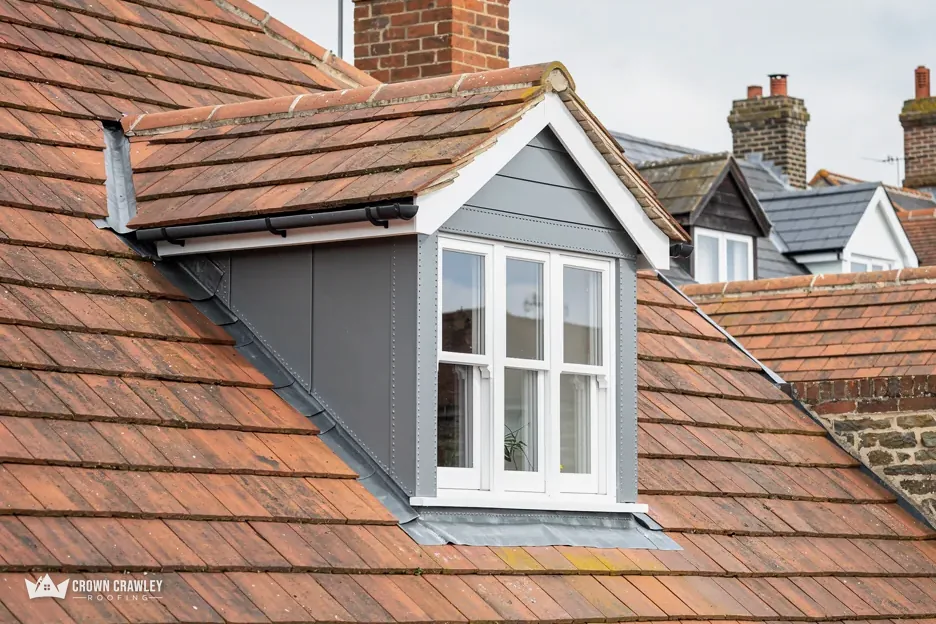
Dormer window with white cladding in a clay tiled roof

Is the covering still within its expected life?

Marley calls around 60 years the life of a concrete tile and is quick to add that it is no guarantee. Clay tiles get a 60-year minimum from the Building Research Establishment, and slate that is looked after can pass a century. These are typical ranges, never promises, and the condition of your own roof says far more than its age. The photos from our survey show you the real state of the slope.

What does the underside of the roof tell us?

A loft gives away more than the slope does. Daylight showing through the covering, dark stains on the rafters, damp insulation and a musty smell all mark places where water finds a way in. We follow each sign back along the timber to its source, because the stain on a ceiling is rarely directly under the fault. With non-breathable underlay in a cold roof, Marley's reading of BS 5250 asks for an eaves gap of 25 mm on pitches of 15 degrees or less and 10 mm on steeper ones, and we check the gap is not blocked.

When the survey turns up slipped tiles or worn battens, the pitched roofing hub sets out the repairs that follow.

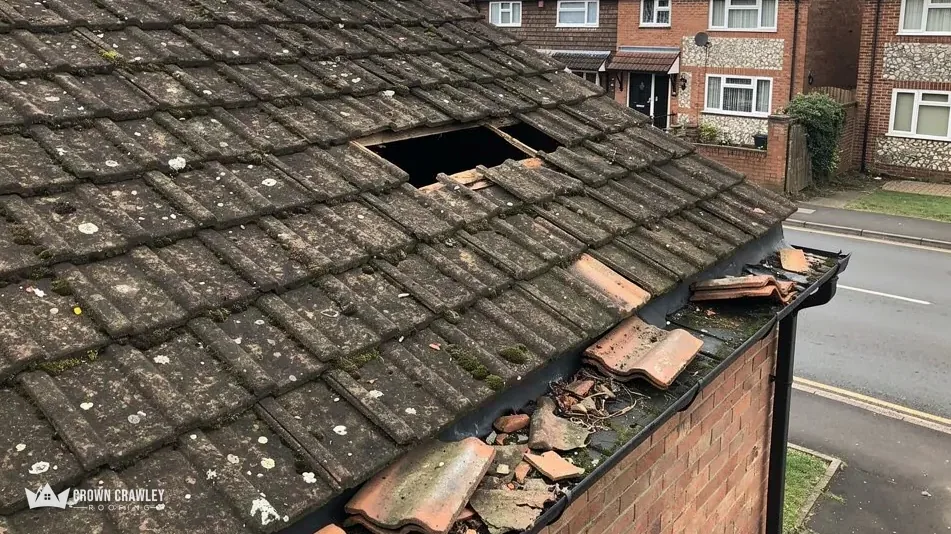
Storm-damaged tiled roof with the battens exposed and tiles on the ground

Stage 02 · Weight

Heavy slabs, light coverings and the frame

Stone, clay and concrete weigh different amounts, so any change of covering on an old Capel roof starts with the frame beneath it.

Before its enlargement in 1865, the county history says, the church of St John the Baptist had roofs of Horsham slabs, walls of hard local sandstone rubble and a short oak-shingled spire on a timber bell-turret, as Cracklow's view of 1824 shows. Horsham slabs are stone, and stone is heavy. Whatever covers your roof today, the lesson holds: the frame under a covering was built to carry that covering, not some other one.

Can I swap the covering for a lighter or heavier one?

You can, with a check. The Planning Portal requires Building Regulations approval where the replacement is at least 15 per cent heavier, and also where the new covering will perform significantly differently in a fire. It recommends a structural engineer's or surveyor's opinion before work begins. Pitch is the second limit. Every covering has a minimum: Marley lists 35 degrees for its plain concrete tile and 17.5 degrees for its Edgemere, while BS 5534 indicates 20 degrees for natural slate. A change that looks small on paper can fall foul of either number, so like for like is the quiet option.

Words behind a weight check

Load
Weight the roof structure carries
Rafter
Sloping timber supporting the covering
Batten
Strip the tiles are hung from
Underlay
Waterproof sheet below the battens
Pitch
The angle of the slope

A heavier covering is a structural question first and a style choice second.

Do ridges and verges need more than mortar?

Marley explains that the 2014 revision of BS 5534 stopped treating mortar's tensile strength as enough by itself, so ridge and hip tiles laid in mortar now want screws or clips too. BS 8612 is the test specification for dry systems at the ridge, hip and verge, which hold the tiles with clips and screws instead of a mortar bed. A roof finished before 2014 may therefore have an older mortar-only ridge, and we check which you have. Our dry ridge and dry verge page explains both systems.

Valleys and chimneys complete the weight picture. A stack, its flashing and the lead behind it add load and detail to a slope, so we examine them before we advise on any new covering. For a sense of scale, Checkatrade's April 2026 chimney repair guide lists national figures of £250 to £1,000 for flashing, £300 to £1,000 for repointing and £180 to £520 for a cap. Your written price comes after the survey, and it is one total.

Capel's parish church, St John the Baptist's, belongs to the Church of England, which means a faculty, not the council, covers work on its roof. Houses, cottages and outbuildings follow the council's rules, which is where the next chapter picks up.

Stage 03 · Permissions

Capel Conservation Area and Surrey's rules

Capel has a recorded conservation area and answers to Mole Valley District Council, so rules come first when a repair grows.

Planning in Capel sits with Mole Valley District Council, and a Capel Conservation Area is on record. Planning here is not a matter for the South Downs National Park authority, because Capel lies outside the park. The exact boundary is the council's to confirm, so ask whether your road lies inside it. A straight repair changes nothing anyone sees, but a different covering, a new rooflight or a changed ridge line deserves a call to the planning team first, because conservation areas change which permissions apply. Our guide to re-roofing in a conservation area lists the questions to put to them.

What does listed mean for a Capel roof?

Capel Quaker Meeting House and Cottage, built in 1724, is listed Grade II. A Quaker meeting house goes through listed building consent for its roof works rather than a church's own system, and so does any listed house: work that affects the building's character needs consent before it starts. If yours is listed, mention it in your first message and the programme stays open until the council has replied.

Capel checks before a re-roof

Planning
Mole Valley District Council
Conservation
Capel Conservation Area recorded
Building control
Southern Building Control Partnership
Scaffold
Surrey licence if on the road
Notice
10 working days ahead
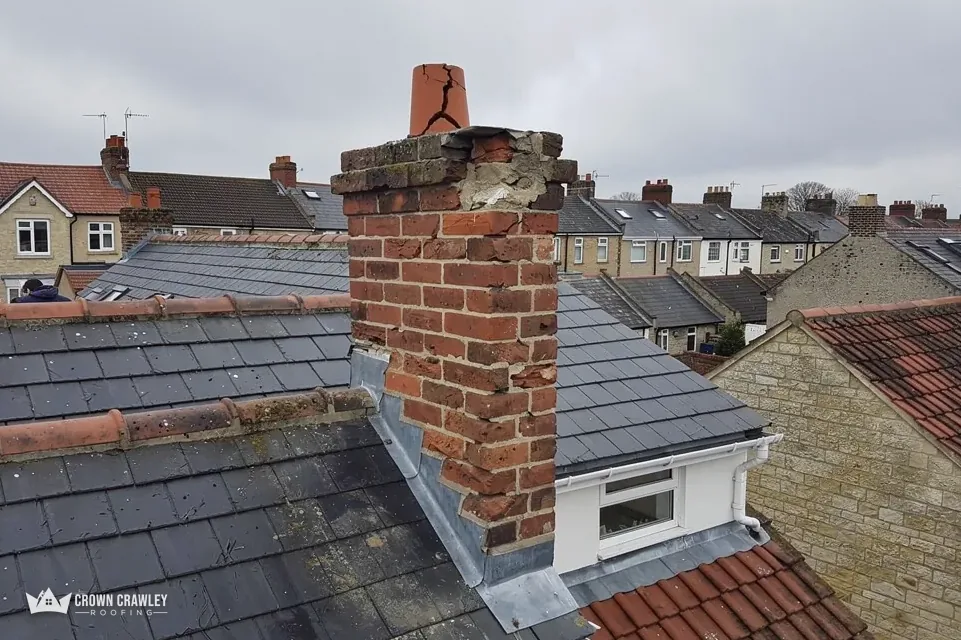
Brick chimney stack on a slate roof with lead flashing

Which Capel roof jobs reach the building control partnership?

The Planning Portal's test has two halves: less than 25 per cent of the building envelope and less than 50 per cent of the roof affected. Inside both, a building control application is not normally needed. A heavier covering or a fire-performance change brings it back in. The Southern Building Control Partnership handles this for Mole Valley, and we contact it before fixing a start date if a survey points to a whole slope. Our roof replacement page sets out the order of work on a complete new roof.

Roof spaces can hold bats and nesting birds. Bats and their roosts are protected under the Habitats Regulations, and a nest is covered while birds are building or using it, so signs at the survey stop work until we agree a plan with you.

Scaffold on a public road or pavement needs a licence from Surrey County Council. Apply 10 or more working days ahead, it says, and pay £208 per 28 days, so we line up the licence with the scaffolder early. Space on a drive or lawn keeps the frame off the highway and out of the licence rules. Either way, you hear which days the poles go up, which days work is on the roof and when the waste leaves. For a Capel quote, photograph the problem area, add your postcode and say whether the house sits inside the conservation area.

Capel roofs: slabs, conservation and scaffold

How do I match tiles on a Capel roof that has been patched?

We note the profile, colour and material of every slope during the survey, working along the ridge and down each hip. If a close match is hard to find, the choices are reclaimed tiles from a hidden slope, a near-match new tile or renewing the slope. The survey photos show what is failing, you choose, and the written price follows that decision.

Can a rooflight go into a Capel roof inside the conservation area?

Repairing with identical tiles laid the old way is the simple case, since nothing visible changes. A different covering, a rooflight or a raised ridge is a question for Mole Valley District Council's planning team, because conservation areas change which permissions apply. Ask them to confirm whether your road is inside the boundary before you approve the work.

How heavy is too heavy when changing a Capel roof covering?

The Planning Portal draws the line at a 15 per cent rise in the covering's weight, and suggests a structural engineer or surveyor looks before anything is ordered. Slab, clay and concrete differ a good deal in weight, so this is a real question in Capel. Pitch matters as well, since each covering has its own minimum. We raise both at the survey, before any material is ordered.

How early should I book a scaffold licence for a roof in Capel?

Surrey County Council asks you to apply at least 10 working days before the scaffold goes up, and it processes applications within 10 days. A licence costs £208 per 28 days. We line up the application with the scaffolder and fix the first day to suit, so nothing stands idle once the survey has been done. Standing the scaffold wholly on your own land avoids the highway licence.

Your Capel roof, with one total price

Email a photo of the roof trouble spot with your postcode, and your Capel survey gets booked.

01293 974253

10-year workmanship guarantee, in writing.

Call Get a free quote