Roofers in Langton Green

Roofs in a Kent village on the Green, inside the High Weald.

Langton Green is a Kent village in the High Weald, with listed buildings near its Green. We survey every roof, show you what we photograph and write up a single total price.

Terraced brick houses with flint detail along a wet street

What we look at around the Green

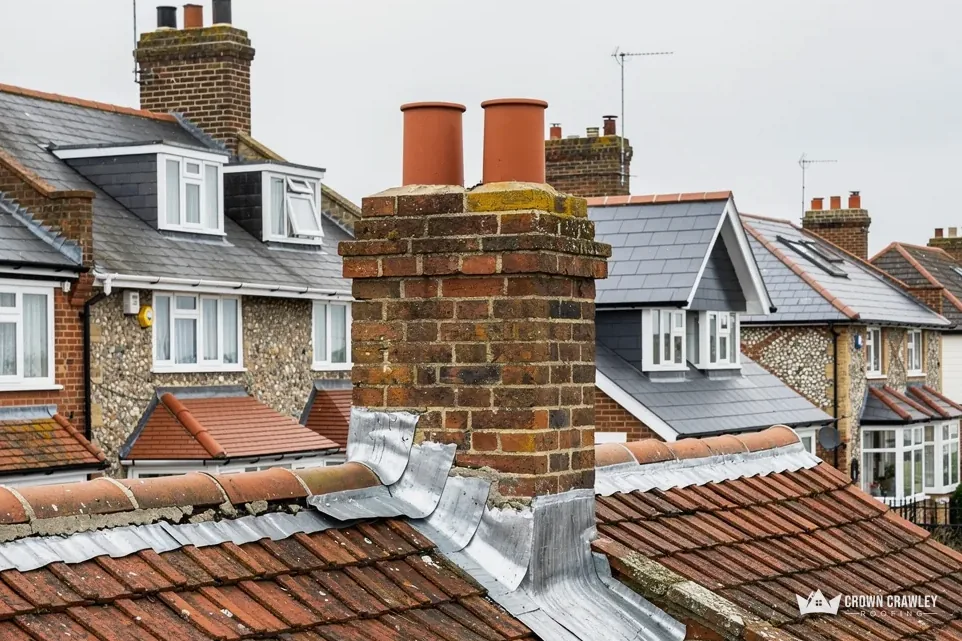
Chimney stack with orange pots and lead flashing among tiled roofs

All Saints, a Grade II* church

The Church of All Saints is listed Grade II* and still holds Anglican services, so roof work on it goes through a faculty, the church's own consent system. Houses nearby follow ordinary planning and building rules.

Clay-tiled roof on an old church

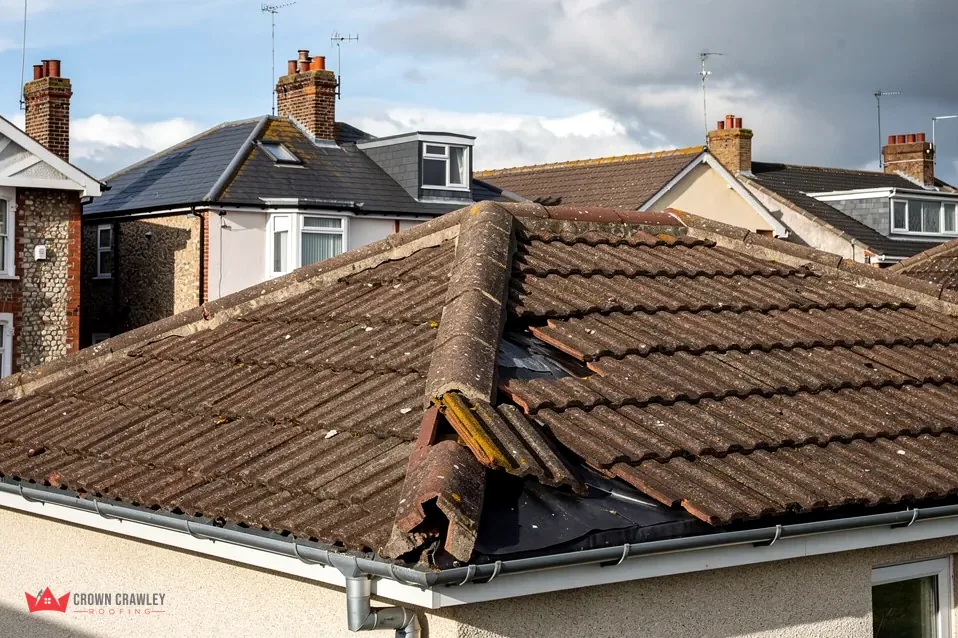
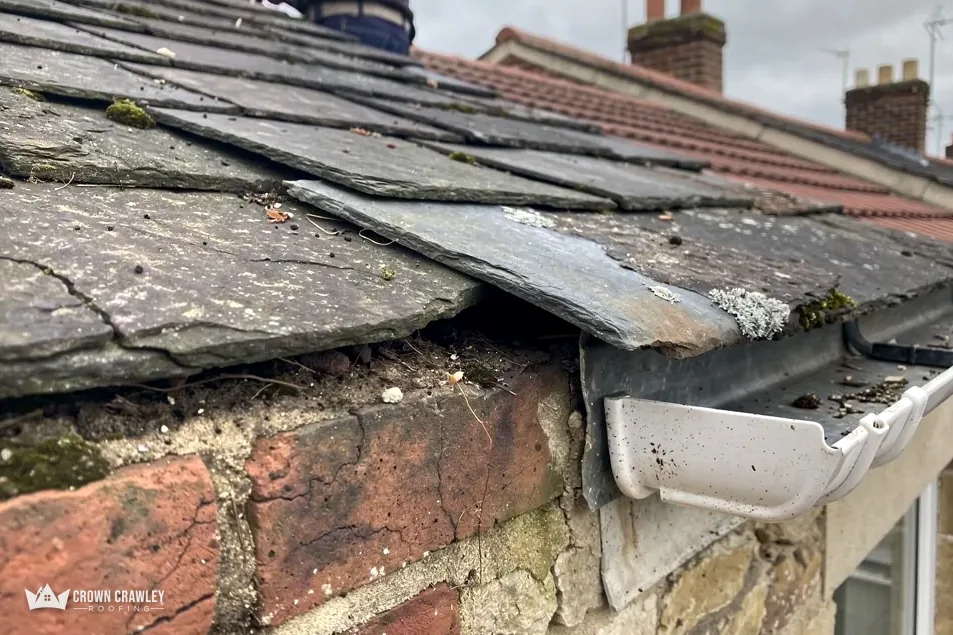
Damaged ridge tiles and exposed mortar at a roof hip

Inside the High Weald National Landscape

The people who look after the High Weald describe sandstone, brick and tile as widely used across the area, alongside timber-framed and weather-boarded buildings. That describes the landscape, not your roof, so we check yours directly.

Brick wall meeting a tiled roof

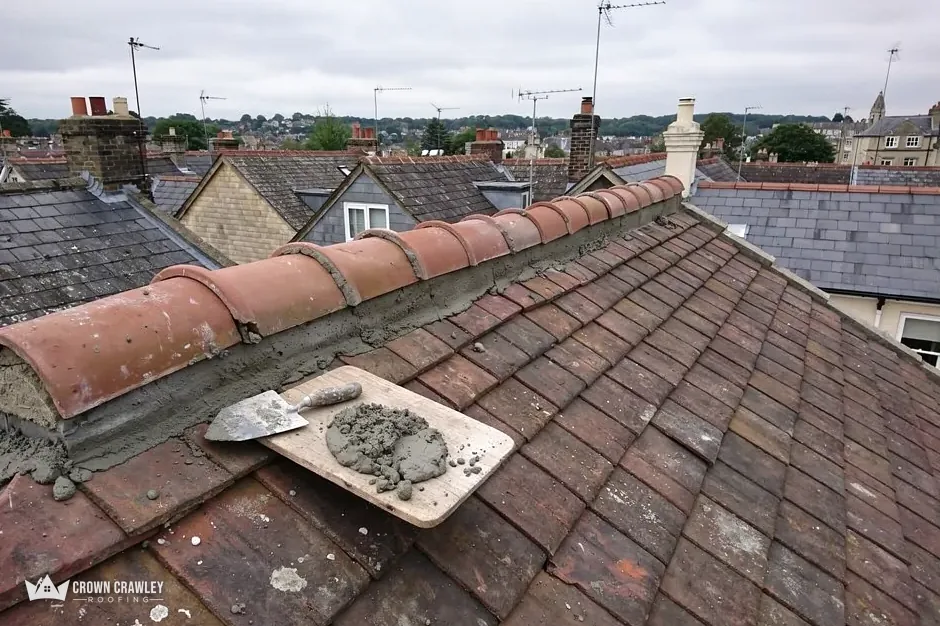
Ridge tile bedded in fresh mortar with a trowel resting on the roof

Manor Cottage and the listed Green

Manor Cottage is listed Grade II*, and 1 and 2, the Green carry Grade II listings. Owners of a listed house should check with Tunbridge Wells's planning team before the roof's character is touched.

Old cottage with a pitched tile roof

Langton Green, in Tunbridge Wells borough

Map of Langton Green and the neighbourhoods around it, with Crawley for reference.

Langton Green sits in Tunbridge Wells borough, in the High Weald National Landscape, once titled Area of Outstanding Natural Beauty.

Distance
20.2 road miles from Crawley, to the east
Drive
About 37 minutes
Council
Tunbridge Wells Borough Council and Kent County Council
Planning authority
Tunbridge Wells Borough Council
Listed church
All Saints, Grade II* (list entry 1240546)
Get a free quote

Langton Green site diary

Roofs in a High Weald village

Three short chapters: reading roofs in a protected landscape, the checks that listed buildings bring, and how Kent handles scaffold licences.

Stage 01 · First look

A High Weald village around the Green

Langton Green lies in the High Weald, so we read its roofs against sandstone, brick, tile and timber, one roof at a time.

Part of the High Weald National Landscape, which spans Kent, Sussex and Surrey, takes in Langton Green. The body that looks after the High Weald describes timber-framed and weather-boarded buildings, with sandstone, brick and tiles in wide use because of the sandstone and clay underfoot. That is a picture of the whole High Weald, not a survey of one village, so we treat it as background and read each roof by itself. A village roof also carries the history of its repairs: a patch of newer tiles, a replaced valley or a modern chimney pot tells us as much as the date of the house. What you have over your head is a question for a ladder and a camera.

On a village roof survey

Flashing
Sealed where tile meets wall
Boarding
Joints tight at the roof edge
Chimney
Flaunching and mortar sound
Tiles
Nibs intact, none slipped
Battens
Sound timber, no rot
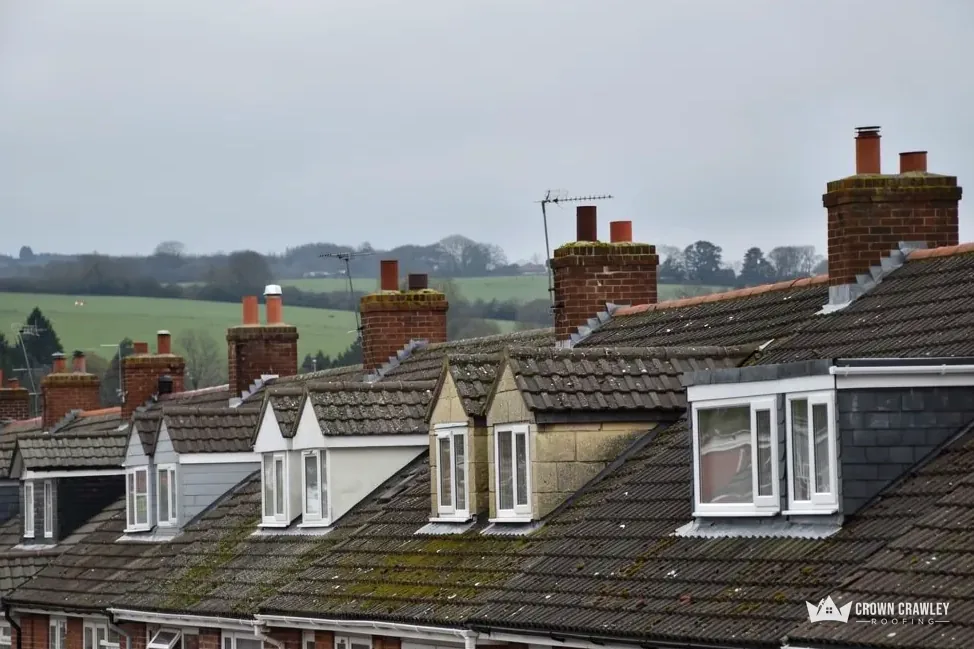
Dormer windows on a weathered tiled roof facing open fields

Where does tile meet timber or boarding?

Wherever a tiled slope runs into a weather-boarded wall, a chimney stack or a brick gable, the join gets a flashing, a metal strip usually of lead, dressed over the tiles and tucked into the wall. Joins give trouble before the slopes do. A cost guide updated in September 2026 puts lead flashing at over 80 years of life, yet it can lift, split or pull from a mortar joint far sooner if the fixing was poor. Chimneys are the other weak spot, because the cement fillet that beds the pots, called flaunching, can crack and let water in. We trace every junction by eye and by hand and photograph the ones that need work. When the fault is only a flashing, the written price is for a flashing and not for a roof.

How long should the tiles last?

Marley gives about 60 years for concrete tiles and adds that this is no promise. For clay, 60 years is the Building Research Establishment's minimum, though old peg tiles cannot be judged by that number, which one conservation source calls clearly not a reliable guide. Natural slate with good maintenance can run past 100 years. If a patch repair will do the job, that is what we price, and the photos show you the failed parts. Age is a starting point and nothing more: a roof in any of these can be sound or tired, and what tells them apart is the state of the battens, the nails and the underlay, the felt layer beneath the tiles. Our pitched roofing page shows how we repair each of those parts.

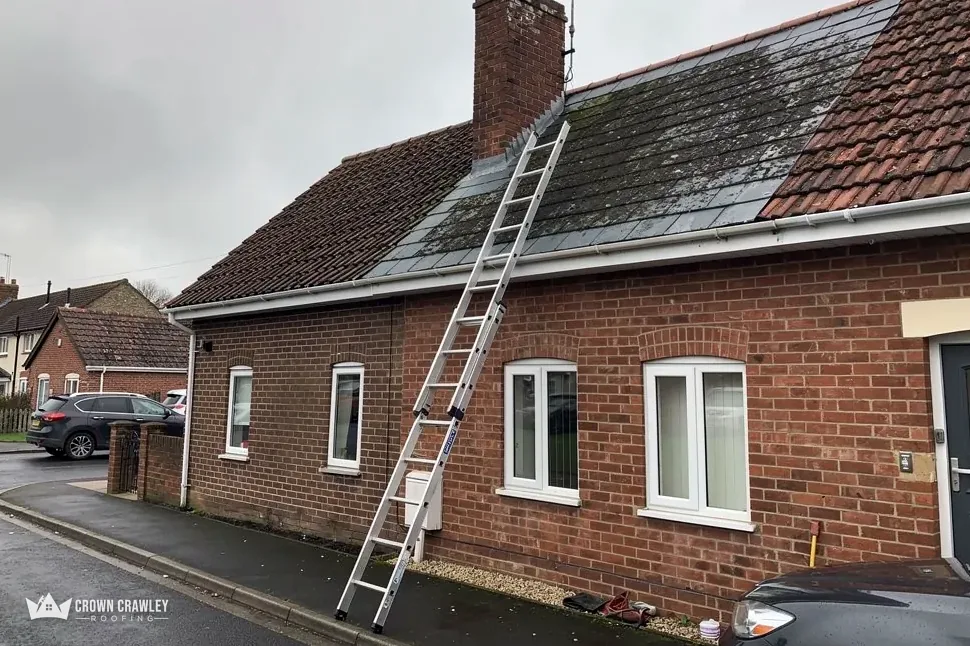
Brick bungalow with a ladder leaning against its tiled roof

Stage 02 · Permissions

Listed buildings and a protected landscape

Tunbridge Wells Borough Council decides planning here, and with a National Landscape and several listed buildings nearby, a bigger job needs a check first.

For planning, Langton Green answers to Tunbridge Wells Borough Council, which also has its own building control section; Kent County Council deals with the highway. New tiles of the same kind on the same pitch leave the outside unchanged and seldom raise a question. Trouble starts when the covering, the shape or the pitch changes, or when the house itself carries a listing.

Does the National Landscape change roof work?

Planning law gives designated land such as the High Weald extra limits on some changes that would otherwise be allowed without an application. For a straight repair or re-tile that makes no difference. For roof windows, dormers and similar alterations it can, and the detail is in our post on planning permission for roof work. Tunbridge Wells's planning team can confirm how it applies to your address, and we can send photos of the roof to help them. Tunbridge Wells Borough Council knows whether your part of Langton Green carries a conservation area designation, an extra layer of control.

Terms you may meet

Faculty
Church consent route for Anglican works
Listed consent
Permission for work changing a listed building
Building envelope
The shell: walls, floor, roof, doors
Underlay
Felt layer beneath the tiles

Like-for-like repairs are simple; a different covering or shape is where a call to the council pays off.

What about listed buildings in the village?

The Church of All Saints and Manor Cottage hold Grade II* listings, with Grade II listings for 1 and 2, the Green. Listed building consent may be needed for work altering the special character of a listed building. All Saints is in Anglican use, so its roof is handled through the faculty system rather than by the council. Owning a listed house? Say so on the first call, whichever grade it holds, so the survey records it, and talk to the council before you choose a covering that differs from the old one.

When does building control come into it?

Under the Planning Portal's rule, building control approval is usually not needed if under 25 per cent of the building envelope and under 50 per cent of the roof is being renewed. Approval is required for a covering that adds 15 per cent or more to the weight, as does one whose reaction to fire is significantly different from the old one. A big re-roof gets flagged in our written price, with a suggestion to talk to the council's building control section before any start date is fixed. We would rather you heard that early than found it out halfway through a job, and the weight of the old and new coverings is worth comparing before you decide.

Stage 03 · On site

Kent scaffold rules and flat roof care

Kent says in writing who applies for a scaffold licence, and the same visit is the moment to look at any flat roof or gutter.

On the highway side, Langton Green is Kent County Council territory, and its guidance answers a question many councils leave open.

Who arranges the scaffold licence in Kent?

Under section 169 of the Highways Act 1980, scaffolding that obstructs the highway cannot go up until the highway authority has granted a licence. Kent County Council says the scaffolding company should apply: it expects the firm to be registered and to seek the licence on your behalf. New applications and renewals are due 5 working days ahead of the start date, and the fee for a week of scaffolding on the highway is £52 for 2026 to 2027. Private land needs no licence, so a front garden with room is worth using. The survey settles where the scaffold can stand. The dates are agreed with the scaffolder, and nearby households are told ahead of the poles arriving. We also plan a safe route for tiles, battens and rubbish between the scaffold and the skip.

Kent scaffold and flat roof checks

Licence
Scaffolding company applies to Kent
Notice
5 working days before start
Fee
£52 a week for 2026 to 2027
Flat roof
Falls, upstands and outlets checked
Gutters
Level, clear, firmly bracketed
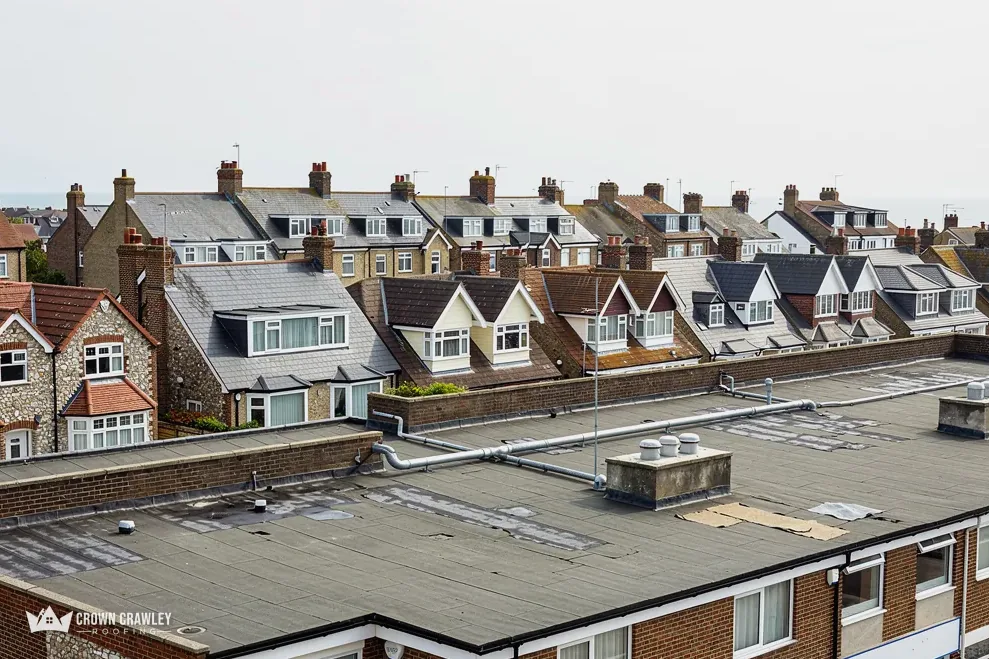
Flat roof in the foreground of a street of dormer-roofed houses

How do we look after a flat roof or porch?

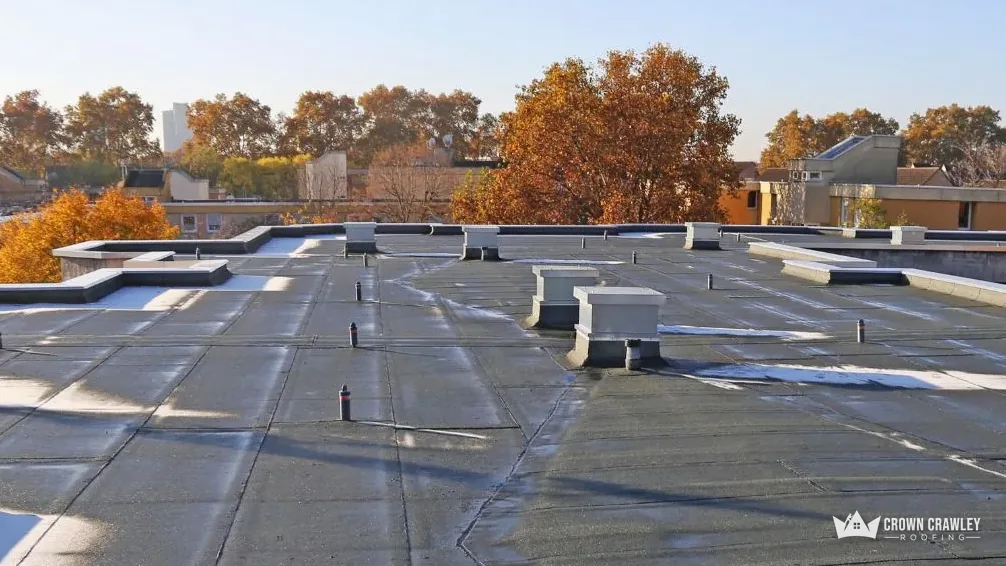
Many village houses have a flat section somewhere, over an extension, porch or garage. GreenSpec gives EPDM rubber an expected service life of 20 to 30 years, and Less puts GRP at 25 to 40 years and felt at 10 to 20. A flat roof must still shed water: the 2025 edition of BS 6229 keeps the 1:80 minimum finished fall, and IKO says to design for 1:40 so that the finished roof reaches it. We look for standing water, blistered or split membrane, and gaps at the upstand where the roof meets a wall. Our flat roofing page explains the options.

Do the gutters and fascias need attention too?

A gutter that sags or holds water sends rain back toward the wall and the roof edge. Brett Martin suggests a fall of 1mm for every 600mm of run, so we check that lengths are level enough to drain, that joints are tight and that brackets are firm. Fascia and soffit boards, the timber at the roof edge and beneath the overhang, are checked for rot while the access is up. Our guttering, soffits and fascias page covers the work. Our next step is a picture: the flat section or roof edge that worries you, plus your postcode, sent through the form or on WhatsApp, and the survey follows from there.

Langton Green roof queries

Does being in the High Weald mean a Langton Green roof needs special tiles?

The designation limits some planning changes, but a repair using the same covering and shape leaves the roof looking unchanged, with no fresh planning question. A different material, pitch or roof window is a matter for Tunbridge Wells's planning team before work starts. For repairs, new tiles are chosen to blend with the old ones in profile and colour.

Is a listed house in Langton Green handled differently?

Yes. Works affecting a listed building's character can need listed building consent, and the village has several listed buildings near the Green. Tell us at the first call if yours is one. We note it at the survey, and you should speak to the council before agreeing to any change of covering or detail on the roof.

Who pays for scaffold on a Kent road?

Scaffold forms part of the job, so it sits inside the one total price you receive in writing. Kent's guidance says the scaffolding company applies for the licence for you. When comparing quotes from any roofer, check whether each includes scaffolding and VAT, because that difference can look like a bargain when it is not one.

How can I tell if the flat roof over my extension is failing?

Look from a window or ladder for water sitting after rain, blisters or splits in the surface, and gaps where the roof meets the wall. Inside, a damp patch on the ceiling below is another sign. Send a photo to us and we will say whether it looks like a repair or a new covering.

A written price for the Green

Send your Langton Green postcode with a picture showing the roof edge, flat section or gutter that concerns you, and a survey date follows.

01293 974253

10-year workmanship guarantee, in writing.

Call Get a free quote