St Lawrence parish church
St Lawrence has been Grade II* since 20 October 1954 and is still used for Church of England worship. Its roof follows the church's own consent route, which differs from an ordinary house.
Parish church roof and tower
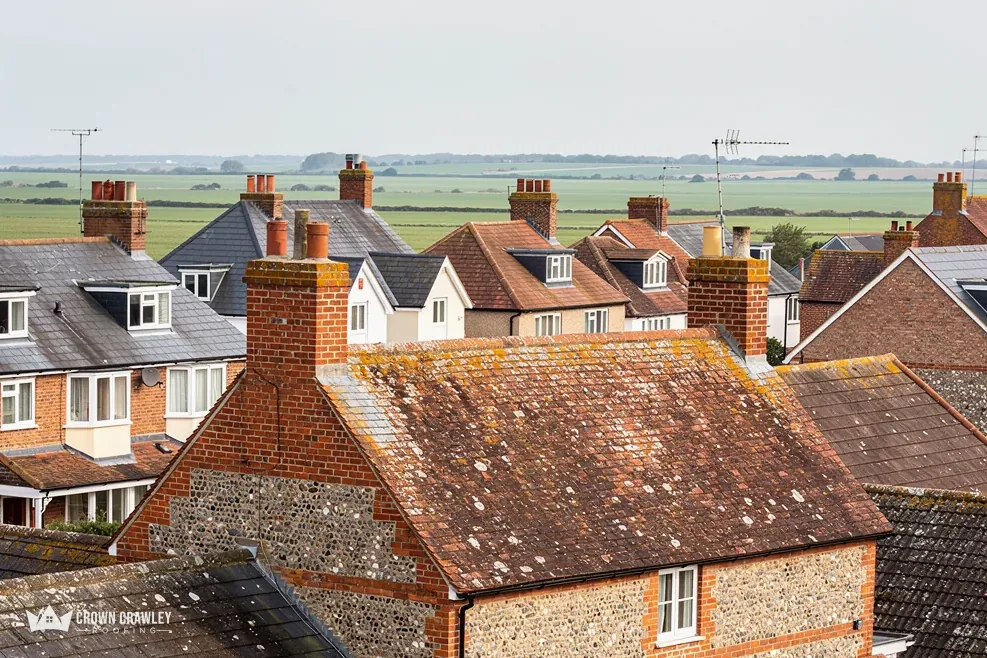
Roofs beside a Grade II* church, The Grange and High Street.
Bidborough is a Kent village with a Grade II* parish church and a Grade II* Grange. We check listing status first, then survey, then price in writing.

St Lawrence has been Grade II* since 20 October 1954 and is still used for Church of England worship. Its roof follows the church's own consent route, which differs from an ordinary house.
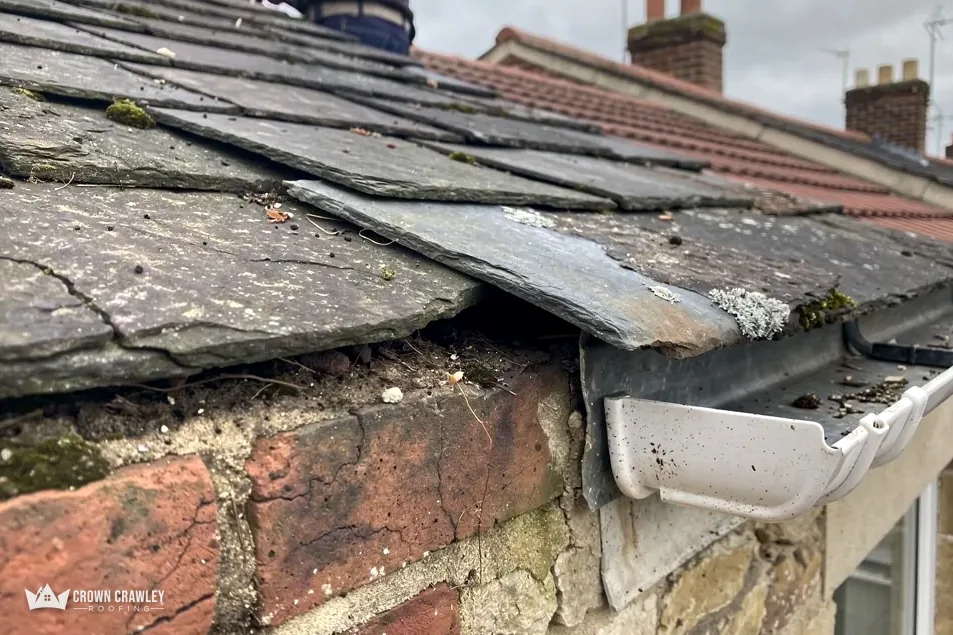
Parish church roof and tower
The Grange is Grade II* and 6 High Street is Grade II. Where a house is listed, roof repairs begin with photographs of every detail, so the new work can put back exactly what was there.
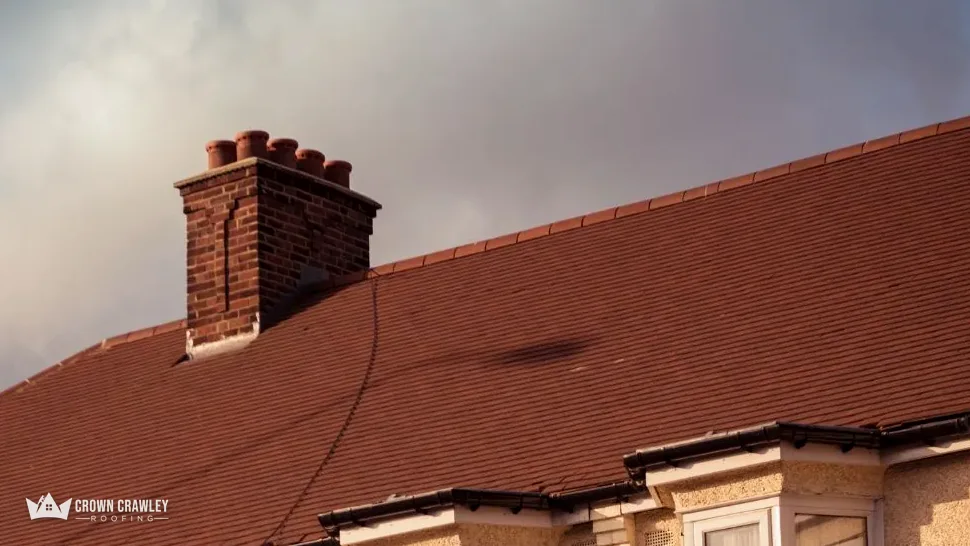
Older house roof with tall chimney

Tunbridge Wells Borough Council can confirm if a given house falls within a conservation area. An unlisted house outside any such area can usually be repaired like for like without a planning question, though we confirm its status first.
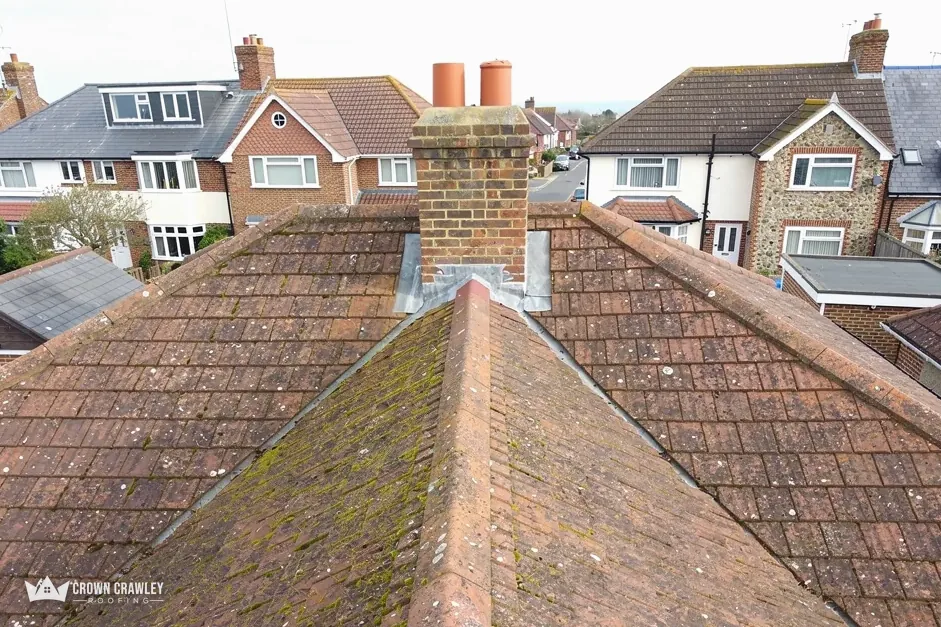
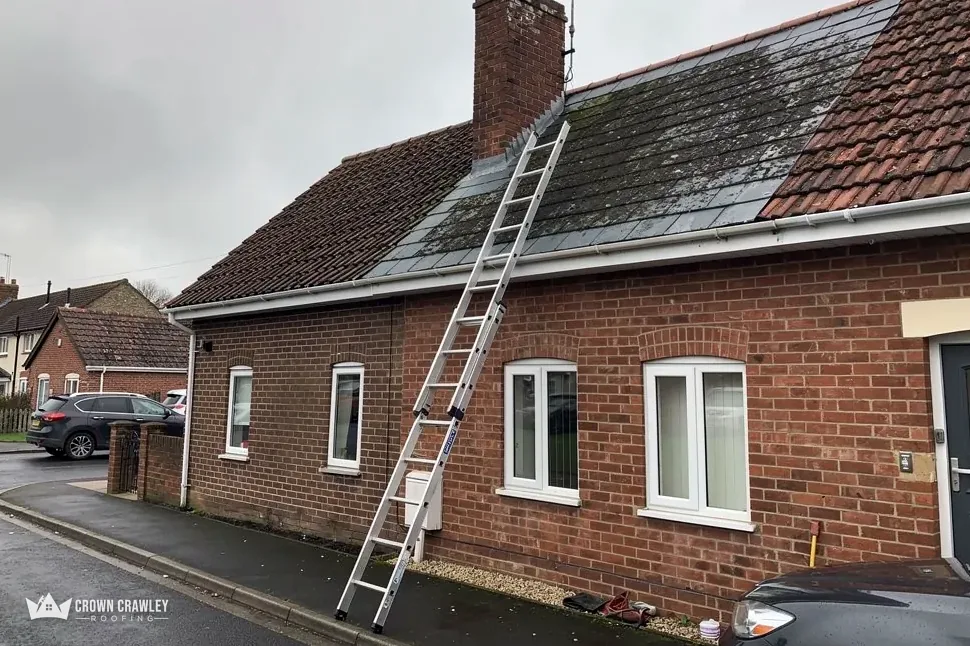
Tiled house roof and gutter
Map of Bidborough and the neighbourhoods around it, with Crawley for reference.
Bidborough is a Kent village in Tunbridge Wells borough, where the borough council handles planning and has its own building control section.
Bidborough site diary
Three short chapters on the listed buildings on the record, how a church roof is consented, and what the borough and the county each ask for on a larger job.
Stage 01 · Listings
Listed entries such as the church and The Grange sit on the national record for Bidborough, which makes your own address worth checking before any price.
The record for this village is short and clear. St Lawrence parish church is Grade II*, first listed on 20 October 1954. The Grange is also Grade II*, and 6 High Street is Grade II. Those are the best known, and in a village of 914 people it is natural to wonder whether your own house is on the list too. We would rather answer the question on the phone than discover it with a scaffold half up, and it costs you nothing to ask us to look the address up while we talk.
Checked at the first visit
Start with the address search on the Historic England website, then confirm with Tunbridge Wells Borough Council's planning team. The paperwork from your purchase may carry the answer as well. If the house is listed, listed building consent is required for any work touching its special character, and that sits apart from planning permission. If it is not, a repair in matching materials is a far simpler affair. Either way, the roof is photographed before any figure is mentioned.
The physical work looks much the same, but the tolerance for mismatch shrinks. We note what the covering is made of, how big the units are, how they overlap and what finishes the ridge, then reuse sound material and source close matches for the rest. Changing from one covering to another, even in the same colour, is a decision for the council and not for a tradesperson. We cover the day-to-day repairs on our pitched roofing page.
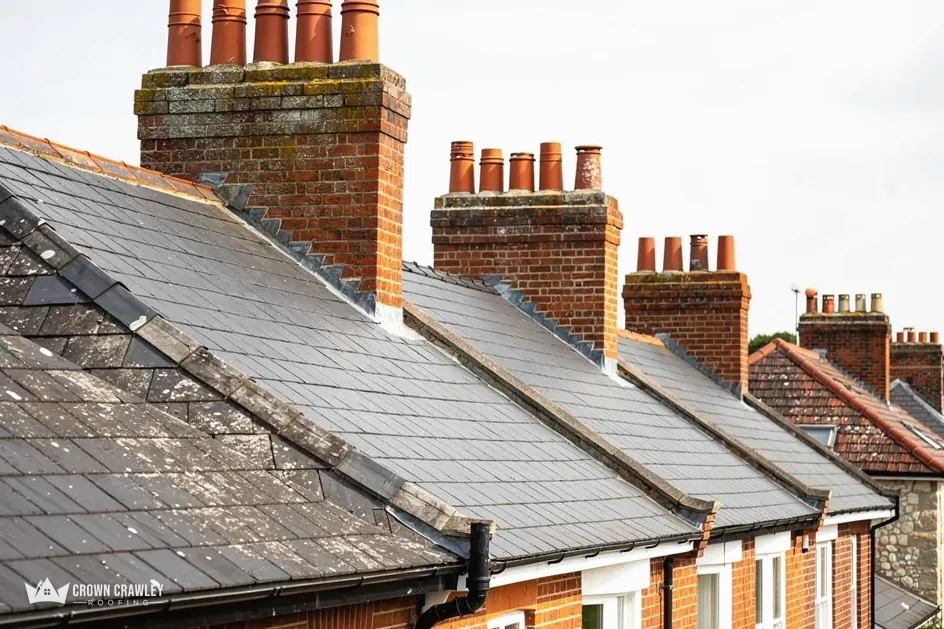
On an older house the chimney tends to be the weak point. Flaunching is the mortar collar around the pot, and the flashings are the strips of metal where the stack meets the slope; both age faster than the brick itself. We check them from the roof and report on them with photographs, and our chimney repairs page shows what putting them right involves.
Gutters and fascias get the same attention. Joints weep, brackets sag and outlets block, whatever the material, and a gutter that spills onto the wall below can undo a sound roof repair. We check falls and joints while the access is up, and the findings come to you as photographs, so you can see each defect before you decide.
Stage 02 · Exemption
A listed church in use for worship is dealt with by its own denomination, not by the usual listed building route.
St Lawrence is recorded as a working Church of England church, so the ecclesiastical exemption applies to it. Anyone who looks after a village church rather than a house will find the rules differ enough to be worth setting out.
Section 60 of the Planning (Listed Buildings and Conservation Areas) Act 1990 disapplies the usual listed building controls for an ecclesiastical building that is in use for ecclesiastical purposes. The 2010 order then says which denominations benefit. For a working Church of England church, the consent is a faculty, granted through the diocese and not the council. The government's guidance on the exemption is explicit that it does not remove the need for planning permission where development affects the exterior of a listed place of worship.
Church roof words
The churchwarden, or whoever holds the parish's records, is the right first call, followed by the diocese's advisers. They will know what the faculty process expects, including a description of the work and the materials. Local records of earlier repairs, with dates and materials, are valuable at a survey, so share them if they exist; if they do not, we record what is there so the file is complete for whoever looks after the roof next. We are glad to survey the roof, photograph its condition and set out the findings in terms the parochial church council can read at a meeting. The consent decision belongs to the diocese, and our job is to describe the roof as it is.
A parish raising money for church work needs something firm to show, so a clear written price with photographs of the defects helps a parochial church council make its case. We keep the description of the roof plain, name each part we mean, and avoid trade shorthand that a meeting might stumble over.
A faculty is the church's way of agreeing roof work, and it comes before any tile moves.
The same ideas apply on a smaller scale to the houses around the church. Your own roof, if it is unlisted, needs no faculty, and if it is listed it needs listed building consent through the borough. Whichever applies, the order of work is the same: identify the status, survey and record, ask for consent where it is needed, then price. If the findings point to a full re-roof, our roof replacement page explains how that job is carried out from stripping to the final inspection.
Stage 03 · Larger jobs
Tunbridge Wells Borough Council and Kent County Council each have a part in a bigger Bidborough job.
Small jobs need none of this. Once a repair grows into a new covering or a big slope, the borough and the county come into it, and the earlier you ask the smoother it goes. We raise these points at the survey rather than at the end.
The Planning Portal's guidance says building control is normally not needed while a job touches less than 25 per cent of the building envelope and less than 50 per cent of the roof. Extra weight changes that: a covering that outweighs the old by 15 per cent or more tips it over, as does any that would perform differently in a fire. Tunbridge Wells Borough Council has a building control section, so that is the first call, and the Planning Portal suggests a structural engineer or surveyor look at a heavier covering. For the planning side, our post on planning permission for roof work sets out the principles.
Rules for a bigger job
Kent County Council says that the scaffolding company should be registered to apply for the licence for the customer, with applications in 5 working days ahead of the start date. Its permit for scaffold on the highway for 7 calendar days is £52 per week in 2026 to 27, and a site inspection can add £78 if the council thinks one is needed. We coordinate with the scaffolder so the paperwork is done before the poles are delivered.
Bats and their roosts are protected in law, and GOV.UK guidance lists re-roofing and roof repair among the jobs that can disturb them. The Wildlife and Countryside Act 1981 adds protection for active or half-built birds' nests by making intentional damage an offence. If droppings or nest material show up at the survey, we stop work in that part of the roof and talk to you before deciding how to proceed.
Bigger jobs also mean more deliveries. We agree stacking space on your property, a route for waste and the hours when the noisy work happens, and you are told each day what is under way. Looking for wildlife is quick and costs nothing extra, and it saves a delay later.
To get started, send a picture of the roof as seen from the road, note whether the house is listed, and add your postcode. We will take it from there.
No. St Lawrence is still used for Church of England worship, so works go through the church's own consent system, a faculty from the diocese, rather than listed building consent. Planning permission can still apply to changes that affect the exterior. The churchwarden or the diocese's advisers are the first people to ask before any roofer is called, and the question belongs before the work starts, not once a scaffold is standing.
Only if the house is listed or the change is a planning matter. For a house that is not listed, like-for-like repairs usually stay straightforward, and the borough council will tell you if your road has conservation area status. If your house is listed, consent is needed for work affecting its character, and Tunbridge Wells Borough Council's planning team is where to ask about any change of covering.
Yes, when the battens and underlay beneath are in good order, the tiles can be refixed or replaced with matches and the ridge rebedded. We show you the worn patches in photos. Where the whole slope is tired, we tell you plainly why further patching would not last, and what a replacement would involve. A survey with photographs settles the question, and the quote that follows is one total price.
Kent County Council says the scaffolding company should do it, on the customer's behalf, and asks for the application 5 working days before the start. We agree the dates with the scaffolder so the pieces line up, and your start date reflects the notice period. Scaffold set up wholly on your own forecourt or garden does not need a highway licence.
Send one picture of the roof from the road with your postcode, and mention any listing, and we book the survey from there.
Message us on WhatsApp