A house with a recorded past
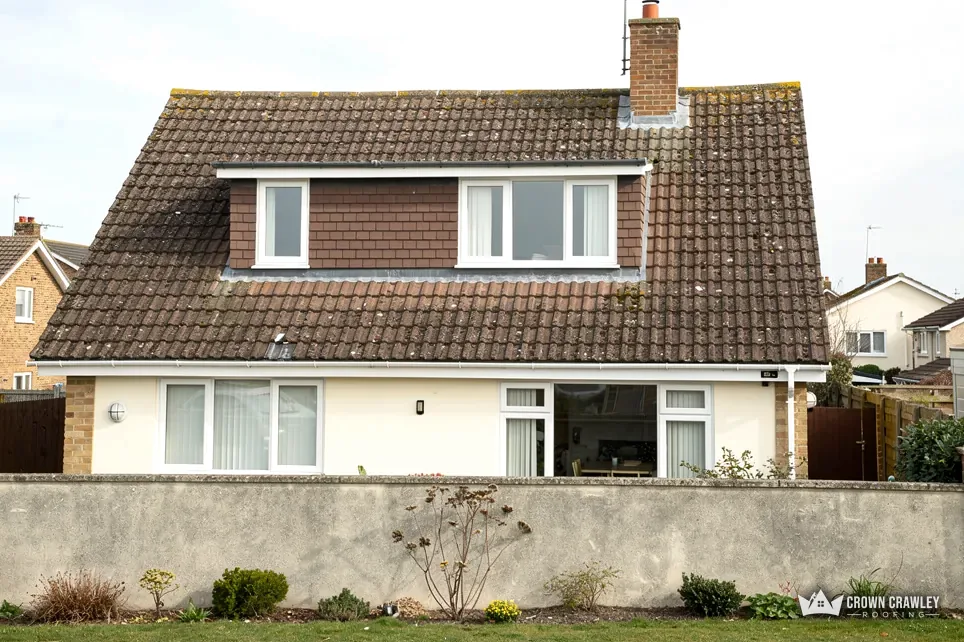
In 1911 the Victoria County History named Hookwood House as the home of the Misses Sanders. A house with a record behind it gets a careful first look at its roof before any price is set.
Large house with a tiled roof
Roofs in a small Surrey settlement between Charlwood and Horley.
Hookwood is a settlement of 666 people in Surrey, between Charlwood and Horley. We go up, photograph the tiles and any flat-roof joins, and give you one written price.
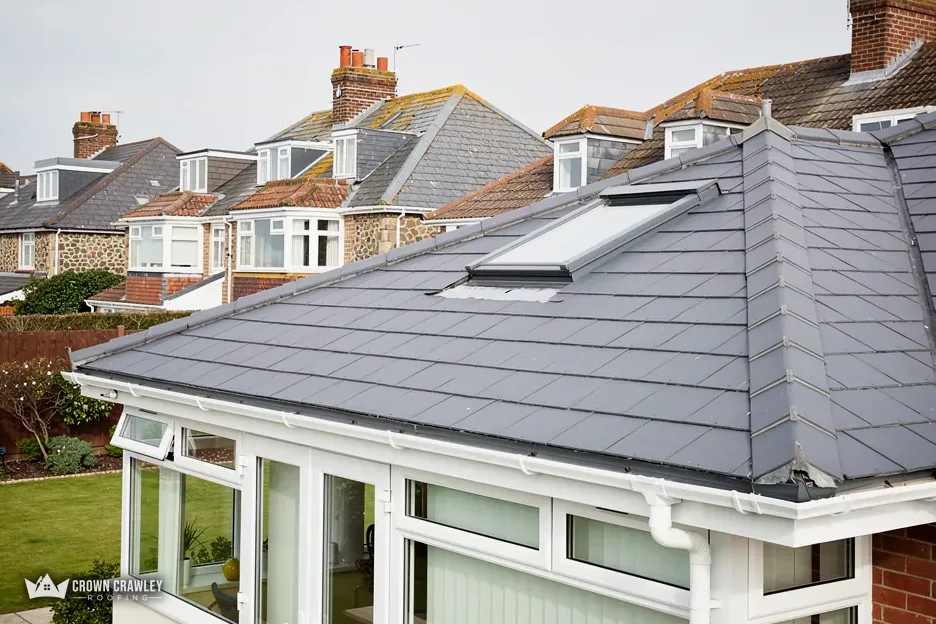
In 1911 the Victoria County History named Hookwood House as the home of the Misses Sanders. A house with a record behind it gets a careful first look at its roof before any price is set.
Large house with a tiled roof
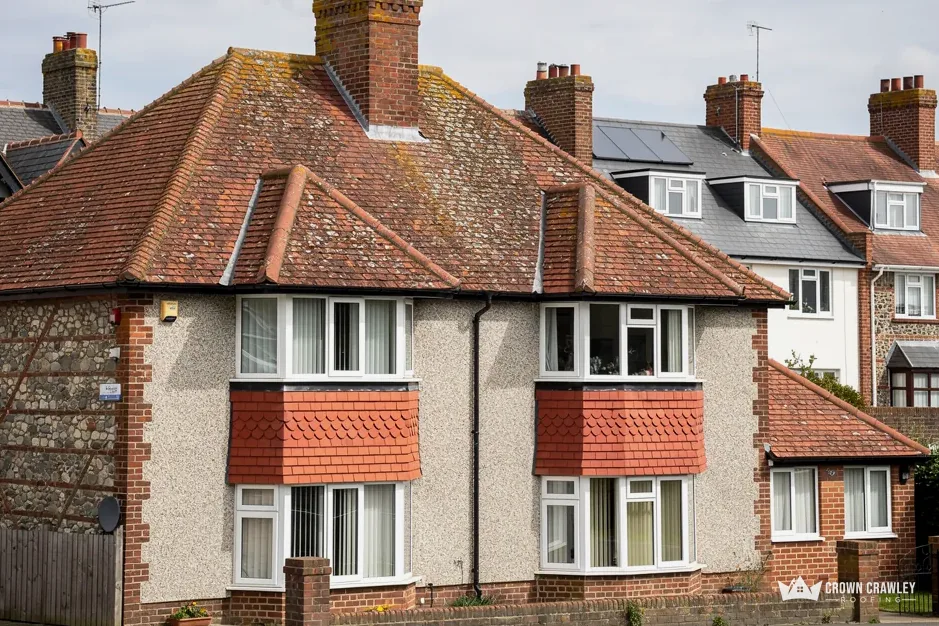
The 2021 Census counted 666 people in the Hookwood built-up area. In a place this small the neighbours notice scaffold, so we plan access and warn them before scaffold arrives and again before it leaves.
Tiled homes along a quiet road
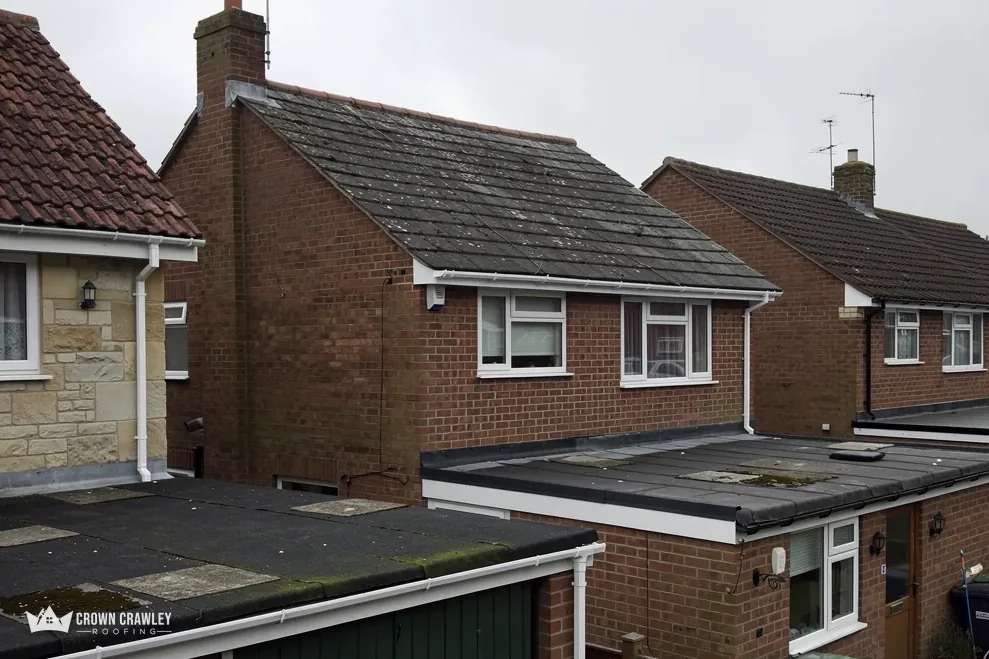
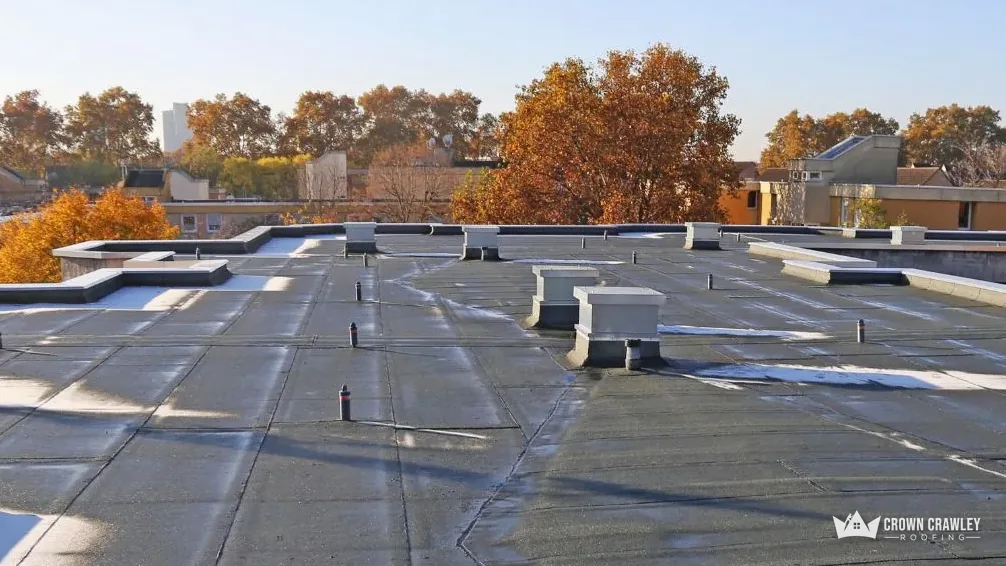
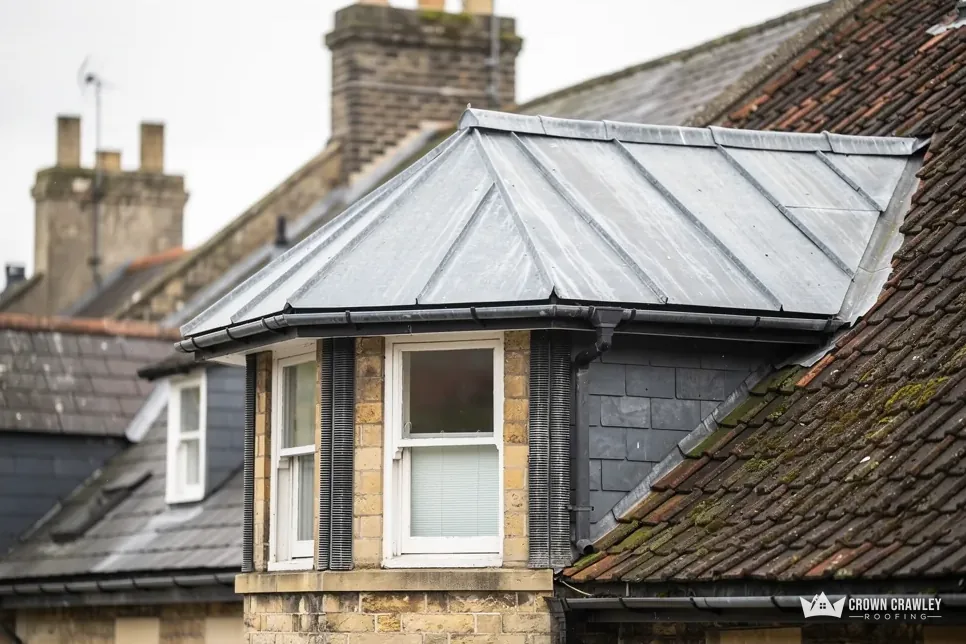
A pitched main roof often sits beside a flat roof over a kitchen, porch or garage. Both need checking, because the join between them is where a leak tends to start.
Flat roof beside a pitched roof
Map of Hookwood and the neighbourhoods around it, with Crawley for reference.
Hookwood lies in Surrey, in Charlwood parish, with Mole Valley District Council as the planning authority.
From survey to sign-off in Hookwood
Three short chapters on a small Surrey settlement, the flat roofs beside its pitched ones, and the Mole Valley and Surrey rules that follow a bigger job.
Stage 01 · Background
Hookwood is small, and the records of it are thin, so the survey does the work that a street name cannot.
Hookwood sits in the parish of Charlwood, between Charlwood and Horley. The Victoria County History of 1911 recorded Hookwood Common as still open ground, two miles north-east of Charlwood village, and Hookwood House as the home of the Misses Sanders, of the old Sanders family of Charlwood. The 2021 Census found 666 residents there, and the place falls within Surrey, with Mole Valley District Council as its local council.
Quite a lot. A postcode says where a roof is, not what is on it. So we begin with a walk round the outside, then go up, and then into the loft if there is a way in. The covering is the obvious part, whether tile or slate. Less obvious is the pitch, because every covering has a lowest slope it can safely sit on: BS 5534 puts natural slate at 20 degrees, and Marley lists its clay plain tiles at 35 or 40 depending on the pattern. On a roof that has been altered, the pitch and the covering can have drifted apart, and that mismatch can let water in at the edges.
First look at Hookwood
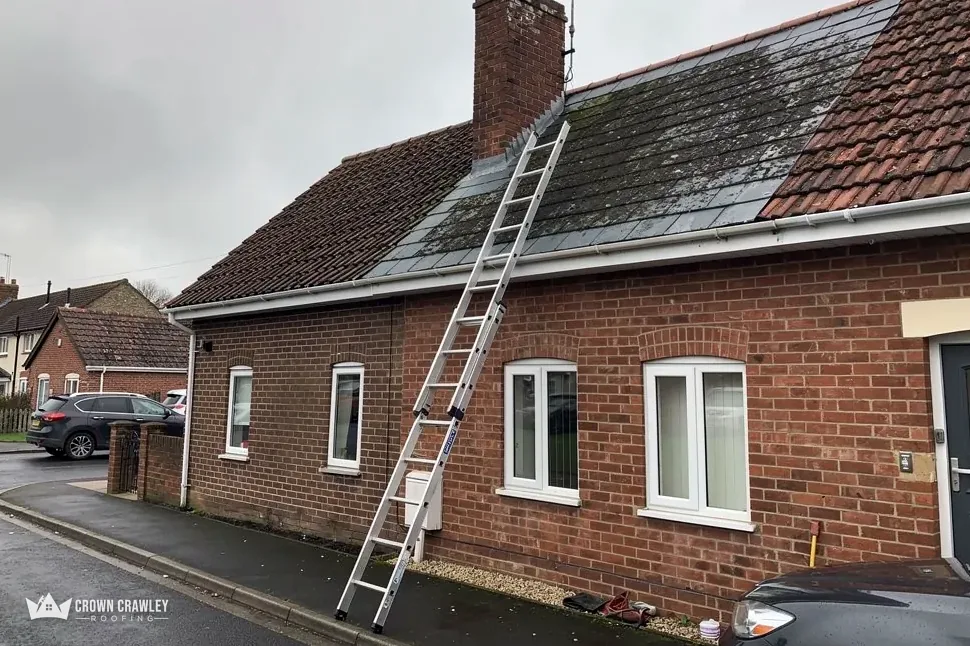
Material by material, the published figures are these. Slate, if well maintained, can last 100+ years. For clay tile, the Building Research Establishment gives 60 years as the least it expects. Concrete tile is put at around 60 years by Marley, though Marley adds that this is no guarantee. None of these is a promise, and a roof also depends on its fixings, its lead and its gutters. A roof of any covering can fail at the edges long before the middle. Our job is to find out which parts of yours have gone and price those alone. Where we can, we lift a corner of the covering to see the deck beneath, and judge whether it is dry and firm.
After the 2014 revision of BS 5534, Marley's guidance is that the strength of mortar by itself cannot be trusted to hold ridge or hip tiles; each bedded tile and fitting should carry a mechanical fixing too. Marley also notes that installing to BS 5534 is not required by law. When we find a ridge held by mortar alone, we show you, and we offer mechanical fixings or a dry-fix system when it is rebedded. On the pitched roofing page you can see what a re-lay involves when the battens are sound.
Stage 02 · Flat roofs
Where a flat roof sits beside a pitched one, the join and the fall of the flat part decide whether water stays out.
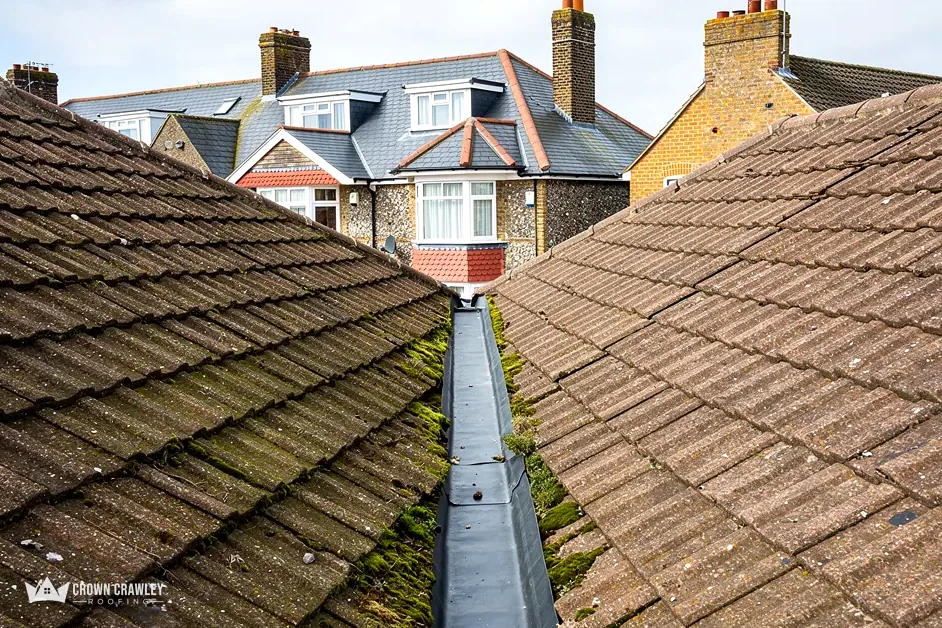
A house in Hookwood may have grown over time, and a flat roof is a common way to add a room, a porch or a store. That makes it worth knowing how a flat roof fails and how its life compares with the pitched roof next to it. The pitched part may have a long life ahead, while the flat part has reached the end of its own, and the survey separates the two. On a flat roof we also press along the deck beneath the membrane to find soft spots, because a new layer laid over a spongy board will fail again at the same place.
Published life spans differ. GreenSpec puts EPDM, a single sheet of synthetic rubber, at 20 to 30 years. A March 2026 cost guide from Less gives glass-reinforced plastic (GRP) as 25 to 40 years and felt as 10 to 20 years. Read them as ranges rather than guarantees. A well-laid roof with a sound fall will outlast a rushed one in a better material. Checkatrade's guides of September 2026 put EPDM at £80 to £100 per m² and felt at £50 to £80 per m² as typical UK ranges, and we write your price only after the survey, because the size of the roof and the access decide what you pay.
Flat roof words
Because it was laid without enough fall, or because the deck has sagged. BS 6229:2025 keeps a minimum finished fall of 1:80 for general roof areas, and IKO advises designing for 1:40 so the finished roof still meets that figure. A puddle that stays for two days after rain tells us the fall has gone wrong. We measure it at the survey. Where a flat roof meets a wall, the membrane is turned up as an upstand and sealed with a flashing, and that junction is the first place we check. Gutters beside a flat roof deserve the same attention. Brett Martin, a gutter maker, advises a fall of 1mm for every 600mm of run, so a sagging gutter holds water at the low point and spills over. A blocked outlet, a cracked joint or a loose bracket shows up as a wet fascia long before it shows indoors. The flat roofing page shows the repair and replacement routes, and our answer on flat roof extension planning permission covers the planning side if you are adding one.
Stage 03 · Permissions
Planning at Hookwood sits with Mole Valley, the roads with Surrey County Council, and each has a say on a large job.
Mole Valley District Council decides planning applications in Hookwood, and building control comes from the Southern Building Control Partnership, a shared service for Mole Valley, Reigate and Banstead and Tandridge. A tile repair seldom involves either body. Contact becomes likely once the work is larger, once a different covering is chosen, or once a flat roof is renewed.
Approved Document L, the Part L guide to saving fuel and power, counts renewing a flat roof's waterproof membrane as renovation. It sets the major renovation line at a quarter of the surface area of the external building envelope, and an element such as the roof is upgraded once more than half of its own surface is renovated. So ask the Partnership about insulation before you agree a new membrane. The Planning Portal applies a different test to a pitched re-roof: below 25 per cent of the building envelope and below 50 per cent of the roof, building control is not normally involved. Mole Valley District Council has a conservation area within about a kilometre of Hookwood's centre, so ask the council whether your house falls inside it. If the whole roof needs stripping, see roof replacement.
Who to ask at Hookwood
Surrey County Council requires a licence for scaffold that stands on the public highway, pavement included. It charges £208 per 28 day period, applications should be made at least 10 working days before the start, and it keeps the application fee if the job falls through. Land that is yours needs no highway licence. The licence, where one applies, is something we arrange with the scaffolder before fixing a start date. If storm damage is behind the job, tell your insurer first, keep photographs, and let us put a temporary cover on before anything else.
One more check applies near the airport. Gatwick's rule is that a crane within 6 km of the airport needs a permit, with two exceptions: kit lower than 10 m, or kit hidden on every side behind taller trees or buildings. If a Hookwood job needs a crane, we ask Gatwick before we book one. Please send a photo of the roof, flat part and pitched part, with your postcode, and we start from there. If you are unsure whether altering the roof's appearance needs permission, ask Mole Valley's planners.
The join between the two is the first place to look, along with the upstand where the flat membrane meets the wall. We check the flashing, the fall and the drainage on the survey. A puddle that sits for two days points to a fall problem, and the survey photos show you where it lies before any price is set.
Published ranges are 20 to 30 years for EPDM, 25 to 40 for glass-reinforced plastic and 10 to 20 for felt, against a Building Research Establishment minimum of 60 years for clay tile and Marley's figure of around 60 for concrete. They are ranges, not promises. A flat roof with a sound fall and a clear drain will outlast a poorly laid one, whatever it is made of.
The Southern Building Control Partnership, which serves Mole Valley, Reigate and Banstead and Tandridge. Ask them whether the work touches the thresholds in the Planning Portal guidance or counts as renovation under Approved Document L. We confirm with them on any larger re-roof, and your quote follows what they say. Keep their reply with the quote, so there is a record of what was agreed.
Only on some jobs, and when one does, Gatwick says a crane or tall equipment within 6 km of the airport needs a permit unless it is under 10 m tall or has taller trees or buildings around it on all sides. We ask Gatwick before we book one. Ordinary scaffold is a separate matter and is covered by the highway licence rules.
Send a photo of the flat roof, the pitched roof and the join between them, with your postcode, and we will arrange a visit.
Message us on WhatsApp