Roofers in Effingham

Roofs in a compact village between the chalk and the clay.

Effingham climbs from the London Clay onto the chalk, with a Grade II* church and part of the village inside a conservation area. We survey first, then send one price in writing.

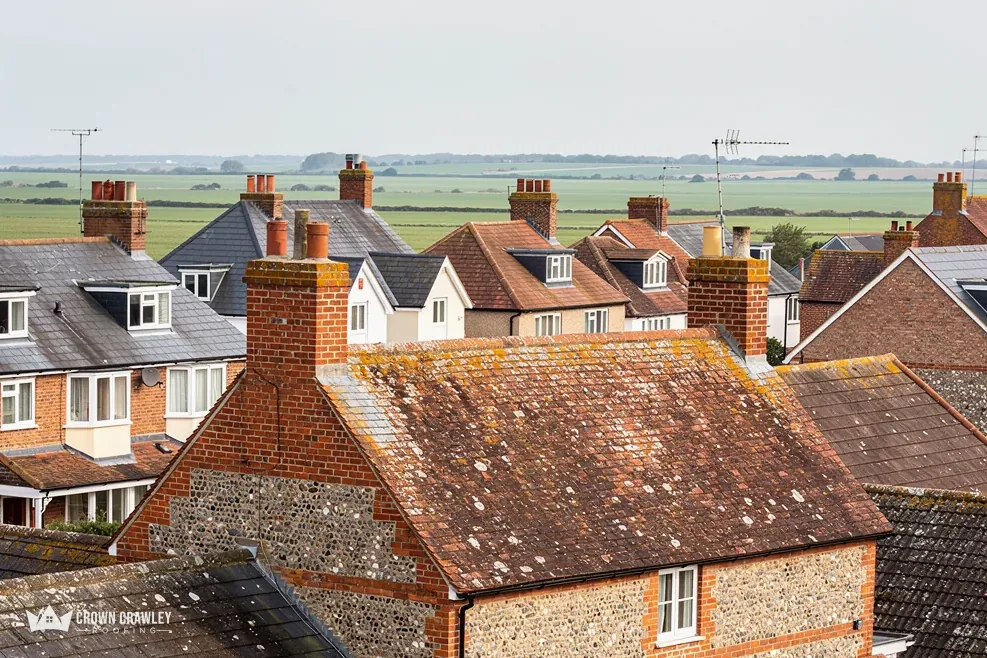
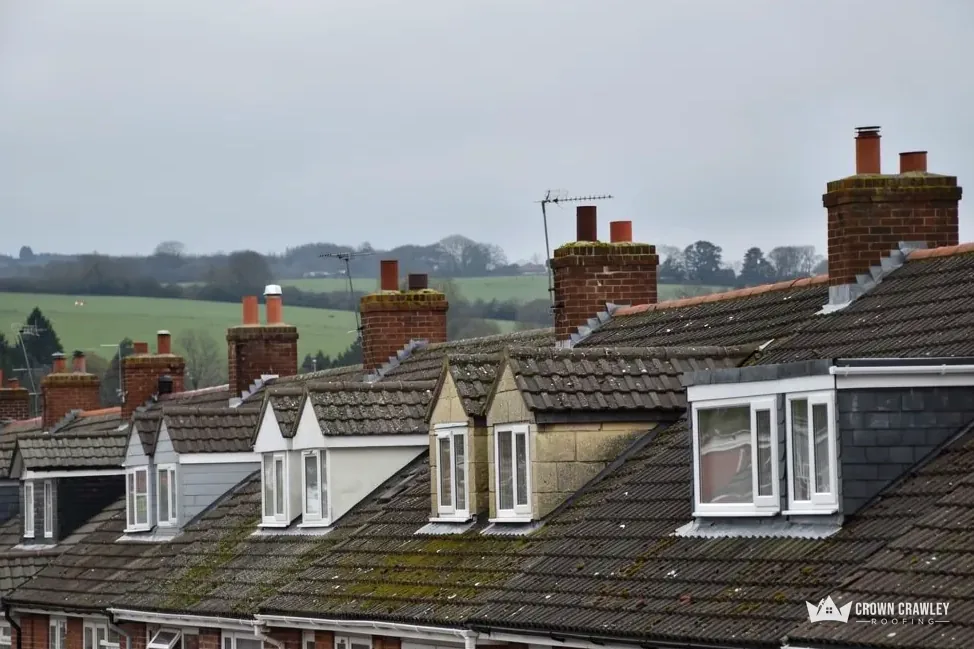
Dormer windows on a weathered tiled roof facing open fields

Three things that shape Effingham roofs

Flint-walled house with a mossy clay tiled roof overlooking fields

A village that spread uphill

The Victoria County History placed the old village on the beds between chalk and London Clay, with houses spreading onto the chalk by 1911. Older and newer roofs now stand close together, so each one is surveyed on its own evidence.

Tiled homes on a village road

Brick chimney with lead flashing on a clay tiled roof

Brick of about 1600

Widdington, opposite the Plough Inn, has a projecting brick porch of about 1600 to 1620. Brickwork this old wants careful flashing and gentle pointing, and we plan ladders and scaffold so they do not rest on it.

Brick wall meeting a tiled roof

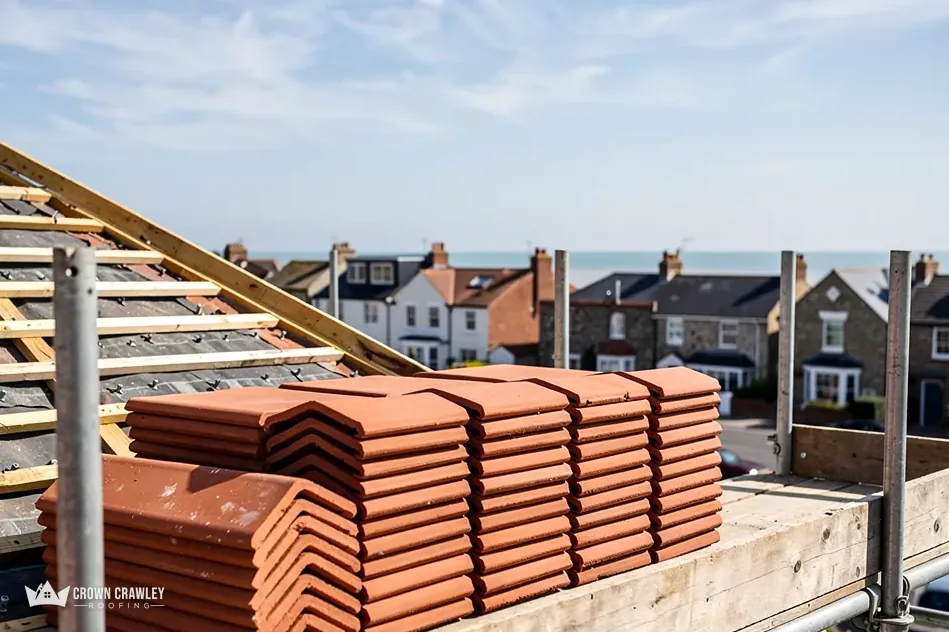
Stack of new clay tiles on scaffold beside roof timbers

A church tower dated 1757

A dated stone suggests the church tower was built or rebuilt in 1757. Near a Grade II* church it is worth asking early whether your own house is listed, because the answer changes the order of the work.

Old stone and clay tile roof

Effingham, south of Leatherhead

Map of Effingham and the neighbourhoods around it, with Crawley for reference.

Effingham is a compact village 3.5 miles south-south-west of Leatherhead on the Guildford road, reaching from the chalk downs onto the London Clay.

Distance
24.3 road miles from Crawley, to the north-west
Drive
About 42 minutes
Council
Guildford Borough Council and Surrey County Council
Planning authority
Guildford Borough Council
Conservation area
Effingham
Parish church
St Lawrence, Grade II*
Get a free quote

Our Effingham notebook

Where the chalk meets the clay

Chapters on the village's growth up the slope, the protections around its older streets, and the checks that come before a bigger job.

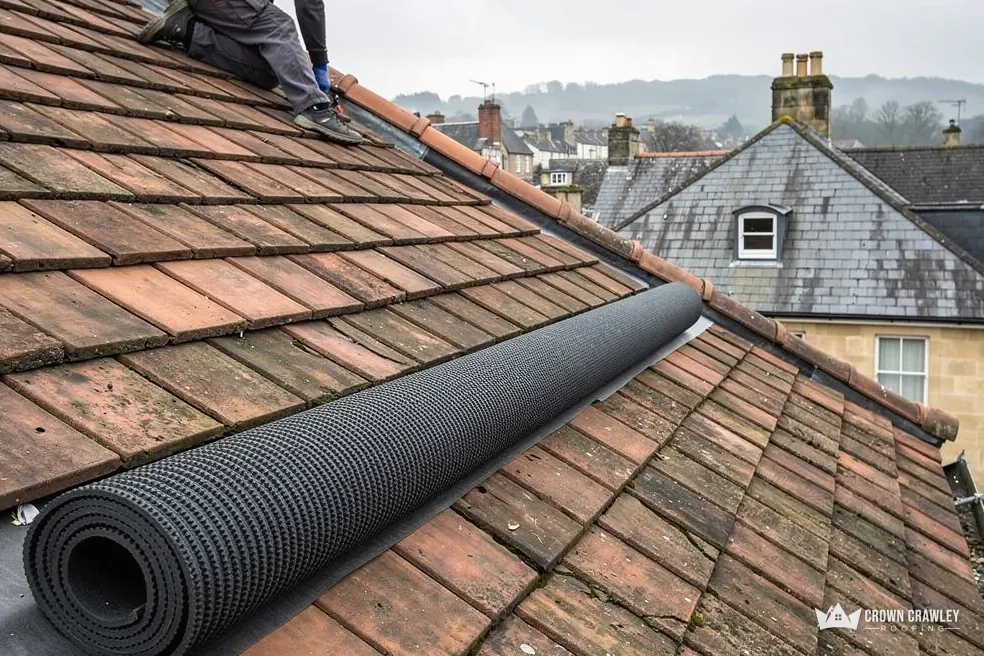
Roll of roofing membrane lying on a clay tiled roof

Stage 01 · Background

Old heart, newer edges

The old village sat low, on the beds between chalk and clay, and later houses climbed the slope above it.

The Victoria County History placed the church and the old village on the beds between the chalk and the London Clay, and noted that by 1911 houses had spread up onto the chalk. So there is an older heart low down and newer building climbing above it. The church tower carries a dated stone suggesting it was built or rebuilt in 1757, and Widdington, an old house opposite the Plough Inn, has a large projecting brick porch of about 1600 to 1620. Together those details describe a compact village where a seventeenth-century porch, an eighteenth-century tower and the later houses that spread up onto the chalk all share a few streets, and their roofs were built to very different habits.

Do old and new roofs need different care?

They need different questions. On an older roof we ask whether the frame has settled, whether the tiles are hand-made or machine-made and whether earlier repairs used materials that suit. On a newer one we ask about the fixings, the underlay and the air movement in the loft. Neither is a better starting point. What counts is what the survey finds, so we climb up, photograph the slope course by course and describe it to you in the words of the trade and then in plain ones.

How long should a covering last?

Published figures are typical spans, never promises. Marley puts concrete tiles at around 60 years, with its own warning that the figure guarantees nothing, a roofing materials guide says well-kept slate can last 100+ years, and a fascia retailer quotes 20 to 40 years for uPVC boards. Nothing on that list is a promise about your roof. Your roof's own condition outranks any table in this list, since a sheltered slope can outlast the average and an exposed gable can fall short of it. We use the numbers to frame the conversation, not to close it.

Roof parts we name

Verge
Roof edge along a gable end
Ridge
Highest line of the roof
Hip
Sloping edge between two slopes
Valley
Inside angle where slopes meet

Where does water get in on a village house?

Often at the edges instead of the middle of the slope: the verge, the valley, the eaves and the gutter line. A gutter wants a slight fall towards the outlet, and Brett Martin's installation advice is 1mm for every 600mm of run. Where a joint has opened or a bracket has dropped, rainwater spills over the fascia and soaks the timber behind. Our gutters, soffits and fascias page shows how we deal with it, and our pitched roofing page covers the slopes above.

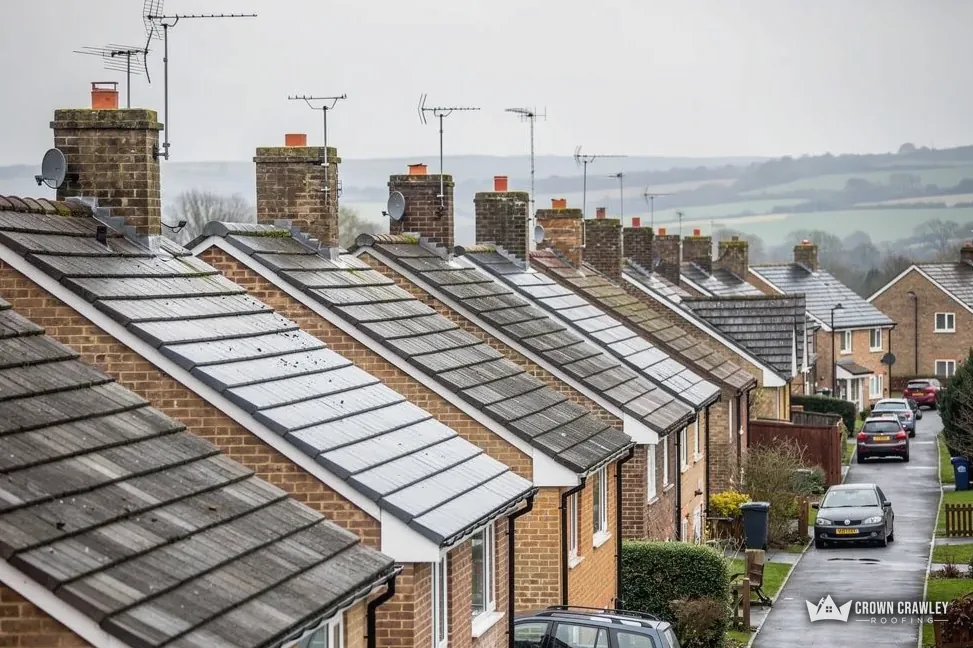
Terraced street with new grey tiled roofs

Stage 02 · Permissions

The conservation area and listed houses

One road in Effingham can pass from a protected frontage to a newer house in a few paces, so the address decides.

Part of Effingham lies in the Effingham conservation area, and the rest does not. Guildford Borough Council is the planning authority, so its planning team holds the answer for your address. We ask for the road and the house name when a survey is booked so that we can raise the same question ourselves.

Will protection around the old streets block a repair?

Not at all, though it raises the standard of care. Putting back tiles of the same colour and profile, in the courses already there, seldom causes difficulty. A new covering, an altered ridge or a rooflight facing the road deserves a conversation with the council first. Our post on planning permission for roof work walks through the usual questions, and the planning team can say what applies at your address. We keep the council's reply with your survey photographs, so the file shows what was agreed.

What changes for a listed house?

Historic England lists Brown's at Grade II and the Church of St Lawrence at Grade II*. A listing brings consent rules for work that would affect a building's special character, so we ask at the first call whether the house is listed. If it is, we wait for the council's view before pricing anything beyond a plain repair. That wait is better than a stop order halfway through a stripped slope.

A roof on a protected street is priced only after we know which rules sit over the address.

Questions to settle first

Planning
Guildford Borough Council
Boundary
Part of the village only
Listing
Ask before the survey
Church
Faculty route, not consent
Matching
Tile sample against the slope

St Lawrence itself is an Anglican parish church still in service, and work on a church in that position follows the denomination's faculty process rather than listed building consent. The parish and diocese handle that. Houses nearby are different, and a close match for old tiles takes time, so we hold a sample against the existing slope in daylight before any order is placed. Colour changes a good deal between wet and dry weather, and a sample judged indoors can mislead.

While we wait for any reply, the time is not wasted. We measure the slopes, count the tiles each course needs, note the ridge and verge details and photograph the eaves, so the written price is ready the day the answer arrives. If the council raises a point, we adjust the specification and show you the change in writing before anything is ordered, so your total never moves quietly behind your back.

Stage 03 · On site

Checks before a bigger Effingham job

A re-roof means thinking about building control, scaffold and the weather before the first tile comes off.

Smaller repairs rarely need anything beyond a ladder and a dry day. A stripped slope is different, because it brings approvals, access and exposure into play at once.

Is approval needed to re-roof in Effingham?

Guildford Borough Council runs building control for Effingham. The Planning Portal gives two ceilings below which no building control application is normally needed: under 25 per cent of the building envelope and under 50 per cent of the roof. Separately, a covering that makes the roof 15 per cent or more heavier needs approval whatever the area, so get a structural opinion before ordering. Where our survey shows a whole slope coming off, we speak to the council before a start is agreed.

The new roof itself has rules of its own. Marley's guidance for a cold roof with a non-breathable underlay is eaves ventilation of 25mm along the length for pitches of 15 degrees or less, and 10mm for steeper ones. Thick loft insulation packed against the eaves can choke that gap, so we look at it during the survey and leave it open when we finish. Battens go on to suit the tile, underlay is lapped so that it drains to the gutter, and the eaves are finished so that nothing sags into the gutter line.

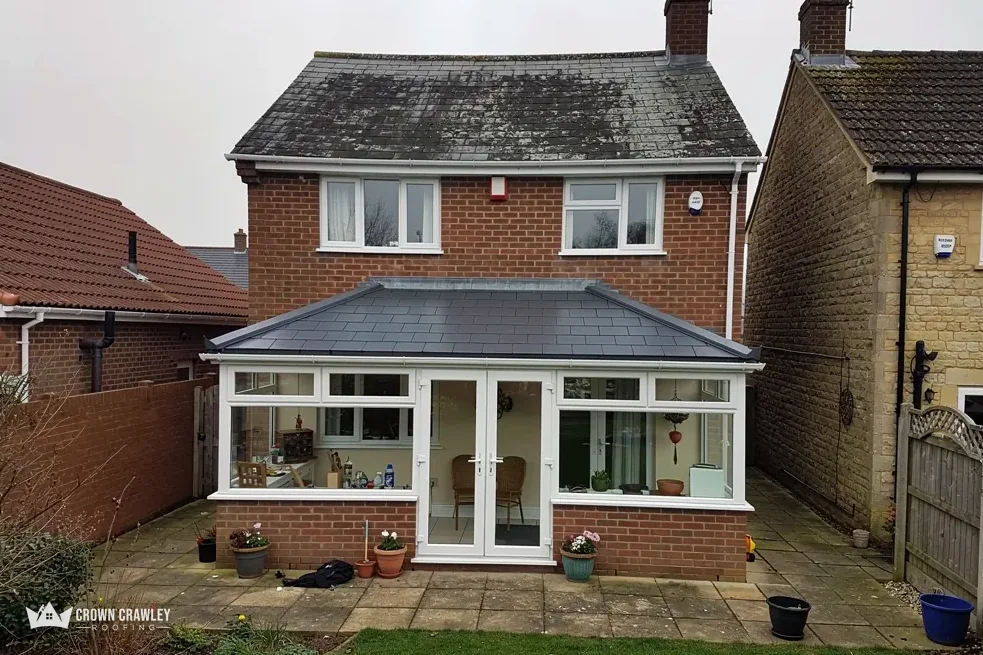
Rear of a brick house with a glazed extension and slate-effect roof

Words on a larger job

Building envelope
The whole shell: walls, floor, roof, openings
Batten
Slim timber lath carrying the tiles
Underlay
Waterproof sheet beneath the tiles
Eaves
Where the slope ends above the gutter

Where will the scaffold stand?

Surrey County Council licenses scaffolding on its roads and pavements at £208 for each 28 days, and it wants the application at least 10 working days ahead. Poles on your own ground need nothing. The survey decides which is possible. Where the road cannot be avoided, the licence is arranged between our scaffolder and us, and your neighbours hear about it first.

What should I do after storm damage?

Make the house safe, then ring your insurer before arranging permanent work. A temporary repair is normally expected, so keep photographs of the damage and the receipts for any emergency work. If you are unhappy with an outcome, the Financial Ombudsman Service handles complaints. For a stack or roof that looks about to fall, Guildford Borough Council's building control page lists a dangerous structures contact. Our emergency roof repairs page explains how a leak is made safe first. To begin, send us the house name, the road and a garden photograph of the slope in question.

Effingham roof Q&A

Can I tell how old my Effingham roof is before a survey?

Not reliably from the ground. Houses here run from old brick to later building on the chalk, and repairs mix materials over the years. Look at the tile colour, the edge of the verge and any stains in the loft, then send photographs. The survey lifts tiles and checks the underlay, which gives a far better guide than any date.

Does the Effingham conservation area affect a simple repair?

Only part of the village is inside it, so check your address with the planning team at Guildford Borough Council. Replacing broken tiles with matching ones usually keeps the look of the roof, and the survey photographs show the colour and profile of what is there now. A new covering or a rooflight facing the road is worth raising with the council first, and we will wait for the reply.

What should I send for an Effingham roof survey?

Send the house name and road, a clear photograph of the roof slope taken from your garden or the lane, and a short note of where the water shows inside. A loft photograph of any damp patch helps too. We book the survey from those, climb up, and return photographs of what we find on your own roof, with a plain account of whether it needs a repair or something larger.

Who handles a scaffold licence if the poles must stand on an Effingham road?

Surrey County Council issues the highway licence, at £208 per 28 day period with at least 10 working days between application and start. Our scaffolder and we sort the application between us and set the roof start to the approved date, and the one written price already includes the licence, so nothing arrives later as a surprise. On your own drive or lawn no highway licence applies, so the survey checks for room there first.

Your Effingham roof, surveyed first

Send the house name, the road and a photograph from the garden of the slope that worries you, and we will fix a survey day.

01293 974253

10-year workmanship guarantee, in writing.

Call Get a free quote