Roofers in Croydon

Roofs in a town of red brick, tile and Grade I landmarks.

Croydon stands at the foot of the North Downs, where the Bourne spring rises near the parish church. Before pricing, we look at the covering, the brickwork around it and whether the building is listed.

Rear of a brick detached house with a tiled roof and garden

Coverings you will meet in Croydon

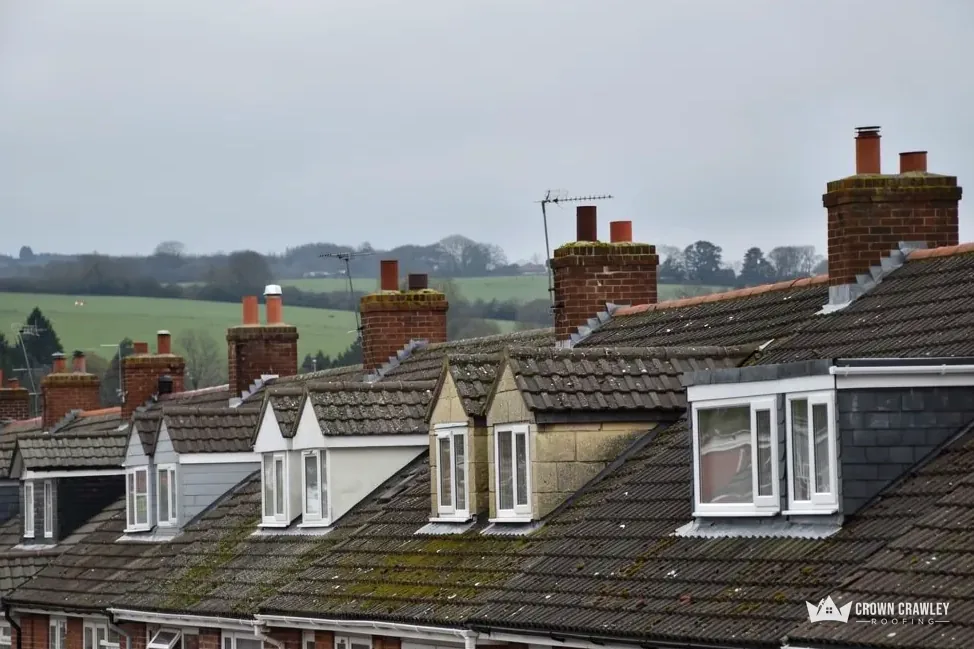
Dormer windows on a weathered tiled roof facing open fields

Red brick of the 1596 hospital

The Victoria County History describes Whitgift's Hospital as red brick with occasional black-brick diapering, in two-storey ranges around a quadrangle. Where brick walls meet a roof, we check the eaves and abutments first.

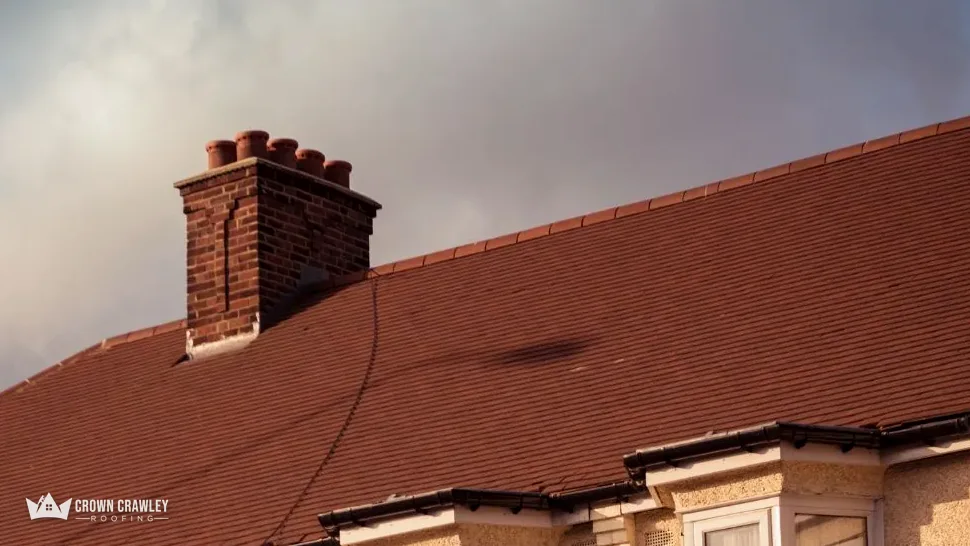
Red brick wall below a tiled roof

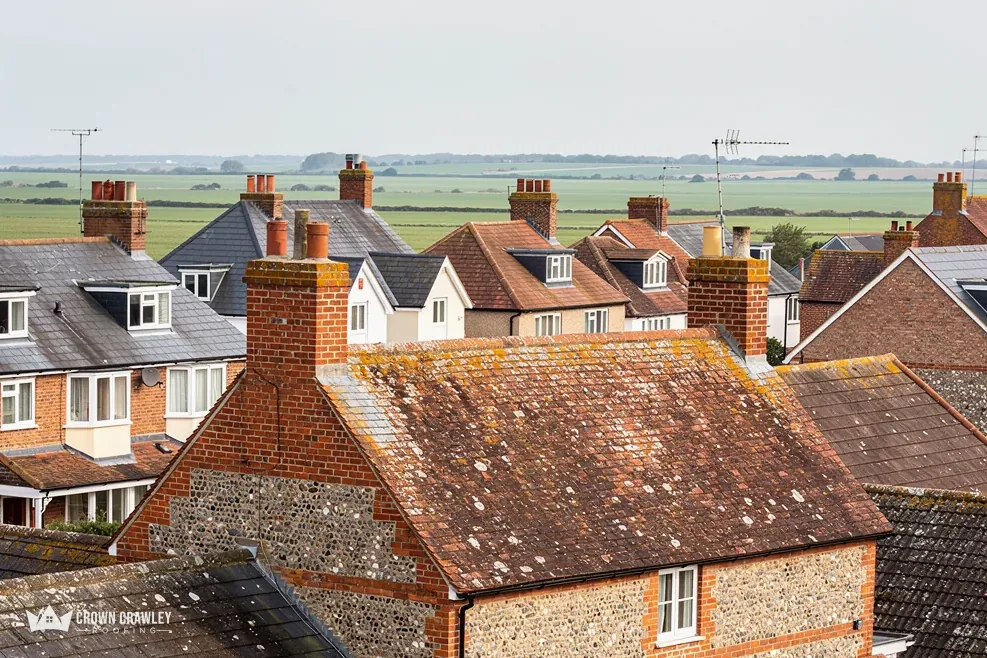
Flint-walled house with a mossy clay tiled roof overlooking fields

Tiled roofs at the Old Palace

In 1912 the roofs at Croydon Palace were recorded as tiled, with the oldest walls in stone and flint rubble and later work in brick. We note every tile profile and colour so a repair matches.

Old tiled roof above brick and flint

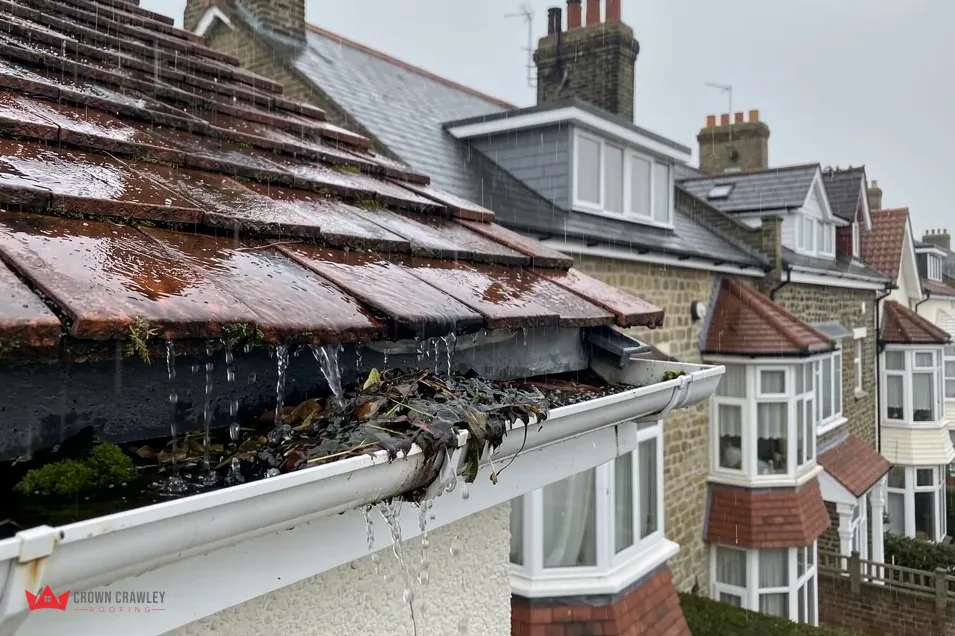
Blocked guttering full of debris below a wet tiled roof

Central Croydon and Church Street

Part of the town lies in the Central Croydon conservation area, which also touches Church Street. St John the Baptist's church and the Old Palace chapel and great hall are Grade I.

Historic buildings with tiled roofs

Croydon, below the North Downs

Map of Croydon and the neighbourhoods around it, with Crawley for reference.

Croydon is a large town at the foot of the North Downs, south of London, where the intermittent Bourne spring rises near the parish church.

Distance
22.1 road miles from Crawley, to the north
Drive
About 37 minutes
Council
London Borough of Croydon (London borough; Greater London Authority above)
Planning authority
London Borough of Croydon
Conservation area
Central Croydon; Church Street
Get a free quote

From survey to sign-off in Croydon

Reading roofs in a town with a long record

Three short chapters on brick and tile in old Croydon, what its Grade I buildings and conservation area mean for a roof, and the cost of a scaffold licence.

Stage 01 · First look

Brick, flint and tile in old Croydon

Croydon's oldest buildings were recorded in brick, flint and tile, so many roof questions here begin at the junction of roof and wall.

Croydon's story is written into its building materials. The Victoria County History, in its 1912 volume, describes Whitgift's Hospital, founded by Archbishop John Whitgift in 1596, as red brick with occasional diapering of black brick. At Croydon Palace it records the older parts in stone and flint rubble and the later work in brick, with tiled roofs throughout, and it describes the Elys Davy almshouses as red brick with tiled roofs. That record covers a handful of historic buildings, not the town, but it shows brick walls and tiled roofs working together in the town's oldest recorded buildings.

Why do the joints matter more than the tiles?

A roof is only as sound as its worst junction. Where a slope finishes against a gable wall, a chimney stack or a parapet, water has to be led away by flashings, which are strips of metal tucked into the brickwork and dressed over the tiles. If the pointing that holds them has eroded, rain finds the gap long before the tile itself fails. On older brick the mortar can also be softer than the brick, and a repoint with the wrong mix does harm. So we look at the wall as well as the roof, and photograph both for you.

Up close in Croydon

Tiles
Cracked, slipped or worn thin
Brickwork
Sound at eaves and gable tops
Stack
Pointing, flaunching and lead intact
Valleys
Clear, flat and not worn through
Gutters
Joints dry, outlets running free
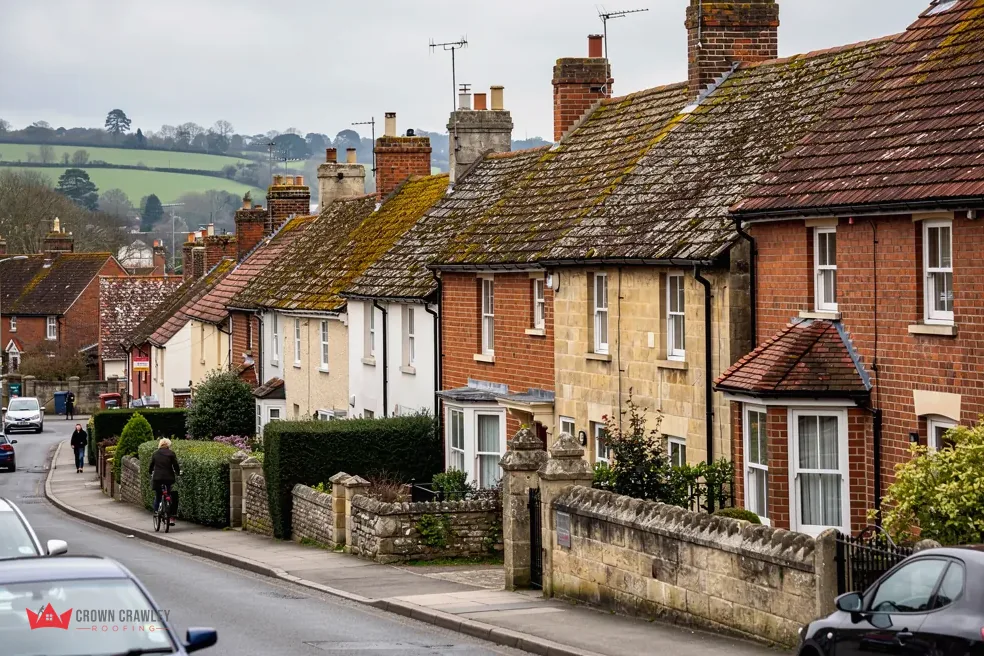
Village street of brick and render houses with old tiled roofs

What does a Croydon survey cover from the roof down?

Every slope first, with ridge, verge and eaves, then the stack, the valleys and the gutters. We lift a few tiles to see the nails and the battens beneath, and we go into the loft where we can, to check for daylight, wet timber and blocked airflow. Marley advises a 25 mm eaves gap on cold roofs of 15 degrees or less, and 10 mm on steeper ones, where a non-breathable (HR) underlay is used; packed insulation can close it. Our pitched roofing page explains how we repair covering, battens and underlay. For stacks with failing pointing or cracked flaunching, the chimney repairs page sets out what that work involves.

You then receive photos of the roof with notes, an explanation of what is a repair and what is a replacement, and one written total. If a leak is already staining a ceiling, we deal with the leak first and talk about the longer fix afterwards. The price is shaped by the area, the covering, the access and whatever the survey finds. A good national benchmark for scale is Checkatrade's roof repair guide, whose table dated June 2026 gives a typical UK range of £110 to £160 per square metre for plain clay tile repairs of up to 3 square metres, excluding VAT.

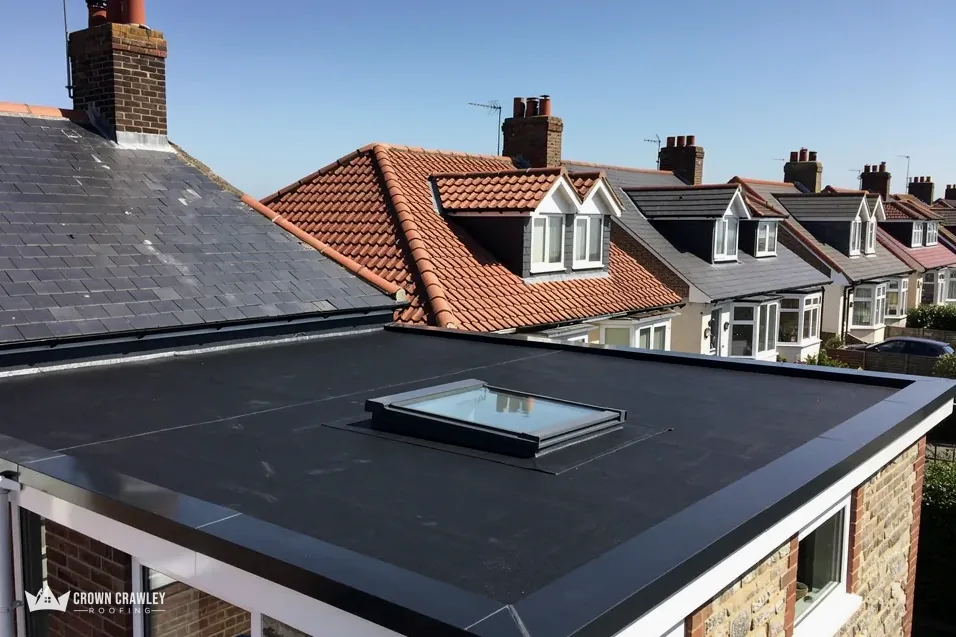
Black flat roof with a rooflight on a house extension

Stage 02 · Listing

Grade I buildings and a conservation area

Part of Croydon is a conservation area and several landmark buildings are Grade I, so the first question is often which rule applies.

On the national planning map, a section of Croydon falls inside the Central Croydon conservation area, and the boundary also touches Church Street. The National Heritage List for England records the Parish Church of St John the Baptist as Grade I, first listed on 29 January 1951, and gives the Hospital of the Holy Trinity, Whitgift's Hospital, the same grade and date. The Old Palace chapel and its great hall are Grade I as well. These are well known buildings, but their listings tell you nothing about the house on your own road.

How do I know whether my Croydon house is covered?

Two checks, and both are free. For the conservation area, ask the London Borough of Croydon's planning team to confirm whether your address is inside the boundary, because the line can run down the middle of a street. For listing, look up your address on the national register. Living near a Grade I building does not list your house, and a house outside the boundary is outside it. We prefer you to settle both before the survey, since the answer changes what we can price.

Heritage words for a Croydon roof

Conservation area
Land where the council guards local character
Grade I
The highest tier of listing
Listed building consent
Council approval for work affecting character
Like for like
Replacing with the same kind of covering

What changes if I am inside the conservation area?

Matching repairs leave a building looking as it did, and the Town and Country Planning Act 1990 leaves such works outside the meaning of development. The picture shifts with swapping the covering, fitting a roof window, building a dormer, or reshaping the roofline, where the council's planning team has the say. A conservation area also counts as designated land for the purposes of permitted development. Our post on re-roofing in a conservation area explains how that bears on a full replacement.

Alterations that affect the character of a listed building need listed building consent. Whether a church is in use by an exempt denomination decides its consent route, so for St John the Baptist's that is for the parish and the council to confirm. For a house or shop that is listed, we survey first, photograph the existing material, and give the council a clear record of what a repair would match. A conservation area does not mean a roof can never be renewed; it means the council is asked first and the covering is chosen to suit the street. Where a roof needs full renewal, our roof replacement page explains the steps.

Stage 03 · Permissions

What a Croydon scaffold licence costs

Croydon publishes precise figures for scaffold on the highway, and they can add a real sum to a job that needs the pavement.

A scaffold that stands on a pavement or road in Croydon needs a licence from the London Borough of Croydon, which is the highway authority. The council publishes its figures: £488 per four weeks for each elevation of scaffold, rising to £610 per four weeks where an elevation is over 10 metres long, plus a refundable bond of £50 per square metre of enclosed highway. The minimum period for a licence is one month, renewals must be made at least seven days before expiry, and the council says the licence is issued only after a site visit. Tacit consent does not apply, so silence from the council is not permission.

Who applies for the licence?

The council's pages do not state which party applies, so the scaffolder and we agree who submits it before a date is promised. Because there is no published lead time for a first application, we build a margin into the start date and tell you what it is. The cost of the licence, when one is needed, sits in the written total, and the quote says whether it is included.

Croydon scaffold licence

Minimum period
One month
Fee
£488 per 4 weeks, per elevation
Over 10 m
£610 per 4 weeks, per elevation
Bond
£50 per m², refundable
Renewal
At least 7 days before expiry
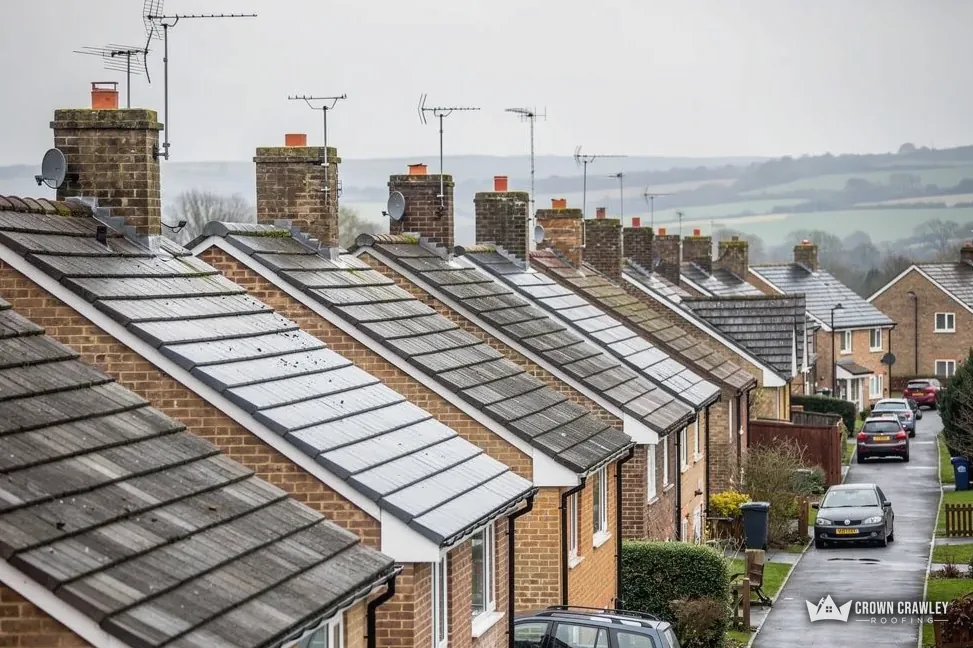
Terraced street with new grey tiled roofs

How do we keep the licence period short?

The fee is charged per elevation and per four weeks, so how long the scaffold stands matters. We plan the job in an order that keeps it up for no longer than the work needs: strip and renew a slope, then the flashings, then the gutters, then take it down. When you set two quotes side by side, ask each whether the licence fee and the bond are included or left to you.

Can I avoid a licence on my own land?

Often yes. On private land, Croydon says, neither a licence nor consent is required for scaffolding, and a suspension of parking bays can still be necessary where cars are affected. A house with a front drive or a rear garden wide enough for the scaffold and a safe route for materials can keep the whole structure off the highway. We check the plot at the survey, because the saving can be large when the licence is charged for each elevation.

Separate from scaffold, building control is a Croydon council service of its own. The Planning Portal's yardstick for a re-roof is 25 per cent of the building envelope and 50 per cent of the roof: below both, an application is normally not needed. Added weight counts too, as a covering at least 15 per cent heavier than before brings approval into play. We tell you at the survey whether a job gets near those lines.

Common Croydon roof queries

What does the Central Croydon conservation area change for a roof?

First check you are inside it: only part of the town is, and the boundary can split a street, so ask the London Borough of Croydon's planning team to confirm your address. If you are inside it, a matching repair is rarely the issue. Swapping the covering, or adding a window or dormer, is the real question, and it is worth putting to the council before you invite a quote.

What does a scaffold licence cost in Croydon?

Croydon charges £488 per four weeks for each elevation, or £610 where an elevation runs over 10 metres, and asks for a refundable bond of £50 per square metre of enclosed highway. The minimum is one month. A scaffold kept on your own ground sits outside the licence, which is why we look at your plot at the survey.

Who submits the scaffold licence application on a Croydon job?

Croydon's pages do not say, so we ask before fixing a date, because the answer decides who carries the fee and the bond. The scaffolder and we agree who submits it, and we allow time for the site visit that the council holds before issuing it. If the job runs longer than the first period, a renewal goes in at least seven days before expiry.

Which Croydon roof jobs go to building control?

The bigger ones. Croydon runs its own building control service. The Planning Portal puts the line at 25 per cent of the building envelope and 50 per cent of the roof, and a covering at least 15 per cent heavier than the old one needs approval. When we survey, we say if your job nears either line.

A written price for your Croydon roof

Send your postcode and a snapshot of the slope, stack or wall junction that worries you, and we will book the survey.

01293 974253

10-year workmanship guarantee, in writing.

Call Get a free quote