A re-roof puts a building site on top of the rooms where you sleep, cook and work. The house sounds different, the loft fills with movement, a scaffold stands outside the windows and a skip takes over part of the drive. None of that means you have to move out. Staying at home is a realistic choice, and the job runs more smoothly when you know what each stage sounds like and have arranged the house around it.
This guide covers the practical side from the householder's chair: where the noise comes from and which rooms take it, what happens to dust and debris above your ceilings, how scaffold, skips and parking work on an ordinary street, and how to shape your days around the work. It also covers pets, children, working from home and wildlife in the roof. No roofer can remove every inconvenience, but a survey beforehand, a clear plan for each day and a few simple preparations on your side take most of the stress out of it.
Noise: what to expect and where it lands
Noise comes in waves, and the loudest waves are predictable. The scaffolders arrive first, and a scaffold going up is a clatter of steel poles and boards against your walls. Once the roof is open, stripping is the loudest part: tiles come off in stacks, battens are levered away from the rafters and old nails shriek as they leave the timber. Rebuilding is quieter but still busy, with nail guns along each batten and tiles being cut at the edges.
Which rooms will be loudest?
Anything directly under the working slope takes the full force, so a top-floor bedroom or a landing is the worst place to be during stripping. Sound travels down through the rafters, then through the ceiling and into the room. Rooms at the back of the ground floor, or at the far end from the slope being worked, are much calmer. Plan to spend the working day in those rooms, and move a cot, a desk or a favourite chair out from under the busy slope before the job starts.
Can you work from home through it?
Video calls and a roof being stripped do not mix. If your job needs quiet, ask at the survey which slope will be worked on first, and we will tell you when the loudest stripping is due so you can book calls around it. A library, a cafe or a relative's spare room for those mornings is a better plan than hoping the noise stops. When the first slope is stripped and the new underlay goes down, a downstairs room may be perfectly usable again. Tell us about night-shift sleepers, babies and anyone unwell, because the order of work can be planned with them in mind. If you plan to book time off, ask at the survey which stages are the noisiest for your particular roof.
Dust, debris and what happens in your loft
Old roofs are dusty places. Years of grit, mortar crumbs, moss and fragments of old felt sit on the battens and the rafters, and stripping shakes some of it down into the loft. Gaps around pipes, loft hatches and light fittings let a fine layer reach the rooms below. The aim is to keep it out of your living space, and a little preparation does most of the work.
What should you do before the start?
Clear the loft hatch and the landing below it, because a roofer may need to look from inside at the start and the end of the job. Cover anything stored in the loft with dust sheets, and take suitcases, boxes of papers and old furniture out of the area under the working slope if you can. Lift pictures and mirrors from top-floor walls, since vibration can walk them off their hooks, and cover wardrobes and beds in the rooms right below the roof. Close the doors of any room you are not using.
Is there any asbestos risk?
HSE guidance treats any building from before 2000 as a place where asbestos may be present until a check shows otherwise. That does not mean your roof contains any. It does mean a suspect board, flue pipe or old sheet should be identified before anyone disturbs it, and never snapped or drilled to find out. Tell us about anything unusual in the loft or on the roof. Our page on the asbestos survey before re-roofing explains the checks for an older house.
Scaffold, skips and parking on your street
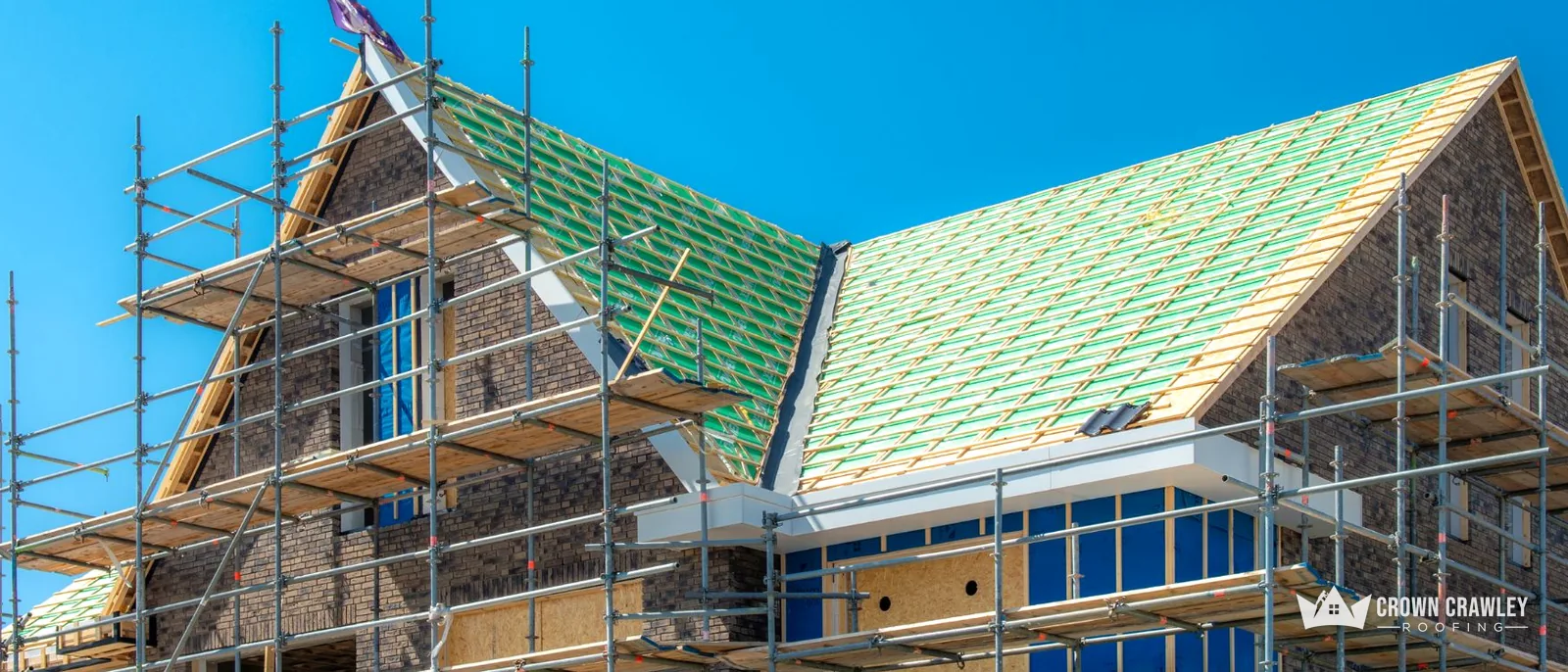
A scaffold goes up on every re-roof, because the eaves have to be reached safely and tiles and waste have to come down in a controlled way. It stays for the whole job, so it affects how you use the front and back of the house. Expect the scaffold to cross a window or two and to narrow the path along one side, and expect boards, ladders and netting to change the light in the rooms behind them for the duration.
Does a scaffold need a licence?
Not if it stands on your own land. A scaffold that obstructs a public pavement or road is different, because section 169 of the Highways Act 1980 requires permission from the highway authority first. For an address in the Crawley area, the authority is West Sussex County Council, and its scaffolding page wants "a minimum of 10 working days' advance notice" before erection. Settling the start date early gives that notice room to run. Ask us who submits the application, and we sort the paperwork out with the scaffolding firm. Our guide to scaffolding cost for a new roof gives the national price picture.
Where do the skip and the vehicles go?
A skip works best on a drive, with boards under it to protect the surface. Without a drive, the skip may have to stand in the road, which can need its own permission, so mention it when we survey, and we will confirm what is needed well before delivery. Move your own cars off the drive and from directly outside the house the evening before, and tell nearby neighbours that a delivery lorry and scaffolders are coming. A short note through the door costs nothing and avoids a blocked street.
A day on site, from first arrival to evening
Knowing the shape of a day helps you plan your own. We agree arrival times with you beforehand and tell you each day what will happen, so there is always a clear answer to what is next. Early on, the work is stripping and sorting the old tiles. Then comes new underlay and battens, then the tiling, and finally the ridge, the verges and the tidy-up. Gutters are checked and cleared as the job finishes, so no stray grit is left in them. The rhythm is steady rather than dramatic: set up, work, cover, clear.
What happens at the end of each day?
Whatever has been stripped is covered before the crew leaves. Underlay and sheeting go over any open area, and anything loose is tied down or lowered to the ground, so an overnight change in the weather does little harm. If rain arrives mid-shift, work on the open section stops and the cover goes on. Our page on what happens if it rains during a re-roof explains the routine. Debris is swept up and waste goes into the skip, never left lying in the garden.
What do the crew need from the house?
Agree in advance whether they can use a toilet and where they can make tea, because it avoids awkward conversations on day one. Keep side gates unlocked or tell us how to get in, and make sure there is a clear route to the garden for the rear slope. Move garden furniture, barbecues, plant pots and washing lines away from the walls, since tiles, nails and bits of timber fall to the ground even where nets are fixed. Keep windows on the working side closed on dusty days.
Children, pets and wildlife near the roof
The danger zone is the ground around the house, not just the roof. Falling tiles, loose nails and moving ladders make the working area unsuitable for children and animals, so a fenced garden section or a closed side gate is worth setting up before the start. Keep a rule that the garden and the drive are off limits while work is in progress, and explain the scaffold to children before they see it for the first time.
How do dogs, cats and small pets cope?
Noise frightens many animals, and an open door while strangers carry materials in and out is a chance for an escape. Keep dogs in a back room with a radio on, or arrange for them to be somewhere else on the loud mornings. Move small caged pets, such as rabbits and guinea pigs, away from the noisy side of the house, since they can be frightened badly by vibration. Cats do best shut in a quiet bedroom at the far end of the house with their litter tray and bedding.
What about bats and nesting birds?
Wild animals sometimes live in roofs, and the law protects them. The bat guidance published on GOV.UK names roof replacement as work that may affect them, and the roosts are protected along with the animals. Birds are protected too, since it is an offence to deliberately wreck a nest while birds are using it. If you have seen bats near the roof or birds nesting at the eaves, tell us at the survey, long before a covering comes off. Our roof replacement page covers the wider process.
Preparing the house and what to send us
Most of the preparation fits into an evening or two. Work through the house from the top down, and keep the list short enough that you will actually finish it.
What is worth doing the week before?
Empty the area under the working slope, as far as you can. Take down pictures, clocks and shelves of ornaments from top-floor walls, cover beds and wardrobes, and clear the landing and the loft hatch. Leave smoke alarms working. Charge phones and agree a way to reach whoever is leading the crew, so a question on the day gets an answer. Take photos of your ceilings and walls before the job begins, which gives you a reference if you notice a new crack later.
Should you stay for the whole job?
There is no rule. People with young babies, shift workers and anyone who needs a quiet home for medical reasons sometimes arrange to be elsewhere for the stripping and return for the rebuilding. For everyone else, a few good arrangements are enough to stay. We tell you the order of work so you can pick the mornings that matter, and the single price you receive in writing is set after the survey and never shifts because of your schedule.
What should you send us first?
Photos of the front and back of the house, the drive or road where the skip would go, and your loft hatch are the most useful. Tell us about work from home, pets, anyone who needs quiet and any doubt about asbestos or wildlife. At the survey we look at all of it first, then set out the plan in writing with the price.
Part of our Roof Replacement & New Roofs in Crawley
Staying put during a re-roof
Is it safe to stay in the house while the roof is stripped?
Yes, with sensible limits. The danger is outside, where tiles and nails fall, so children and pets should stay clear of the walls. Inside, rooms under the working slope are noisy and dusty, so spend the day in a room further away. Open sections are covered before the crew goes home.
Do I have to be in during the day?
Not for the whole day. You need to be reachable, to agree the access and any change on the roof, and to be home for the start and the final walk round. Leave a clear route to the garden, unlocked side gates and a number we can call. Photos of progress are shared with you when you cannot be there.
What if I have no drive for the skip and the scaffold?
Tell us when we survey. Scaffolding that obstructs the public highway needs permission from the highway authority, and each council sets its own notice period. West Sussex County Council states 10 working days at the least. Equipment on the road may need further permission, so we confirm what applies to your street first and fix the date with you.