Ask three roofers whether your roof needs repairing or replacing and you can get three different answers. Sometimes that is because the roof is a borderline case. More often it is because nobody has laid out the sum. A repair is cheap now and may need doing again. A replacement is expensive now and may not need touching for a very long time. The right choice depends on how much working life the roof still has and whether the damage sits in one place or everywhere, not on how old it feels.
Below, we take the decision roof type by roof type, then look at the weak spots that fail early on any roof, and finish with what a survey ought to tell you. If you are leaning towards a full re-cover, the main roof replacement page explains what is involved. If it is a handful of loose tiles, the cost of repairing them is in a separate post, linked in the first section.
Do the sum before you decide
Forget the roof's age for a moment and ask two plainer questions. Is the trouble in one place or spread across the whole surface? And what have repairs cost you over the last few seasons? Those two answers settle most cases, and you can work them out at the kitchen table with a pen and the last few invoices.
What does repairing cost compared with replacing?
Checkatrade's roof tile replacement guide (October 2026) prices a visit for a few dislodged or cracked tiles (up to five) at £170 to £500, with the top figure covering scaffolding. The same firm's roof replacement guide (October 2026) quotes around £12,000 for a three-bed semi, and that is a national guide rather than a quote. Say your roof needs three callouts of that kind over a few winters. That adds up to between £510 and £1,500, which is a small fraction of £12,000. While the faults stay local, repairing is the better buy by a distance. You can see our own take on small jobs in the post about the cost of repairing roof tiles.
When does the sum tip the other way?
When each repair is followed by another one somewhere new. Faults that pop up on every slope tell you the covering, the battens or the underlay as a whole have run out of road. Repairs then become a subscription, and each one may need access equipment that costs as much as the fix. Checkatrade's roof replacement guide mentions £700 to £1,300 for scaffold on a new roof. A roof that needs scaffolding twice in a year has paid for a good chunk of its own replacement already without getting any better.
Concrete and clay tiled roofs
Most pitched roofs on British houses are tiled, and the decision for them has a clear shape. Concrete tiles are put at around 60 years by Marley, who stresses that is no guarantee. Clay carries a published 60-year minimum from the Building Research Establishment, yet one conservation article warns that the number is clearly unreliable for old peg tiles. A tile roof is rarely finished because the tiles themselves are spent. It is finished because what sits under them is.
Which tiled faults are repairs?
A handful of tiles slipped or cracked by frost, a ridge section that has loosened, a patch of mortar gone at a verge. Checkatrade's June 2026 repair table gives roughly £90 to £120 per square metre for concrete and £110 to £160 for plain clay, for small areas and before VAT. Our guide on pitched roof repairs works through each layer of a tiled roof in turn.
Which are signs of a replacement?
Battens that are dark, split or bowed across a wide area, because they cannot be renewed without lifting every tile above them. Underlay that has perished across a slope, which hides behind the tiles until water appears indoors. Tiles that keep slipping because the nails have given up. And a loft with daylight in several places at once. Any one of these can be local. Several together point to a roof that is working through its last winters. In that situation, ask the surveyor to show you the battens and underlay in photos before you say yes, because the state of those two layers usually makes the decision for you.
Natural slate: the roof that outlives its nails
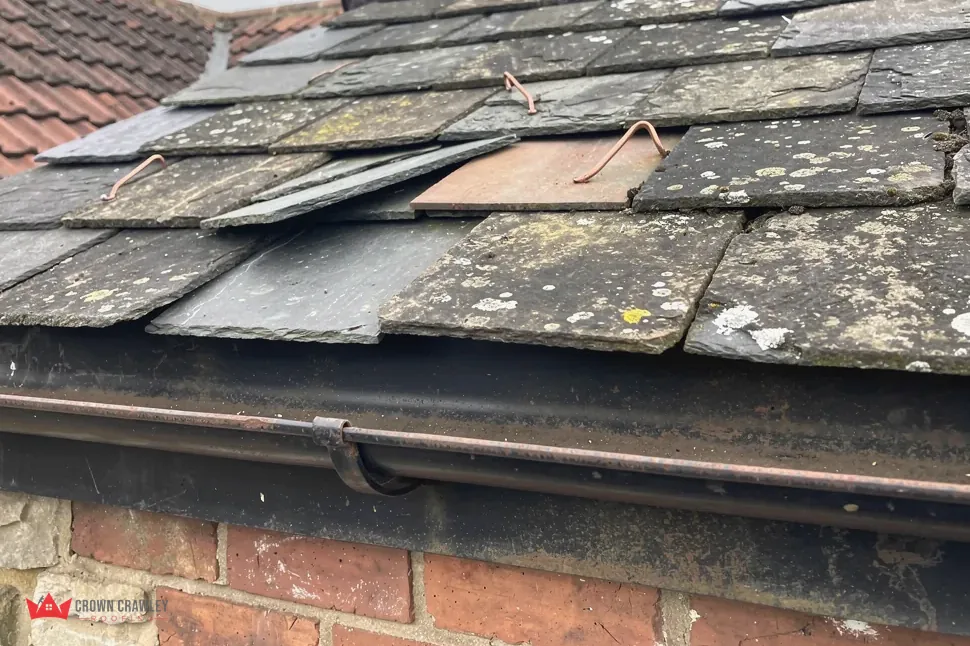
Slate is the long-distance runner of roofing. The Confederation of Roofing Contractors' guide to roofing materials says slate can last 100+ years if well maintained. That figure belongs to the stone though. The nails that hold it do not share the stone's patience.
What is nail sickness?
It is the slow rusting of the fixings that hold each slate to its batten. Nothing is wrong with the slate, but it slides out of place one at a time, and a roof that seems perfect when you look up from the lawn can start dropping slates in the first gale. A single slipped slate can often be held with a tingle, which is a thin copper or lead tongue nailed to the batten and bent up over the slate's lower edge.
When is it worth stripping and relaying slate?
When slipping is happening on every slope, the cheaper route is often not patching at all. The sound slates are taken off, sorted and set aside, the battens and underlay are renewed, and the good slates go back on with new fixings, topped up with matching reclaimed ones. Checkatrade's repair table puts natural Spanish slate at £150 to £220 per square metre for small repairs, which is a reminder that repeated slate patching adds up quickly. A relay costs a lot but keeps a roof with a century of life in the stone. If a slate roof is nearing the end of what the fixings can do, replacing the fixings is where the money should go. That conversation is worth having with a roofer who works on slate often, since they will know how a given roof has weathered.
Flat roofs: patch, recover or start again
Flat roofs live shorter lives than pitched ones, so age counts for much more. The published ranges are wide, and they are typical figures rather than promises. EPDM is a rubber membrane, and its expected working life is listed by GreenSpec as 20 to 30 years. Less puts GRP, the fibreglass system, at 25 to 40 years and felt at 10 to 20 years.
When is a patch enough?
If the covering is well inside its range and the leak has one source, like a seam that has parted, an edge that has lifted or an outlet choked with leaves. A local repair, or clearing a drain that has been holding water, may be all it needs. Ponding that sits on the roof for days after rain is worth a note for the survey, because it can point to a deeper problem with the fall.
When should the whole surface go?
When the covering is at the far end of its range and repairs keep appearing. Felt is the one to watch. A felt roof past its first couple of decades, patched more than once, is usually the case where a full replacement makes better sense than another patch. Checkatrade's September 2026 guides give £80 to £100 per square metre for EPDM and £50 to £80 for felt, so the material you choose changes the total. A longer-lived covering can win over its life even if it costs more on day one, particularly when the roof is hard to reach and every future visit needs access equipment. Our page on flat roofing sets out the options.
Weak spots that fail ahead of the rest
On any roof, a few parts wear out before the main covering does. Knowing them stops you replacing a roof for a fault that belongs to one of them.
Which details leak first?
Flashings, the lead or metal strips sealing the roof against a chimney or wall. Valleys, the channels where slopes meet. The flaunching, the sloped mortar cap that seats a chimney pot. The mortar bedding at the ridge. And the eaves, where the underlay meets the gutter. A leak at one of these is easily mistaken for a failing roof, because the stain on the ceiling looks the same whatever its cause. Photos taken in the loft, tracing the damp to its source, tell the two apart.
The sums here are friendly. Checkatrade's repair table gives £50 to £70 per metre for lead flashing repairs and £50 to £70 per metre for dry ridge repairs. MyJobQuote puts full chimney leadwork at £350 to £460 without scaffolding. These are much smaller numbers than a new roof, so it is worth testing a detail before blaming the whole roof.
Does a new roof renew these as well?
It should. A re-cover is the natural moment to replace flashings, ridge fixings and eaves details, as the tiles around them are off already. If your roof is sound but its details are old, a targeted repair on the weak parts may keep the main covering going. If the covering itself is tired, ask for the details to be part of the same total price, because renewing a tired roof and keeping tired flashings undoes some of the benefit.
What your survey should settle
A good survey does not simply say repair or replace. It shows you why, with photos of your own roof, and it measures the choice against what you are likely to do with the house.
Which questions should you ask?
Where is the water coming from, and is the cause in the covering, the layers beneath or a detail? How much life does the roof have left, as an honest range and not a promise? What would the repair cost as one total, and what would a replacement cost as another total? Do those two totals include VAT and scaffolding? A roofer who can answer all of these with photos has done the work of looking.
What if you plan to sell or extend?
The answer can shift. A buyer's survey that flags the roof can hold up a sale, and an exhausted roof sitting above a loft conversion or an extension is a poor foundation for the money that follows. Conversely, if you are selling soon and the roof is sound apart from a few faults, tidy repairs with photos may do more for you than a full replacement. Our guide to the cost of re-roofing a three-bed semi helps with the maths if you are weighing the bigger job, and a written price after the survey fixes the real number.
Photos of the problem area and the loft are a good first step. They let us say which way your own sum is likely to fall before a survey is booked.
Part of our Roof Replacement & New Roofs in Crawley
Repair or replace, answered
How many repairs are too many on one roof?
There is no magic number, but the pattern matters more than the count. Repairs in one spot suggest a local fault. New faults on different slopes each winter suggest the whole covering is failing. Add up what you have paid over the last few years and compare it with the written price for a replacement.
Is it worth repairing a roof that is almost worn out?
Sometimes, for a short while. A repair can buy time to plan and save, or to get through a winter. But if the battens, underlay and covering are all tired, money spent on repairs is money not spent on the new roof. A survey can tell you how much time a repair would realistically buy.
Will a new roof cut my repair bills?
Usually it stops them for a long while, because new layers and fixings leave little to fail. Upkeep still matters, though. Gutters still clog, moss still grows and flashings still need an occasional look. Treat a new roof as a reset on repairs, not an end to maintenance.