When a roof comes off, a homeowner reasonably asks whether the tiles can go back on. They are stacked neatly in the skip or on the scaffold, they look all right, and new ones cost money. Sometimes reuse is exactly the right call. On a good clay or slate roof it can be the better choice, for the look of the house as much as the budget. On other roofs it is a false economy, and the new battens, underlay and labour go onto a covering that fails again in a few years.
Whether tiles can be reused depends on what they are made of, what condition they are in, how they were fixed and what the rules now expect. This guide goes through each of those in turn. It explains how a roofer tests old tiles, where reuse suits clay and slate, why old concrete is harder, what the fixing standard BS 5534 means for a relaid roof, and how to mix reclaimed tiles with new ones when there are not enough. It sits within our wider roof replacement service, which follows a job from the survey to the sign-off visit.
Why reuse is worth asking about
Tiles are the largest single material cost on a re-roof, and the idea of keeping them is natural. There are three good reasons to ask. The first is cost, because relaying sound tiles avoids buying a new covering. The second is appearance: an older clay roof carries a colour and texture that new tiles take years to match, which matters on a period house or in a street where roofs sit side by side. The third is waste, since a covering that does not go to a skip is a covering that does not need making again.
What does reuse not save?
It does not save the labour. Stripping, sorting, cleaning and relaying tiles takes longer than laying new ones from a pallet, because each tile is checked by hand. It does not save the battens or the underlay either, which are normally renewed on a re-roof whatever happens to the tiles. So the saving is on the tiles themselves, and it shrinks quickly if a large share fail the check. Ask for the quote to show clearly whether it assumes reuse and what happens if more tiles are rejected than expected.
Does reuse change the paperwork?
Not in itself. The Planning Portal applies two tests to a re-roof. One asks how much is touched: under 25 per cent of the building envelope and under 50 per cent of the roof. The other asks whether the new covering is a lot heavier (15 per cent or more) or reacts very differently in a fire. Relaying the same tiles leaves weight and fire performance as they were, which is an advantage. Our page on re-roofing and building regulations sets the rules out.
How a roofer tests old tiles
Looks alone are not enough. A tile can seem fine from the scaffold and fail the moment it is lifted, so the check is done tile by tile, as the roof is stripped.
What are they looking for?
Every tile is turned over and examined. Cracks, hairline splits, chipped nibs (the lugs on the underside that hang on the batten) and broken nail holes mean rejection. So do tiles with a flaking or powdery face, which suggests the surface is breaking down. Tiles that are heavily stained with moss or lichen are not necessarily poor; the growth can be cleaned off and the tile underneath may be sound. Our page on cleaning a clay tile roof covers that process.
What about frost and water damage?
A tile with a chipped or crumbling face is already losing its protective skin, so it goes in the reject pile, as does any tile that has been patched with sealant or mortar in the past. The roofer sorts the tiles into three piles: sound and ready to relay, worn but usable as spares or for less exposed areas, and rejects. How big each pile is tells you how much new tile to buy.
Who decides?
The roofer does, and should show you. Ask to see the reject pile and the photos taken when the tiles came off. A roofer who is honest about the numbers earns more trust than one who tells you every tile is fine. We send pictures of your own tiles as they come off, so the sorting is out in the open.
Reusing clay tiles
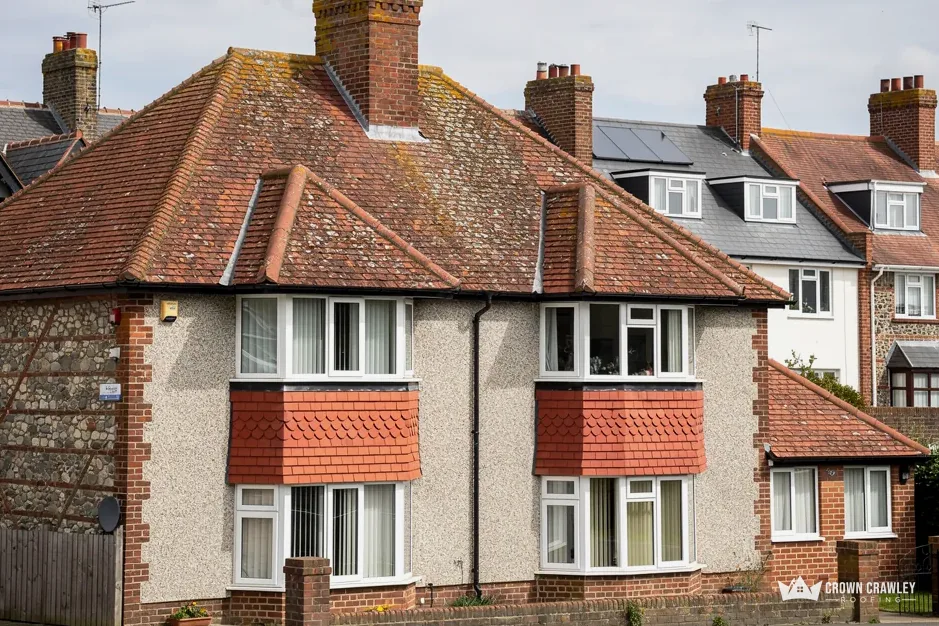
Clay is the material most often reused, and for good reason. A clay tile that has survived decades of weather has usually shown it can stand up to it, and the body of the tile is the same colour all the way through.
How long do clay tiles last?
Marley, in a 2016 article, cites a building research minimum of 60 years for clay tiles. That is a floor for clay only and not a promise for any single tile. For old peg tiles, a building conservation article calls the 60-year figure an unreliable guide, which fits the practical advice: judge each tile by its condition and not its age.
What affects clay reuse?
Handmade and peg tiles often vary in size and curve, so a relayed roof depends on the roofer's eye and on sorting tiles into sizes. Fixings matter in a different way, covered in the BS 5534 section below. Older tiles may be a different size from modern ones, so any new tiles that are mixed in need to be chosen to match. Our page on clay tile roof cost sets out what drives the price of a clay roof, and the conservation area re-roofing page explains why keeping the old covering is sometimes the expected route.
What about listed buildings?
Reusing the existing tiles is often what a listed building needs. Works that alter a listed building's character need listed building consent, though the South Downs National Park Authority notes that regular like-for-like in-situ repairs do not. Check with the council's planning team before you plan the job. Our page on re-roofing a listed building covers the process.
Reusing natural slate
Natural slate is long-lived, which is why reuse works so well for it. A conservation roofing materials guide puts well-maintained slate at 100 years and more. The stone is rarely the problem; the fixings are.
What goes wrong first with old slates?
Slate is held by nails or hooks, and on old roofs those nails corrode. The slate itself is fine, but it slips because the fixing has gone. This is often called nail sickness. Where the slates are sound, they come off, get sorted and go back on new battens with fresh fixings, and the roof gets a second life. A slate that has split along its layers or flaked on the surface is rejected, and the rest are kept.
What are the pitch limits?
Pitch matters because water has to run off before it can work back under the slate. Cupa Pizarras reads BS 5534 as setting a 20-degree floor for natural slate, with hook fixings ruled out on any slope under 25 degrees. A roof you are re-slating at a lower pitch than that needs the manufacturer's advice, not guesswork. Measure the pitch before you plan reuse, or ask your roofer to.
Can slate reuse go wrong?
Yes, in two ways. If the pile of sound slates is too small to finish the roof, the shortfall has to be made up with new or reclaimed slate, and the match is never perfect. And if the slates are thin or worn, relaying them can break more of them. In both cases the survey and the sort tell you before you commit. Our page on replacing a slate roof with tiles covers the alternative.
Why old concrete tiles are harder to reuse
Concrete tiles are not a poor material. Marley puts the life of a concrete tile at around 60 years, with a caveat that this is a typical figure and not a warranty. The difficulty lies in reuse, not in the first life.
What changes with age?
A concrete tile weathers on the surface, and an old one is more likely to have a worn face or tired nibs. Lifting, stacking and relaying is the point at which a marginal tile cracks. A roofer relaying old concrete should expect a higher share of rejects than with clay or slate, and the quote should allow for that. Our page on moss on concrete roof tiles shows what age does to the face.
When is new the better buy?
If the roof has already had repairs, if many tiles are flaking, if the tiles are of a type that is no longer made so that spares are hard to find, or if the slope is low and the roof needs a covering suited to the pitch, a new covering is normally the sounder choice. Relaying tired tiles on new battens means paying twice for the same problem. Marley lists minimum pitches by tile type, from 12.5 degrees for its Mendip 12.5 to 35 degrees for its concrete plain tile, so check the data sheet for any tile you plan to lay. A roofer who tells you a roof is better stripped and renewed is not trying to sell you something; ask for photos of the rejects and judge for yourself.
Our page on the cost to re-roof a 3-bed semi helps put that choice in context.
BS 5534 and fixing a relaid roof
This is the point that catches people out. A relaid roof is a new roof as far as fixing goes, and the current standard applies to it in the same way.
What is BS 5534?
BS 5534:2014+A2:2018 is the current British Standard for slating and tiling pitched roofs and vertical cladding. Marley points out that working to it is not a legal requirement. In practice it is the standard roofers, manufacturers and building control bodies work to, so a roof that ignores it is hard to defend if something goes wrong.
What does it mean for reused tiles?
Marley explains that since the 2014 revision, mortar by itself stopped being accepted as the only hold on ridge or hip tiles; every bedded piece should carry a mechanical fixing as well. So a reused ridge cannot simply be rebedded in mortar as before; it needs clips, screws or a dry-fix system. For dry ridge, hip and verge, the test specification is BS 8612. Our page on roof replacement sets out these parts, and the sister pages on pitched roofing cover ridge and verge work in depth.
Does the standard always suit old tiles?
Not always. BSI adds a caution: old roofs, especially ones laid with traditional or salvaged materials, may not fit the standard's recommendations neatly. That is where judgement comes in: an old handmade peg tile may need a different fixing pattern from a modern interlocking tile. The roofer should say what fixing pattern they will use on your roof and why, and put it in writing.
Part of our Roof Replacement & New Roofs in Crawley
Reusing tiles, answered
Can I mix reclaimed tiles with new ones on one roof?
Yes, if they are the same size and profile and the mix is planned. Reclaimed tiles usually go on the most visible slopes, and new ones on a rear or side slope. Matching colour is the hard part, so ask to see samples against your existing tiles first.
Will reusing tiles make my quote cheaper?
Usually by the cost of the tiles, but not the labour, which is higher, and not the battens or underlay. The saving shrinks if many tiles are rejected on the day. Ask the quote to say what happens to the price if more tiles fail the check than expected.
Do reused tiles need to be fixed differently?
They are fixed to the current standard like any other covering. BS 5534 expects mechanical fixings, and bedding ridges and hips in mortar with nothing else is out. BSI notes the standard may not suit every old roof, so ask what fixing pattern is planned.