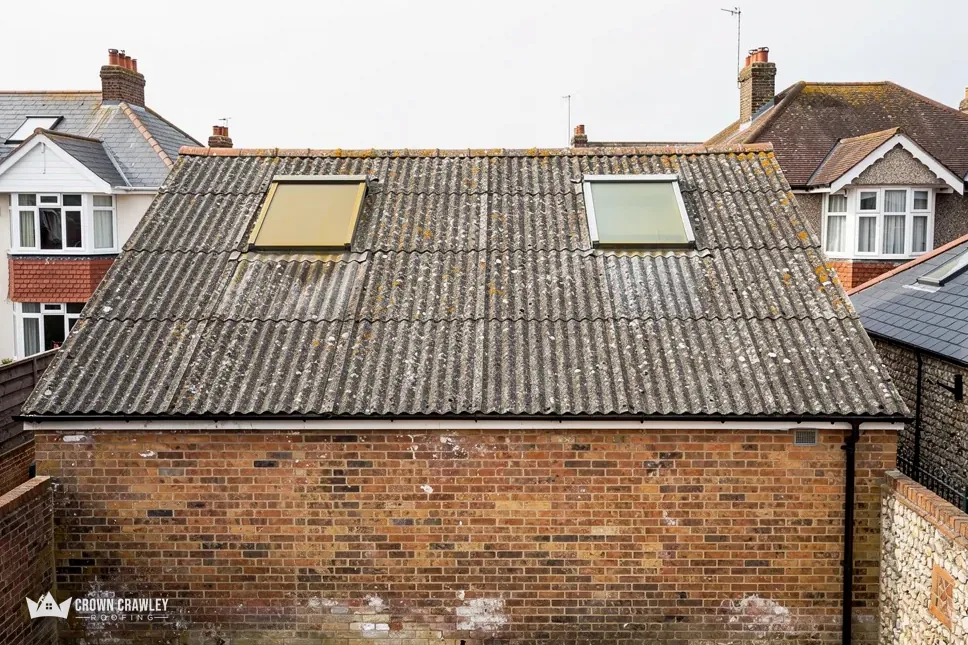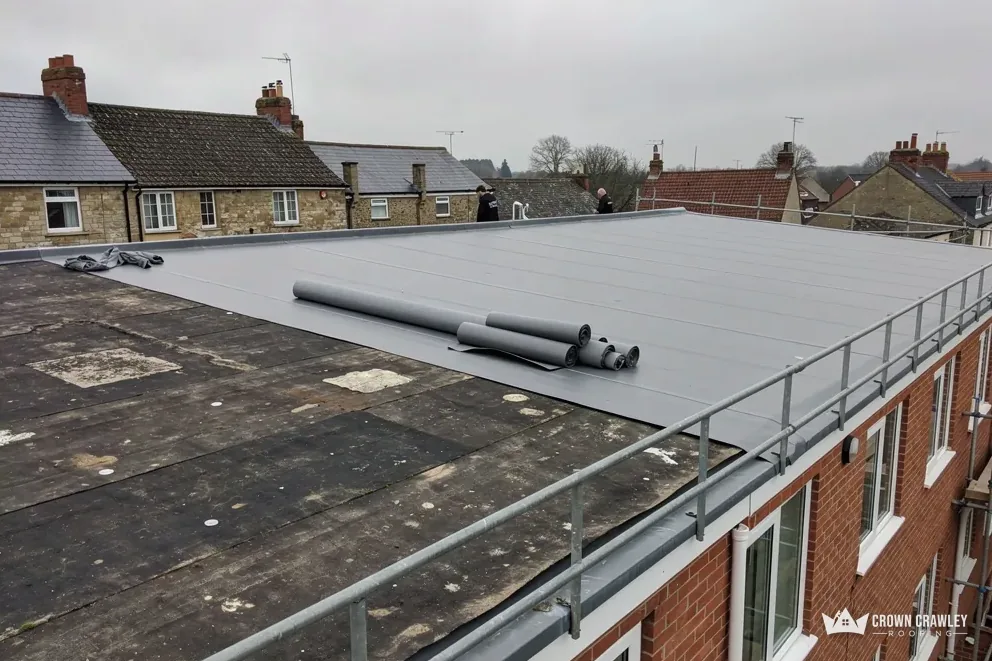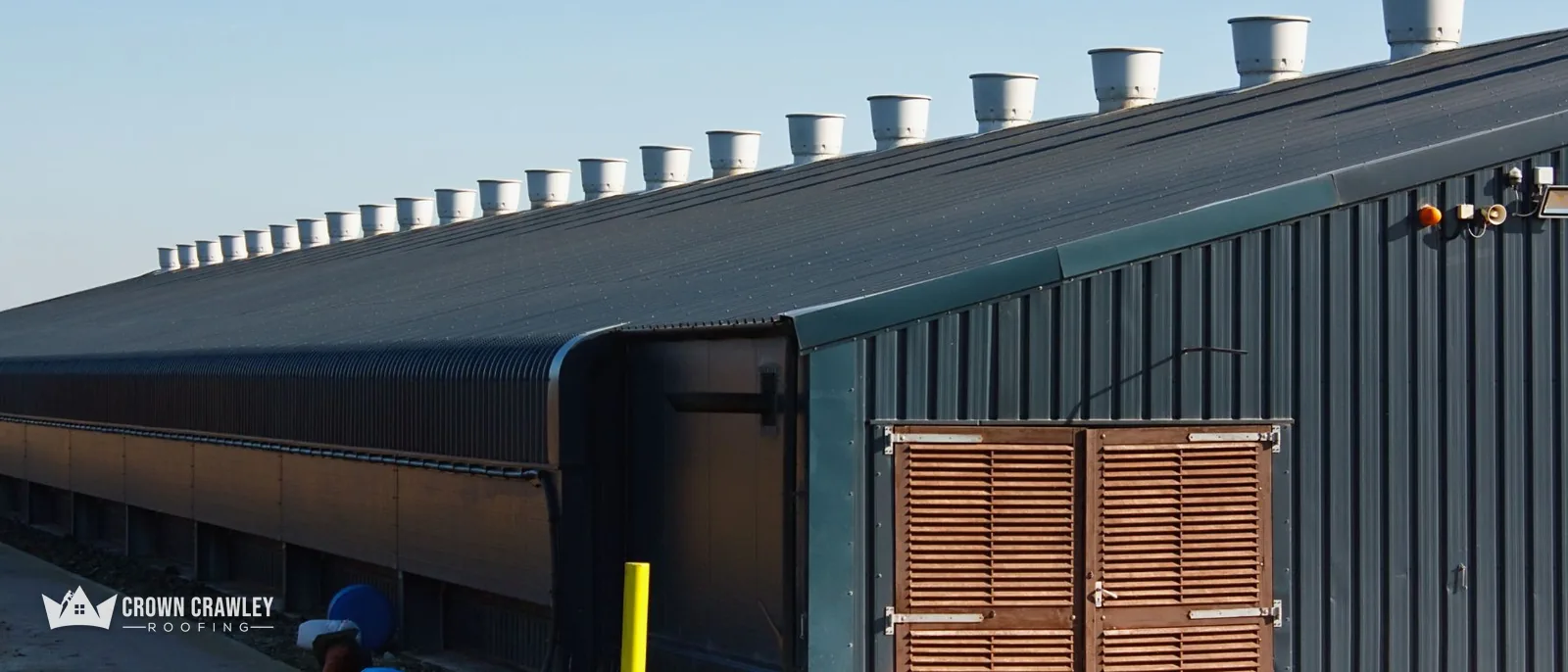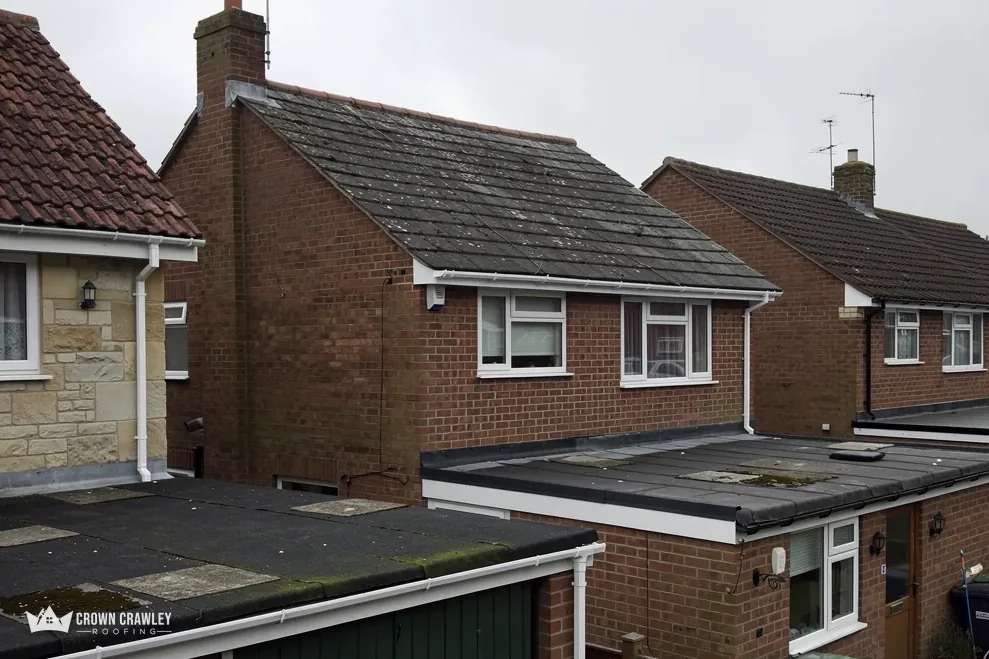
Plenty of warehouses, workshops and farm-style buildings still wear their original corrugated sheets, grey and mossy, with a few patches of green. If the building went up or was refurbished before 2000, HSE's advice is to assume the sheets contain asbestos until a survey says otherwise. That does not make the roof an emergency. Asbestos cement that is sound and left alone releases little. The trouble starts when the sheets crack, get drilled, or are broken up in the course of a repair.
So the owner usually faces a plain choice. Either a new sheeted roof goes over the old one, which is overcladding, or the old sheets come off and a new roof replaces them. Both can be done well and both can go wrong. Alongside our wider commercial roofing work, this guide explains how each works, what drives the choice, what HSE's rules say about who may do what, why the old sheets stay fragile, and what to ask for before anyone climbs up. It is general guidance, not legal advice, and an asbestos survey of your own roof comes first.
Why old sheets are still up there
Fibre cement sheeting was a standard way to cover big, cheap, low-maintenance buildings for a long stretch of the last century. It lasts well, resists rot and weathers to a grey surface, so many roofs are still performing their basic job long after the people who built them have gone. Asbestos fibres were mixed into the cement to give strength.
Is a weathered sheet dangerous?
Weathering is not the same as breaking up. HSE counts weathered asbestos cement as non-licensed work, so long as the sheets are not otherwise substantially damaged and they come off intact, with care. The risk comes from disturbing the fibres, which is why drilling, cutting, scrubbing or pressure washing an old sheet are all things to avoid.
How do you know what you have?
You cannot tell by looking. HSE notes that it is difficult to tell the difference between asbestos insulating board and its non-asbestos equivalents, and the same caution holds for sheeting that looks similar. A survey and a laboratory test on a small sample settle the question, and the result goes into the building's asbestos register if it has one. Our answer on an asbestos survey before re-roofing explains that step for homes, and the principle is the same for a unit.
Asbestos cement is only one of the materials HSE lists. Insulating board and other products can sit under the same roof, in soffits, partitions or linings, so a survey of the whole building gives a fuller picture than a sample from the sheets alone.
How overcladding works
Overcladding leaves the old sheets in place and fits a new weatherproof roof over them. On an industrial unit the usual version is a framework of support brackets or rails fixed to the existing purlins, then new insulated panels or lined metal sheets laid across them. The old roof becomes a hidden layer under the new one.
What are the advantages?
The old sheets are not lifted, snapped or carried, so there is less dust to control and less waste to dispose of. The business inside can often keep working, because the building is not opened to the weather while the new roof goes on. The new roof can also bring better insulation, which an old single-skin sheet lacks, and it may be quicker to finish than a full strip.
What are the drawbacks?
The asbestos is still there. It stays in the building for every future owner, every maintenance visit and the eventual demolition, so it needs to stay recorded and labelled. Fixings that must pass through or beside the old sheets can disturb them, so the method statement has to deal with that point head on. The old sheets also stay fragile under the new roof, and a person who falls through the new one can land on the old. Any extra weight on an ageing frame needs checking by an engineer.
There is a fire and rules angle too. On houses, the Planning Portal asks for approval where a new covering adds 15 per cent or more to the roof's weight. A commercial building has its own requirements, so raise the scheme with your building control body early. Our guide to replacing metal roof sheets covers the new-roof side of the job.
How removal works
Removal takes the old sheets off and puts a new roof in their place. Done properly it ends the asbestos question for the roof, though not for other parts of the building.
What happens on the day?
The area below is cleared or protected, and an exclusion zone keeps unprotected people away. Sheets are unfixed and lowered whole, never dropped or thrown, with fixings undone rather than snapped. HSE's guidance for this work says the waste should be double-wrapped and labelled.
Who is allowed to do it?
HSE separates asbestos work into three kinds. Non-licensed work covers cement sheeting taken off intact. Notifiable non-licensed work applies where the material has been substantially damaged or broken up, and for that the contractor must notify the enforcing authority and keep health records for 40 years. Licensed work covers the more hazardous products, and most insulating board removal falls in it. If HSE's licensing rules cover the work, the contractor must hold the licence, and it is fair to ask to see it. Never assume that a roofer who can remove sheets can also remove everything else on a site.
What about the waste?
Asbestos waste is hazardous waste and travels under consignment rules. The household exemption in the government's guidance covers domestic hazardous waste other than asbestos waste, so a business never has an exemption to lean on. The carrier must be registered and the site receiving it must be permitted to take it. Ask to see the paperwork when the load leaves, and keep a copy with the building file. The consignment note is your evidence of where the waste went.
Overcladding or removal: how to decide
No single answer fits every roof. Lay the considerations side by side and the choice usually becomes clearer.
Condition of the sheets
Sound sheets with no more than light weathering are the best candidates for overcladding, because disturbance is limited. Sheets that are cracked, holed or crumbling raise the chance that work on or beside them creates dust, and HSE's guidance says that if asbestos cement starts to break up and makes significant dust, the work becomes notifiable. A badly damaged roof tips the balance towards removal by a contractor properly set up for it.
Condition of the frame
Rusted purlins or a sagging frame need repair before anything is added, and a new roof laid on a weak structure only hides the problem. A structural engineer can say whether the existing frame will take the extra load. Ask for that opinion in writing, because it also protects the later work.
Future plans for the building
If you plan to sell, extend, change use or demolish within a few years, leaving asbestos in place may only delay a cost. Buyers, lenders and tenants may ask for the asbestos register, and a roof with asbestos still on it can affect the conversation. If you plan to keep the unit for the long term and the sheets are sound, overcladding is a fair route, provided the register records exactly what sits under the new skin.
Operations and budget
A business that cannot stop production may prefer overcladding because the interior stays closed in. The price follows the survey, because roof area, height, access, panel specification and waste route all drive it. After the survey you get a single written total, never a rate per square metre.
What the duty to manage means for an owner
HSE's duty to manage asbestos falls on whoever is responsible for maintaining a non-domestic building, and the lease decides whether that is the owner, the landlord or the tenant. The core idea is simple: find out whether asbestos is there, record where it is and what condition it is in, and make sure anyone who might disturb it is told.
What does that involve in practice?
HSE's starting point is a date: a building put up or refurbished before 2000 should be treated as containing asbestos. From there the duty-holder arranges a survey, keeps a register, assesses the risk and puts a plan in place for managing what remains. When the register shows sheeting in poor condition, the plan may point to repair, overcladding or removal. You can read HSE's own page on whether asbestos is present before your first call to a contractor.
What should you hand a contractor?
Give the contractor the asbestos register and survey before the quote, not after. A roofer who has not seen it is guessing, and the price may change once the real picture emerges. If a register does not exist, a survey is the first step. Contractors who work on a roof have duties of their own, and you share responsibility for making sure the work is planned safely. A written method statement that names the route, the access and the waste arrangements shows that the planning has happened.
Our commercial roof condition survey guide shows how a roof inspection fits with the asbestos paperwork.
Fragile sheets and working at height
Even a roof that looks solid can fail underfoot without warning. HSE says plainly that these roofs are always fragile, and overcladding does not change the old sheets, because the new skin sits above them rather than replacing them.
What precautions come as standard?
Anyone on or near the roof needs a safe way to reach the work and a safe way to stay there. In practice that means edge protection round the eaves, crawling boards or staging to spread the load, covers or guard rails round rooflights, and safety nets or platforms under the sheets where the construction allows. Harnesses are the last line of defence, not the first, and a roof with no safe system of work does not get walked on.
Why does the new roof stay dangerous?
An overclad roof hides the old sheets under new metal, so a later contractor may not know that fragile asbestos sits below. Notices at the access points and an entry on the register carry that warning forward. Our guide to fragile roof safety sets out the access methods in full.
What should we send you?
Before a survey visit, send the building address, the asbestos register or survey if there is one, a few photos of the roof from the ground, and the date you are aiming to finish by. If production has to carry on below, say so, because it changes the order of work. We look at the sheets and the frame, explain the choices for your roof with photos, and put a single written total in your hands after the visit.
Part of our Commercial Roofing in Crawley & Gatwick
Asbestos roof questions
Can I just paint or seal an asbestos cement roof?
Surface treatments are sometimes used to bind loose material, but preparing the surface means brushing or scraping, and that disturbs the sheets. Cleaning is therefore a job to plan with a surveyor. Ask what method is proposed, what happens to the run-off and who checks the work, before any coating goes on.
Does overcladding need building control approval?
That depends on the building and the scheme, so ask your building control body before the work starts. The Planning Portal's home guidance treats a covering that adds 15 per cent or more in weight as a trigger. Changing a commercial roof can also affect insulation, structure and fire safety, which all count.
Who keeps the asbestos paperwork after the job?
The person responsible for maintaining the building keeps the register, and it should be updated after the work: a note of what was removed, or what was left and covered. Ask the contractor for waste consignment notes and any air test results too. Keep them with the building file for the next owner.